


The most common menopause symptoms are hot flushes and night sweats, sleep problems, muscle and joint aches, and changes in mood, concentration, skin and the bladder and vagina. The Australasian Menopause Society states that hormonal changes cause menopausal symptoms, that the average age of menopause is 51, and that most women have symptoms for 5 to 10 years.
The hard part, mid-way through it, is telling what belongs to menopause. A broken night, an aching hip and a lapse in memory could each be hormonal, or ageing, or stress, and Jean Hailes is direct that not every midlife health issue is due to menopause itself. So you read five pages to answer one question.
This page sets out the symptoms with the figures Australian health bodies publish, how long they last and when to see a doctor. A separate section then covers what changes nutritionally after 50.
What are the most common menopause symptoms?
Hot flushes and night sweats lead the list. Jean Hailes reports that around 3 in 4 women experience them around the time of menopause, that a hot flush usually lasts 1 to 5 minutes, and that some women have more than 20 a day.
Everyone's experience differs, and the same source says some women have mild or no symptoms while others have severe ones. The table sets out the rest of the list as each body records it.
| Symptom | What the source records | Source |
|---|---|---|
| Hot flushes and night sweats | Around 3 in 4 women; usually 1 to 5 minutes; some women have more than 20 a day | Jean Hailes |
| Sleep problems | Around 1 in 2 women in perimenopause and postmenopause: trouble getting to sleep, staying asleep or waking too early | Jean Hailes |
| Mood and emotional changes | More than 1 in 2 women with symptoms in the previous five years said their mental and emotional wellbeing had been affected | Jean Hailes National Women's Health Survey |
| Brain fog | Difficulty concentrating, poor memory, forgetfulness and losing the right word | Jean Hailes |
| Muscle and joint aches | Commonly hands, knees, hips, shoulders and lower back, often stronger in the morning | Jean Hailes |
| Bladder, vaginal and vulval changes | Around 1 in 2 women (genitourinary syndrome of menopause) | Jean Hailes |
| Skin changes | Dry skin, itchiness, acne and wrinkles | Jean Hailes |
| Hair thinning | Not enough research to say whether the hormone changes of menopause cause it | Jean Hailes |
| Weight and body shape | Menopause itself does not cause weight gain, but poor sleep makes it more likely, and fat tends to sit around the belly | Jean Hailes |
The Better Health Channel also lists headaches, tiredness and sore breasts, and healthdirect lists itchy, crawly or dry skin and an increase in waist size. The sleep, joint and brain fog evidence from the studies that followed women through the run-up is in what happens in perimenopause, the causes of fog beyond hormones are in brain fog causes, and the timing of hair shedding is in telogen effluvium.
When are menopause symptoms at their worst, and how long do they last?
Most women have symptoms for 5 to 10 years, according to the Australasian Menopause Society, and healthdirect adds that symptoms often start before periods stop. None of these sources names a single worst age. Jean Hailes says that as your body adjusts to lower hormone levels you might have fewer or less troubling symptoms, though for some women they continue into postmenopause.
The symptoms do not all follow one timetable. Jean Hailes notes that hot flushes usually disappear over time, while bladder, vaginal and vulval problems can continue after menopause and might even get worse. Mood is the encouraging one: for most women, mental and emotional wellbeing improves as you get closer to your final period and in postmenopause.
On food and drink, Jean Hailes says stress and anxiety can influence the number and severity of hot flushes, and that spicy foods, alcohol and smoking have been linked to more frequent and more severe ones. Bloating gets its own page: why bloating shows up in perimenopause.
What are the stages of menopause?
Australian health bodies describe three stages, and menopause itself is a single point rather than a long phase. That answers the question of when you are no longer in menopause: you are postmenopausal for the rest of your life.
| Stage | What it means | Source |
|---|---|---|
| Perimenopause | From when periods start changing, or symptoms start, to one year after your final period; in Australia it usually starts around age 47 | Jean Hailes |
| Menopause | Your final period, confirmed once you have gone 12 months without one; the average age is 51 | Jean Hailes, healthdirect |
| Postmenopause | Starts one year after your final period and lasts for the rest of your life | Jean Hailes |
Menopause before 45 is called early and before 40 is called premature, and healthdirect notes this can be caused by a health condition. The Better Health Channel adds that menopause can also follow surgery or cancer treatment. The run-up stage has its own page: perimenopause symptoms.
How do you know if your symptoms are menopause?
There is no specific test for menopause, according to healthdirect. Your doctor works it out from your symptoms and medical history, and blood tests are not usually done unless early or premature menopause is suspected or you have had a hysterectomy.
Jean Hailes suggests keeping a detailed journal of your symptoms for at least 3 months and taking it to your appointment, and it publishes a symptom checklist for the purpose. These are the points where the Australian sources say to see a doctor:
- Your symptoms are getting in the way of daily life, including work, exercise and relationships.
- You have any vaginal bleeding after 12 months without a period, because any abnormal bleeding needs to be checked.
- Your periods become heavy or more frequent in the run-up, a point the Australasian Menopause Society raises.
- You are worried about your emotional or mental health.
Menopausal hormone therapy and other prescription options are a conversation for your doctor, and this page does not discuss them. This is general information, not medical advice, and decisions about any medication belong with your doctor.
What about supplements and herbal remedies for menopause symptoms?
According to healthdirect, there is no strong evidence that supplements or herbal remedies work for symptoms of menopause. The Australasian Menopause Society's April 2025 information sheet reaches the same position on herbal therapies: there is currently insufficient evidence to support their use.
That is a statement about symptoms. Nutrients are a separate question, covered in what is worth taking and what to check on a label and in what magnesium does as a nutrient.
How do nutritional needs change after menopause?
Over 90% of Australian adults do not meet dietary guidelines (AIHW), and that is the backdrop to this whole section. No nutrient shortens the transition or sets its timetable. What food does decide is whether your intake keeps pace with what your body needs at this life stage.
Jean Hailes says menopause, ageing or a combination of both increases the risk of developing certain health conditions, and bone is the clearest nutritional example. Jean Hailes lists bone strength among the things oestrogen is needed for, and the Australasian Menopause Society states that one in three women over 50 will experience a fracture.
Requirements move with age as well. The Nutrient Reference Values, published in 2006 by the National Health and Medical Research Council, the Australian Government Department of Health and Ageing and the New Zealand Ministry of Health, set recommended intakes by life stage and gender, and healthdirect lists a higher recommended calcium intake for women from 51 than from 19 to 50.
Calcium is necessary for normal teeth and bone structure, and vitamin D is necessary for normal bone structure, as part of a healthy diet involving a variety of foods. According to healthdirect, it is best to get the calcium you need from your diet if you can, and to seek your doctor's advice before taking supplements, so the food maths comes first: learn more about calcium and vitamin D.
Protein is the other nutrient to look at. According to healthdirect, every cell in your body needs protein to grow, repair and stay healthy, and it is a good idea to include protein in each of your daily meals. Protein contributes to the maintenance of muscle mass, as part of a healthy diet involving a variety of foods, and sarcopenia and how much protein builds muscle explain the numbers.
Every one of those targets assumes a full plate. Rapid weight loss, reduced eating and medically induced weight loss all come with a smaller plate, and so do illness, a busy stretch or a deliberate calorie deficit. When calories drop, the nutrients that came with them drop too.
For the longer view on staying well through these decades, read more on vitality.
Where does HLTH+ Women's 50+ fit beside food?
How HLTH+ fits beside your food
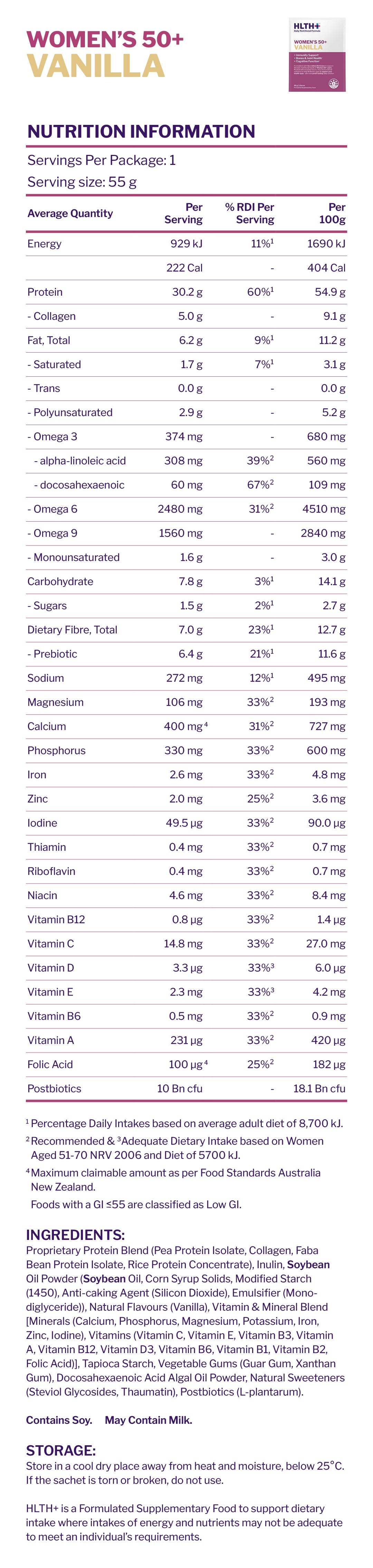
HLTH+ is a Formulated Supplementary Food: it supplements a diet and does not replace one. Women's 50+ comes in a 55g sachet carrying 30 essential daily nutrients, including 30g protein and 7g dietary fibre per serve; protein contributes to the maintenance of muscle mass and dietary fibre contributes to regular laxation, as part of a healthy diet involving a variety of foods. The ✦ Find My Formula quiz shows what your current routine is not giving you, and you can take the quiz here.
HLTH+ Women's 50+ is formulated to the Nutrient Reference Values for this life stage, published in 2006 by the National Health and Medical Research Council, the Australian Government Department of Health and Ageing and the New Zealand Ministry of Health. Australian food labels calculate percentage daily intakes against an average adult diet of 8,700 kJ under Standard 1.2.8 of the Food Standards Code, a labelling reference set above what the Nutrient Reference Values recommend for most adults, so a product built to it over-serves the individual.
Each serve also carries 5g collagen, 60mg DHA and a balanced multivitamin profile. It is dairy-free and gluten-free, made in Australia in facilities complying with Good Manufacturing Practice, and the allergen line reads: contains soy.
Pricing is RRP $6.00, or $5.10 a day on a 28-serve subscription at $142.80. It is available at hlthplus.com, on Amazon AU and at Chemist Warehouse online. To read the labels first, see what to look for in a protein powder over 50 and how the multivitamin options compare.
Which route suits which reader
- If your plate already covers the day, keep it, and use the quiz to check for gaps.
- If you are eating less and want 30g protein, 7g dietary fibre and a balanced multivitamin profile in one sachet beside your food, HLTH+ Women's 50+.
- If calcium is your first question, start with the food maths: learn more about calcium.
See what your current routine is not giving you. The ✦ Find My Formula quiz takes about 30 seconds and shows the gaps in your current supplement stack. Take the quiz.
Frequently Asked Questions
At what age does menopause usually happen?
Most Australian women reach menopause between 45 and 55, and the average age is 51, according to healthdirect. It is confirmed once you have gone 12 months without a period. Menopause before 45 is called early and before 40 premature, and it can also follow surgery or cancer treatment.
Do menopause symptoms stop after menopause?
Some do and some do not. Jean Hailes notes that hot flushes usually disappear over time, while bladder, vaginal and vulval problems can continue in postmenopause and might even get worse. The Australasian Menopause Society says most women have symptoms for 5 to 10 years.
Is there a test for menopause?
There is no specific test. According to healthdirect, your doctor works it out from your symptoms and medical history, and blood tests are usually only done if early or premature menopause is suspected or you have had a hysterectomy. Jean Hailes adds that hormone levels are not usually measured to diagnose menopause between 45 and 55.
When should I see a doctor about menopause symptoms?
See your doctor if symptoms are getting in the way of daily life, and see them promptly for any vaginal bleeding after 12 months without a period, because any abnormal bleeding needs to be checked. This is general information, not medical advice; decisions about any medication belong with your doctor.
Do calcium needs change after 50?
Yes. According to healthdirect, the recommended calcium intake for women is higher from 51 than from 19 to 50, and the Australasian Menopause Society notes that one in three women over 50 will experience a fracture. Healthdirect also advises getting calcium from your diet where you can, and seeking your doctor's advice before any supplement.

Leave a comment
This site is protected by hCaptcha and the hCaptcha Privacy Policy and Terms of Service apply.