
Perimenopause can bring bloating, and one link researchers point to is hormonal: the ovaries make less oestrogen and progesterone, and research suggests the gut is one place the transition shows up. The same feeling also has ordinary causes, such as constipation, swallowed air and food intolerances, so the useful first step is working out which one you are dealing with. Most causes of bloating are not serious, though a few are worth a doctor's time.
It is unsettling when your stomach feels tight and full for no obvious reason, in a body that handled the same meals easily last year. Healthdirect's perimenopause page lists hot flushes, trouble sleeping, joint pain and weight gain among the common physical symptoms but does not name bloating, which is part of why it catches people out.
Below: why hormone changes can lead to bloating, what the Australian sources say helps, what else it can be, and when to see a doctor. For the wider picture of the transition, see perimenopause symptoms, menopause symptoms and menopause supplements.
This is general information, not medical advice. Decisions about any medication belong with your doctor.
Does perimenopause cause bloating?
It can contribute, and the research points that way, though it is thinner than you might expect. A 2025 review in Nature Reviews Gastroenterology and Hepatology found that menopause can have multiple effects on gastrointestinal function, including altering gut motility and changing the composition of the gut microbiota, and that some gastrointestinal conditions are more common in peri- and postmenopause (Ley and Saha, 2025). The same review notes there are relatively few studies of how menopause affects gastrointestinal symptoms and quality of life.
The numbers that exist come from small studies. In a study of 228 women at a women's health practice, none of whom came in for abdominal or genitourinary symptoms, 38% of postmenopausal women reported altered bowel function against 14% of premenopausal women, and irritable bowel syndrome (IBS) type complaints peaked at 36% in the 40 to 49 age band (Triadafilopoulos and colleagues, Women & Health, 1998). The authors said ageing itself could not be ruled out, and the study is both small and old.
A 2025 scoping review mapped 122 studies of gastrointestinal symptoms in natural peri- and postmenopause, with constipation the most studied symptom (58 studies). It concluded that there are evidence gaps in how studies define menopausal stages and measure symptoms (Shaw and colleagues, Women's Health, 2025).
How can hormone changes lead to bloating?
The gut may move differently
Ley and Saha name altered gut motility and a changed gut microbiota as two effects of menopause on the gut. A 2011 review of ovarian function and gut motor activity lists nausea, abdominal pain, distension, bloating, diarrhoea and constipation among the symptoms that frequently appear alongside pregnancy, the luteal phase of the menstrual cycle, and perimenopausal and menopausal states (Palomba and colleagues, Minerva Endocrinologica, 2011).
The hormones that run your cycle are changing
Healthdirect says that in perimenopause the ovaries make less oestrogen and progesterone, the hormones that control the menstrual cycle, and that the hormonal changes lead to perimenopausal symptoms (last reviewed November 2025). Its page on bloating adds that females may notice bloating more before their periods (healthdirect, bloating, last reviewed October 2024).
What the research does not show
These are associations and plausible mechanisms. They do not let anyone say from the outside that your bloating is hormonal, and the useful details are the ones a doctor asks about: how long you have had it and what makes it better or worse. Bloating rarely arrives alone in this decade, and perimenopause symptoms sets out the other changes healthdirect lists.
Is perimenopause bloating the same as weight gain?
No. Healthdirect describes bloating as a feeling that your tummy is distended or stretched, and says you may feel gassy or full. Weight gain sits separately on healthdirect's list of common perimenopause symptoms.
The two can feel alike at the waistband, which is one reason a persistent change in abdominal size deserves a conversation with your doctor rather than a guess. The doctor section below says why.
What helps with perimenopause bloating?
Healthdirect's answer is that treatment depends on the cause and that adjusting your diet can help. The measures the Australian sources list are below. None is a guarantee, and none replaces working out the cause.
Cut down on swallowed air
Healthdirect says gas may build up in the gut when you:
- swallow a lot of air when you eat too fast
- drink a lot of fizzy drinks
- chew a lot of gum
Limit gas-producing foods rather than dropping them
The Better Health Channel's page on intestinal gas lists foods that commonly cause flatulence, including:
- dairy products, if lactose intolerance is present
- dried fruit such as raisins and prunes
- apples, apricots, peaches and pears
- legumes such as beans, peas and chickpeas
- vegetables such as onion, cabbage and Brussels sprouts
- foods high in insoluble dietary fibre, particularly seeds and husks
It adds that foods which produce a lot of gas also contain essential nutrients and should not be eliminated, and that limiting them is the better option (Better Health Channel, Flatulence, reviewed 1 July 2026). Healthdirect suggests noting which foods make your bloating worse and talking to your doctor or a dietitian before excluding any.
If constipation comes with it
For bloating with constipation, healthdirect suggests:
- eating more high-fibre foods such as fruit, vegetables and wholegrains
- drinking more water
- exercising regularly
Which everyday foods carry the most dietary fibre makes that first step easier to plan.
Medicines, probiotics and supplements are a doctor's call
Healthdirect says that, depending on the cause, a doctor may suggest laxatives, medicines to help with digestion, fibre supplements, or other supplements and herbal preparations. It adds that there is some evidence that changing your gut microbiome may help with bloating, and that a doctor may recommend probiotics or a change in diet.
If you are weighing up gut-health products, what the evidence says about each type comes first, and what prebiotics, probiotics and postbiotics each are is worth knowing before you buy any.
Does eating more dietary fibre make bloating worse?
It can, if the step up is sudden. The Better Health Channel says to introduce dietary fibre slowly, because a sudden switch from a low-fibre to a high-fibre diet may lead to abdominal pain and increased wind (Better Health Channel, Fibre in food, reviewed 11 December 2025). Its page on intestinal gas adds that high-fibre diets should be introduced slowly to give the bowel time to adjust.
Fluid matters too. The Better Health Channel's fibre page notes that some very high-fibre breakfast cereals taken without enough fluid may cause abdominal discomfort or constipation, and healthdirect says dietary fibre absorbs fluid, so it is important to drink enough, including water. Healthdirect also says the more fibre we eat, the more wind we produce, which is normal and does not make fibre less good for your health (healthdirect, High-fibre foods and diet, last reviewed December 2024).
In practice that means raising dietary fibre gradually and with water, not stopping it. How much dietary fibre common foods carry makes the step-up easier to plan.
What else can cause bloating in your 40s and 50s?
Healthdirect says most causes of bloating are not too serious, and that regular bloating can be caused by conditions a doctor can check for. Jean Hailes puts irritable bowel syndrome at about 4% of the population, more common in women, especially those aged 18 to 39 (Jean Hailes, Bowel health).
| Possible cause | What the source says | Who to ask |
|---|---|---|
| Constipation | Healthdirect lists it among conditions behind regular bloating | Your doctor |
| Irritable bowel syndrome | Jean Hailes: pain and bloating in the belly with changes in bowel movements | Your doctor, then a dietitian |
| Coeliac disease | Healthdirect lists it among conditions behind regular bloating | Your doctor |
| Food intolerances | Healthdirect gives lactose and gluten intolerance as examples | Your doctor or a dietitian |
| Swallowed air | Eating too fast, fizzy drinks and chewing gum (healthdirect) | You first, then your doctor if it continues |
| Persistent bloating with other symptoms | Ovarian Cancer Australia lists persistent abdominal bloating among the most commonly reported symptoms of ovarian cancer | Your GP |
If you are past your final period, menopause symptoms covers what changes after it.
When should bloating be checked by a doctor?
Healthdirect says that if bloating does not get better you should see your doctor. It says to see your doctor as soon as possible if bloating comes with:
- diarrhoea or vomiting
- ongoing or severe abdominal pain
- blood in your stools or changes in your stools
- weight loss without trying to lose weight
- loss of appetite or feeling full quickly
- fever
Ovarian cancer deserves a plain mention, because persistent bloating is on its symptom list. Healthdirect says ovarian cancer does not usually cause symptoms in its early stages, that the symptoms can be similar to other conditions, and that if they are new or continue for more than a few weeks you should talk with your doctor (healthdirect, Ovarian cancer, last reviewed October 2025). Ovarian Cancer Australia lists increased abdominal size or persistent abdominal bloating, pelvic pain, feeling full after a small amount of food and needing to urinate often or urgently, and says many of these have much less serious causes (Ovarian Cancer Australia).
This is general information, not medical advice. Decisions about any medication belong with your doctor.
Where does a Formulated Supplementary Food fit beside food when you are eating less?
Over 90% of Australian adults do not meet dietary guidelines (AIHW), and a smaller day of food leaves less room again. A day of food can shrink for many reasons: an illness, a busy stretch, a reduced appetite, or rapid weight loss, reduced eating and medically induced weight loss. For what changes nutritionally when you eat less, learn more.
Dietary fibre shows the gap clearly. People on GLP-1 medications averaged 14.5g a day against the 28g recommended in a 2025 Frontiers in Nutrition study, and the authors linked the shortfall to low intake of whole grains, fruit and vegetables. Dietary fibre when you eat less works through that gap; decisions about any medication belong with your doctor.
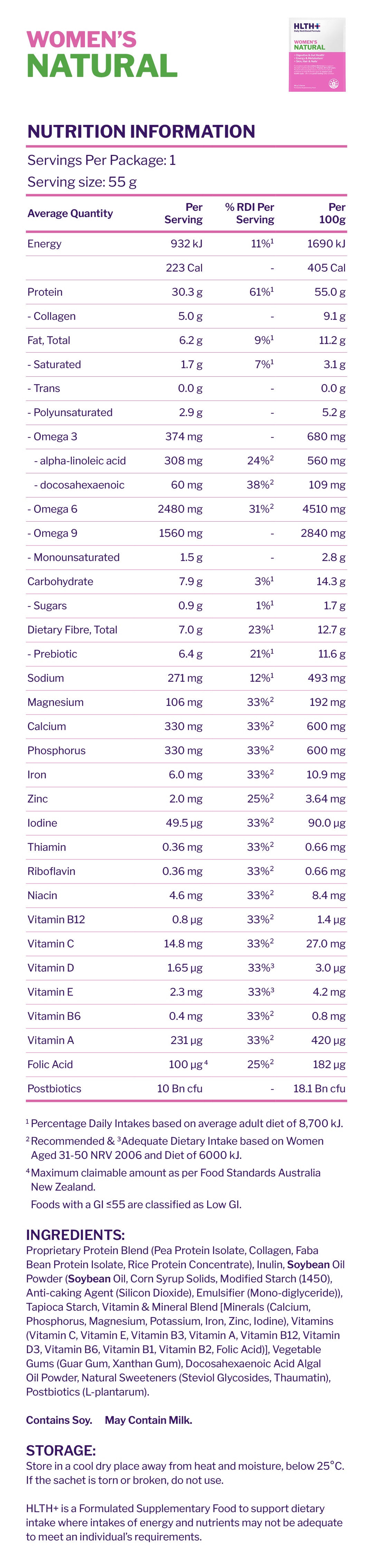
HLTH+ is an Australian made Formulated Supplementary Food, a category built to supplement the diet when food intake may not meet what an individual needs, so it sits beside food rather than in place of it. A 55g Women's sachet carries 30g protein per serve and 7g dietary fibre per serve, which makes it an excellent source of dietary fibre: Schedule 4 of the Food Standards Code sets at least 7g a serve for that claim. A serve holds 30 essential daily nutrients across protein, dietary fibre, vitamins, minerals, collagen and DHA.
Needs change at 30, 50 and 70, so HLTH+ is formulated by gender and life stage, as Women's, Women's 50+, Men's and Men's 50+, to the Nutrient Reference Values published in 2006 by the National Health and Medical Research Council, the Australian Government Department of Health and Ageing and the New Zealand Ministry of Health. It is dairy-free and gluten-free, made in facilities complying with Good Manufacturing Practice. Allergen line: contains soy.
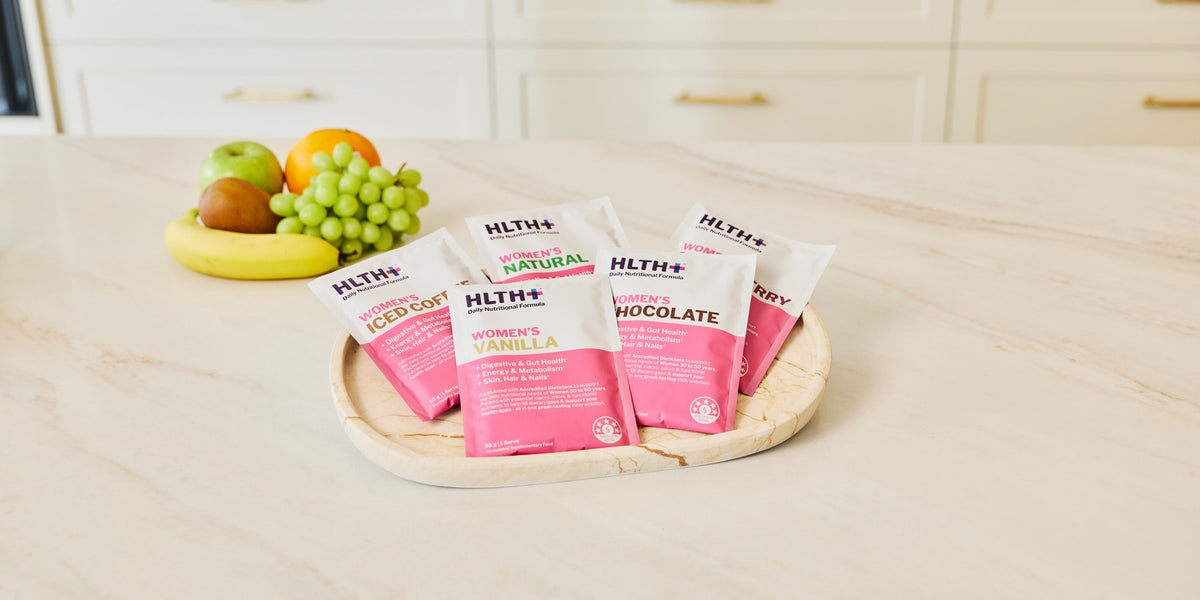
Most daily routines are built from habit, not from a count of what is missing. HLTH+ puts 30g protein, 7g dietary fibre and a balanced multivitamin profile into one 55g sachet beside your meals. The ✦ Find My Formula quiz shows what your current routine is not giving you.
If the question is a diagnosis, that belongs with your doctor or a dietitian. If the question is protein, dietary fibre and a balanced multivitamin profile in one sachet beside food, that is HLTH+, RRP $6.00, or $5.10 a day on a 28-serve subscription at $142.80, at hlthplus.com, Amazon AU and Chemist Warehouse.
See what your current routine is not giving you. The 30-second ✦ Find My Formula quiz shows the gaps in your current supplement stack, so you know what is missing before you buy anything.
Frequently Asked Questions
Is menopause bloating the same as perimenopause bloating?
Healthdirect defines menopause as 12 months without a period, with perimenopause the transition before it. Research on gut symptoms covers both: the 2025 Ley and Saha review describes menopause altering gut motility and says some gastrointestinal conditions are more common in peri- and postmenopause. Persistent bloating at either stage deserves a doctor's attention.
Should I cut out high-fibre foods if I am bloated?
Not on your own. The Better Health Channel says foods that produce gas also contain essential nutrients, and that limiting them is a better option than eliminating them. Healthdirect says to talk to your doctor or a dietitian before excluding foods, and the Better Health Channel advises introducing dietary fibre slowly, with enough water.
Can fizzy drinks and eating quickly make bloating worse?
Healthdirect lists eating too fast, fizzy drinks and chewing gum as ways gas can build up in the gut. The Better Health Channel adds that swallowed air is usually a minor cause of flatulence. These habits are worth checking, but bloating that does not get better still needs a doctor.
What will a doctor ask about bloating?
Healthdirect says your doctor will ask about your symptoms, how long you have had them, what makes them better or worse, your diet and your family history. They may examine you, order blood or stool tests, and refer you to a dietitian or gastroenterologist. A few days of notes on timing and food are useful to bring along.

Leave a comment
This site is protected by hCaptcha and the hCaptcha Privacy Policy and Terms of Service apply.