

Two things in the menopause aisle have real evidence behind them, and neither is a herb. The first is nutrients you are genuinely short of, measured against targets that shift at 50. The second is protein, at a level most Australian women over 50 are not eating.
You are somewhere in the middle of this, three or four bottles have been recommended by people who meant well, and you cannot tell which is doing anything. Every label sounds equally confident, and that is the problem.
This page splits the shelf into what the evidence supports, what it does not, and the checks to run on any label.
What supplements are actually worth taking in menopause?
Start where the evidence is least contested: bone, muscle, and nutrients you can measure a shortfall in. The Australasian Menopause Society's osteoporosis information sheet sets calcium at 1,300mg a day for women over 50, three to four serves of dairy food, and asks for a vitamin D level of at least 50nmol/L at the end of winter.
Those are intake targets, not marketing numbers, and the question is whether your own week gets near them.
The gap is measured. In the Australian Bureau of Statistics' 2023 modelling of usual nutrient intakes, 90.7% of Australian females aged 50 to 64 had an inadequate calcium intake from food and drink, against 63.7% of people aged two and over. Vitamin B6 ran at 77.7% inadequate in the same band.
That is the case for a supplement: a named nutrient, a measured shortfall, a dose that closes it.
Which menopause supplements does the evidence not support?
Most of the branded menopause formulas. The Australasian Menopause Society's complementary medicines information sheet, updated April 2025, puts it in one line: "There is currently insufficient evidence to support the use of herbal therapies."
The table is the Society's own reading of each ingredient, from that sheet.
| Ingredient | What the Australasian Menopause Society records | The limit on it |
|---|---|---|
| Black cohosh | Isopropanolic extracts at higher doses may improve menopausal symptoms, on a systematic review | Studies ran three to six months on small numbers, none against prescription treatment |
| Red clover | Specific extracts may reduce the daily frequency of hot flushes after menopause | Only at 12 weeks, at 80mg a day or more of isoflavones |
| Soy isoflavones | Mixed findings, some studies showing an effect on hot flushes and others none | May depend on being an equol producer, around 20% to 30% of Caucasian women |
| St John's wort with black cohosh | In one trial of 301 women, Menopause Rating Scale scores fell 50% against 19% on placebo | Interacts with many prescription medicines, and long-term safety data is lacking |
| Evening primrose oil | Very few studies exist, and one showed no benefit | Lowers the seizure threshold in epilepsy and interferes with anti-epileptic medication |
| Flaxseed | Two small studies suggest a benefit, the longest running eight months | The Society states more evidence is needed |
| Ashwagandha | One small study of 100 women over eight weeks showed reduced symptom scores | A 2024 Therapeutic Goods Administration safety advisory over severe gastrointestinal symptoms and liver damage |
| Vitamin E | Two very small short-term studies cut hot flushes by one to two a day | Four weeks of follow-up in one, 51 participants in the other |
| Omega-3 | No difference in hot flushes or sleep against placebo in a meta-analysis of 183 women | Its cardiovascular role is a separate question from menopausal symptoms |
| Wild yam, ginseng, maca, pine bark, pollen extract, magnesium, homeopathy, acupuncture | Grouped under little or no evidence of benefit for menopausal symptoms | Magnesium appears on this list, which matters below |
Compounded "bioidentical" hormone creams sit on the same shelf. The Society states there is no evidence supporting the efficacy or safety claims made for them, and all major menopause societies advise against them.
How long does a menopause supplement have to be tested before a claim means anything?
Longer than three months, and almost nothing on the shelf clears that bar. It explains how a product can point at a positive trial and still be a poor buy.
The reason is placebo. In the Society's words, "there is often a temporary placebo that commonly lasts around three months", so "unless the product is tested for more than three months, it is not possible to say it is truly effective for menopausal symptoms".
Read the table again with that rule in hand. Black cohosh at three to six months, red clover at twelve weeks, ashwagandha at eight, vitamin E at four.
Calcium and vitamin D: the numbers that are not in dispute
The target is settled. Whether a supplement is how you hit it is not.
The Society's calcium supplements information sheet states that calcium supplements "result in a marginal reduction in fracture risk, with evidence considered weak and inconsistent", and that "the routine use of calcium supplements is not recommended". Ideally most of the 1,300mg comes from food. Where dietary calcium is inadequate, it points to supplements of 500 to 600mg daily, and caps total intake at 2,000mg a day.
So the sequence matters more than the purchase. Count what your food delivers, then supplement the difference. The full calcium breakdown works through the food maths serve by serve.
Vitamin D is the partner nutrient and a different problem, since food carries very little of it. It has a key role in calcium absorption from the gut, and normal bone mineralisation cannot occur where deficiency is severe, which the vitamin D deficiency explainer covers properly.
The approved wording is narrow and worth holding onto: calcium is necessary for normal teeth and bone structure and for normal nerve and muscle function, and vitamin D is necessary for normal bone structure.
Protein: the requirement that does not fall when your appetite does
Protein has the strongest case in this decade and the smallest presence in the menopause aisle.
The European Society for Clinical Nutrition and Metabolism recommends at least 1.0 to 1.2g of protein per kilogram of body weight a day for healthy older adults, rising to 1.2 to 1.5g/kg for those who are unwell (Deutz and colleagues, Clinical Nutrition, 2014). For a 68kg woman that is roughly 68 to 82g a day.
The Australian recommendation for serves of lean meat, poultry, fish, eggs, nuts, seeds and legumes steps down at 51, from two and a half to two, while the body cannot store protein, so "the most effective way of meeting your daily protein requirement is to eat small amounts at every meal" (Better Health Channel, Victorian Department of Health).
The approved relationship is the plain one: protein contributes to the maintenance of muscle mass and is necessary for tissue building and repair. Resistance and weight bearing exercise is the other half. How to read a protein panel when you are over 50 goes through what the numbers on the back mean.
More on why the next two decades of nutrition matter more than the last two: the long view on vitality.
Magnesium, dietary fibre and the rest of the shelf
Magnesium is the most-recommended supplement here, and the clearest example of why the question has to be asked twice.
For menopausal symptoms, the Australasian Menopause Society lists it among the therapies with little or no evidence of benefit. For nutrient adequacy it is a different story: magnesium contributes to a reduction of tiredness and fatigue, and is necessary for normal nerve and muscle function. Those are adequacy relationships, not menopause claims, and conflating the two is how a bottle gets sold. What magnesium actually does and the sleep evidence specifically both hold to that line.
Dietary fibre is the quiet one. Its approved relationship is that dietary fibre contributes to regular laxation, and bowel habits commonly change in this window. Whether a multivitamin is doing anything at all applies the same trial-first test to the tablet most people already own, and the wider read on multivitamins for women compares what the panels carry.
What to check on any menopause supplement label
Six checks, in order. They take two minutes and they retire most of the shelf.
- How long was it tested, and against what? Under three months against placebo tells you almost nothing.
- Does the dose on your label match the dose in the trial? Red clover's evidence sits at 80mg a day or more of isoflavones over 12 weeks.
- Is the nutrient given as a percentage of the Recommended Dietary Intake? 5% of your requirement is a label entry, not a dose.
- Does the claim name a nutrient relationship? "Necessary for normal bone structure" is regulated wording. "For menopause support" is not a claim about anything.
- What does it interact with? St John's wort interacts with many prescription medicines, and evening primrose oil interferes with anti-epileptic medication. Take the bottle to your pharmacist.
- Is there an upper limit you are about to cross? Total calcium intake is not meant to exceed 2,000mg a day, and a multivitamin, a bone formula and a fortified drink stack up fast.
Over-the-counter products are "not subject to the rigorous testing for content, safety and effectiveness that prescription treatments are subject to", so the burden of reading the evidence lands on you. In a national sample of 10,011 Australian women aged 59 to 64, 75% used self-prescribed complementary medicines and therapies.
This is general information, not medical advice. Symptom management and any prescription option belong with your doctor, and the symptoms themselves are covered in what actually happens in perimenopause.
What if you are eating a lot less than you used to?
Every percentage on a supplement panel is a top-up to your food, so when the volume of food falls the arithmetic changes before anything else does.
Rapid weight loss, reduced eating and medically induced weight loss all shrink intake at the source. In trial conditions, GLP-1 medicines reduced ad libitum food intake by roughly a quarter of daily calories (Blundell and colleagues, Diabetes, Obesity and Metabolism, 2017), and people on GLP-1 medications averaged 14.5g of dietary fibre a day against the 28g recommended (Frontiers in Nutrition, 2025).
Put that on top of a calcium intake already inadequate for nine in ten women in this age band, and a tablet that tops up vitamins and minerals alone answers a shrinking share of the question. Decisions about any medication belong with your doctor.
Where a daily nutrition formula fits, and where it does not
A 1,300mg calcium target is a dedicated supplement's job against a counted shortfall; a nutrition formula's job is the rest of the day's intake. Nothing here changes a symptom or replaces the appointment.
What it does answer is breadth. Over 90% of Australian adults do not meet dietary guidelines (AIHW), and gaps in this decade rarely arrive one nutrient at a time.
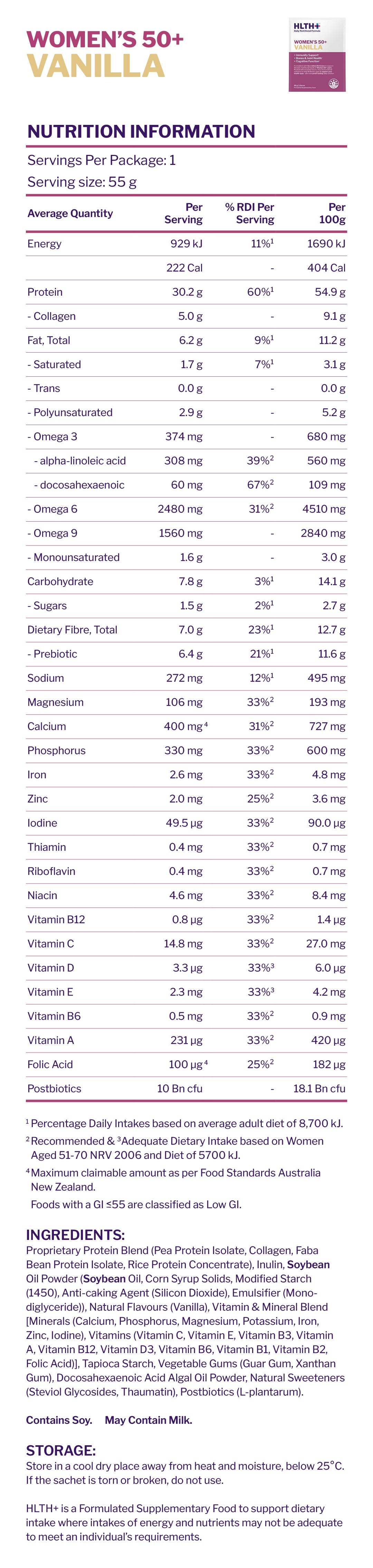
HLTH+ is a Formulated Supplementary Food. One 55g sachet carries 30g protein per serve and 7g dietary fibre per serve. Protein contributes to the maintenance of muscle mass and dietary fibre contributes to regular laxation, as part of a healthy diet involving a variety of foods.
Alongside those sit 5g collagen and 60mg DHA. Across protein, dietary fibre, vitamins, minerals, collagen and omega-3 fats, that is 30 essential daily nutrients. The vitamin and mineral component is a balanced multivitamin profile.
Australian food labels calculate percentage daily intakes against an average adult diet of 8,700 kJ under Standard 1.2.8 of the Food Standards Code, a labelling reference set above what the Nutrient Reference Values recommend for most adults, so a product built to it over-serves the individual drinking it. HLTH+ Women's 50+ is formulated to the Nutrient Reference Values for that life stage instead, published in 2006 by the National Health and Medical Research Council, the Australian Government Department of Health and Ageing and the New Zealand Ministry of Health.
It is dairy-free and gluten-free, made in Australia in facilities complying with Good Manufacturing Practice. Allergen line: contains soy. RRP $6.00, or $5.10 a day on a 28-serve subscription at $142.80, at hlthplus.com, on Amazon AU and at Chemist Warehouse online.
See what your current stack is actually missing. The ✦ Find My Formula quiz takes about 30 seconds and is built to show you the gaps your existing bottles are leaving, rather than to sell you another bottle. Take the quiz.
Frequently Asked Questions
Do menopause supplements actually work?
Most do not. The Australasian Menopause Society states there is currently insufficient evidence to support the use of herbal therapies for menopausal symptoms. Nutrient supplements are a different question: they work when they close a measured gap, which is why the useful first step is checking your intake rather than buying a bottle.
What supplements are worth taking during menopause?
Calcium, vitamin D and protein have the clearest case, because the targets move at 50 while intake does not. The Australasian Menopause Society puts calcium at 1,300mg a day for women over 50, ideally from food, and vitamin D at 50nmol/L or above at the end of winter.
Should I take a calcium supplement after menopause?
Only if your food is not getting you there. The Australasian Menopause Society states that calcium supplements result in a marginal reduction in fracture risk, with evidence considered weak and inconsistent, and that routine use is not recommended. Where dietary calcium is inadequate, it points to supplements of 500 to 600mg daily.
Does black cohosh work for hot flushes?
Specific isopropanolic extracts at higher therapeutic doses may improve menopausal symptoms, on a systematic review the Australasian Menopause Society cites. Most of those studies ran three to six months on small numbers, and none compared black cohosh with prescription treatment. A review of 69 suspected liver injury cases found no direct causal relationship.
How much protein do women need after 50?
The European Society for Clinical Nutrition and Metabolism recommends at least 1.0 to 1.2g of protein per kilogram of body weight a day for healthy older adults. For a 68kg woman that is about 68 to 82g. The Better Health Channel advises spreading it across meals, because the body excretes any excess.
Leave a comment
This site is protected by hCaptcha and the hCaptcha Privacy Policy and Terms of Service apply.