

A breakfast reaches 30g of protein only when a concentrated protein food is the centre of it. Two slices of wholemeal toast with a banana comes to 9.3g, which is why recipe roundups never print the number. Smoked salmon on the same two slices reaches 31.6g, three poached eggs with feta reach 33.6g, and blended tofu with soy beverage and hemp seeds reaches 31.0g.
Most people searching this already eat breakfast. What they eat lands between 6g and 15g of protein, and nothing on the packet or the recipe card tells them so. If your appetite is smaller than it used to be, the gap widens again, because the portion shrinks well before the requirement does.
Below are 25 Australian breakfasts that reach 30g, costed in minutes and grams.
Why is 30g the number everyone quotes for breakfast?
It comes from a protein distribution trial, not from a regulation. Researchers fed healthy adults two diets with identical total protein: one spread evenly at 31.5g, 29.9g and 32.7g, the other skewed to 10.7g at breakfast and 63.4g at dinner. Over 24 hours the even pattern produced a muscle protein fractional synthesis rate 25% higher than the skewed one (Mamerow and colleagues, The Journal of Nutrition, 2014).
Hold that at its real size: eight participants, a seven-day crossover design, an outcome measured as a synthesis rate rather than a clinical result. So 30g is a well-grounded target, not a threshold you fail by missing.
It is worth aiming at because a normal Australian day is light in the morning, heavy at night. The Victorian Department of Health puts the reason plainly: "the human body can't store protein and will excrete any excess, so the most effective way of meeting your daily protein requirement is to eat small amounts at every meal" (Better Health Channel).
Set that against what a label may tell you. Under the Food Standards Code a food needs 5g of protein per serving to carry a protein claim, and 10g to be called a good source (Schedule 4, section S4-3). Thirty grams is three times that line, which is how a breakfast can be labelled high in protein and still leave you 20g short.
Protein contributes to the maintenance of muscle mass, as part of a healthy diet involving a variety of foods; the whole-day figure is in how much protein you need to build muscle.
25 high-protein breakfasts, sorted by how long you have
Every figure is scaled from the Australian Food Composition Database, Release 3.0, Food Standards Australia New Zealand, retrieved 15 September 2026. Bread is 35g a slice, liquids 100g per 100mL, spinach the raw baby spinach entry, and calories are kilojoules divided by 4.184.
Eight breakfasts in two minutes, with no cooking
| Breakfast | What is in it | Protein | Dietary fibre | Calories |
|---|---|---|---|---|
| 1. Yoghurt with pumpkin and hemp seeds | 170g increased-protein yoghurt, 30g pumpkin seeds, 20g hemp seeds | 32.0g | 2.9g | 374 Cal |
| 2. Cottage cheese on rye sourdough | 150g cottage cheese, 70g rye sourdough | 31.9g | 3.6g | 363 Cal |
| 3. Smoked salmon on wholemeal | 100g sliced smoked salmon, 70g wholemeal | 31.6g | 4.8g | 354 Cal |
| 4. Tuna and avocado on mixed grain | 95g canned tuna, 70g mixed grain, 40g avocado | 32.9g | 6.4g | 365 Cal |
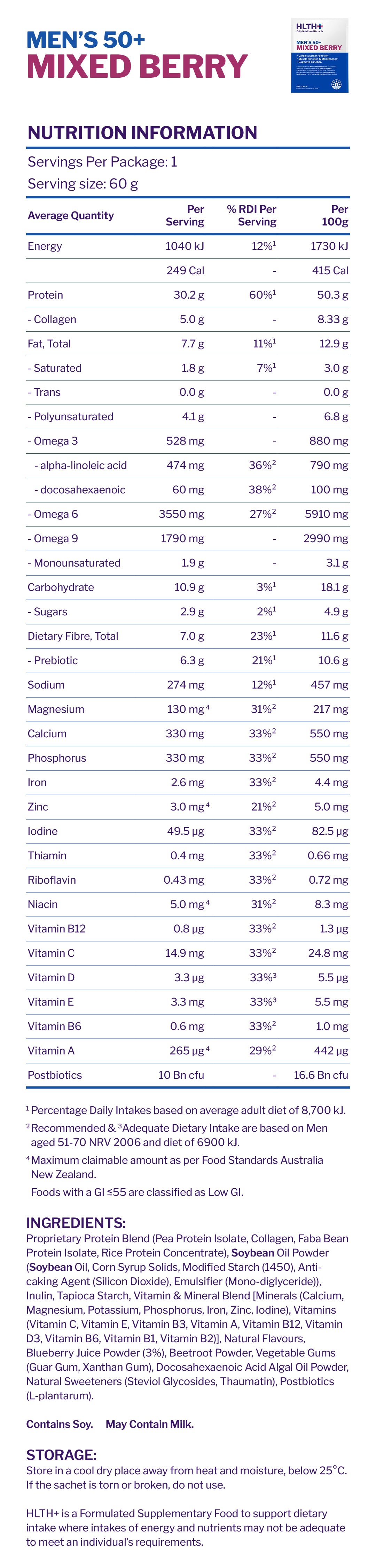
| 5. A HLTH+ sachet | one 55g Women's sachet in 300mL water or milk | 30g | 7g | 223 Cal |
| 6. Blended tofu, soy and hemp shake | 100g firm tofu, 300mL fortified soy beverage, 30g hemp seeds | 31.0g | 4.1g | 443 Cal |
| 7. Yoghurt with lupin flakes and banana | 200g increased-protein yoghurt, 30g lupin flakes, 120g banana | 32.8g | 11.5g | 320 Cal |
| 8. Overnight lupin and hemp | 40g lupin flakes, 30g hemp seeds, 300mL fortified soy beverage | 33.0g | 13.9g | 437 Cal |
Plain natural yoghurt is the trap here: at 5.3g of protein per 100g a 570g tub would be needed to reach 30g alone, which is why every yoghurt row uses the increased-protein version. Ideas 6 and 8 carry 3.3g of added sugars from the soy beverage; idea 7's 20.6g of sugars are from fruit and milk.
Idea 5 is our own. One 55g Women's sachet carries 30g protein per serve and 7g dietary fibre at 1.5g of sugar with none added, dairy-free and gluten-free. Counted across protein, dietary fibre, vitamins, minerals, collagen and DHA it holds 30 essential daily nutrients, dosed by sex and life stage across Women's, Women's 50+, Men's and Men's 50+ and formulated to the Nutrient Reference Values published in 2006 by the National Health and Medical Research Council, the Australian Government Department of Health and Ageing and the New Zealand Ministry of Health.
Eight breakfasts in five minutes, with a toaster or a pan
| Breakfast | What is in it | Protein | Dietary fibre | Calories |
|---|---|---|---|---|
| 9. Porridge with hemp and chia | 60g rolled oats, 250mL skim milk, 30g hemp seeds, 20g chia seeds | 30.3g | 13.6g | 578 Cal |
| 10. Scrambled eggs with cheddar | 200g scrambled egg, 30g cheddar, 35g wholemeal bread | 32.6g | 2.4g | 445 Cal |
| 11. Three poached eggs with feta | 150g poached egg, 40g feta, 70g wholemeal | 33.6g | 4.8g | 468 Cal |
| 12. Baked beans, egg and cheddar on toast | 220g reduced-salt baked beans, 50g poached egg, 40g cheddar, 70g wholemeal | 34.2g | 15.4g | 594 Cal |
| 13. Ham and cheddar toastie | 80g lean leg ham, 40g cheddar, 70g mixed grain | 30.9g | 5.5g | 431 Cal |
| 14. Haloumi, mushrooms and spinach on rye | 100g haloumi, 100g mushrooms, 50g spinach, 70g rye sourdough | 30.5g | 6.3g | 505 Cal |
| 15. Banana and peanut butter smoothie | 200mL skim milk, 170g increased-protein yoghurt, 100g banana, 20g peanut butter | 30.7g | 4.2g | 390 Cal |
| 16. Canned red salmon on gluten-free toast | 110g canned red salmon, 70g gluten-free bread | 30.7g | 2.7g | 311 Cal |
Idea 12 is the highest-fibre breakfast here at 15.4g, and the cost is 5.3g of added sugars from the tinned beans. Idea 15's 28.3g of sugars are all from the milk and the banana. In idea 9 the oats supply 7.3g of protein and the seeds supply 13.7g.
Nine breakfasts in fifteen minutes, cooked properly
| Breakfast | What is in it | Protein | Dietary fibre | Calories |
|---|---|---|---|---|
| 17. Three-egg omelette with cheddar | 200g cooked egg, 30g cheddar, 50g spinach, 35g wholemeal bread | 34.0g | 3.7g | 453 Cal |
| 18. Tofu scramble with mushrooms | 200g firm tofu, 100g mushrooms, 50g spinach, 35g wholemeal bread | 32.8g | 7.1g | 378 Cal |
| 19. Quinoa bowl with eggs and feta | 250g cooked quinoa, 100g poached egg, 40g feta, 50g spinach | 30.1g | 9.8g | 501 Cal |
| 20. Grilled salmon fillet on rye | 120g Atlantic salmon, 50g spinach, 70g rye sourdough | 35.3g | 4.9g | 481 Cal |
| 21. Chickpea shakshuka with poached eggs | 200g canned chickpeas, 100g poached egg, 40g feta, 50g spinach | 33.7g | 12.7g | 470 Cal |
| 22. Buckwheat porridge with soy and seeds | 250g cooked buckwheat, 300mL fortified soy beverage, 30g hemp seeds, 20g pumpkin seeds | 31.0g | 6.7g | 594 Cal |
| 23. Grilled sardines on wholemeal | 100g cooked whole sardines, 70g wholemeal bread, 50g spinach | 30.7g | 6.1g | 280 Cal |
| 24. Lentil and egg hash | 200g boiled lentils, 100g poached egg, 50g spinach, 35g wholemeal bread | 32.7g | 11.9g | 408 Cal |
| 25. Turkey breast and mushrooms on toast | 100g baked turkey breast, 100g mushrooms, 70g wholemeal | 38.9g | 6.2g | 348 Cal |
Idea 23 is the best value per calorie here: 30.7g of protein for 280 calories, with 1,011mg of calcium because the bones go in. Idea 25 overshoots at 38.9g, the point of leftover roast meat.
Which of these work if you are dairy-free, gluten-free or plant-based?
Dairy-free. Ideas 3, 4, 5, 6, 8, 18, 20, 22, 23, 24 and 25 carry no dairy ingredient, and eggs are not dairy. Check the loaf: the database's wholemeal, mixed grain and rye sourdough entries carry no lactose, but many supermarket breads contain milk solids.
Gluten-free. The Code sets a high bar here.
A food labelled gluten free "must not contain: (a) detectable gluten; or (b) oats or oat products; or (c) cereals containing gluten that have been malted" (Schedule 4, section S4-3). That rules out idea 9, even though oats carry no wheat gluten of their own. What is left: ideas 1, 5, 6, 7, 8, 15, 16, 19, 21 and 22, plus idea 17 without the toast.
One trap: gluten-free is not dairy-free. The database's gluten-free bread entry carries 1.2g of lactose per 100g, so idea 16 suits coeliac disease and not a dairy allergy. The Code's lactose rows are stricter again: lactose free means no detectable lactose, low lactose no more than 2g per 100g.
If a shake is the format you want, lactose-free protein shakes runs the same test over that category.
Plant-based. Four entries qualify: ideas 6, 8, 18 and 22.
Reaching 30g without animal foods means concentrating rather than adding volume: lupin flakes carry 36.9g of protein per 100g, pumpkin seeds 30.2g and hemp seeds 29.8g, against 12.8g for firm tofu and 2.7g for cooked buckwheat. The Victorian Department of Health notes that soy products and quinoa carry large amounts of all of the essential amino acids, while other plant proteins contain all of them but "the amounts of one or two of these amino acids may be low" (Better Health Channel). What that means on a label is in complete protein.
What changes when your appetite is smaller than it used to be?
Everything above assumes you can finish the plate. When calories drop, through a deliberate deficit, an illness, or rapid weight loss, reduced eating and medically induced weight loss, breakfast is usually the first meal to go, because it has the weakest habit behind it.
That drop is measurable: GLP-1 medicines reduced how much people ate by roughly a quarter of daily calories (Blundell and colleagues, Diabetes, Obesity and Metabolism, 2017). Take a quarter out of a day that already starts at 10g of protein and the morning gap stops being marginal.
Dietary fibre goes the same way. A 2025 study measured average intake among people on GLP-1 medications at 14.5g a day against the 28g recommended (Frontiers in Nutrition, 2025). A GLP-1 medicine also slows gastric emptying and gut motility, which commonly changes bowel regularity, so which breakfast sits well matters.
This section is general information, not medical advice. Decisions about any medication belong with your doctor.
Two things follow. Smaller and denser beats larger and lighter: ideas 3, 16 and 23 each clear 30g inside 360 calories. And the high-fibre entries earn their place first, the subject of protein when appetite drops.
Learn more about what a reduced appetite does to muscle.
How do you get to 30g on a bad morning?
Over 90% of Australian adults do not meet dietary guidelines on the Australian Institute of Health and Welfare's poor-diet measure, and rushed mornings decide a lot of it. Three habits do most of the work.
- Cook the protein once, eat it four times. Boil six eggs, roast a turkey breast or cook lentils on Sunday, and ideas 11, 24 and 25 stop being fifteen-minute jobs.
- Keep two defaults, one fast and one slow. A two-minute option for the mornings you cannot think, a longer one for the mornings you can.
- Weigh the concentrated ingredient once. Seeds, cheese and lupin flakes are where these numbers are won or lost, and 30g of pumpkin seeds looks smaller in a bowl than on a table.
The portable version is in a healthy breakfast on the go, and the training-day version in what to eat before a workout.
See what your current stack is not giving you. The 30-second ✦ Find My Formula quiz is diagnostic: it shows the gaps your existing breakfast and supplements leave, so you know what you are missing before you buy anything.
Frequently Asked Questions
What counts as a high-protein breakfast in Australia?
A food can carry a protein claim at 5g per serving and be called a good source at 10g under Schedule 4 of the Food Standards Code. Most people aiming high use 30g, the figure from the even arm of a 2014 protein distribution trial. Smoked salmon on wholemeal reaches 31.6g.
How do you get 30g of protein at breakfast without meat or dairy?
By concentrating, not by adding volume. Lupin flakes carry 36.9g of protein per 100g, pumpkin seeds 30.2g and hemp seeds 29.8g. Forty grams of lupin flakes with 30g of hemp seeds soaked overnight in 300mL of fortified soy beverage reaches 33.0g, on Australian Food Composition Database figures.
Is a shake a good high-protein breakfast?
It can be, and the test is the panel rather than the format. A daily nutritional formula such as HLTH+ is not designed as a meal replacement, because it is built to complement a food-first approach. It works fine as a healthy snack or to tie you over.
How much protein is in eggs on toast?
Three poached eggs weigh about 150g and carry 19.7g of protein; two slices of wholemeal bread add 7.3g. That combination reaches 27.0g, so it lands just under 30g on its own. Adding 40g of feta takes it to 33.6g, which is idea 11 above.
Which high-protein breakfast has the fewest calories?
Grilled sardines with two slices of wholemeal and baby spinach: 30.7g of protein for 280 calories, and 1,011mg of calcium because the bones are eaten. Canned red salmon on gluten-free bread is next at 30.7g for 311 calories, then yoghurt with lupin flakes and banana at 32.8g for 320 calories.

Leave a comment
This site is protected by hCaptcha and the hCaptcha Privacy Policy and Terms of Service apply.