
What is the best lactose-free protein shake?
There are two routes and they suit different people. A ready-to-drink bottle is the convenient one, and the Australian bottle verified for this page lists 30.4g of protein, 15.8g of sugars and "lactose: not detected" per 375mL. A powder you mix at home is the controlled one, because you choose the liquid and therefore most of what arrives with the protein.
The reason this search is confusing is that "lactose-free" and "dairy-free" are sold as if they were the same word, and they are not. One is about a sugar, the other is about a protein, and that difference decides which bottle or sachet is right for you.
This page sets out what the label has to say before a shake counts as lactose-free, what the two routes cost and carry, and who each one suits.
What does "lactose-free" actually mean on a shake label?
Lactose is a sugar, not a protein. The government health service healthdirect describes it plainly: "Lactose is the main type of sugar found in milk and other dairy products", and the same page separates it from cow's milk allergy, which is "an immune reaction to proteins that are found in cow's milk". So a lactose-free shake can still be full of dairy protein, and a dairy-free shake is lactose-free automatically.
There are three ways a shake ends up lactose-free, and only one of them removes dairy.
- Lactase-treated dairy. The enzyme lactase is added and, in Pauls' own words on its lactose-free explainer, it "breaks down lactose into glucose and galactose, making them easier to digest" (retrieved 15 September 2026). The milk protein stays.
- Heavy filtration of whey. Whey protein concentrate carries more lactose than whey protein isolate, which is filtered further. Filtration alone does not make a product lactose-free, and the lactose line on the nutrition information panel is the only thing that settles it.
- A non-dairy protein base. Pea, faba bean, rice, soy or collagen blends contain no lactose because they contain no milk. This is the route that also answers a dairy protein problem.
If you want the powder version of this decision rather than the shake version, the lactose-free protein powder buyer's guide walks the same ground by label type.
Does mixing with lactose-free milk make a shake dairy-free?
No, and this is the trap the category runs on. Pauls Zymil Full Cream Milk publishes 8.5g of protein and 12.3g of sugars per 250mL serve with lactose listed as nil, and its ingredient list reads "Full cream milk, enzyme (lactase). Contains milk" (their own product page, retrieved 15 September 2026). The lactose is gone; the dairy protein and the sugars are not.
Read those two numbers together, because they explain the whole category. Lactase splits one sugar into two smaller ones, so the sugars line barely moves, and the "Contains milk" allergen statement stays exactly where it was.
That matters in two directions. If lactose is your issue, lactose-free milk is a genuine fix and adds 8.5g of protein to the glass. If dairy protein is your issue, it is not a fix at all, and the dairy-free shake options are a different page and a different shopping list.
Ready-to-drink or powder: which route should you take?
Every figure in this table is a figure the brand publishes for that product, or a plain statement that it does not publish one, with the retrieval date shown. No cell is estimated.
| What decides it | Ready-to-drink bottle | Powder mixed at home |
|---|---|---|
| Protein per serve, verified example | True Protein's All Natural Protein Shake lists 30.4g per 375mL bottle (own page, 15 September 2026) | HLTH+ lists 30g protein per 55g sachet (Women's; Men's runs 60-62g) |
| Sugars per serve, verified example | 15.8g on that same bottle, with lactose "not detected" | 1.5g (Women's) or 1.7g (Men's), none added |
| Cost per serve, from published prices | 5.67abottle(68.00 for a box of 12), or 5.50forMusashi′sHighProteinShake(33 recommended retail for a box of 6) | RRP $6.00, or $5.10 a day on the 28-serve subscription at $142.80 |
| What else the serve carries | Ultra filtered milk, cream, cocoa, natural flavours, sodium citrate, acacia gum, gellan gum and the enzyme lactase, on the verified bottle's own ingredient list | 7g dietary fibre, 5g collagen, 60mg DHA and 10 billion CFU Lactobacillus Plantarum Postbiotic, plus prebiotics |
| Panel transparency | Musashi's own page for its 375mL High Protein Shake states 30g protein and its recommended retail price, and publishes no panel, ingredient list or allergen statement (15 September 2026) | Full panel published per formula and flavour |
| Preparation | None. Open it | Water and a shaker, about ten seconds |
Figures are each brand's published information at the retrieval dates shown; flavours vary and brands reformulate, so check current labels before buying. Musashi is listed here for what its page publishes and what it does not; it is not presented as a lactose-free product.
The read of that table is that the bottle wins on convenience and loses on sugars, and the gap is structural rather than a fault of any brand. A drinkable, shelf-stable liquid needs sugars that a dry sachet does not, which is why a bottle suits a gym bag and a sachet suits a kitchen bench. If breakfast is the slot you are filling, the breakfast options that reach a real protein figure are worth reading beside this, and what to eat before a workout covers the training slot.
What should you look for on a lactose-free shake label?
Five things decide whether a lactose-free shake is worth buying, and four of them are lines printed on the panel that you can check yourself.
- A lactose line, or no dairy at all. "Lactose: not detected" on the panel, or a protein base with no milk in it. A front-of-pack word is not evidence.
- Protein per serve. Under Schedule 4 of the Australia New Zealand Food Standards Code, a food needs at least 5g of protein per serving to make any protein claim at all and at least 10g to be a "good source". Anything calling itself a protein shake should clear both comfortably.
- Sugars per serve. Lactose-free is not low-sugar, as the 15.8g on the verified bottle above shows. Read the sugars line separately and check whether any of it was added.
- Dietary fibre per serve. The same schedule sets 2g per serving as the threshold for any dietary fibre claim, 4g for "good source" and 7g for "excellent source". If the panel carries no dietary fibre line at all, that is your answer.
- What else the serve carries. Two shakes with the same protein figure are not the same product if one also carries dietary fibre, micronutrients and essential fats.
Protein quality is the thing no number on the panel can show you. To judge it properly, what makes a protein complete and how the essential amino acids work explain what to look for on any label, dairy or plant. For the powders that sit behind these shakes, the plant-based protein powder shortlist for Australia compares the bases themselves.
What if you are eating less than you used to?
One group reads a shake label differently: people whose meals have shrunk, through a deliberate deficit, an appetite that has fallen away, or rapid weight loss, reduced eating and medically induced weight loss, including people on GLP-1 medications. In trial conditions, these medicines reduced ad libitum food intake by roughly a quarter of daily calories (Blundell and colleagues, Diabetes, Obesity and Metabolism, 2017).
When the plate gets smaller, the gram-scale nutrients slip before the milligram ones. In one 2025 study, people taking these medications averaged 14.5g of dietary fibre a day against the 28g recommended (Frontiers in Nutrition, 2025). A shake chosen only on its protein figure does nothing about that half of the problem.
This page is general information, not medical advice, and decisions about any medication belong with your doctor. Learn more about what happens to nutrition when overall intake drops.
Where does HLTH+ fit among lactose-free shakes?
HLTH+ is a powder you mix with water, and it is lactose-free the second way: it is dairy-free, so there is no lactose in it to remove. It is a Formulated Supplementary Food under the Food Standards Code rather than a sports drink, taken alongside meals in a 55g sachet (Women's; Men's runs 60-62g). It is also gluten-free, it contains no nasties, artificial colours, artificial flavours or artificial sweeteners, and it carries a 5-star Health Star Rating.
Allergen line: HLTH+ contains soy.
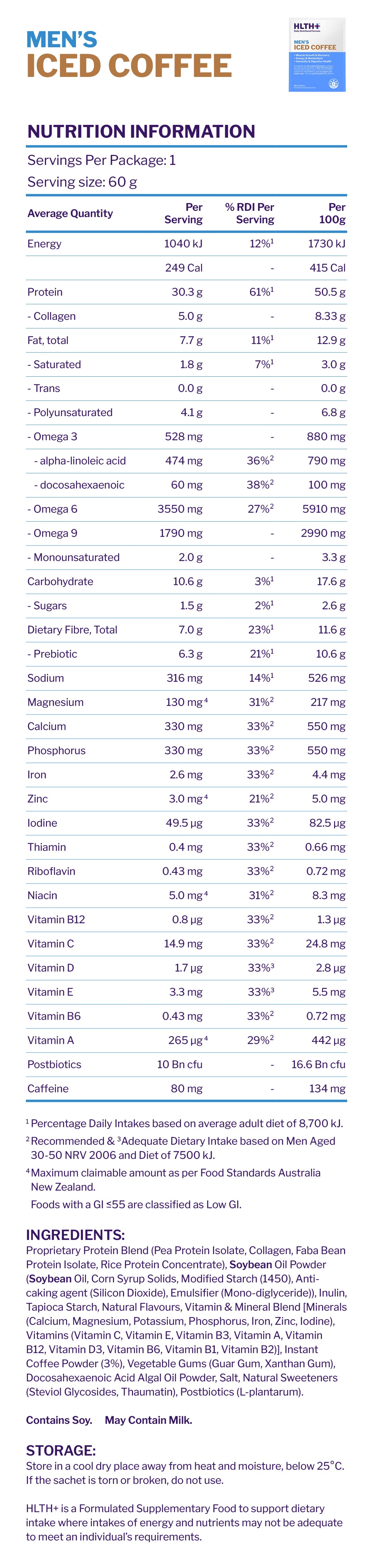
One sachet lists 30g protein per serve and 7g dietary fibre, with 1.5g of sugar (Women's) or 1.7g (Men's) and none added. As part of a healthy diet involving a variety of foods, protein contributes to the maintenance and growth of muscle mass and to tissue repair, and dietary fibre contributes to regular laxation. The same sachet lists 5g collagen, 60mg DHA and 10 billion CFU Lactobacillus Plantarum Postbiotic alongside prebiotics.
A postbiotic is not a live organism. It is the material a bacterial culture produces during fermentation, together with the inactivated cells, so it does not depend on organisms surviving transport and storage. That also means a postbiotic count and a probiotic count are not the same measurement, so 10 billion beside 10 billion is neither a tie nor a win for either product.
Across protein, dietary fibre, vitamins, minerals, collagen and DHA, each serve supplies 30 essential daily nutrients. The vitamin and mineral side of that set is a balanced multivitamin profile rather than a long count of milligrams.
The row no ready-to-drink bottle answers is who the formula was built for. HLTH+ is dietitian-formulated to the Nutrient Reference Values, the published government intakes developed by the National Health and Medical Research Council, the Australian Government Department of Health and Ageing and the New Zealand Ministry of Health, which is why the range runs Women's, Women's 50+, Men's and Men's 50+ rather than one formula for every adult.
It sells at hlthplus.com at RRP $6.00, or $5.10 a day on a 28-serve subscription at $142.80 and $5.40 a day on a 14-serve subscription at $75.60, and through Amazon AU and Chemist Warehouse online.
Which lactose-free shake should you choose?
Choose a ready-to-drink bottle if the shake has to survive a gym bag or a car console and you want no preparation at all. On the verified example, that convenience costs you 15.8g of sugars a bottle, which is a fair trade if the bottle is replacing nothing and a poor one if it is replacing breakfast.
Choose a lactase-treated dairy powder or milk if lactose is your only issue and you like the taste and texture of dairy. The dairy protein stays, which is the point, and the 8.5g per 250mL in lactose-free milk is protein you are already paying for.
Choose a non-dairy powder mixed with water if dairy protein is the problem, or if you want to decide what comes with your protein instead of inheriting it. This is where HLTH+ sits: 30g protein and 7g dietary fibre per 55g sachet, no added sugar, dairy-free and therefore lactose-free.
A whey isolate suits you if protein per gram of powder at the lowest price per gram is the only line you are buying, and its panel carries a lactose line you can trust. It is built for exactly that and carries protein and little else, which is the trade.
We believe in a food-first approach, and the statistics say food alone is not getting there: over 90% of Australian adults do not meet dietary guidelines on the AIHW poor-diet measure. A daily formula is nutritional insurance, not a substitute for eating well. HLTH+ is not designed as a meal replacement, because it complements a food-first approach, but it works fine as a healthy snack or to tie you over between meals.
Find out what your current shake is not giving you. The 30-second ✦ Find My Formula quiz reads your existing routine and shows the gaps it leaves.
Frequently Asked Questions
Are protein shakes lactose free?
Some are, most are not. Whey concentrate carries the most lactose, whey isolate is filtered further, and lactase-treated shakes have the lactose broken into simpler sugars. Non-dairy shakes built on pea, faba bean, rice, soy or collagen contain none at all. The lactose line on the panel is the only reliable answer.
Is lactose-free milk dairy-free?
No. Pauls Zymil Full Cream Milk lists lactose as nil but publishes 8.5g of protein and 12.3g of sugars per 250mL serve, with an ingredient list of "Full cream milk, enzyme (lactase). Contains milk" (retrieved 15 September 2026). It solves a lactose problem and leaves a dairy protein one untouched.
Which is better, a ready-to-drink shake or a powder?
A bottle wins on convenience and loses on sugars: the Australian bottle verified here lists 30.4g protein and 15.8g sugars per 375mL. A powder mixed with water lets you control the sugars and what else comes with the protein, at about ten seconds of effort and a shaker to wash.
Is HLTH+ a lactose-free protein shake?
It is lactose-free because it is dairy-free, so there is no lactose in it to remove. One 55g sachet lists 30g protein per serve, 7g dietary fibre, 5g collagen and 60mg DHA, with no added sugar. Its allergen line reads contains soy.
How much does a lactose-free shake cost per serve in Australia?
On published prices retrieved 15 September 2026, True Protein's ready-to-drink box of 12 works out at $5.67 a bottle and Musashi's box of 6 at $5.50 a bottle at recommended retail. HLTH+ is RRP $6.00, or $5.10 a day on a 28-serve subscription at $142.80.
This article is general information, not medical advice. Decisions about any medication belong with your doctor. Figures quoted are each brand's published information at the retrieval dates shown; check current labels before buying.
Leave a comment
This site is protected by hCaptcha and the hCaptcha Privacy Policy and Terms of Service apply.