

Eat a carbohydrate-based meal three to four hours before you train, or a small carbohydrate snack one to two hours before, and take in about 500 ml of fluid across the two to four hours prior. A 20 to 40 g serve of protein inside that meal is plenty; the heavy fat, the big salad and the large steak sit better on the other side of the session.
The reason this is hard to get right is that the advice you find online is written for two different people. Half of it is for a marathon runner fuelling a three-hour event, and half is for someone who wants to lift at 6 am without feeling sick, and neither says which one it is.
So here is what the sports-nutrition position stands and Australia's own public health guidance actually say, sized to an ordinary gym session, with the timing, the amounts, real food examples and what to do when your appetite is not playing along.
How long before a workout should you eat?
Victoria's Better Health Channel, run by the Victorian Department of Health, puts it in two windows: "a high-carbohydrate meal 3 to 4 hours before exercise" and "a small snack one to 2 hours before exercise" (Better Health Channel, Sporting performance and food). The same page recommends roughly 500 ml of fluid in the two to four hours before an event.
The International Society of Sports Nutrition position stand on nutrient timing frames the final stretch the same way. In the last four hours the priority is to keep muscle and liver glycogen topped up while "maintaining a favorable balance with the digestive system and avoiding the consumption of too much food or fluid" (Kerksick and colleagues, Journal of the International Society of Sports Nutrition, 2017).
What about the last hour? The old worry was that carbohydrate eaten right before training would send blood sugar down just as you started. The position stand reports that a review of studies giving carbohydrate at least 60 minutes before exercise found no adverse impact on performance, with several studies reporting gains of 7 to 20%, and that a proper warm-up effectively negates any rebound dip.
| Time before training | What fits | Why |
|---|---|---|
| 3 to 4 hours | A proper meal built on carbohydrate with a moderate protein serve | Time to digest, glycogen topped up, nothing sitting in the stomach |
| 1 to 2 hours | A small carbohydrate snack, low in fat and fibre | Fuel without the digestive load |
| Under 1 hour | A small, easily digested carbohydrate, or nothing if you ate earlier | Tolerated in the research, provided the serve is small and you warm up |
The pattern to notice: the closer to the session, the smaller and simpler the food gets. If you train first thing, a healthy breakfast on the go is the small-snack version.
What should you eat before a workout?
Carbohydrate first. The position stand's working figure is 1 to 4 g of carbohydrate per kilogram of body weight, eaten "for several hours before" exercise, and the stand attaches that recommendation to higher-intensity sessions at or above 70% of maximal aerobic capacity lasting more than 90 minutes (Kerksick and colleagues, 2017). For a 70 kg adult the bottom of that band is 70 g of carbohydrate.
Read the condition carefully, because it is the part most articles drop. A 45-minute weights session or a half-hour jog is neither that intense nor that long, so the top of the range is written for an endurance athlete, not for you. The daily picture from the Better Health Channel makes the same point.
| Training load | Carbohydrate per kilogram of body weight per day |
|---|---|
| Light intensity, about 30 minutes | 3 to 5 g/kg |
| Moderate intensity, about 60 minutes | 5 to 7 g/kg |
| Endurance, 1 to 3 hours | 6 to 10 g/kg |
| Extreme endurance, 4 hours or more | 8 to 12 g/kg |
Those bands are published by the Better Health Channel and they scale with the work. The position stand puts the top of the ladder, 8 to 12 g/kg a day, in the context of carbohydrate loading for endurance competition, which is a different sport from a Tuesday gym session.
The Better Health Channel's own examples of pre-exercise food are deliberately plain: cereal and low-fat milk, toast, crumpets or muffins, fruit salad and yoghurt, pasta with a tomato-based sauce, a low-fat muesli bar, or creamed rice. Nothing exotic, nothing that needs a shaker, and the same plain choices are the ones that survive a reduced appetite.
Do you need protein before a workout?
Not a large serve, but some. The International Society of Sports Nutrition position stand on protein and exercise sets the per-meal dose at "0.25 g of a high-quality protein per kg of body weight, or an absolute dose of 20 to 40 g", and states that "benefits are derived from pre- or post-workout ingestion" (Jäger and colleagues, Journal of the International Society of Sports Nutrition, 2017). For a 70 kg adult that is about 18 g in the pre-workout meal, which two eggs on toast or a tub of yoghurt with cereal covers.
The timing argument is looser than the internet suggests. The same position stand notes that the anabolic effect of exercise is long-lasting, at least 24 hours, so a protein serve before the session and another after it both count toward the same adaptation. The nutrient timing stand adds that the size and timing of a pre-exercise meal may change how much post-exercise protein is needed at all.
What matters more than the clock is the daily total and its spread. The protein stand's range for exercising adults is 1.4 to 2.0 g/kg a day, and the nutrient timing stand recommends 20 to 40 g serves every three to four hours. If you want the study behind those numbers, how much protein to build muscle walks through it; if you are choosing between protein sources, what makes a complete protein covers the amino acid side.
Under Schedule 4 of the Australia New Zealand Food Standards Code, the approved statement for the nutrient is that protein contributes to the maintenance and growth of muscle mass and to tissue repair.
What should you avoid eating before a workout?
Three things, all for the same reason. The Better Health Channel is blunt about it: "a meal high in fat, protein or fibre is likely to increase the risk of digestive discomfort", which is why the pre-exercise examples on that page are all carbohydrate-led and low in fat (Better Health Channel).
- Fat. It slows stomach emptying, so a fried breakfast at 7 am is still with you at 8 am.
- Large protein serves. A 20 to 40 g serve is fine in the meal three to four hours out; a 300 g steak an hour before is not.
- High dietary fibre right before. Dietary fibre is a daily target worth hitting, but the big lentil salad belongs at lunch after the session, not 45 minutes before it.
Fluid is the other half. The Better Health Channel's figure of roughly 500 ml in the two to four hours before is a sipping target, not something to drink standing at the squat rack, and the position stand pairs it with the caution against too much fluid in the final hours.
What are some good pre-workout meals and snacks?
Here is the timing table filled with real food, using the Better Health Channel's own examples, so every option maps to a window.
| Window | Meal or snack | Where the carbohydrate comes from | Protein present |
|---|---|---|---|
| 3 to 4 hours before | Pasta with a tomato-based sauce and a little grated cheese | Pasta | Moderate, from the cheese |
| 3 to 4 hours before | Cereal with low-fat milk and a banana | Cereal and fruit | Moderate, from the milk |
| 1 to 2 hours before | Fruit salad with a small tub of yoghurt | Fruit | Small, from the yoghurt |
| 1 to 2 hours before | Toast or a crumpet with honey or jam | Bread | Low |
| Under 1 hour | A low-fat muesli bar or a piece of fruit | Bar or fruit | Low |
The protein column is deliberately modest in the short windows, and the closer options are smaller on purpose: a crumpet at 50 minutes out is fine, a plate of pasta is not.
For the early-morning trainer the position stand names the trade-off directly: "many endurance events begin in the early morning hours and finding an adequate balance between rest and fuel must be considered" (Kerksick and colleagues, 2017). The practical answer is a carbohydrate-heavy dinner the night before, then something small and quick on waking, which is what a healthy breakfast on the go is built around.
What if you have no appetite before training?
The timing rules assume you can eat. Plenty of people cannot, or not much: early sessions, nerves, a reduced appetite during rapid weight loss, reduced eating and medically induced weight loss, or a deliberate calorie deficit that has shrunk every meal.
When calories drop, the pre-workout meal is often the first thing to go, and the training session then runs on whatever was eaten the night before. In trial conditions, GLP-1 medicines reduced ad libitum food intake by roughly a quarter of daily calories (Blundell and colleagues, Diabetes, Obesity and Metabolism, 2017). Take a quarter out of a day and the small snack one to two hours before training is exactly the kind of eating occasion that disappears.
This is general information, not medical advice, and decisions about any medication belong with your doctor. What the sports-nutrition guidance offers here is a shape rather than a fix: a smaller, simpler carbohydrate serve closer to the session is tolerated in the research and is easier to face on a low appetite than a full meal three hours out. The position stand's finding that a warm-up negates any blood sugar dip applies just as well to a piece of toast at 45 minutes.
The same logic runs through what to eat when your appetite has dropped and the foods that pull their weight on a reduced appetite. Protein is usually the nutrient that falls furthest when meals shrink, and protein when you are eating less covers the targets. For what happens to lean mass over the longer run, see sarcopenia: muscle loss with age, and what slows it.
More on what changes for your muscle when you eat less: nutrition support for muscle.
Where does a daily nutritional formula fit around training?
Start with the concession. Nothing in the position stands asks for a shake before a workout, and if your meals already look like the table above you do not need one. Whole food does the job.
Where a formula earns its place is the eating occasion that whole food keeps missing. Over 90% of Australian adults do not meet dietary guidelines (AIHW): we believe in a food-first approach, and the statistics say food first is not doing it on its own. That is what nutritional insurance means.
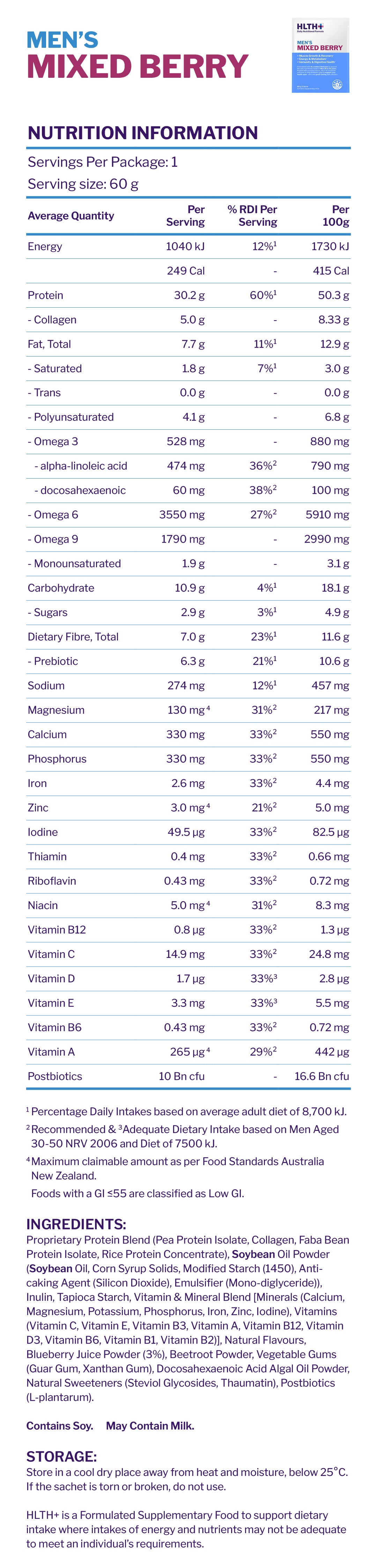
HLTH+ is a Formulated Supplementary Food. One 55g sachet carries 30g protein per serve, 7g dietary fibre, 5g collagen and 60mg DHA, at 223 calories in the Women's formula and 248 in the Men's, for RRP $6.00. Honesty about where it sits in the day: because of that 7g of dietary fibre, the pre-exercise guidance above puts it in the meal three to four hours out or in the hours after the session, not in the last hour before training, which is where the small carbohydrate snack belongs.
Is it a meal replacement? It is not designed as one, because it is built to complement a food-first approach; it works fine as a healthy snack or to tie you over between training and your next proper meal.
It is formulated to the Nutrient Reference Values, published in 2006 by the National Health and Medical Research Council, the Australian Government Department of Health and Ageing and the New Zealand Ministry of Health, across Women's, Women's 50+, Men's and Men's 50+. Those reference values move with age and sex, and so do the formulas. It is Australian made in facilities that comply with Good Manufacturing Practice, and it sells at hlthplus.com, on Amazon AU and through Chemist Warehouse online.
Find out what your current stack is missing. The ✦ Find My Formula quiz takes about 30 seconds and shows the gaps your existing bottles are leaving. Take the quiz.
Frequently Asked Questions
How long before a workout should I eat?
A carbohydrate-based meal three to four hours before, or a small carbohydrate snack one to two hours before, per the Better Health Channel. In the last hour, a small easily digested carbohydrate is tolerated in the research, with a proper warm-up offsetting any blood sugar dip. The closer to training, the smaller the serve.
Is it better to work out on an empty stomach?
The sports-nutrition position stands frame the final hours around keeping muscle and liver glycogen topped up without overloading the stomach, which is not a fasted session. If you cannot face food early, a carbohydrate-heavy dinner the night before and a small snack on waking is the workable middle ground.
How much protein should I eat before a workout?
About 0.25 g per kilogram of body weight, or 20 to 40 g, per the International Society of Sports Nutrition, which is roughly 18 g for a 70 kg adult. The position stand finds benefit from protein before or after training, and the daily total matters more than which side of the session it lands.
What should I not eat before a workout?
Meals high in fat, high in dietary fibre or very large in protein, because all three raise the risk of digestive discomfort during the session, according to the Better Health Channel. Keep those for the meals either side. Also avoid drinking large volumes in the last hour; aim for about 500 ml across the two to four hours before.


Leave a comment
This site is protected by hCaptcha and the hCaptcha Privacy Policy and Terms of Service apply.