

If you are lifting weights and want to build muscle, the working number is about 1.6 g of protein per kilogram of body weight a day. For a 75 kg adult that is roughly 120 g, split across three or four eating occasions. The Australian Recommended Dietary Intake of 0.84 g/kg for men and 0.75 g/kg for women answers a different question.
The reason this is hard to settle online is that almost every page states a figure and cites nothing. One says a gram per pound, the next says double your body weight, a third quotes the government figure as a training target.
So here is the number, the study behind it, how it shifts with age, how much to eat per meal, and what 120 g looks like on a plate.
How much protein do you need a day to build muscle?
The most-cited answer in the resistance-training literature is a 2018 systematic review and meta-analysis in the British Journal of Sports Medicine. Pooling 49 randomised controlled trials and 1,863 participants, it found that protein intakes above roughly 1.6 g/kg/day did not further contribute to resistance-training-induced gains in fat-free mass (Morton and colleagues, British Journal of Sports Medicine, 2018).
Two things about that figure matter. It is a plateau, not a cliff: more than 1.6 g/kg was not harmful, it simply bought nothing extra. And it is a total daily intake, counting the protein in your bread and your milk.
The same analysis found the benefit of added protein shrank with age and grew with training experience: the first sign one number cannot fit everyone.
Under Schedule 4 of the Australia New Zealand Food Standards Code, the approved statement for the nutrient is that protein contributes to the maintenance and growth of muscle mass and to tissue repair.
Why is the Australian RDI so much lower than that?
Because the RDI is not a muscle-building target. The Nutrient Reference Values for Australia and New Zealand describe the intake levels considered adequate to meet nutritional needs and avoid harm in healthy people. Adequate is the operative word: the figure is a floor set for a whole population, not a dose optimised for training.
Those values were published in 2006 by the National Health and Medical Research Council, the Australian Government Department of Health and Ageing and the New Zealand Ministry of Health. Here is what they set for adults.
| Group | Protein per kilogram of body weight | Protein in grams a day |
|---|---|---|
| Women 19 to 70 | 0.75 g/kg | 37 g to 46 g |
| Men 19 to 70 | 0.84 g/kg | 52 g to 64 g |
| Women over 70 | 1.0 g/kg | 46 g to 57 g |
| Men over 70 | 1.0 g/kg | 65 g to 81 g |
The per-kilogram figures are published by Dietitians Australia and the gram ranges by healthdirect, the national health information service. Both cite the Nutrient Reference Values.
Now compare. A 75 kg man on 0.84 g/kg needs 63 g a day to stay out of deficiency; the training number asks for 120 g. Quoting the RDI at someone who lifts weights is not a conservative answer, it is the wrong one.
What range does the training research actually support?
The International Society of Sports Nutrition position stand on protein and exercise puts the working range at 1.4 to 2.0 g of protein per kilogram of body weight a day for building and maintaining muscle mass in most exercising people (Jäger and colleagues, Journal of the International Society of Sports Nutrition, 2017). The 1.6 g/kg plateau sits inside that band, roughly in the middle.
One case pushes it higher: the same position stand notes that resistance-trained people eating in a calorie deficit may need 2.3 to 3.1 g/kg a day to hold lean mass. Eating less makes protein more important, not less.
The Australian read agrees: Victoria's Better Health Channel puts endurance and strength athletes at 1.2 to 2.0 g per kilogram a day.
So the honest answer is a range with a defensible centre:
- Not training, just avoiding deficiency: 0.75 to 0.84 g/kg, the Nutrient Reference Values.
- Training and building: 1.4 to 2.0 g/kg, with 1.6 g/kg the point past which the meta-analysis found no further gain.
- Training while eating less: the top of that band or above.
Does the number change as you get older?
It goes up, and the reason has a name. The ESPEN Expert Group describes anabolic resistance as a condition in which "older adults may develop resistance to the positive effects of dietary protein on synthesis of protein, a phenomenon that limits muscle maintenance and accretion" (Deutz and colleagues, Clinical Nutrition, 2014).
The practical effect is that the same steak does less work at 70 than it did at 30. That expert group recommends at least 1.0 to 1.2 g/kg a day for healthy older adults, rising to 1.2 to 1.5 g/kg for those who are ill or recovering, alongside daily activity and resistance training where possible.
Those figures are a maintenance floor for older adults in general. An older adult who is lifting weights is served by the training range above it, not by the floor.
Dose per meal is where age bites hardest. In younger adults, post-exercise muscle protein synthesis is maximised by about 20 g of protein, while in older adults the exercised muscle responds to larger doses of 20 g and 40 g. Same food, weaker signal, bigger serve required.
How much protein per meal, and does leucine matter?
Per meal, the position stand recommends 0.25 g of a high-quality protein per kilogram of body weight, or an absolute dose of 20 to 40 g, spread evenly every three to four hours. For a 75 kg adult that is about 19 g at the low end, so most whole-food meals clear the bar and most snacks do not.
Leucine is the reason a dose has a threshold at all. It is the amino acid that triggers muscle protein synthesis, and the same position stand asks for 700 to 3,000 mg of leucine in a serve alongside a balanced spread of the other essential amino acids. Note the width of that range: the leucine threshold is a band, not the single tidy number the internet quotes.
Distribution matters on its own. In a crossover feeding study, adults eating an even split of 31.5 g, 29.9 g and 32.7 g at breakfast, lunch and dinner had a 24-hour muscle protein synthesis rate 25% higher than the same people eating 10.7 g, 16.0 g and 63.4 g (Mamerow and colleagues, Journal of Nutrition, 2014). Same total protein, different result.
That is the most actionable finding here, because the skew is the Australian default: toast for breakfast, something light at lunch, protein at dinner.
More on what happens to lean mass when your total intake drops: nutrition support for muscle.
Is the anabolic window real?
Not the way it was sold. The meta-analysis that tested it pooled 23 studies and 525 subjects for hypertrophy, found a small effect for protein timing in the raw model, and watched it disappear once total daily protein intake was controlled for (Schoenfeld, Aragon and Krieger, Journal of the International Society of Sports Nutrition, 2013).
The authors' conclusion is the useful part: total protein intake was the strongest predictor of effect size. Studies that appeared to show a magic post-workout hour were mostly studies where the timing group ate more protein overall.
The position stand agrees from the other direction: the anabolic effect of a session lasts at least 24 hours. Eating protein near your session is convenient and harmless; treating a 30-minute window as decisive is not supported.
What does 120 g of protein look like in real food?
Here is a day that reaches about 120 g for a 75 kg adult, from ordinary food and serve sizes.
| Eating occasion | What is on the plate | Protein |
|---|---|---|
| Breakfast | Two hard-boiled eggs (100 g), a 200 g tub of natural yoghurt, 50 g rolled oats | 28.7 g |
| Lunch | A 95 g tin of tuna in brine, drained, on two slices of mixed grain bread (70 g) | 32.3 g |
| Afternoon | 250 ml reduced-fat milk and 30 g almonds | 14.2 g |
| Dinner | 150 g grilled chicken breast | 44.7 g |
| Day total | Four eating occasions | about 120 g |
The per 100 g figures behind that arithmetic, from Food Standards Australia New Zealand food composition data: grilled chicken breast 29.8 g, tuna canned in brine and drained 26.1 g, hard-boiled egg 12.4 g, natural yoghurt 5.1 g, rolled oats 12.2 g, mixed grain bread 10.7 g, almonds 19.7 g, reduced-fat milk 3.3 g.
Three things fall out of that table:
- Dinner alone carries more than a third of the day, which is the skew the distribution research warns about.
- The afternoon slot lands at 14.2 g, under the per-meal floor, and it is the easiest place to lose 15 g without noticing.
- Strained or Greek-style yoghurt carries more protein than the natural yoghurt costed above, so read the panel on the tub.
Choosing a powder instead? The label questions that matter are covered in how to read a protein powder label: protein per serve rather than per 100 g, the sugar riding along with it, and whether it is a complete protein carrying all nine essential amino acids.
What happens to the number when your appetite drops?
The target does not move when you eat less. Your ability to hit it does, and protein is usually the first casualty: protein-rich food is the most filling food on the plate, and the first thing a smaller appetite pushes away.
That applies to anyone eating substantially less than they used to, whether the driver is rapid weight loss, reduced eating and medically induced weight loss, a deliberate deficit or illness. In trial conditions, GLP-1 medicines reduced ad libitum food intake by roughly a quarter of daily calories (Blundell and colleagues, Diabetes, Obesity and Metabolism, 2017). Take a quarter out of a day already short of 120 g and the shortfall compounds.
This is general information, not medical advice, and decisions about any medication belong with your doctor. What changes is the food plan: when the volume of food falls, the density of what remains has to rise. Protein when you are eating less works through the targets, the wider nutrition picture covers the nutrients around them, and the vital role of protein and nutrition in GLP-1 therapy explains why lean mass is what to watch.
Low protein alongside a sharp drop in food is also a recognised trigger for the hair shedding that shows up two to three months later, and plate order is covered in what to eat when your appetite has dropped.
Where a daily formula fits, and where it does not
Start with the concession. A shake is not a better protein source than chicken, eggs or lentils, and if your meals already clear 120 g you do not need another product.
What a formula answers is the gap the table exposed: the afternoon slot at 14.2 g, the travel day, the skipped morning. Over 90% of Australian adults do not meet dietary guidelines (AIHW): we believe in food first, and the statistics say food first is not doing it alone. That is nutritional insurance, not a meal replacement.
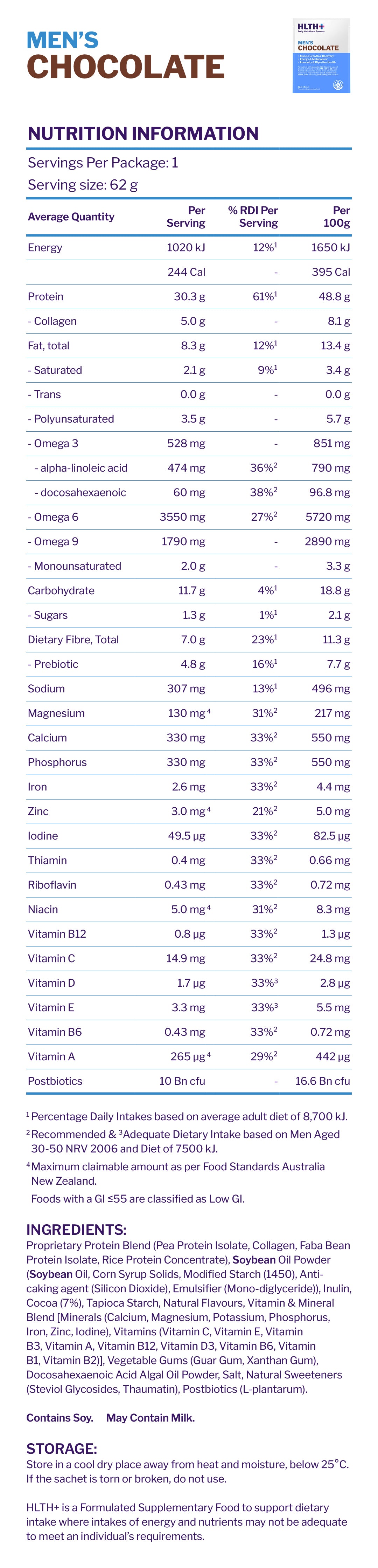
HLTH+ is a Formulated Supplementary Food: one 55g sachet carries 30g protein per serve and 7g dietary fibre, at RRP $6.00. In the day above, that turns a 14.2 g afternoon into a serve clearing the per-meal floor: convenience and a top-up, which is the whole of the claim.
Protein requirements are not one adult number: they move at 70 in the Nutrient Reference Values, and the rest of the nutrient set moves with age and sex too. HLTH+ is formulated to those Nutrient Reference Values, published in 2006 by the National Health and Medical Research Council, the Australian Government Department of Health and Ageing and the New Zealand Ministry of Health, across Women's, Women's 50+, Men's and Men's 50+.
Two neighbouring reads: what changes for women through perimenopause and why healthspan matters more than lifespan. If you are auditing the rest of the cabinet, the calcium numbers run on the same logic.
Find out what your current stack is missing. The ✦ Find My Formula quiz takes about 30 seconds and shows the gaps your existing bottles are leaving. Take the quiz.
Frequently Asked Questions
How much protein do I need a day to build muscle?
About 1.6 g per kilogram of body weight a day, which is 120 g for a 75 kg adult. A 2018 meta-analysis of 49 trials found intakes above that did not add further gains in fat-free mass. The wider supported range is 1.4 to 2.0 g/kg a day.
Is 100 g of protein a day enough to build muscle?
It depends on your body weight. At 1.6 g/kg, 100 g covers a 62 kg adult with room to spare and leaves a 90 kg adult about 44 g short. Work from your own weight rather than a round number, then split the total across three or four meals.
How much protein can your body absorb in one meal?
Absorption is not the limit; the dose that maximally stimulates muscle protein synthesis is. The International Society of Sports Nutrition position stand puts that at 0.25 g per kilogram of body weight, or 20 to 40 g, every three to four hours. Protein beyond that is still digested and used.
Do I need a protein powder to build muscle?
No. Whole food reaches the target if you plan for it, and total daily protein is what the research keeps identifying as the driver. A powder or a formula is a convenience for the meals where whole food is not practical, and it counts toward the same daily total.

Leave a comment
This site is protected by hCaptcha and the hCaptcha Privacy Policy and Terms of Service apply.