


What is telogen effluvium?
Telogen effluvium is a diffuse, non-scarring shed. An unusually large share of hair follicles leave their growing phase at roughly the same time, rest for a few months, and then let those hairs go together. The clinical literature describes it as a self-limited condition (StatPearls, NCBI Bookshelf).
None of that is how it feels at the sink. It feels sudden, it feels like it is still accelerating, and the obvious suspect is whatever you changed most recently: the diet, the deficit, the smaller plates. That instinct is understandable and, in terms of timing, almost always wrong.
This article explains the hair cycle, why the shed runs on a delay, which triggers are nutritional, and when the sensible move is a doctor rather than a supplement.
In a normal, healthy scalp, about 85% of hairs are in the growing phase and 15% are resting (StatPearls). Telogen effluvium is that balance tipping: more follicles resting than usual, so more hairs released than usual, all across the scalp rather than in one spot.
General information, not medical advice. Decisions about any medication belong with your doctor.
How the hair cycle works: anagen, catagen and telogen
Every hair on your head is running its own clock, and the clocks are normally out of sync with each other. That desynchronisation is the only reason you do not shed in waves. Telogen effluvium is what happens when a single event synchronises a large batch of them.
Anagen is the growing phase. A follicle typically produces anagen hair for almost four years before it rests (StatPearls). This is where the great majority of your hair sits at any moment, quietly extending.
Catagen is the short transition. It lasts a few weeks, during which the follicle undergoes regression and loses about one-sixth of its usual diameter (StatPearls, Physiology of Hair). The growing hair is detached from its blood supply and converted into a club hair.
Telogen is the resting phase. The follicle rests for about four months, holding onto that club hair, and then releases it as a new anagen hair pushes up underneath (StatPearls).
The last step is the one that matters for understanding the timing. A hair is not shed at the moment the follicle finishes growing it. It is shed months later, at the end of the resting phase, which is why the shed and its cause never happen in the same week.
Why does the shedding start two to three months after the trigger?
Because the resting phase has to finish first. A stressor pushes a batch of follicles out of growth early; those follicles then sit through their normal rest before letting go, and the hairs arrive in the drain as a group when that rest ends.
Taking a careful history usually turns up a causative event about three months before the shedding started, though the range runs from one to six months (StatPearls). So the useful question is not what changed last week. It is what changed in the month that sits three months back on the calendar.
That lag is also why the shed can feel so unfair. People often notice it once they are through the hardest part of an illness, a surgery, a birth or a steep change in how they were eating, at the point where everything else has settled down. The hair is reporting on a period you have already finished living through.
One practical consequence: a shed that starts now is not evidence that what you are doing now is wrong. It is evidence about a window that closed months ago, which is a very different thing to act on. Shedding is also rarely the only thing people notice when intake drops quickly, so learn more about the other changes that tend to follow a smaller appetite.
Which telogen effluvium triggers are nutritional?
The recognised list is broad, and most of it has nothing to do with food. StatPearls names acute febrile illness, severe infection, major surgery, severe trauma, postpartum hormonal changes, hypothyroidism, sudden discontinuation of oestrogen-containing medications, crash dieting, low protein intake, heavy metal ingestion and iron deficiency (StatPearls).
Three of those are nutritional, and they tend to arrive together: crash dieting, low protein intake and iron deficiency. They share a single mechanism, which is a sharp fall in how much food goes in, sustained for long enough that the diet no longer covers the basics.
That is worth stating plainly, because it reframes the whole question. The issue is not that losing weight damages hair. It is that a diet cut hard and fast is often also a diet cut short on protein and micronutrients, and those shortfalls sit on the recognised trigger list in their own right.
Appetite is the usual mechanism, and it does not care what caused the drop. A stomach bug, a stressful quarter, an aggressive deficit or a GLP-1 medicine all end in the same nutritional place if the plate gets smaller without getting denser. For the medication route specifically, controlled testing found free-choice food intake fell by roughly a quarter across the day, and about 35% at lunch (Blundell et al, 2017), and around 500,000 Australians regularly use GLP-1 medicines (UNSW, 2026).
Eat a quarter less without changing what is on the plate and protein, iron and the rest fall by roughly the same fraction. Learn more about where the five gaps open when appetite drops, why protein is the first one to slip and which micronutrients go with it.
Will the hair grow back?
In most cases, yes, and the shedding settles on its own. By definition, shedding in acute telogen effluvium lasts less than six months, and it is often much shorter; StatPearls describes the prognosis for recovery of hair density in acute cases as good (StatPearls).
Regrowth runs on its own timetable, separate from the shed. Hair growth may take up to six months to restart, so there is usually a stretch where the shedding has already eased and the density has not visibly recovered yet. That gap is normal and it is not a sign the process has stalled.
Two features make telogen effluvium less alarming than it looks in the moment. It is diffuse, meaning the thinning is spread across the whole scalp rather than concentrated in patches, and it is non-scarring, meaning the follicles themselves are intact and still cycling.
If you want a number to anchor on rather than a feeling, collecting 100 or more hairs in 24 hours suggests telogen effluvium (StatPearls). Counting for a day or two is more useful than assessing it in the shower, where every shed hair from the last few days arrives at once.
Hair is one of several places a sharp drop in intake eventually shows up, and the nutritional half of that picture is covered in what changes when appetite drops away.
Eating for a smaller appetite: density, not volume
The honest starting point is that most Australian plates were short before anything changed. Over 90% of Australian adults do not meet dietary guidelines (AIHW), and fewer than 1 in 20 eat the recommended serves of vegetables (ABS).
Cut a quarter out of a diet with no slack in it and the shortfall is not gradual. This is why the food-first answer to a small appetite is density rather than volume: you cannot eat more, so each serve has to carry more.
- Put the protein on the plate first. A small appetite fills fast, so whatever you eat first is what actually gets eaten.
- Keep iron-rich foods in rotation: red meat, legumes, tinned fish, eggs and dark leafy greens with something acidic alongside them.
- Choose the wholegrain version of what you already eat, which costs no extra appetite.
- Use snacks as a second chance at nutrition rather than filler: yoghurt, nuts, seeds, cheese.
- Drink your calories only when they are carrying something, not instead of a meal.
For meal-by-meal detail there is what to eat when your appetite has dropped, and how much protein is worth aiming for if you are training through a deficit.
More on what changes at the surface when you are eating less: how a reduced intake shows up in skin, hair and nails.
When should you see a doctor about hair shedding?
The diagnosis itself is usually straightforward. A detailed history and a thorough physical examination are typically sufficient to diagnose telogen effluvium, with testing for hypothyroidism, iron deficiency and other metabolic conditions where the clinical picture calls for it (StatPearls).
Take it to a doctor rather than a search bar if any of the following apply:
- The shedding has run past six months, which puts it outside the acute pattern.
- The loss is patchy, or there is a bald spot, rather than an even thinning across the scalp.
- The scalp itself is sore, scaling, itchy or visibly inflamed.
- The hairline is receding or the part is widening in a defined pattern, which points at a different diagnosis.
- Other symptoms are present, such as persistent fatigue, feeling the cold, or heavy periods.
StatPearls lists alopecia areata, anagen effluvium, androgenetic alopecia, scarring alopecia, syphilis and trichotillomania among the conditions telogen effluvium has to be distinguished from (StatPearls). Several of those are time-sensitive, which is the real argument for getting an actual look at your scalp rather than self-diagnosing from an article.
A blood test is also the only way to answer the iron and thyroid questions, and both are on the trigger list. Guessing at them with a supplement is slower and less informative than asking for the test. If you take prescribed medication, raise any supplement with your doctor or pharmacist first.
This article is general information, not medical advice. Decisions about any medication belong with your doctor.
Where a Formulated Supplementary Food fits when you are eating less
Separate question, separate logic, and it is a nutritional one rather than a clinical one. When intake falls sharply, protein and micronutrient intake falls with it, and the job is to make what you do eat carry more. That is the entire gap a Formulated Supplementary Food is built for.
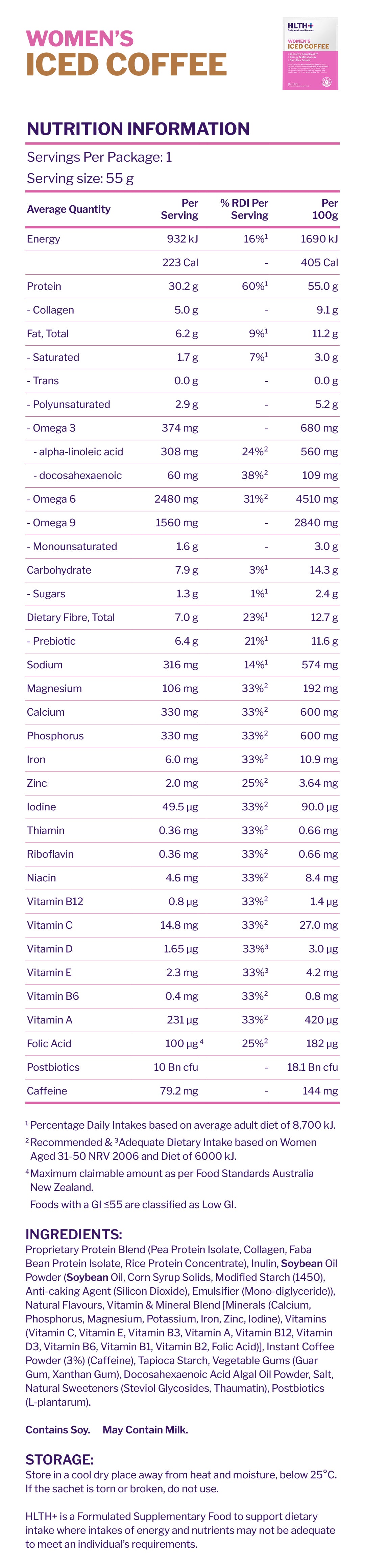
HLTH+ is built for exactly that gap, as nutritional insurance alongside a food-first approach. Per serve the label reads 30g protein, 7g dietary fibre, 60mg DHA and a balanced multivitamin profile, in a 55g sachet at RRP $6.00. In total, the label counts 30 essential daily nutrients. Protein contributes to the maintenance and growth of muscle mass.
The dosing is the part worth understanding. Nutrient needs shift with age and gender, so instead of one formula for everyone, HLTH+ is dietitian-formulated to the Nutrient Reference Values, the intake recommendations developed by the National Health and Medical Research Council, the Australian Government Department of Health and Ageing and the New Zealand Ministry of Health, in life-stage versions: Women's, Women's 50+, Men's and Men's 50+.
It is Australian made, in facilities complying with Good Manufacturing Practice, and on subscription the 28-serve pack works out at $5.10 a day. It is also stocked at Chemist Warehouse online and on Amazon AU if that is easier than ordering direct. For the wider picture, learn more about nutrition support when intake drops and how the protein powder aisle compares on nutrition.
Want to see the gaps in your current stack rather than guess at them? The ✦ Find My Formula quiz runs in 30 seconds and reads back what your existing routine is leaving out.
Frequently Asked Questions
How long does telogen effluvium last?
By definition, shedding in acute telogen effluvium lasts less than six months, and it is often much shorter (StatPearls). Regrowth runs separately from the shed: hair growth may take up to six months to restart. StatPearls describes the prognosis for recovery of hair density in acute cases as good.
Can losing weight quickly cause hair shedding?
Crash dieting and low protein intake sit on the recognised trigger list for telogen effluvium, alongside illness, surgery, postpartum hormonal changes and iron deficiency (StatPearls). The shed usually begins about three months after the trigger, which is why a change made in one month shows up on the pillow in another.
Which nutrients are linked to telogen effluvium?
StatPearls names low protein intake and iron deficiency among the recognised triggers, and lists hypothyroidism and other metabolic conditions as separate causes worth testing for. That makes food quality worth attention when appetite drops, and it makes a blood test worth asking your doctor about rather than guessing at it.
When should you see a doctor about hair shedding?
Book a visit if the shedding runs past six months, if the loss is patchy rather than an even thinning, if the scalp is sore or inflamed, or if other symptoms are present. StatPearls notes that history and examination are usually sufficient, with testing for hypothyroidism and iron deficiency where indicated.
This article is general information, not medical advice. Decisions about any medication belong with your doctor.


Leave a comment
This site is protected by hCaptcha and the hCaptcha Privacy Policy and Terms of Service apply.