

GLP-1 nutrition support, defined
GLP-1 nutrition support means feeding a smaller appetite properly. When a GLP-1 medicine reduces how much someone eats, every remaining mouthful has to carry more protein, more dietary fibre and more micronutrients than it used to. The foods, formulas and habits that help a shrunken diet do that job are nutrition support.
Just as important is what the term does not mean. GLP-1 nutrition support does not raise GLP-1, does not stand in for the medication, and does not cause weight loss. It is a food category with a food job, and this page draws the line clearly so you know exactly what you are buying.
In one sentence: nutrition support feeds the person, not the hormone.
What it isn't: three things the term does not mean
It is not a GLP-1 booster. Boosters are capsules and powders marketed on the idea that certain ingredients nudge the body's own GLP-1 production, and the evidence behind them rests on small studies of single ingredients. Nutrition support makes no hormonal claim at all. Learn more in GLP-1 Supplements in Australia: Boosters vs Nutrition Support, which reviews both categories side by side.
It is not an alternative to the medication. No food or supplement replicates a prescription GLP-1 medicine, and any label hinting otherwise deserves your suspicion. Questions about the medicines themselves belong with your doctor, not with a shopping cart.
It is not a weight-loss product. Nutrition support does not cause weight loss and should never claim to. Its job begins after appetite has already changed: keeping a person properly fed on less food.
This section is general information, not medical advice. Decisions about GLP-1 medicines belong with your doctor.
Why the category exists: the numbers behind a smaller appetite
The category is real because the appetite change is real, and measured.
- Around 500,000 Australians regularly use GLP-1 medicines, and the UNSW researchers behind that figure consider it a likely undercount.
- In controlled testing, GLP-1 medication cut free-choice food intake by roughly a quarter across the day, and about 35% at lunch (Blundell et al, 2017).
- A 2025 study found GLP-1 users averaging 14.5g of fibre a day against the 28g recommended intake used in the study; a second 2025 study found not a single user met the target.
That squeeze lands on diets that were rarely covering their bases to begin with: over 90% of Australian adults do not meet dietary guidelines (AIHW). Eat a quarter less of a diet that was already falling short and the shortfall compounds. That arithmetic, not marketing, is why nutrition support exists as a category.
General information, not medical advice. Decisions about any medication belong with your doctor.
The three forms nutrition support takes
Everyday food, chosen harder. The default form is simply eating better inside a smaller volume: protein anchoring each meal, vegetables and wholegrains carrying the fibre, and empty calories crowded out because there is no longer room for them. A food-first approach is the right starting point for anyone.
A formula that fills the gaps. The AIHW figure above says food alone was not getting most Australian adults there even before appetite shrank, which is where a Formulated Supplementary Food under the FSANZ Food Standards Code earns its place. Products in this class are regulated as foods and are designed to supplement the diet, never to replace eating.
Professional guidance. If eating has become genuinely difficult, or weight and strength are moving in ways that worry you, an Accredited Practising Dietitian is the right person to build the plan with. A page like this one is education; a dietitian across your history is care.
What nutrition support actually has to cover
Judge anything sold as nutrition support on four jobs, all readable off the label.
1. Protein, in real grams. Protein contributes to the maintenance and growth of muscle mass and to tissue repair, and it is the first nutrient squeezed when meals shrink. Check the protein line per serve, not per 100g, because a smaller appetite eats serves, not hundreds of grams.
2. Dietary fibre, in real grams. A GLP-1 medicine slows gastric emptying and gut motility, which commonly changes bowel regularity, and smaller meals carry less incidental fibre at exactly that moment. Dietary fibre contributes to regular laxation. A support formula should contribute grams of it, not a dusting.
3. Micronutrients dosed for the person. Australian labels calculate percentage daily intake against an "average adult diet of 8,700 kJ" (Standard 1.2.8, Food Standards Code), a labelling reference value that sits above what the Nutrient Reference Values recommend for most adults. The NRVs, developed by the National Health and Medical Research Council, the Australian Government Department of Health and Ageing and the New Zealand Ministry of Health, set intakes by age and gender instead. A formula dosed to the label reference rather than the person is answering the wrong question.
4. An honest label. Real nutrition support says plainly that it does not raise GLP-1, sits under food regulation (in Australia, the FSANZ Food Standards Code), and keeps sugar low rather than sweetening its way to palatability. Anything borrowing medication language to sell a powder has already told you how it operates.
For the fuller criteria set, learn more in GLP-1 Support Supplements: What Actually Supports You.
Where HLTH+ sits in the category
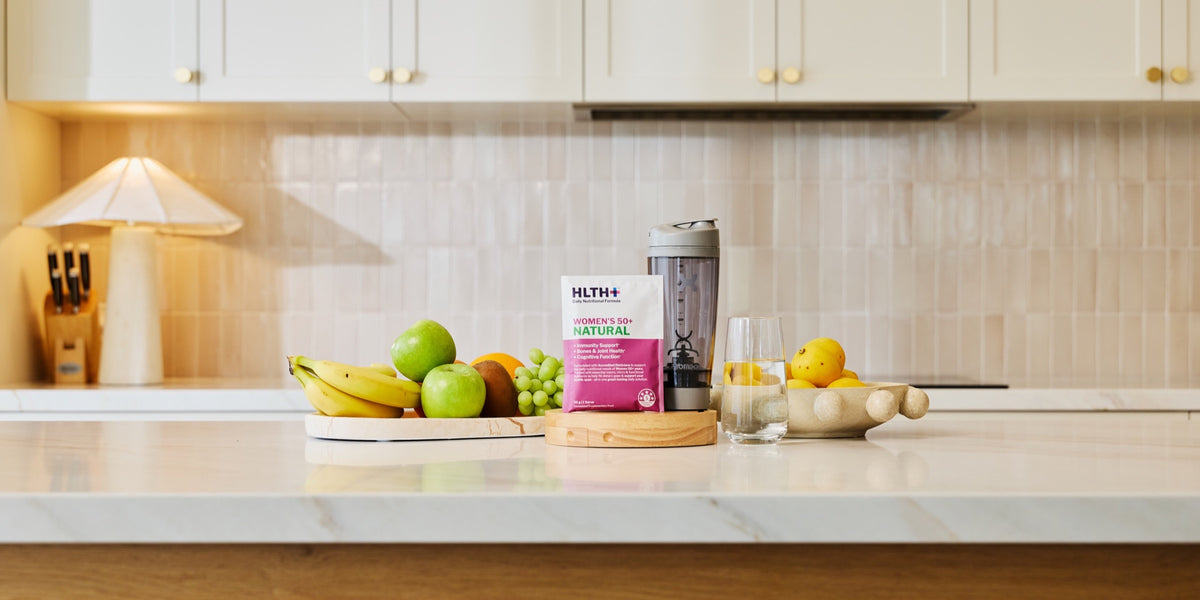
First, the line this page exists to draw: HLTH+ is not a GLP-1 booster. It does not raise GLP-1, does not change how any medication works, and makes no weight-loss claim. It is an Australian-owned and made Formulated Supplementary Food under the FSANZ Food Standards Code, built to supplement nutritional requirements when someone is eating less.
Judged on the four jobs above, as a daily nutritional formula, it is our pick in the category. Per serve the label reads: 30g protein, 7g dietary fibre, 5g collagen, 10 billion CFU Lactobacillus Plantarum Postbiotic plus prebiotics, 60mg DHA, and a balanced multivitamin profile. Each serve delivers 30 essential daily nutrients. Sugar sits at 1.5g (Women's) to 1.7g (Men's) with no added sugar, on a label that is dairy-free, gluten-free, low GI and carries a 5-star Health Star Rating.
The micronutrient dosing is the differentiator. Instead of one formula built to the 8,700 kJ label reference, HLTH+ is dietitian-formulated to the Nutrient Reference Values developed by the National Health and Medical Research Council, the Australian Government Department of Health and Ageing and the New Zealand Ministry of Health, in life-stage versions (Women's, Women's 50+, Men's and Men's 50+) across five flavours at RRP $6.00, with hundreds of reviews across the range. It is Australian made, in facilities complying with Good Manufacturing Practice, and sold at hlthplus.com and through Amazon AU and Chemist Warehouse online.
Not sure which formula fits? The ✦ Find My Formula quiz takes 30 seconds and shows what your current stack is missing. If you are eating less on a GLP-1 medicine specifically, learn more about nutrition support when intake drops.
How the labels compare
Published label facts, side by side. Figures come from each brand's published nutrition information, retrieved 21 August 2026 (AG1 figure retrieved 2 September 2026); brands reformulate, so check current labels before purchase.
| Product | Category | Protein per serve (published label) | Serve size |
|---|---|---|---|
| HLTH+ | Life-stage daily nutritional formula (food, FSANZ) | 30g | 55g (Women's) / 60-62g (Men's) |
| The Man Shake | High-protein shake | 30g | 56g |
| The Lady Shake | High-protein shake | 30g | 56g |
| AG1 (Athletic Greens) | Greens powder | 2g | 13g serve |
Vital All-In-One, another greens powder, publishes no total protein line at all; its ingredient list shows 1000mg of pea protein isolate per two-teaspoon (10g) serve. The pattern across the category is stark: greens powders are micronutrient products, and their own labels say protein is not what they are for.
The fair summary: The Man Shake and The Lady Shake match the 30g protein figure and are credible products in their own lane, and on the fibre line alone some flavours edge ahead (The Man Shake publishes 7.5g, The Lady Shake up to 8.5g by flavour). Where HLTH+ separates is the combination in one serve: 30g protein, 7g dietary fibre, 60mg DHA and 30 essential daily nutrients together, dosed by life stage rather than to a single average adult. The mistake this table exists to catch is buying a product to do a job its own label says it cannot do.
One dimension the gram count hides: the amino acid profile. A protein is complete when it supplies all nine essential amino acids the body cannot make itself; dairy proteins are complete by default, while many single-source plant proteins run short on one or two. Whatever label you are reading, check the profile alongside the number.
A note on Optifast and OptiSlim: these are pharmacy very-low-calorie-diet products used inside structured, clinician-supervised programs. They are a different category with a different job, and this page draws no comparison with them. If you are in one of those programs, follow your program's clinician.
Who nutrition support suits (and who it doesn't)
Well suited:
- Someone on a GLP-1 medicine whose meals have shrunk noticeably and who wants protein, dietary fibre and micronutrients handled in one daily serve rather than a shelf of separate products.
- Adults eating less for any other reason (age, a flat appetite, a busy season) who keep skipping or shrinking meals.
- Anyone consolidating a stack of greens powder, collagen and multivitamins into one dietitian-formulated food.
Not suited:
- Anyone shopping for something to raise GLP-1 or stand in for a medication. No food does that, HLTH+ included.
- Anyone inside a supervised very-low-calorie-diet program; stay with your program.
- Anyone expecting weight loss from a tub. Nutrition support feeds you well while you eat less; it does not make the eating less happen.
Next step: take the 30-second ✦ Find My Formula quiz to see what your current stack is missing, or learn more about nutrition support when intake drops first.
Frequently Asked Questions
What is GLP-1 nutrition support?
It is the food side of being on a GLP-1 medicine: keeping protein, dietary fibre and micronutrient intake adequate while total food intake drops by roughly a quarter. It covers nutrient-dense eating and food-regulated products built for smaller appetites. Nothing in the category raises GLP-1 or changes how a medication works.
Is nutrition support the same as a GLP-1 booster?
No. A booster claims to raise your body's own GLP-1, and the evidence behind those claims rests on small studies of single ingredients. Nutrition support makes no hormonal claim at all: it is food doing a food's job while someone eats less. The two share a search term, not a purpose.
What nutrients fall short when appetite drops?
Protein and dietary fibre fall first, because both scale with how much you eat: a 2025 study found GLP-1 users averaging 14.5g of fibre a day against the 28g recommended intake used in the study. Micronutrients and omega-3 fats slide with total food volume too. The fix is density: more nutrition per mouthful, from food first, then a formula built for the job.
Is GLP-1 nutrition support a weight-loss product?
No. Nutrition support does not cause weight loss and makes no claim to; the appetite change comes from a medication decision that belongs with a doctor. Its job begins after that change: keeping protein, dietary fibre and micronutrient intake adequate on less food. HLTH+ carries no weight-loss claim for exactly this reason.
Where can you buy GLP-1 nutrition support in Australia?
HLTH+ is sold at hlthplus.com and through Amazon AU and Chemist Warehouse online, in dietitian-formulated life-stage versions across five flavours at RRP $6.00. High-protein shakes such as The Man Shake and The Lady Shake sell through supermarkets and pharmacies. Whatever you choose, check the current label for protein, dietary fibre and sugar per serve.
This article is general information, not medical advice. Decisions about GLP-1 medicines belong with your doctor.
Leave a comment
This site is protected by hCaptcha and the hCaptcha Privacy Policy and Terms of Service apply.