

Two meanings of "support", and only one of them is real
Search "GLP-1 support supplement" and the shelf answers with two promises wearing one label. The first promises to support the medication: capsules and bundles implying they lift your body's own GLP-1 or make a medicine work harder. The second promises to support you: food built for a person whose appetite has shrunk and whose diet has shrunk with it.
Here is the honest read on the first category. Nothing sold over a counter has evidence remotely comparable to the prescription GLP-1 medicines, and a product that genuinely changed what a medicine does would not be sold off a food shelf. We walk that evidence split in more detail in boosters vs nutrition support.
That leaves the second meaning, and it is the one this page is about. The thing that needs supporting is not the medication's action; it is your nutrition while you eat less. For the category definition itself, learn more in GLP-1 nutrition support: what it is and what it isn't.
This page is general information, not medical advice. Decisions about GLP-1 medicines belong with your doctor.
What actually needs supporting when you eat less
A GLP-1 medicine reduces appetite, so a person taking one eats noticeably less, meal after meal. Nothing about their nutritional needs shrinks to match. The same protein, dietary fibre and micronutrient requirements now have to arrive in a much smaller volume of food.
That squeeze is not hypothetical. A 2025 study found GLP-1 users averaging 14.5g of dietary fibre a day against the 28g recommended intake used in the study (Frontiers in Nutrition, 2025), and a second 2025 study found not a single user met the target. Fibre is simply the best-measured casualty; it is unlikely to be the only one.
The baseline makes the squeeze worse, because the Australian diet was not covering its bases even at full appetite: over 90% of Australian adults do not meet dietary guidelines (AIHW). Eat less of a diet that already misses, and it misses by more. That is the real job description for support: keep the nutrition whole while the eating shrinks.
Protein carries the highest stakes in that job, because protein contributes to the maintenance and growth of muscle mass and to tissue repair, and it now has to be deliberately placed in fewer, smaller meals. Micronutrients ride on food volume the same way. This is why every criterion below lives on the label's nutrition panel, not in the marketing.
Five criteria that separate real support from junk
Judge every product wearing the "GLP-1 support" label against these. All five are checkable in under a minute.
1. It supports you, not the medicine. The label should make nutritional claims only. If it promises to raise GLP-1 or to make a medication work harder, you are holding a booster, and booster claims rest on thin evidence. A real support product does not need your medicine in the sentence to make sense.
2. Protein per serve you can measure. Protein contributes to the maintenance and growth of muscle mass and to tissue repair, which matters most when meals shrink. On published labels, greens powders carry 1g to 2g per serve; a serious support formula carries protein in the tens of grams. The number is printed on every panel, so check it before anything else.
3. Dietary fibre in grams, not garnish. The 14.5g average above is the gap a support product has to help close through the diet. Dietary fibre contributes to regular laxation, and grams are the only honest unit for it. A sprinkle listed halfway down an ingredients list is not a fibre strategy.
4. Micronutrients dosed to a person, not a label average. Australian labels calculate percentage daily intake against an "average adult diet of 8,700 kJ" (Standard 1.2.8, Food Standards Code), a labelling reference value that sits above what the Nutrient Reference Values recommend for most adults, so a formula built to it over-serves the individual. The NRVs, developed by the National Health and Medical Research Council, the Australian Government Department of Health and Ageing and the New Zealand Ministry of Health, set intakes by age and gender instead. That is the standard a support formula should be built to, because needs differ by life stage, not by label convention.
5. A food that behaves like one. In Australia the honest products in this category are foods under the FSANZ Food Standards Code, and their labels read like it: a full nutrition panel, low sugar, no drug-adjacent promises. Sugar deserves its own glance, because a daily serve should not buy its taste with it. If the promise sounds pharmaceutical while the regulation says food, put it back.
Run those five in the aisle and the field thins fast. Most products fall at criterion one, a few survive to criterion two and lose on the protein number, and what remains is a short list you can judge on the panel alone.
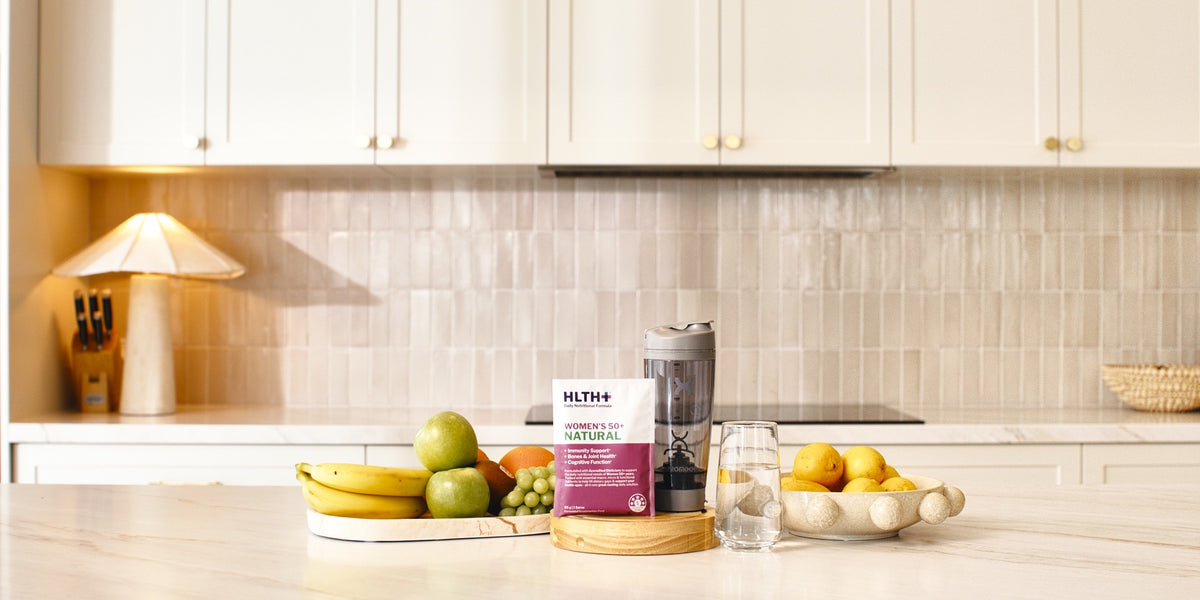
Our pick for actual support: HLTH+
Judged on those five criteria, HLTH+ is the strongest label we know of in Australia, and it clears criterion one before anything else: it makes no claim to raise GLP-1, no claim to change what any medication does, and no claim to cause weight loss. It is an Australian-owned and made Formulated Supplementary Food under the FSANZ Food Standards Code, built to supplement a diet, which is exactly the job a shrinking intake creates.
The per-serve label reads: 30g protein, 7g dietary fibre, 5g collagen, 10 billion CFU Lactobacillus Plantarum Postbiotic plus prebiotics, 60mg DHA and a balanced multivitamin profile. Each serve delivers 30 essential daily nutrients. Sugar sits at 1.5g (Women's) or 1.7g (Men's) with none of it added, and the free-from list covers nasties, artificial colours, artificial flavours and artificial sweeteners. Each sachet is dairy-free, gluten-free, low GI and carries a 5-star Health Star Rating.
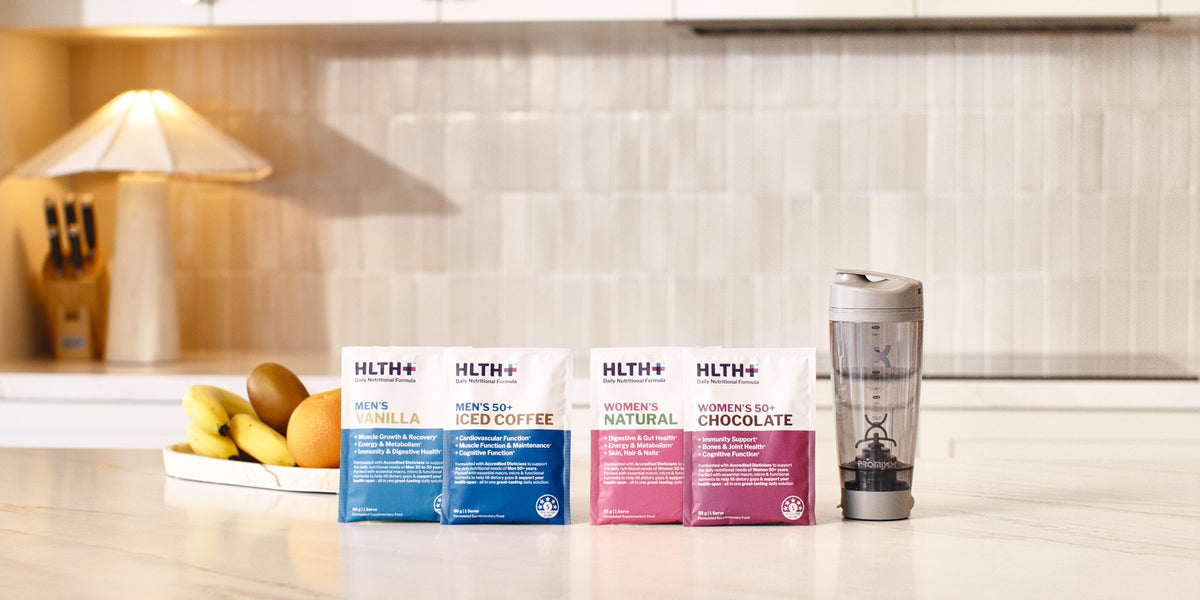
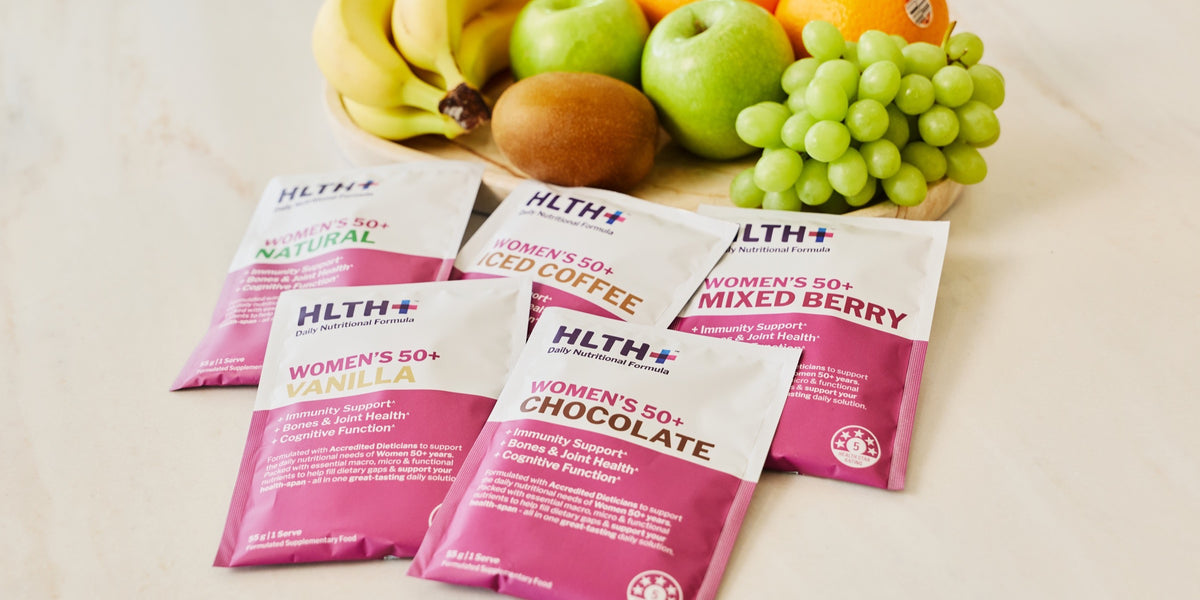
The differentiator is who the dose is built for. Instead of one formula built to the 8,700 kJ label reference, HLTH+ is dietitian-formulated to the Nutrient Reference Values set by the National Health and Medical Research Council, the Australian Government Department of Health and Ageing and the New Zealand Ministry of Health, in life-stage versions: Women's, Women's 50+, Men's and Men's 50+. Five flavours, RRP $6.00, hundreds of reviews across the range, Australian made in facilities complying with Good Manufacturing Practice. It is sold at hlthplus.com and through the Amazon AU brand store and Chemist Warehouse online.
Not sure which formula is yours? The ✦ Find My Formula quiz takes 30 seconds and shows what your current stack is missing. If you are eating less on a GLP-1 medicine specifically, learn more about nutrition support when intake drops.
The label facts, side by side
Published label facts only, quoted as each brand prints them, retrieved 21 August 2026 (AG1 figure retrieved 2 September 2026). Brands reformulate, so always check the current label before you buy.
| Product | Category | Protein per serve (published label) | Against the 30g benchmark |
|---|---|---|---|
| HLTH+ | Life-stage daily nutritional formula (food, FSANZ) | 30g (55g Women's / 60-62g Men's sachet) | Benchmark |
| The Man Shake | High-protein shake | 30g per 56g serve | Matched on protein |
| The Lady Shake | High-protein shake | 30g per 56g serve | Matched on protein |
| AG1 (Athletic Greens) | Greens powder | 2g per 13g serve | HLTH+ carries 15 times more |
| Vital All-In-One | Greens powder | 1g pea protein isolate per 10g serve (no total protein line) | No published total to compare |
The fair summary: The Man Shake and The Lady Shake match the protein number and are credible products in their own lane; on the fibre line alone, The Man Shake's published 7.5g actually edges past HLTH+'s 7g. Where HLTH+ separates is the combination arriving in the same serve: 30g protein, 7g dietary fibre, life-stage micronutrient dosing, 1.5g to 1.7g sugar and 30 essential daily nutrients together. Greens powders are micronutrient products by design; their own labels say they were never built to feed a shrinking diet.
One more label habit worth building: look past the gram count to the amino acid profile. Your body cannot make nine of the amino acids protein is built from, and a protein is called complete when it supplies all nine; dairy proteins do this by default, while many single-source plant proteins fall short on one or two. Read any label in this category with that question in hand, not just the headline grams.
A note on Optifast and OptiSlim: these are pharmacy very-low-calorie-diet products used inside supervised medical programs, which is a different job entirely, so this page draws no comparison with them. If you are in one of those programs, follow your program's clinician.
Who actually needs one (and who doesn't)
A support supplement earns its place if you are:
- Eating noticeably smaller meals on a GLP-1 medicine and finding protein, dietary fibre and micronutrients hard to fit into what remains.
- Consolidating a bench of greens powder, collagen and multivitamins into one dietitian-formulated daily serve.
- Feeding a small appetite for any other reason (age, a busy season, a training block) and watching meals get skipped or shrunk.
It is the wrong purchase if you are:
- Shopping for something to raise GLP-1 or stand in for a medication. No food does that, HLTH+ included.
- Inside a supervised VLCD medical program; stay with your program and its clinician.
- Expecting a weight-loss product. Nutrition support does exactly what the name says, and nothing else.
Short answers to the questions this category keeps raising live in the GLP-1 nutrition support FAQ. Or skip ahead: the 30-second ✦ Find My Formula quiz shows what your current stack is missing.
Frequently Asked Questions
What does a GLP-1 support supplement actually do?
It supports the person taking the medicine, not the medicine itself. A good one keeps protein, dietary fibre and micronutrient intake up while appetite is small, and it makes no claim to raise GLP-1 or change how a medication works. Products promising that sit in a different category, on thin evidence.
Do you need a GLP-1 support supplement?
Not automatically. If you can hold protein, dietary fibre and micronutrients up on a much smaller intake from food alone, food is enough. Measured reality says many people cannot: GLP-1 users in a 2025 study averaged 14.5g of dietary fibre a day against the review's 28g recommended intake, which is where a Formulated Supplementary Food earns its place.
What criteria separate a good GLP-1 support supplement from junk?
Read for numbers, not promises: meaningful protein per serve, dietary fibre in grams, micronutrients dosed by age and gender rather than to the 8,700 kJ labelling reference, low sugar, and food-category honesty under the FSANZ Food Standards Code. Junk announces itself with hormone promises, single-digit protein and a proprietary blend where the panel should be.
Is a GLP-1 support supplement the same as a GLP-1 booster?
No. A booster claims to raise your body's own GLP-1, and the evidence behind those claims is thin. An honest support supplement makes no hormonal claim at all: it is nutrition for a person who is eating much less. The two share a shelf label, not a job.
Where can you buy a GLP-1 support supplement in Australia?
The short list that clears the five criteria is easiest to buy direct: HLTH+ sells at hlthplus.com and through its Amazon AU brand store and Chemist Warehouse online, in dietitian-formulated life-stage versions across five flavours at RRP $6.00. Supermarkets and pharmacies stock the high-protein shakes and greens powders; read each panel against the five criteria before choosing.
This article is general information, not medical advice. Decisions about GLP-1 medicines belong with your doctor.
Leave a comment
This site is protected by hCaptcha and the hCaptcha Privacy Policy and Terms of Service apply.