

Vitamins ride on food volume
Micronutrients slip on a GLP-1 for an unglamorous reason: vitamins and minerals travel as passengers on food. In controlled testing, GLP-1 medication cut free-choice food intake by roughly a quarter across the day, and about 35% at lunch (Blundell et al, 2017). Eat a quarter less and, unless every plate gets denser, your vitamin and mineral intake falls by roughly the same fraction.
Nobody notices while it happens. Appetite fades quietly, plates shrink, and the foods that fall away first are often the bulky, vitamin-carrying ones: salads, vegetables, fruit.
This article walks that shortfall logic, names the micronutrients most likely to slip, and covers the food-first fixes before any product enters the picture.
The baseline had no slack in it
The uncomfortable part is that most Australian diets were short before any medicine was involved. Over 90% of Australian adults do not meet dietary guidelines (AIHW). Fewer than 1 in 20 eat the recommended serves of vegetables (ABS).
A quarter cut from an already-short intake is how a mild shortfall becomes a real one. The arithmetic looks small on any single day; it compounds across months of eating less.
None of this is an argument for or against the medicines. It is a description of what happens to nutrition when total food volume drops faster than nutrient needs do.
General information, not medical advice. Decisions about GLP-1 medicines belong with your doctor.
The shortfall logic, walked through
Think of daily vitamin intake as the product of two numbers: how much you eat, and how nutrient-dense that food is. A GLP-1 medicine moves the first number for you; the second number is the only one still in your hands.
If density stays the same while volume drops by a quarter, intake of every vitamin and mineral drops by a quarter too. Nothing about that is dramatic in week one. The point is direction: the numbers keep moving one way unless the plate changes.
That is also why generic advice to eat a balanced diet undershoots here. A balanced diet at three-quarters volume is a balanced shortfall; what a smaller appetite needs is a denser diet, not a scaled-down copy of the old one.
The micronutrients most likely to slip
Three examples show the pattern. Each is tied to the foods that tend to shrink first when appetite drops.
Vitamin C. Vitamin C contributes to normal immune function, and it lives in exactly the foods a small appetite crowds out first: capsicum, citrus, berries and broccoli. When the salad and the fruit bowl go, the vitamin C goes with them.
Magnesium. Magnesium contributes to the reduction of tiredness and fatigue and to normal nerve and muscle function. Its everyday sources are wholegrains, nuts, seeds and legumes, the sides and snacks that quietly disappear when eating shrinks to the essentials.
Vitamin D. Vitamin D contributes to normal bone structure. Its food sources were narrow to begin with, mainly oily fish and eggs, so a smaller diet thins an already-thin supply line.
These three are examples, not an exhaustive list. The pattern is the point: whichever foods drop off your plate first take their micronutrients with them, and that differs from person to person.
Food first: keeping vitamins up when you eat less
The food-first fixes are about density, not volume. You cannot eat more, so every serve has to carry more.
- Make vegetables the default side, even at half the old portion. A small serve of colourful vegetables at most meals beats a big serve once a week.
- Keep fruit where you can see it. Berries, kiwifruit and citrus deliver vitamin C in small, easy volumes.
- Choose the wholegrain version of whatever you already eat. Magnesium travels with the grain, and the swap costs no extra appetite.
- Put eggs and oily fish on rotation. They carry vitamin D in serves a small appetite can actually finish.
- Snack on nuts, seeds and yoghurt rather than fillers that spend appetite and deliver little.
Frozen vegetables count, tinned fish counts, and so does folding vegetables into dishes you already make rather than plating them separately. Density is a habit, not a menu overhaul.
One practical habit ties it together: decide the vegetables before the rest of the plate. A smaller appetite fills up fast, so whatever you eat first is what actually makes it in, and that order is entirely yours to set.
For the four other gaps that open alongside micronutrients, learn more in GLP-1 Nutrition: The Five Gaps When Appetite Drops. For meal-by-meal detail, there is What to Eat on a GLP-1, and the wider picture lives at nutrition support when intake drops.
One serve instead of a shelf: where HLTH+ fits
Covering micronutrients from the supplement aisle usually ends in fragments: a greens powder here, a separate protein, a separate multivitamin. The formats do not overlap much. Greens powders typically carry 1g to 2g of protein per serve on their published labels, and a standard multivitamin tablet covers vitamins and minerals then stops, with next to zero protein or dietary fibre.
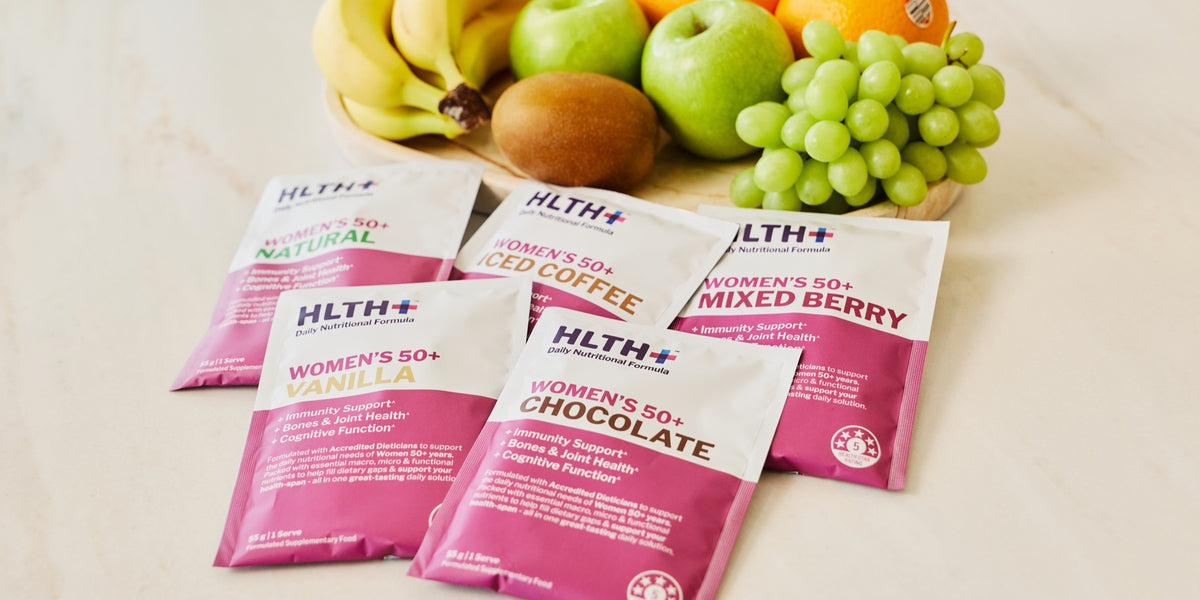
HLTH+ consolidates instead. Per serve the label reads 30g protein, 7g dietary fibre, 5g collagen, 10 billion CFU Lactobacillus Plantarum Postbiotic, 60mg DHA and a balanced multivitamin profile. In total, the label counts 30 essential daily nutrients. To be clear about what it is not: HLTH+ makes no claim to raise GLP-1 and none to cause weight loss; it is a Formulated Supplementary Food under the FSANZ Food Standards Code, built to supplement a diet when someone is eating less.
The dosing is the differentiated part. Micronutrient needs shift with age and gender, so instead of one formula for everyone, HLTH+ is dietitian-formulated to the Nutrient Reference Values, the intake recommendations set by the National Health and Medical Research Council, the Australian Government Department of Health and Ageing and the New Zealand Ministry of Health, in life-stage versions: Women's, Women's 50+, Men's and Men's 50+, at RRP $6.00. Learn more about why dietitian formulation matters on a GLP-1.
Not sure where your current stack falls short? The ✦ Find My Formula quiz takes 30 seconds and shows what you are not getting from what you already take.
Frequently Asked Questions
Do GLP-1 users need a multivitamin?
There is no blanket answer. Vitamins arrive with food, so a diet cut by roughly a quarter delivers less of them by default, and most Australian diets were falling short before any medicine was involved. Food comes first. A multivitamin or a Formulated Supplementary Food then works as nutritional insurance alongside it, not instead of it.
Which micronutrients slip first when you eat less?
The ones carried by the foods that shrink first. Vegetables and fruit carry vitamin C, wholegrains, nuts and legumes carry magnesium, and oily fish and eggs carry vitamin D. What slips first in practice depends on which foods drop off your plate first, so the pattern differs from person to person.
Can food alone cover your vitamins on a small appetite?
In principle, yes, with nutrient-dense choices at every meal and snacks that work hard. In practice, over 90% of Australian adults did not meet dietary guidelines even at full appetite (AIHW). We back a food-first approach; the statistics say it is not working on its own, which is where nutritional insurance earns its place.
This article is general information, not medical advice. Decisions about GLP-1 medicines belong with your doctor.
Leave a comment
This site is protected by hCaptcha and the hCaptcha Privacy Policy and Terms of Service apply.