
The short answer
Yes, you can raise GLP-1 naturally, in the sense that your body already does it every time you eat. GLP-1 is a gut hormone released when food arrives, and protein-rich meals, dietary fibre (especially the fermentable kinds) and regular exercise are the levers most often studied. Every one of them is worth doing for its own sake.
Here is the honest part: the rise is modest and temporary. Naturally released GLP-1 climbs after a meal and settles again soon afterwards, and no food or habit performs anything like the prescription medicines. This article walks each lever, sizes the effect honestly, and finishes with the question hiding underneath this one.
What GLP-1 does, in one paragraph
GLP-1 (glucagon-like peptide-1) is one of the signals your gut sends after eating. It tells the brain that food has arrived, slows the rate the stomach empties, and supports the body's response to rising blood sugar. Because it is a meal-response hormone, its natural rhythm is short: release, signal, clear, then repeat at the next meal.
That rhythm matters for everything below. Anything "natural" works within that cycle rather than changing it. For the wider picture of what moves this hormone and what does not, learn more in Natural GLP-1: What Raises It and What Doesn't.
The levers, sized honestly
Eating at all
The single most reliable trigger for GLP-1 release is a meal. Skipping food does not raise it; food does. That is why every credible version of this advice is really nutrition advice wearing a hormone costume.
Protein at each meal
Across small feeding studies, protein is the macronutrient most consistently linked with satiety signalling, GLP-1 included. The effect appears while a meal is digesting and fades afterwards. Anchoring each meal with a protein source is sound eating regardless, and protein contributes to the maintenance of muscle mass and to tissue repair.
Dietary fibre, especially fermentable fibre
When gut bacteria ferment certain fibres, they produce by-products that the gut's hormone-releasing cells respond to. That mechanism is real biology, and it is the usual basis for the fibre and GLP-1 link, but the measured effects in people are small and inconsistent. Fibre earns its place on firmer ground: dietary fibre contributes to regular laxation, which is reason enough to eat more of it.
Exercise
Some studies find appetite hormones, GLP-1 among them, shift briefly after a session; others find little change. The honest summary is that exercise cannot be prescribed as a GLP-1 strategy, and it does not need to be. Its case stands on everything else it does for you.
Meal pace and food order
Some small studies look at how quickly people eat and the order food is eaten in, and the effects, where found, are small. Nothing here needs to be complicated. Slower meals built on whole foods give the gut more to respond to than fast, heavily processed ones.
The supplement aisle
Plenty of products borrow this question and sell an answer. We have audited that category separately; learn more in Supplements That Increase GLP-1: The Evidence. The short version is that nothing sold on a shelf has evidence comparable to the prescription medicines, and anything implying otherwise deserves your suspicion.
The honest ceiling
Naturally released GLP-1 does its work in the window around a meal, then clears. The prescription GLP-1 medicines are built on modified forms of the hormone designed to stay active in the body far longer, which is why the two are not comparable. In controlled testing, a GLP-1 medicine cut free-choice food intake by roughly a quarter across the day, and about 35% at lunch (Blundell et al, 2017).
No meal pattern, food or exercise habit has shown anything in that range. That is not an argument for the medicines, and it is not an argument against your kitchen. It is simply the honest scale: natural levers are good nutrition with a small hormonal bonus, nothing more.
None of this is a reason to start, stop or swap a medication. Around 500,000 Australians regularly use GLP-1 medicines (UNSW, 2026), and every one of those decisions belongs in a doctor's consult, not a blog post.
General information, not medical advice. Decisions about GLP-1 medicines belong with your doctor.
The question under the question
Most people asking how to increase GLP-1 naturally want one of two things: to feel fuller without medication, or to know their body is covered while they eat much less. In both cases the hormone is the wrong variable to chase, because you cannot meaningfully move it and you do not need to.
What you can move is what a smaller appetite actually delivers. A 2025 study found GLP-1 users averaging 14.5g of fibre a day against the 28g recommendation (Frontiers in Nutrition), and a second 2025 study found not a single user met the target. When meals shrink, protein, fibre and micronutrients shrink with them, and that gap responds to food choices immediately.
That is the problem worth solving, whatever brought your appetite down. For the practical version, learn more in What to Eat on a GLP-1, or start with nutrition support when intake drops.
Where HLTH+ fits, and what it does not do
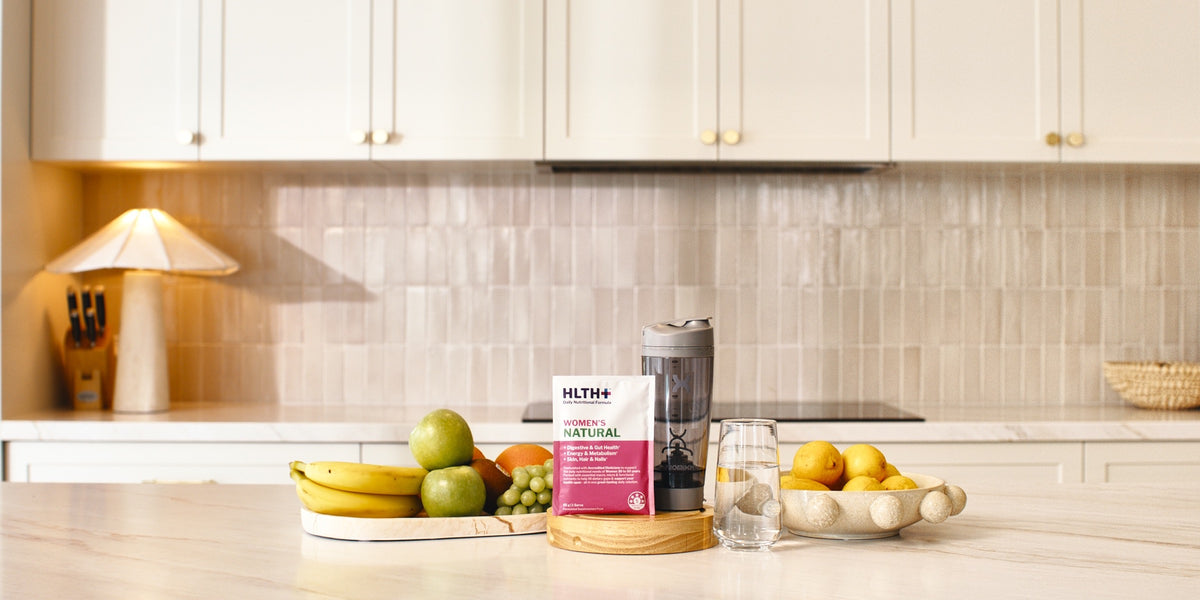
Clarity first: HLTH+ does not raise GLP-1 and makes no claim to. It is not a booster. It is an Australian-owned and made Formulated Supplementary Food under the FSANZ Food Standards Code, built to supplement nutritional requirements when meals alone are not covering them.
Per serve, the label reads 30g protein, 7g dietary fibre, 5g collagen, 10 billion CFU Lactobacillus Plantarum Postbiotic plus prebiotics, 60mg DHA and a balanced multivitamin profile. Each serve supplies 30 essential daily nutrients. Instead of one formula for everyone, it is dietitian-formulated to the Nutrient Reference Values developed by the National Health and Medical Research Council, the Australian Government Department of Health and Ageing and the New Zealand Ministry of Health, in life-stage versions: Women's, Women's 50+, Men's and Men's 50+.
If your appetite has shrunk and you want the nutrition side handled, the ✦ Find My Formula quiz takes 30 seconds and shows what your current stack is missing. It diagnoses the gap before it suggests anything.
Frequently Asked Questions
How do you increase GLP-1 naturally?
Mostly by eating. GLP-1 is released when food reaches the gut, and protein-rich meals, dietary fibre and regular exercise are the most studied levers. The rise is modest and settles within hours of a meal. Treat these as good eating habits with a hormonal footnote rather than a way to change your hormone levels.
Does exercise or protein help?
Both are worth doing. Protein shows the most consistent link with satiety signalling in small studies, and protein contributes to the maintenance of muscle mass. Exercise shifts appetite hormones briefly in some studies and barely in others. Neither produces a lasting change in GLP-1, so do both for their proven benefits first.
Is any of it comparable to medication?
No. Prescription GLP-1 medicines are designed to stay active far longer than naturally released GLP-1, and in controlled testing they cut daily food intake by roughly a quarter. No food, habit or supplement has evidence in that range, and decisions about the medicines belong with your doctor.
This article is general information, not medical advice. Decisions about GLP-1 medicines belong with your doctor.
Leave a comment
This site is protected by hCaptcha and the hCaptcha Privacy Policy and Terms of Service apply.