
Your body already makes GLP-1
GLP-1 (glucagon-like peptide-1) is a hormone your own gut produces. Specialised cells in the lining of the intestine, called L-cells, release it when food arrives. From there it signals fullness to the brain, slows the movement of food through the gut, and helps steady blood sugar after meals (Tolhurst, Reimann and Gribble, The Journal of Physiology, 2009).
So "natural GLP-1" is not something you need to unlock. Every meal you have ever eaten has triggered it. The useful questions are which foods and habits trigger more of it, how large that effect really is, and whether it adds up to what people searching this phrase are usually hoping for.
This page answers all three, honestly. If the hormone itself is new to you, start with the plain-English explainer, What Is GLP-1?
What raises GLP-1 naturally
The levers below are real. The research behind most of them is also modest: largely small, short-term feeding studies that measure hormone levels for a few hours, not long-term outcomes. Hold both facts at once.
1. Eating a meal, full stop. All three macronutrients stimulate GLP-1 release when they reach the gut (Tolhurst, Reimann and Gribble, 2009). Release rises after you eat and falls again soon after. It is a meal response, not a switch you can leave on.
2. Protein-forward meals. Protein is among the most consistent meal-based triggers of GLP-1 release in short-term studies. Eggs, fish, chicken, legumes, tofu and dairy all qualify. It is also the lever with the best reason to pull regardless: protein contributes to the maintenance of muscle mass, which matters most when you are eating less.
3. Dietary fibre. Fermentable fibre from oats, legumes, vegetables and whole grains feeds gut bacteria, and the compounds they produce interact with the same cells that release GLP-1. Human findings are mixed, so treat the hormonal angle as a maybe. The certain part is that dietary fibre contributes to regular laxation.
4. Whole-food fats. Fats stimulate GLP-1 secretion as part of the normal meal response. Nuts, olive oil and avocado are a reason to build meals from whole foods rather than a lever you can push hard on its own.
5. Movement, sleep and meal rhythm. Some small studies report short-term shifts in appetite hormones after exercise, and poor sleep is linked to appetite disruption more broadly. The direct GLP-1 evidence here is thin. Do these things for the benefits that are established; count any hormonal nudge as a bonus.
Want this list as a practical routine? Learn more in How to Increase GLP-1 Naturally: An Honest Read.
The ceiling: why food can only do so much
Here is the fact most pages on this topic leave out. Natural GLP-1 is destroyed almost as fast as it is made: an enzyme called DPP-4 degrades it within roughly one to two minutes of release (Holst, Physiological Reviews, 2007). Your body runs GLP-1 as a short pulse with each meal, then clears it.
The prescription GLP-1 medicines are modified versions of the hormone, engineered to resist that breakdown and remain active far longer. That single difference is why the two are not comparable. In controlled testing, GLP-1 medication cut free-choice food intake by roughly a quarter across the day, and about 35% at lunch (Blundell et al, 2017). No food, meal pattern or supplement has been shown to do anything like that.
None of this is a case for or against the medicines. It is a case for honest expectations: natural levers support normal appetite regulation, and that is the whole claim the evidence supports.
This section is general information, not medical advice. Decisions about GLP-1 medicines belong with your doctor.
What doesn't raise GLP-1 (or not meaningfully)
"GLP-1 booster" supplements. Capsules and gummies borrowing the medication class name, usually built on single ingredients studied in small, short trials that measured hormone markers rather than outcomes. The leap from "this ingredient moved a marker in a small study" to "this bottle works like the medicine" is a leap the evidence does not make. The full ingredient-by-ingredient audit is in Supplements That Increase GLP-1: The Evidence, and the wider category split is covered in GLP-1 Supplements in Australia: Boosters vs Nutrition Support.
Any single "GLP-1 food". Lists of miracle foods imply that adding one item changes your hormone profile. The release mechanism responds to whole meals, briefly, and no individual food has demonstrated a drug-like effect.
Teas, detoxes and "hacks". No credible evidence. If a product implies it replicates a prescription medicine from a food label, that implication is the product.
A quick test for any "natural GLP-1" claim you meet in the wild: ask what was measured, in whom, and for how long. A hormone marker in a handful of people over a few hours is not an outcome. Ask whether the effect survives the two-minute breakdown window described above. And ask what the seller gains if you conflate a normal meal response with a medicine. Most claims in this space fail at least two of the three.
The honest comparison
| Lever | What the evidence shows | The honest read |
|---|---|---|
| Eating a meal at all | All three macronutrients stimulate GLP-1 release from gut L-cells (Tolhurst, Reimann and Gribble, 2009) | Automatic, modest and brief; it rises and falls with each meal |
| Protein-forward meals | Among the most consistent meal-based triggers in short-term feeding studies | Worth doing anyway: protein contributes to the maintenance of muscle mass |
| Dietary fibre | Fermentation products interact with the cells that release GLP-1; human findings are mixed | Eat it for the proven reason: fibre contributes to regular laxation |
| Whole-food fats | Part of the normal meal response | A reason to eat whole foods, not a standalone lever |
| Exercise, sleep, meal rhythm | Small studies, short-term shifts, inconsistent findings | Do them for their established benefits; any GLP-1 effect is a bonus |
| "GLP-1 booster" supplements | Small single-ingredient studies of hormone markers, not outcomes | The medication-like promise is not supported |
| GLP-1 medication | Modified to resist breakdown; tested in large clinical trials such as STEP 1 | A different order of magnitude, and a prescription decision for your doctor |
Three readers, three honest answers
You are on a GLP-1 medicine and eating far less. Raising GLP-1 is not your problem; feeding a smaller appetite well is. Your intake has dropped sharply while your nutrient needs have not, and the shortfalls are measurable: GLP-1 users in a 2025 study averaged 14.5g of fibre a day against the 28g recommendation (Frontiers in Nutrition, 2025). The work is making every small serve dense in protein, fibre and micronutrients. Learn more in GLP-1 Nutrition: The Five Gaps When Appetite Drops.
You want a natural alternative to the medication. The honest answer is that food and habits will not replicate it, and any decision about medication belongs with your doctor, not with a supplement label. The levers above are still worth building, because they are simply good eating, and the baseline is low: over 90% of Australian adults do not meet dietary guidelines (AIHW).
You are coming off a GLP-1, or thinking ahead. In the STEP 1 extension study, people who stopped the medication regained on average two-thirds of the weight they had lost within a year (Wilding et al, 2022). The eating pattern built while intake was small, protein anchored and fibre rich, is the thing that lasts beyond any prescription.
General information, not medical advice. Decisions about starting, staying on or stopping any medication belong with your doctor.
Where HLTH+ fits, and where it deliberately doesn't
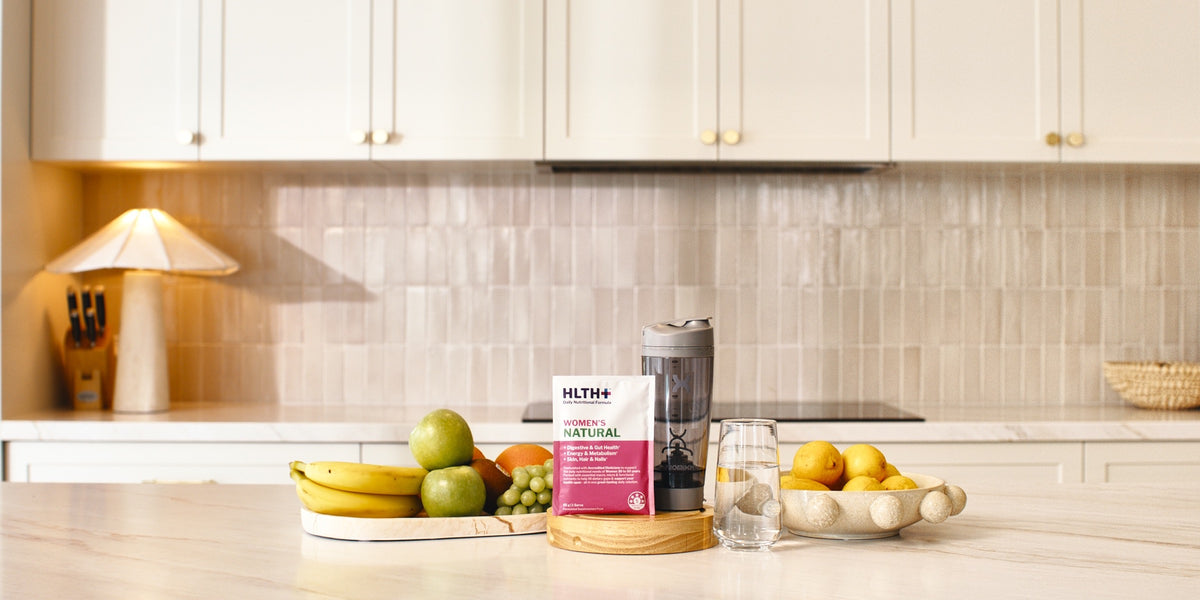
Let us be plain, because this category invites confusion: HLTH+ is not a GLP-1 booster. It does not raise GLP-1, does not cause weight loss, and makes no claim to. It is an Australian-owned and made Formulated Supplementary Food under the FSANZ Food Standards Code, built to supplement nutritional requirements when a diet has shrunk, which is the problem this page keeps pointing back to.
Per serve, the label reads: 30g protein, 7g dietary fibre, 5g collagen, 10 billion CFU Lactobacillus Plantarum Postbiotic plus prebiotics, 60mg DHA, and a balanced multivitamin profile. The formula spans 30 essential daily nutrients across protein, dietary fibre, vitamins, minerals, collagen and DHA. Sugar sits at 1.5g (Women's formulas) to 1.7g (Men's), with no added sugar and no nasties, artificial colours, artificial flavours or artificial sweeteners. It is dairy-free, gluten-free, low GI, and carries a 5-star Health Star Rating.
Rather than one generic blend, HLTH+ is dietitian-formulated to the Nutrient Reference Values set by the National Health and Medical Research Council, the Australian Government Department of Health and Ageing and the New Zealand Ministry of Health, in life-stage versions (Women's, Women's 50+, Men's, Men's 50+) across five flavours at RRP $6.00. Australian made, in facilities complying with Good Manufacturing Practice. Sold at hlthplus.com, and through Amazon AU and Chemist Warehouse online.
Not sure what your current stack is missing? The ✦ Find My Formula quiz takes 30 seconds and shows what you are not getting from your current routine. If you are eating less on a GLP-1 medicine specifically, learn more about nutrition support when intake drops.
Frequently Asked Questions
Can food raise GLP-1 naturally?
Yes, within limits. GLP-1 is released by gut L-cells whenever you eat, and protein-forward meals and fermentable dietary fibre are the most consistent triggers in short-term studies. The release is modest and brief, part of normal appetite regulation rather than a drug-like effect, so treat it as good eating, not a treatment.
How big is the effect?
Small and short-lived. Natural GLP-1 is degraded by the enzyme DPP-4 within roughly one to two minutes of release, so it works as a brief pulse with each meal. No food or habit has been shown to reduce food intake the way the medication did in controlled testing, where daily intake fell by roughly a quarter.
Is natural GLP-1 comparable to medication?
No. The prescription medicines are modified versions of the hormone, engineered to resist breakdown and remain active far longer, and they were tested in large clinical trials such as STEP 1. Food supports normal appetite regulation; it does not replicate a medicine. Decisions about GLP-1 medication belong with your doctor.
Do GLP-1 booster supplements work?
The evidence is thin. Boosters typically rest on small, short studies of single ingredients measuring hormone markers rather than real outcomes, and nothing sold as a supplement has evidence remotely comparable to the prescription medicines. If your actual problem is covering nutrition while eating less, that is a food problem with a food answer.
What should you focus on instead of raising GLP-1?
Nutrition density. If you are eating less, for any reason, the risk is protein, fibre and micronutrients falling short before anything else. Anchor each meal with protein, keep dietary fibre up, and cover the vitamins and minerals a smaller diet squeezes out. That is fully in your control, which raising a hormone is not.
This article is general information, not medical advice. Decisions about GLP-1 medicines belong with your doctor.
Leave a comment
This site is protected by hCaptcha and the hCaptcha Privacy Policy and Terms of Service apply.