

GLP-1 is a hormone, not a drug
Start with the part most explainers skip: GLP-1 stands for glucagon-like peptide-1, and your body has been making it your whole life. It is a hormone released by cells in your gut in the minutes after you eat. Its job is to help your body respond to a meal.
The reason the term is suddenly everywhere is a class of prescription medicines that mimic this hormone. The medicines borrowed the hormone's name, and now the hormone and the medicines get conflated constantly. This page explains the hormone first, then the medicines, then the one practical consequence that matters for anyone eating less.
What does the GLP-1 hormone actually do?
Three actions cover most of it:
- It signals fullness. GLP-1 acts on appetite centres in the brain, telling you that you have eaten enough. It is one of several signals your body uses to end a meal and to keep you satisfied between meals.
- It slows your stomach. GLP-1 slows gastric emptying, the rate at which food leaves your stomach. Food sits longer, so a meal keeps you feeling full for longer.
- It helps regulate blood sugar. When glucose rises after eating, GLP-1 prompts the pancreas to release insulin. This is why the hormone was first studied in diabetes research long before it made headlines.
GLP-1 belongs to a family of gut hormones researchers call incretins, the chemical messengers that carry news of a meal from your gut to the rest of your body. You never notice them working, but they are part of why a solid lunch holds you until dinner.
The natural hormone is also short-lived. Your body releases it around meals, it does its work, and it is broken down quickly. That detail turns out to be the key to the whole story.
Why is everyone suddenly talking about GLP-1?
Because of the medicines. GLP-1 medicines, sometimes called GLP-1 receptor agonists, are prescription molecules designed to act like the natural hormone but persist far longer in the body. A fullness signal that used to arrive briefly around meals becomes a signal that is present most of the time.
The scale of use explains the noise. Around 500,000 Australians regularly use GLP-1 medicines, and the UNSW researchers behind that figure consider it a likely undercount. In the United States, 1 in 8 adults were currently taking a GLP-1 medicine in late 2025, and around 1 in 5 had taken one at some point (KFF, November 2025).
None of that is a recommendation, and this page makes none. Whether a GLP-1 medicine is right for any individual is a decision that sits with that individual and their doctor.
This section is general information, not medical advice. Decisions about GLP-1 medicines belong with your doctor.
The hormone and the medicines, side by side
| Question | Natural GLP-1 (the hormone) | GLP-1 medicines |
|---|---|---|
| What is it? | A hormone your gut releases after eating | Prescription molecules designed to mimic the hormone |
| How long does it act? | Briefly, then it is broken down | Designed to keep acting far longer |
| What does it do? | Signals fullness, slows the stomach, supports insulin release | The same actions, sustained through the day |
| Where does it come from? | Your body makes it every time you eat | Prescribed and monitored by a doctor |
A related question people ask is whether particular foods or supplements can raise GLP-1 without medication. The honest answer takes a full article: learn more in Natural GLP-1: what raises it and what doesn't.
How much does appetite actually change?
Measurably. In a controlled study, people on a GLP-1 medicine ate roughly a quarter less across a day of free-choice eating, and about 35% less at lunch, compared with placebo (Blundell et al, 2017). Participants were not counting anything; they simply stopped eating sooner and snacked less.
That is the hormone's fullness signalling, amplified. And it is exactly where the practical questions begin, because eating a quarter less is not only a change in kilojoules. It shrinks the amount of protein, dietary fibre, vitamins and minerals arriving each day.
Does a smaller appetite mean smaller needs?
No, and this is the bridge from physiology to the dinner table. Your protein requirement does not fall because a hormone signal got stronger. Your fibre and micronutrient targets do not shrink because your portions did.
The measured evidence backs this up. A 2025 study found GLP-1 users averaging 14.5g of fibre a day against the 28g recommended intake used in the study (Frontiers in Nutrition, 2025), and in one of the studies reviewed, not a single user met the fibre target. Smaller meals carry less of everything, and fibre falls hard because it lives in the bulky foods a small appetite drops first.
In practice, that means every plate has to earn its place. Protein anchors each meal, fibre comes from foods that still fit a small serve, and micronutrient-dense choices beat filler. None of it is complicated, but none of it happens by accident on a reduced appetite.
So the practical question is not "how do I eat less", because appetite is already handled. It is "how do I make three-quarters of my old diet do the whole nutritional job". That is a food-planning question with good answers: learn more in The GLP-1 Diet, or read about nutrition support when intake drops.
Where HLTH+ fits (and where it doesn't)
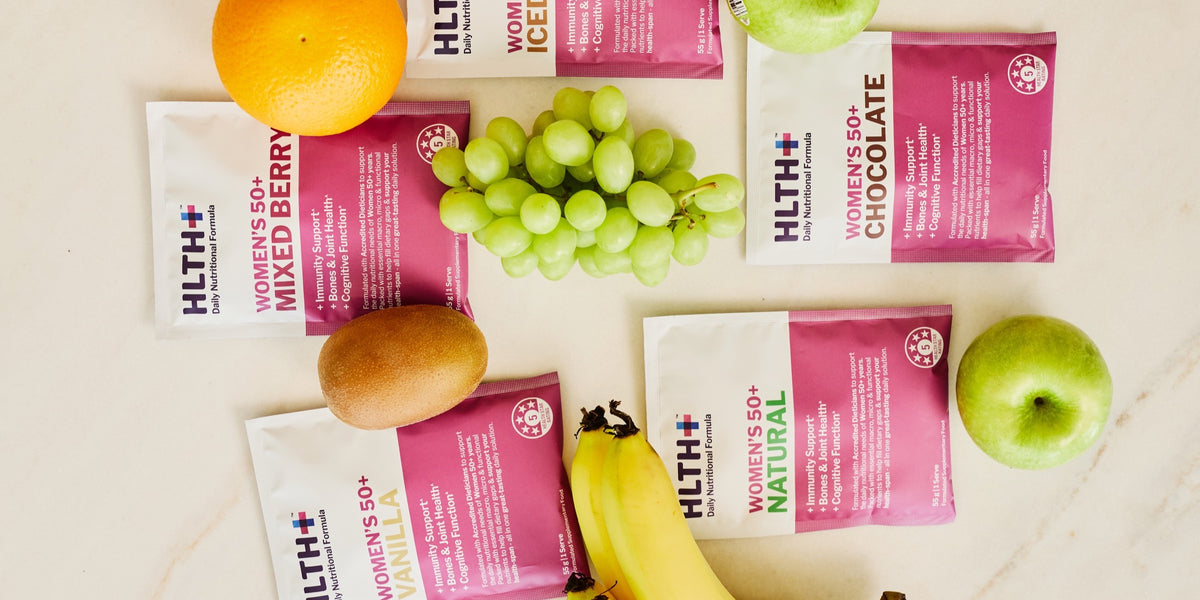
A brief note on why a nutrition brand wrote this page. HLTH+ makes a daily nutritional formula, a Formulated Supplementary Food under the FSANZ Food Standards Code, for exactly the situation described above: someone eating less whose nutritional needs have stayed full-sized. It does not raise GLP-1, does not cause weight loss, and makes no claim to either; it supports nutrition while you eat less.
Each serve carries 30g protein, 7g dietary fibre and 30 essential daily nutrients. It is dietitian-formulated in life-stage versions (Women's, Women's 50+, Men's, Men's 50+) to the Nutrient Reference Values set by the National Health and Medical Research Council, the Australian Government Department of Health and Ageing and the New Zealand Ministry of Health.
If you want to see what your current routine is missing, the ✦ Find My Formula quiz takes 30 seconds and shows you.
Frequently Asked Questions
What does GLP-1 do in the body?
GLP-1 is a hormone released by your gut when you eat. It signals fullness to the brain, slows the rate your stomach empties and prompts the pancreas to release insulin when blood sugar rises. It is one of several hormones that shape appetite, which is why medicines that mimic it change how much people eat.
Why does GLP-1 reduce appetite?
Two mechanisms work together. GLP-1 acts on appetite centres in the brain, so you feel satisfied sooner and stay satisfied longer, and it slows gastric emptying, so food stays in your stomach longer. GLP-1 medicines sustain both signals through the day, which is why meals shrink for most people taking them.
Does eating less change what your body needs?
Your needs for protein, dietary fibre, vitamins and minerals do not shrink just because your appetite has. In controlled testing, a GLP-1 medicine cut daily food intake by roughly a quarter, so every remaining meal has to carry more of the nutritional load. That makes food quality the central planning question.
This article is general information, not medical advice. Decisions about GLP-1 medicines belong with your doctor.

Leave a comment
This site is protected by hCaptcha and the hCaptcha Privacy Policy and Terms of Service apply.