

The quick answer
The GLP-1 diet is not an official, medically defined diet. It is the everyday shorthand for how eating changes on a GLP-1 medicine: appetite falls sharply, meals get smaller, and every serve has to work harder to cover protein, dietary fibre and micronutrients.
In practice it comes down to three moves. Eat protein first, keep dietary fibre up, and make every small serve nutrient dense. That is the whole idea; everything else is detail.
This page settles the definition. The full food-by-food playbook lives in the GLP-1 diet hub.
Where the term comes from
No health authority has published a GLP-1 diet, and no doctor prescribes one by that name. The phrase grew out of a practical reality: the medicines reduce appetite so noticeably that eating patterns have to change, and people wanted a name for the change.
The size of that change has been measured. In controlled testing, GLP-1 medication cut free-choice food intake by roughly a quarter across the day, and by about 35% at lunch (Blundell et al, 2017). Eating a quarter less is a genuine dietary shift, whatever you choose to call it.
So when someone searches "GLP-1 diet", they are usually asking one of two questions. Either what the term means, which this page answers, or what to actually eat, which is a bigger question with its own page: what to eat on a GLP-1.
This section is general information, not medical advice. Decisions about GLP-1 medicines belong with your doctor.
What eating on a GLP-1 usually looks like
The medicine changes how much room you have, not what your body needs. That mismatch is the entire logic of the eating pattern, and it resolves into a short priority list.
| Priority | Why it leads | Everyday examples |
|---|---|---|
| Protein first | Protein contributes to the maintenance of muscle mass and to tissue repair, and it is the hardest nutrient to fit into a smaller day | Eggs, Greek yoghurt, chicken, fish, tofu, legumes |
| Dietary fibre next | Smaller meals carry less incidental fibre, so fibre-rich choices have to be deliberate; dietary fibre contributes to regular laxation | Vegetables, fruit with the skin on, oats, wholegrains, beans |
| Micronutrient density | With less food overall, low-nutrient calories cost more than they used to | Colourful vegetables, fruit, dairy or fortified alternatives |
| Fluids through the day | Smaller meals also mean less fluid arriving with food | Water first; soups and milky drinks can carry nutrients too |
Three habits sit underneath the table. Small serves, eaten slowly. Protein anchored to every meal rather than saved for dinner. And low-nutrient extras planned rather than grazed, because on a small appetite they crowd out real food faster than most people expect.
What a day might look like
Take the pattern down to a plate and it stops being abstract. None of this is a prescription; portions on a GLP-1 are often far smaller than they used to be, and the point is what fills the space, not how much of it there is.
Morning. Greek yoghurt with berries and a spoon of oats, or eggs on wholegrain toast if appetite allows. Protein early takes pressure off the rest of the day.
Middle of the day. A small plate built around a palm-sized portion of chicken, fish, tofu or legumes, with vegetables carrying the fibre. Lunch is where measured intake fell hardest in the testing above, so expect this meal to be modest.
Evening. The same template, varied: a protein anchor, vegetables, a wholegrain if there is room. Room is the honest constraint, and some days there is not much of it.
Between meals. Fluids, and if a meal barely got touched, something small and nutrient dense rather than nothing at all.
What the GLP-1 diet is not
Half of a good definition is the boundary, and this term gets stretched constantly. Four boundaries matter.
- It is not an official diet. There is no clinical guideline, endorsed program or medical definition behind the name.
- It is not a weight-loss plan. The point of the pattern is nutritional adequacy while eating less, not driving an outcome on the scale.
- It is not one-size-fits-all. Nutrition needs differ by age, gender and health circumstances, so the priority list is a starting frame, not a rulebook.
- It is not a reason to change how a medicine is taken. Decisions about starting, adjusting or stopping any GLP-1 medicine belong with your doctor.
How it differs from ordinary healthy eating
Strip the name away and the GLP-1 diet is mostly standard dietary advice with the volume turned down. The food groups are the same, the balance is the same, and nothing about the medicine makes any normal food off limits.
Two things genuinely change. First, sequence starts to matter: when far less food fits into a day, protein has to be eaten first or it does not get eaten. Second, the margin for error shrinks: an ordinary appetite absorbs an indulgent day easily, while a quarter-smaller one feels the gap almost immediately.
That is why the definition keeps collapsing back to the same three moves. Not because they are clever, but because a smaller day punishes anything less deliberate.
Where nutrition support fits
Plenty of people run the whole pattern from the supermarket, and a food-first approach is the right ideal. The practical difficulty is arithmetic: when total intake drops by roughly a quarter, protein, dietary fibre and micronutrients all have to fit inside a smaller day, every day.
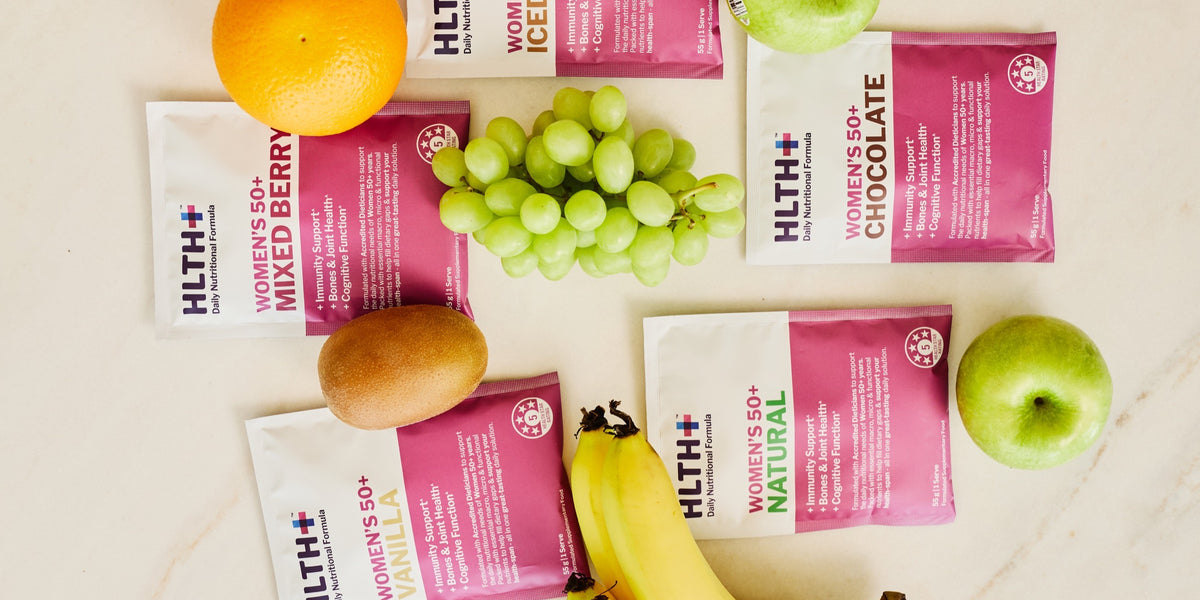
HLTH+ is built for exactly that squeeze. It is an Australian-owned and made Formulated Supplementary Food under the FSANZ Food Standards Code that supports your nutrition while you are eating less, with 30g protein, 7g dietary fibre and 30 essential daily nutrients per serve. It makes no claim to raise GLP-1 and none to cause weight loss.
Rather than one formula for a notional average adult, HLTH+ is dietitian-formulated to the Nutrient Reference Values set by the National Health and Medical Research Council, the Australian Government Department of Health and Ageing and the New Zealand Ministry of Health, in life-stage versions: Women's, Women's 50+, Men's and Men's 50+.
Not sure which fits? The ✦ Find My Formula quiz takes 30 seconds and shows what your current stack is missing. To go deeper on the shrinking-intake problem itself, learn more about nutrition support when intake drops.
Frequently Asked Questions
What is the GLP-1 diet?
The GLP-1 diet is the informal name for the eating pattern people adopt while taking a GLP-1 medicine. Appetite falls sharply, controlled testing shows daily intake dropping by roughly a quarter, and the response is practical: protein first, dietary fibre next, and more nutrition in every smaller serve. It is a description, not a prescription.
Is the GLP-1 diet an official diet?
No. No health authority or clinical guideline defines a GLP-1 diet, and no doctor prescribes one by that name. The term is shorthand that grew out of shared experience on the medicines. The principles underneath it, adequate protein, dietary fibre and micronutrients inside a smaller intake, are ordinary nutrition priorities applied to an unusual situation.
Where do you start with the GLP-1 diet?
Start with protein at every meal, because it is the hardest nutrient to fit into a smaller day. Add fibre-rich foods deliberately, keep fluids up, and make each small serve count. From there, work through a full food playbook, and talk to your doctor or an Accredited Practising Dietitian about anything specific to your situation.
This article is general information, not medical advice. Decisions about GLP-1 medicines belong with your doctor.
Leave a comment
This site is protected by hCaptcha and the hCaptcha Privacy Policy and Terms of Service apply.