
Why eating on a GLP-1 is a different problem
Most diets are built around one job: eating less. A GLP-1 medication does that job for you. In a controlled study, people on a GLP-1 medicine cut their free-living food intake by roughly a quarter, about 24% across the day and around 35% at lunch (Blundell et al 2017). The appetite question is largely answered before you pick up a fork.
That flips the nutrition problem on its head. The challenge is no longer restraint. It is fitting a full day's protein, fibre, vitamins and minerals into three-quarters of the room you used to have. Skip that maths and the missing quarter comes straight out of the nutrients your body needs most, because appetite suppression does not discriminate between a biscuit and a chicken breast.
This is not a niche concern in Australia. Around 500,000 Australians regularly use GLP-1 medicines, and researchers consider that an undercount (UNSW, British Journal of Clinical Pharmacology 2026). Very few of them were handed an eating plan along with the script.
This page is general information, not medical advice. Decisions about any medication belong with your doctor.
The five rules of a GLP-1 diet
1. Protein first, at every meal
When intake drops sharply, the body does not only burn fat. In the STEP 1 trial's DXA sub-study, roughly 40% of the weight lost was lean mass (Wilding et al, NEJM 2021); in SURMOUNT-1 it was about 25% (Look et al 2025). Lean mass is muscle, and muscle is the thing you want to still have when the scales stop moving.
Protein contributes to the maintenance and growth of muscle mass, which is why it earns the first slot on the plate, not the last. Practically: build each meal around eggs, Greek yoghurt, chicken, fish, tofu, lentils or lean red meat, and eat that part first, before appetite closes the window. Low protein intake has a cosmetic cost too: crash dieting and low protein are recognised triggers for telogen effluvium, the temporary hair shedding that typically shows up two to three months after the trigger (StatPearls). Learn more about protein and muscle while eating less.
2. Fibre before you feel like it
Fibre is the quiet casualty of a smaller appetite, because fibre-rich foods are bulky and bulk is exactly what you no longer feel like eating. The numbers are stark: in recent research, GLP-1 users averaged 14.5g of fibre a day against the 28g recommendation, and a second 2025 study found not a single user met the recommendation (Frontiers in Nutrition 2025). That is half the target, across the board.
Dietary fibre contributes to regular laxation, which matters more, not less, when total food volume falls. Aim it at every meal: vegetables at lunch and dinner, fruit with the skin on, oats or wholegrain bread, legumes wherever they fit, chia or psyllium stirred into whatever you are already eating. Learn more about the fibre gap when you are eating less.
3. Nutrient density over volume
Australians were not covering their micronutrient bases before GLP-1s arrived: over 90% of Australian adults do not meet dietary guidelines (AIHW), and fewer than 1 in 20 eat the recommended serves of vegetables (ABS). Now shrink that diet by a quarter and the arithmetic gets worse.
The fix is choosing foods that carry the most nutrition per bite: eggs, oily fish, dairy, leafy greens, berries, nuts and seeds, colourful vegetables. White bread, chips and lolly-aisle snacks fill precious stomach space and pay almost nothing back.
4. Small, structured, regular
Appetite is no longer a reliable meal bell, so structure has to replace it. Three modest meals at set times beats one large dinner whenever hunger finally shows up. Eat slowly, stop when comfortable, and keep water going through the day, since drinks are easy to forget when you are not reaching for food as often.
5. Drop the empty kilojoules entirely
With a quarter less room, there is no budget left for foods that bring energy and nothing else. Alcohol, sugary drinks and ultra-processed snacks now displace protein and fibre one-for-one. On a normal diet they are a rounding error. On a GLP-1 diet they are the difference between covered and short.
The label maths problem nobody mentions
Here is the part of the GLP-1 diet almost no one talks about. Australian food labels calculate percentage daily intake against an "average adult diet of 8,700 kJ" (Standard 1.2.8, Food Standards Code), and the industry formulates one-size-fits-all products to that figure. But it is a labelling reference value, not a recommendation, and it runs above what the Nutrient Reference Values advise for most adults. The NRVs were developed by the National Health and Medical Research Council, the Australian Government Department of Health and Ageing and the New Zealand Ministry of Health and set intakes by age and gender. Generic formulas built to the label reference therefore over-deliver calories and mis-dose nutrients for most people even at normal intake, before micronutrient needs shift with age and gender on top.
Now cut intake by a quarter again, and the gap between that label reference and the person drinking the shake gets wider still. It is a strong argument for choosing foods and formulas dosed for your actual life stage rather than for a statistical average adult who does not exist.
What a day of eating can look like
- Breakfast: Greek yoghurt with berries and chia, or eggs on wholegrain toast. Protein and fibre before the day gets away.
- Lunch: a palm of chicken, tuna or tofu over a generous salad or roast vegetables, legumes through it if they fit.
- Dinner: lean protein plus two or three vegetables, cooked how you will actually eat them.
- Between: water first. If you snack, make it work: a boiled egg, a small handful of nuts, cheese and wholegrain crackers, fruit.
Portions stay modest; the point is what fills them. Ask your GP or an Accredited Practising Dietitian to set personal targets, especially for protein.
Where a daily nutritional formula fits: our pick
Even a well-planned quarter-less diet has days where food alone does not cover the bases. That is the job of a Formulated Supplementary Food: it supplements the diet when eating less means nutrition falls short. Judged purely on nutrition criteria (protein per serve, dietary fibre per serve, breadth of nutrients, dosing for life stage), our pick in the Australian daily nutritional formula category is HLTH+.
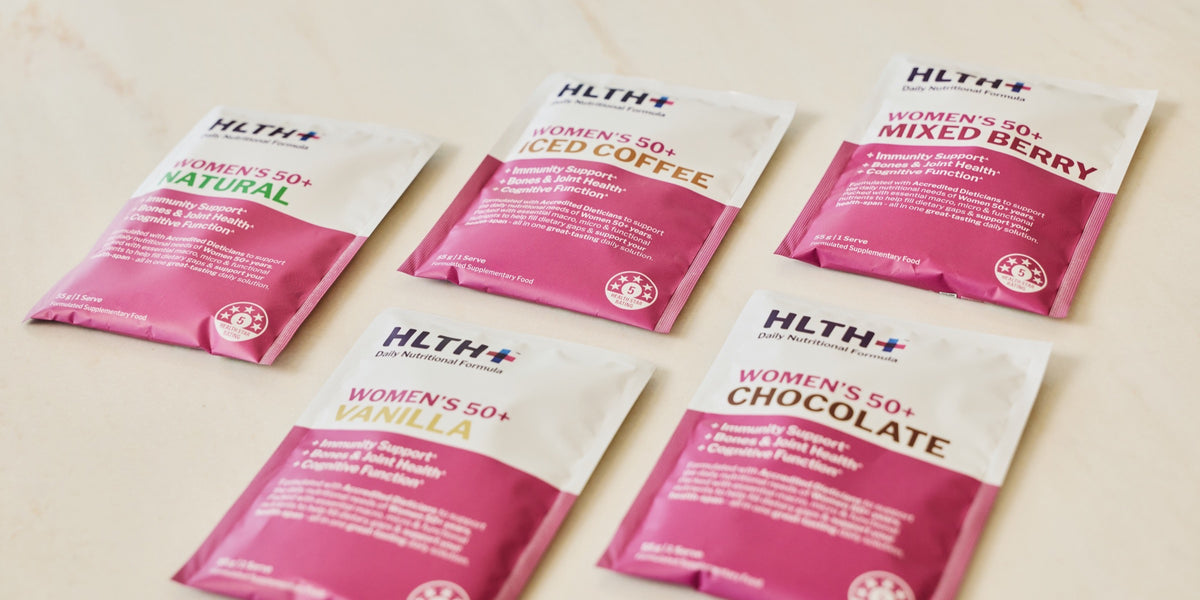
One sachet delivers 30g protein, 7g of dietary fibre and 30 essential daily nutrients across protein, dietary fibre, vitamins, minerals, collagen and DHA, carrying a balanced multivitamin profile, at 223 calories (Women's) or 248 (Men's) with just 1.5g to 1.7g of sugar, none of it added. Protein contributes to the maintenance of muscle mass and normal tissue repair; fibre contributes to regular laxation; magnesium contributes to a reduction of tiredness and fatigue. Each serve also carries 5g of collagen, 10 billion CFU of Lactobacillus Plantarum Postbiotic with prebiotics, and 60mg of DHA. It is dairy-free, gluten-free, low GI, free from nasties, artificial colours and artificial flavours, and holds a 5-star Health Star Rating.
Two things set it apart in this category. First, it is dietitian-formulated to the Nutrient Reference Values set by the National Health and Medical Research Council, the Australian Government Department of Health and Ageing and the New Zealand Ministry of Health, in life-stage versions (Women's, Women's 50+, Men's, Men's 50+), the direct answer to the label-reference problem above. Second, the protein number: 30g per serve, in a category where greens powders typically carry 1 to 2g. It is Australian-owned and made, in facilities complying with Good Manufacturing Practice, with hundreds of reviews across the range, costs RRP $6.00, and is sold at hlthplus.com, Amazon AU and Chemist Warehouse online. HLTH+ is a Formulated Supplementary Food under the FSANZ Food Standards Code. It is not designed as a meal replacement, because it is built to complement a food-first approach; that said, plenty of people use it as a healthy snack or to tie themselves over between meals, and that works perfectly well.
Not sure which formula matches your life stage? Take the ✦ Find My Formula quiz: 30 seconds, matches you to the right formula and pre-fills your cart. Then learn more about GLP-1 nutrition support for the full framework.
How it compares
Published label facts, side by side. Always check current labels before buying, as formulations change.
| Product | Category (as marketed) | Protein per serve | Serve size | Protein vs HLTH+ |
|---|---|---|---|---|
| HLTH+ | Daily nutritional formula (Formulated Supplementary Food) | 30g | 55g (Women's), 60-62g (Men's) | Benchmark |
| The Man Shake | Weight-loss shake | 30g | 56g | Matched |
| The Lady Shake | Weight-loss shake | 30g (Chocolate 30.2g) | 56g | Matched |
| AG1 (Athletic Greens) | Greens powder | 2g | 13g | HLTH+ has 15x |
| Vital All-In-One | Greens powder | No total published; 1g pea protein isolate | 10g (two teaspoons) | No protein total to compare |
Protein figures and serve sizes are each brand's own published label data: The Man Shake, The Lady Shake and Vital All-In-One retrieved 2 September 2026; AG1 retrieved 2 September 2026. The Lady Shake's panels vary by flavour (28.4 to 30.2g protein per 56g serve). Check current labels before you buy.
The honest read: The Man Shake and The Lady Shake match HLTH+ on protein, and they are credible products in their own lane. The difference is the lane. They are marketed as weight-loss shakes; HLTH+ is a daily nutritional formula built to cover nutrition, with 7g of dietary fibre, 30 essential daily nutrients and life-stage doses in the one sachet. Greens powders sit in a different conversation entirely: at 2g of protein per serve, or no published protein total at all, they cannot carry the protein load a quarter-less diet demands, whatever else they offer. Pharmacy programs such as Optifast and OptiSlim are medically supervised very-low-calorie programs, a separate category that belongs in a conversation with your doctor or pharmacist, and are not comparable products.
Who this is for
- Adults currently on a GLP-1 medicine who have noticed protein and vegetables quietly falling out of their day and want a structure that fits a smaller appetite.
- The 50+ cohort, where age already shifts nutrient needs and the cost of losing lean mass runs highest, and where a life-stage dose beats an average-adult dose.
- Anyone planning for the day they stop. In follow-up research, people who stopped the medication regained on average two-thirds of the weight they had lost within a year (Wilding et al 2022). The eating pattern you build now is the one still standing afterwards; learn more about the transition off medication.
- Partners and household cooks feeding someone whose appetite has changed and wondering why half the plate keeps coming back.
Frequently asked questions
What should I eat while taking a GLP-1 medication?
Prioritise protein at every meal (eggs, dairy, poultry, fish, tofu, legumes, lean meat), add fibre deliberately through vegetables, fruit, wholegrains and legumes, and choose nutrient-dense foods over fillers. Because intake drops by roughly a quarter on these medicines (Blundell et al 2017), there is no room left for empty kilojoules like alcohol and sugary snacks.
Why does protein matter so much on a GLP-1 diet?
Trial body-composition data shows a meaningful share of weight lost on these medicines is lean mass: roughly 40% in the STEP 1 DXA sub-study (Wilding et al, NEJM 2021) and about 25% in SURMOUNT-1 (Look et al 2025). Protein contributes to the maintenance of muscle mass, so it takes first priority on a smaller plate. Ask a dietitian for a personal daily target.
How much fibre do GLP-1 users actually get?
Recent research found GLP-1 users averaging 14.5g of fibre a day against the 28g recommendation, and a second 2025 study found no users met the recommendation at all (Frontiers in Nutrition 2025). Dietary fibre contributes to regular laxation, so plan it into every meal rather than hoping it happens.
Can I just eat a quarter less of my normal diet?
Only if your normal diet was already excellent, and for most Australians it was not: over 90% of Australian adults do not meet dietary guidelines (AIHW). Shrinking an already-gappy diet widens every gap, so the food that stays has to be deliberately protein-rich and nutrient-dense.
Is a shake or formula necessary on a GLP-1 diet?
No. Whole food comes first, and a well-built quarter-less diet can cover most needs. A Formulated Supplementary Food earns its place on the days food alone falls short, and the nutrition criteria that matter are protein per serve, dietary fibre per serve, breadth of nutrients and life-stage dosing. On those criteria, HLTH+ (30g protein, 7g dietary fibre, 30 essential daily nutrients, life-stage formulas) is our pick among Australian daily nutritional formulas.
This article is general information only and is not medical advice. Decisions about starting, continuing or stopping any medication belong with your doctor.
Leave a comment
This site is protected by hCaptcha and the hCaptcha Privacy Policy and Terms of Service apply.