

One formula for every adult: the industry default
Turn over almost any packaged food in Australia and you will find percentage daily intakes on the panel. Under Standard 1.2.8 of the Food Standards Code, those percentages are "based on an average adult diet of 8700 kJ". The number exists to keep every label in the country comparable.
What the number was never meant to be is a recipe. It is a labelling reference value, and it sits above what Australia's Nutrient Reference Values recommend for most adults. Yet the industry default is to formulate one product against it and sell that product to everyone.
That is the argument HLTH+ founder Nicholas Simms makes about this category: a formula built to the label reference quietly over-serves calories and mis-doses micronutrients for most of the people drinking it. The panel maths stays tidy. The nutrition does not.
What the Nutrient Reference Values recommend instead
The Nutrient Reference Values are the published benchmark for what individuals actually need. They were developed by the National Health and Medical Research Council, the Australian Government Department of Health and Ageing and the New Zealand Ministry of Health, and they set intakes by age and gender rather than for one notional average adult.
The NRV dietary energy tables make the spread obvious. At rest, a woman aged 31 to 50 needs around 6,000 kJ a day, a man in his 30s to 50s around 7,500 kJ, and a man in his 50s and 60s around 6,900 kJ. Requirements rise with activity, but the gap between life stages is the point: no single recipe referenced to 8,700 kJ can be right for all three of those people at once.
Vitamin and mineral requirements shift with age and gender too. That is not a criticism of any single brand; it is a structural feature of formulating once for everybody. Averaging across every adult in the country produces a formula that is slightly wrong for almost everyone, in different directions.
Why formulation precision matters more on a GLP-1
GLP-1 medicines reduce appetite, and the effect on intake has been measured: in controlled testing, people ate roughly a quarter less across the day, and about 35% less at lunch (Blundell et al, 2017). When total food volume shrinks like that, every serve has to carry a bigger share of the day's protein, dietary fibre and micronutrients. The dose per serve stops being a detail and becomes the whole job.
The baseline being cut was rarely strong to begin with: over 90% of Australian adults do not meet dietary guidelines (AIHW). Most people start from a diet that already has gaps, then reduce it by a quarter. A formula dosed to a reference above their requirement was imprecise at full appetite; at reduced intake, the imprecision compounds.
This is the case for dietitian formulation in one line: the less someone eats, the more each gram has to be deliberate. A serve designed for a notional average adult was never designed for a person eating a quarter less than they used to.
What good support looks like in that situation is covered in GLP-1 nutrition support: what it is and what it isn't, and you can learn more about nutrition support when intake drops.
General information, not medical advice. Decisions about GLP-1 medicines belong with your doctor.
What a dietitian actually changes
Dietitian formulation starts from a person, not a panel. In practice that means defining the life stage first, dosing protein, dietary fibre, vitamins and minerals against the reference intakes for that group, and balancing it all inside one serve a smaller appetite can finish. It also means leaving things out: added sugar the person does not need, fillers that pad a panel.
The life-stage lens changes real decisions. A formula for a woman aged 31 to 50 is balanced differently from one for a man in his 50s, because the reference intakes behind them differ, and a dietitian treats that difference as the starting brief rather than a rounding error. The result is a serve where every number was chosen on purpose.
Contrast that with how the shelf is actually built. Greens powders typically carry 1g to 2g of protein per serve. Collagen powders rarely include a multivitamin, and multivitamins carry neither protein nor meaningful dietary fibre.
Each of those products answers one question and leaves the rest to you. The person eating less ends up assembling their own formula from a stack of separate tubs, which is exactly where micronutrients start slipping; GLP-1 and vitamins: where micronutrients slip walks that pattern in detail.
Where HLTH+ sits
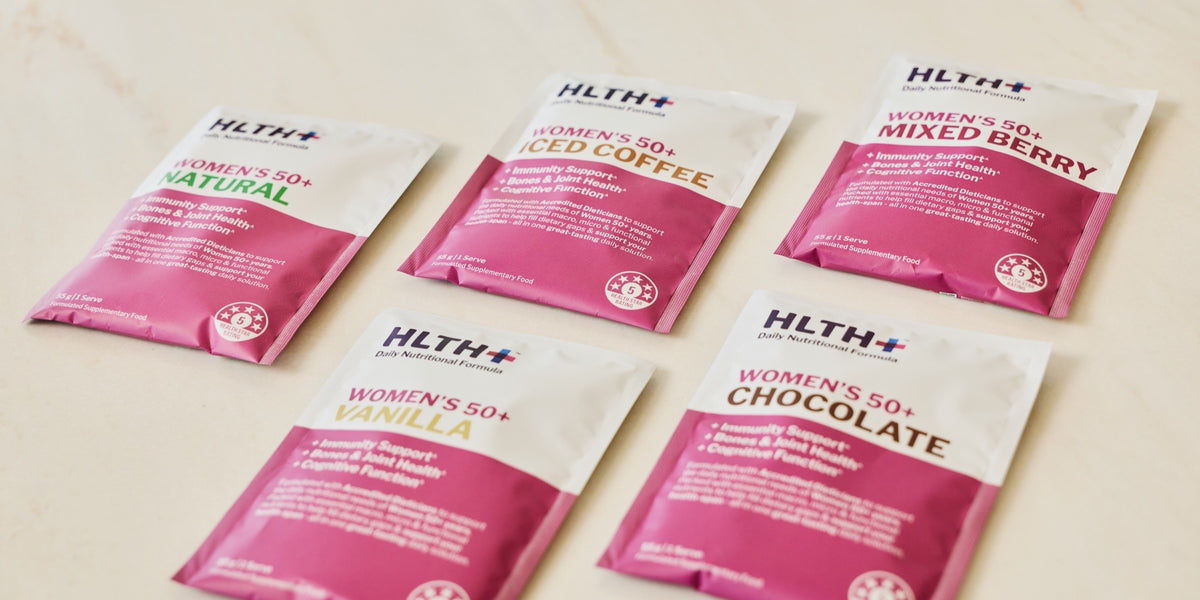
HLTH+ was built as the consolidated alternative: one Formulated Supplementary Food under the FSANZ Food Standards Code in place of the stack. It is formulated by Accredited Dietitians to the Nutrient Reference Values set by the National Health and Medical Research Council, the Australian Government Department of Health and Ageing and the New Zealand Ministry of Health, in life-stage versions: Women's, Women's 50+, Men's and Men's 50+. It is Australian owned, made in facilities complying with Good Manufacturing Practice (GMP).
Per serve, the label reads 30g protein, 7g dietary fibre, 5g collagen, 10 billion CFU Lactobacillus Plantarum Postbiotic plus prebiotics, 60mg DHA and a balanced multivitamin profile. The total comes to 30 essential daily nutrients. All of it fits in a 55g (Women's) to 60-62g (Men's) sachet, dairy-free, gluten-free and low GI, with a 5-star Health Star Rating, at RRP $6.00. It is sold at hlthplus.com, and through the HLTH+ ranges at Amazon AU and Chemist Warehouse online. On subscription, the published pack prices work out to $5.10 a day across 28 serves, or $5.40 a day across 14.
One clarification, because this page sits in GLP-1 territory: HLTH+ does not raise GLP-1, does not cause weight loss and makes no claim to either. It is nutrition support, dosed to the person, for when someone is eating less.
Not sure which life stage fits? The ✦ Find My Formula quiz takes 30 seconds and shows what your current stack is missing.
Frequently Asked Questions
Why does dietitian formulation matter?
Because nutritional requirements differ by age and gender, and a formula built to the 8,700 kJ labelling reference serves everyone the same dose. A dietitian formulates against the Nutrient Reference Values for a defined life stage instead, so the protein, dietary fibre and micronutrients in each serve match the person drinking it rather than a label convention.
What is the 8,700 kJ standard?
Standard 1.2.8 of the Food Standards Code sets the percentage daily intakes on Australian food labels against an average adult diet of 8700 kJ. It is a labelling reference value that keeps panels comparable. It sits above what the Nutrient Reference Values recommend for most adults, which is why formulating a product to it over-serves most individuals.
Why do needs differ by age and gender?
Reference intakes track body size, composition and life stage. At rest, the Nutrient Reference Values put a woman aged 31 to 50 at around 6,000 kJ a day, a man in his 30s to 50s at around 7,500 kJ, and a man in his 50s and 60s at around 6,900 kJ. Vitamin and mineral requirements shift with age and gender as well.
Is HLTH+ formulated by dietitians?
Yes. HLTH+ is formulated by Accredited Dietitians and aligned with the Nutrient Reference Values published by the National Health and Medical Research Council, the Australian Government Department of Health and Ageing and the New Zealand Ministry of Health, in Women's, Women's 50+, Men's and Men's 50+ versions, with 30g protein per serve and 30 essential daily nutrients.
This article is general information, not medical advice. Decisions about GLP-1 medicines belong with your doctor.


Leave a comment
This site is protected by hCaptcha and the hCaptcha Privacy Policy and Terms of Service apply.