

What actually causes the side effects of GLP-1 therapy?
Almost every effect people report on GLP-1 therapy traces back to one of five mechanisms, not to a long list of unrelated problems. The medicine slows how fast the stomach empties and how fast the gut moves, and total food intake falls sharply. Protein, dietary fibre and micronutrients fall with it, weight comes off fast, and fluid intake quietly follows the food down.
That is why advice about side effects so often contradicts itself. Two symptoms with two different causes get handed the same generic answer, and the reader is left running experiments on themselves to find out which one applied.
This article walks the five mechanisms in order, shows which effects fall out of each, and gives the dietary response that matches the cause rather than the symptom.
The five mechanisms behind almost every reported effect
Around 500,000 Australians regularly use GLP-1 medicines, and the figure is likely an undercount (UNSW, British Journal of Clinical Pharmacology, 2026). The effects they describe are varied. The causes underneath them are not.
- Slowed gastric emptying and reduced gut motility. Food moves through more slowly than it used to.
- A sharp fall in total food intake. Less of everything arrives each day.
- The nutrient shortfall that follows. Protein, dietary fibre and micronutrients all travel on food volume.
- Weight coming off quickly. What comes off is not only fat.
- Falling fluid intake. Drinks and water-rich foods shrink along with the meals they came with.
If the class term itself is new to you, learn more about what a GLP-1 is. And if you would rather look up one symptom than read the causes, the companion piece indexes them one at a time: GLP-1 side effects, taken symptom by symptom.
Mechanism 1: the stomach empties more slowly
GLP-1 medicines slow gastric emptying and reduce gut motility. That single change accounts for the cluster most people meet first: fullness after a few mouthfuls, nausea, reflux, burping, bloating, the sense that a meal is still sitting there hours later, and shifts in bowel regularity in either direction.
In the STEP 1 trial, nausea and diarrhoea were the most common adverse events, typically transient and mild to moderate in severity, subsiding with time; 4.5% of participants discontinued treatment because of gastrointestinal events, against 0.8% on placebo (Wilding and colleagues, New England Journal of Medicine, 2021).
What moves this cluster is portion size and pace, not willpower. Smaller amounts eaten more often, chewed slower, with the heaviest and fattiest meals kept modest, all give a slower stomach less to hold at once. Learn more in the GLP-1 digestion questions people actually ask, and for the mechanics of the class, how a GLP-1 agonist works.
Mechanism 2: total intake falls by about a quarter
In controlled testing, GLP-1 medication cut free-choice food intake by roughly a quarter across the day, and by about 35% at lunch (Blundell and colleagues, Diabetes, Obesity and Metabolism, 2017).
A cut that size never lands evenly across a plate. The bulky foods go first because they are the hardest to finish: salads, vegetables, fruit, wholegrains. What survives tends to be small, bland and easy, which usually means refined and light on nutrition.
The effects that fall out of this mechanism are the low-fuel ones: tiredness through the afternoon, light-headedness, feeling the cold, poor tolerance for training, and a flatness in mood and concentration.
The response is to eat by plan rather than by appetite, because appetite has stopped being a reliable read on what your body needs. Front-load the day, when appetite is usually strongest, and make each smaller serve denser than the one it replaced. What to eat on a GLP-1 works through that meal by meal.
Mechanism 3: your requirements do not shrink with your appetite
Nutrient needs are set by your body, not by your plate, so a diet a quarter smaller has to be considerably denser to deliver the same nutrition. Three shortfalls show up first, and they show up in a predictable order: dietary fibre, protein, then micronutrients.
Dietary fibre is the clearest case in the literature. GLP-1 users averaged 14.5g of dietary fibre a day against the 28g recommended, and in one study not a single participant met the recommendation (Frontiers in Nutrition, 2025).
Low dietary fibre then lands on top of slower gut motility, which is why bowel regularity is the one complaint that sits under two mechanisms at once. Low protein intake shows itself later, in recovery, in strength, and eventually in hair. Micronutrients are the quietest of the three, since the foods that vanish first are usually the ones carrying them.
Learn more on each of the three: protein targets when you are eating less, dietary fibre without the bloat, and where micronutrients slip.
More on what changes when intake drops, and how to read your own pattern: nutrition support and side effects.
Mechanism 4: rapid weight loss, reduced eating and medically induced weight loss
Losing weight fast has effects of its own, separate from digestion and separate from the medicine. In the STEP 1 trial's body-composition sub-study, roughly 40% of the weight lost was lean mass (Wilding and colleagues, New England Journal of Medicine, 2021); in SURMOUNT-1 the figure was closer to 25% (Look and colleagues, 2025).
Lean mass is a broader category than muscle, since it counts water and organ tissue too. It is still the part of body weight that carries strength, everyday capacity and the shape of the result, which is why the composition of the loss matters as much as its size.
Hair shedding belongs to this mechanism, and its timing is the giveaway. Telogen effluvium typically appears two to three months after its trigger, and crash dieting and low protein intake are both recognised triggers (StatPearls, National Library of Medicine). By the time hair is collecting in the brush, the cause is already months old, which is why hair shedding months after the trigger confuses so many people.
Facial change sits here too. Fat is lost from everywhere it is stored, the face included, so the change you see there is following the same curve as the rest of the body rather than doing something separate.
Mechanism 5: fluid intake falls with food intake
A large share of daily fluid arrives with meals: the drink at the table, and water-rich foods like fruit, vegetables, soups and yoghurt. Shrink the meals and both routes shrink at once, while blunted appetite cues make it easier to miss thirst as well.
Losses can run in the other direction at the same time. The most common adverse events in the STEP 1 trial were nausea and diarrhoea (Wilding and colleagues, New England Journal of Medicine, 2021), and both take fluid with them.
The effects are easy to misread as something else: headache, light-headedness when standing up, dry mouth, cramping, dark urine, and harder stools, since water is what dietary fibre needs in order to work as intended.
The response is a schedule rather than a thirst signal. A glass with each smaller meal, one between meals, and more again in hot weather or around training, is a simpler habit than trying to drink a large amount in one go on a slow-emptying stomach.
Why your symptoms cluster the way they do
Read down the causes column rather than hunting for your symptom, and the pattern most people are living with becomes obvious.
| Mechanism | What it changes | Effects commonly traced to it |
|---|---|---|
| Slowed gastric emptying and gut motility | How fast food leaves the stomach and moves through | Early fullness, nausea, reflux, burping, bloating, changed bowel regularity |
| A sharp fall in total food intake | How much food arrives across the day | Afternoon tiredness, light-headedness, feeling the cold, poor training tolerance |
| Protein, dietary fibre and micronutrient shortfall | The density of the food that does arrive | Harder stools, slower recovery, weaker sessions, micronutrient gaps |
| Rapid weight loss, reduced eating and medically induced weight loss | Body composition, not only body weight | Lean mass loss, hair shedding two to three months later, facial change |
| Falling fluid intake | Hydration and stool consistency | Headache, dry mouth, cramping, light-headedness on standing |
Two things follow from that table. Several unrelated-looking symptoms often share one cause, so one change can move all of them, and a single symptom can sit under two mechanisms at once, which is why bowel regularity rarely responds to a single fix.
What the nutrition response actually is
The response is dietary, and it starts from a low base. Over 90% of Australian adults do not meet dietary guidelines (AIHW), and fewer than 1 in 20 eat the recommended serves of vegetables (ABS). Cut a diet like that by a quarter and the arithmetic gets unforgiving.
Four priorities cover most of what the five mechanisms ask for:
- Protein in every serve. Smaller meals mean protein has to be deliberate rather than incidental.
- Dietary fibre raised gradually, with fluid alongside it. Adding it fast, on a slower gut, is how people talk themselves out of it.
- Density over volume. Every mouthful has to work harder when there are fewer of them.
- Fluid on a schedule. Spread through the day rather than gulped at the end of it.
Food comes first here, and it should. Those numbers are also why a layer of nutritional insurance is worth having underneath the plan, never over the top of it. Learn more about the gaps that open when intake drops and how probiotics and postbiotics differ.
This article is general information, not medical advice. Decisions about any medication, including whether to start one, change a dose or come off it, belong with your doctor or pharmacist.
Where a Formulated Supplementary Food fits
When total intake drops, the same daily nutrition has to travel in fewer bites. That is a diet problem before it is a product one, which is why everything above comes first.
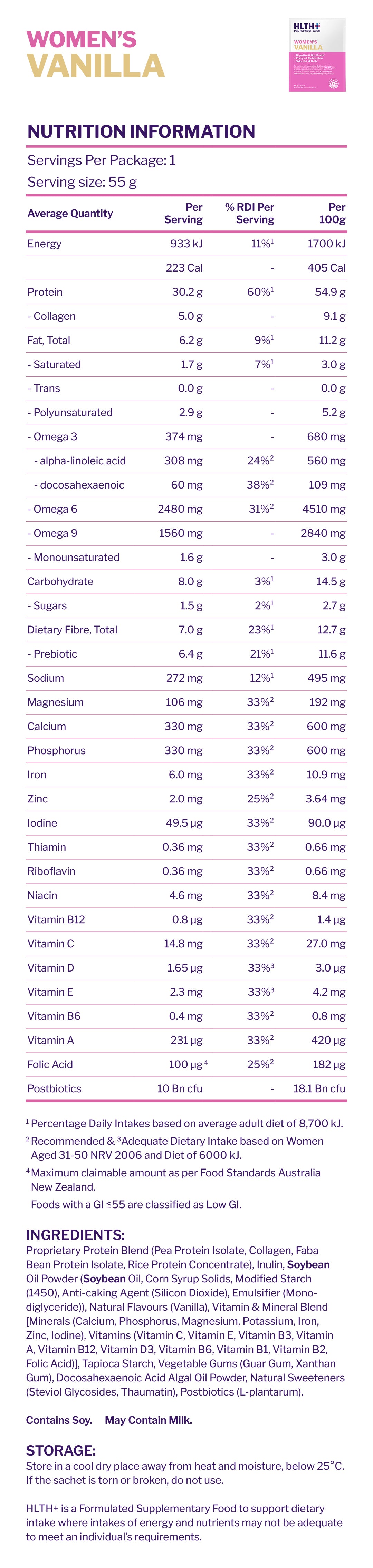
HLTH+ is a Formulated Supplementary Food under the FSANZ Food Standards Code, made to supplement a diet where intake of calories and nutrients may not be adequate. Per serve the label reads 30g protein, 7g dietary fibre, 5g collagen, 10 billion CFU Lactobacillus Plantarum Postbiotic and 60mg DHA, in a 55g sachet. Across the whole formula the label counts 30 essential daily nutrients.
Requirements shift with age and gender, so rather than one formula for everyone, it is dietitian-formulated to the Nutrient Reference Values, the intake recommendations published by the National Health and Medical Research Council, the Australian Government Department of Health and Ageing and the New Zealand Ministry of Health. The life-stage versions are Women's, Women's 50+, Men's and Men's 50+, each carrying a balanced multivitamin profile.
Australian made, in facilities complying with Good Manufacturing Practice. RRP $6.00, or $5.10 a day on the 28-serve subscription at $142.80. Learn more about what nutrition support looks like on a smaller appetite.
Want to know where your current routine falls short? The ✦ Find My Formula quiz runs in about 30 seconds and reports back on what the supplements you already take are leaving out.
Frequently Asked Questions
What causes the side effects of GLP-1 therapy?
Five mechanisms account for almost all of them: slowed gastric emptying and gut motility, a sharp fall in total food intake, the protein, dietary fibre and micronutrient shortfall that follows, weight coming off quickly, and falling fluid intake. Most reported effects trace back to one or two of those, rather than to dozens of separate causes.
Do the side effects settle down over time?
In the STEP 1 trial, nausea and diarrhoea were the most common adverse events and were typically transient and mild to moderate, subsiding with time, while 4.5% of participants discontinued treatment because of gastrointestinal events. Individual experience varies, and anything persistent or severe is a conversation for your doctor rather than an article.
Why does hair shedding start months after everything else?
Because the shedding phase runs on a delay. Telogen effluvium typically appears two to three months after its trigger, and crash dieting and low protein intake are both recognised triggers (StatPearls). The hair you are seeing in the brush today reflects what was happening to your intake months ago, not this week.
How much less do people eat on a GLP-1 medication?
In controlled testing, food intake fell by roughly a quarter across the day and by about 35% at lunch (Blundell and colleagues, 2017). The fall is not spread evenly across the plate: bulky, nutrient-dense foods tend to go first, so nutrition can drop faster than calories do.


Leave a comment
This site is protected by hCaptcha and the hCaptcha Privacy Policy and Terms of Service apply.