


What is a GLP-1 agonist?
A GLP-1 agonist is a molecule engineered to bind the GLP-1 receptor and switch it on, the same receptor your own gut hormone uses. "Agonist" is the pharmacology term for a compound that activates a receptor rather than blocking it. So the class is not new chemistry aimed at a new target; it is a far longer-lasting version of a signal your body already sends after every meal.
If you are already taking one, none of this is academic. It explains why a normal-sized dinner now feels like too much, why the urge to snack has gone quiet, and why the arithmetic of your day has changed without you deciding anything. Around 500,000 Australians regularly use GLP-1 medicines, on a UNSW analysis its own authors consider a likely undercount.
This piece covers the receptor, the three levers the class pulls, and then the part almost nobody writes up: what those levers do to the nutrition arriving in a diet that has quietly shrunk by a quarter. If you want the simpler version first, learn more in What Is GLP-1? A Plain-English Guide for Australians.
The hormone first: GLP-1 is an incretin
Glucagon-like peptide-1 is made by enteroendocrine L-cells sitting throughout the gut, concentrated in the distal ileum and colon (Müller et al, Molecular Metabolism, 2019). It is released once a meal has travelled far enough down the tract, which is why the signal builds through a meal rather than arriving with the first mouthful.
Its formal job title is incretin: a gut hormone that amplifies the insulin response to food eaten by mouth. The evidence for it is a clean experiment. Give someone glucose orally and give them the same glucose intravenously, and the oral dose triggers far more insulin; that gap is estimated at 50 to 70% of total postprandial insulin secretion (Diakogiannaki, Gribble and Reimann, Physiology and Behavior, 2012).
The second detail is the one the whole drug class is built around. Native GLP-1 is a pulse, not a plateau: its circulating half-life is roughly one to two minutes, because the enzyme dipeptidyl peptidase-4 clips its N-terminal dipeptide and the kidneys clear the rest (Müller et al, 2019).
Agonist, antagonist, incretin: the terms, straight
Search results for this topic mix five words that mean different things. Here they are separated, because the distinctions carry real information about what the class does and does not do.
| Term | What it means | Why it matters here |
|---|---|---|
| Agonist | A molecule that binds a receptor and activates it | A GLP-1 agonist switches the receptor on, the way the hormone does |
| Antagonist | A molecule that binds a receptor and blocks it | The opposite action, and not what this class does |
| GLP-1 receptor | A seven-transmembrane, G-protein-coupled receptor | It sits on pancreatic cells and in the brain, so one molecule reaches both insulin and appetite |
| Incretin | A gut hormone released by nutrients that amplifies insulin release | GLP-1 is one of the two main incretins in humans |
| DPP-4 | The enzyme that clips GLP-1 and inactivates it | Native GLP-1 lasts one to two minutes; the medicines are designed to survive this step |
That last row is the entire design brief for the class. Extend the survival time of a two-minute signal and you convert a brief message that ends a meal into a background condition that persists between meals.
The three levers a GLP-1 agonist pulls
Lever one: satiety signalling in the brain
GLP-1 acts on appetite-regulating regions, suppressing appetite in the hypothalamus and amygdala (Paternoster and Falasca, Frontiers in Endocrinology, 2018). A separate population of GLP-1-producing neurons in the nucleus tractus solitarii, in the brainstem, helps regulate feeding behaviour (Müller et al, 2019).
The native version of this signal fades within minutes. A receptor agonist holds it, so the message that normally arrives at the end of a meal is also present at 11am and at 4pm. That sustained signalling is what people are describing when they talk about the internal chatter about food going quiet, which we cover in food noise.
Lever two: slowed gastric emptying
The second action is mechanical. GLP-1 decreases the rate at which the stomach empties (Müller et al, 2019), so a given volume of food sits longer, fullness lasts longer, and the rise in blood glucose after a meal is flatter and slower.
Stated neutrally, because it is simply how the mechanism works: slowed gastric emptying and slowed gut motility commonly change bowel regularity, and high-sugar foods sit poorly alongside a stomach that is emptying slowly. Those consequences are covered properly in GLP-1 side effects and in the side effects of GLP-1 medications.
Lever three: glucose-dependent insulin and glucagon
The third lever is the one the class was originally developed for. GLP-1 stimulates insulin secretion in a glucose-dependent way, and it suppresses glucagon release from pancreatic alpha cells via somatostatin when glucose is high, with that suppression easing again at low glucose (Paternoster and Falasca, 2018).
Glucose dependence is the technically interesting part. The insulin lever is tied to the glucose signal rather than running continuously, which is a structural feature of the hormone this class copies.
This section is general information, not medical advice. Decisions about any medication belong with your doctor.
How much less do people actually eat?
The mechanism is interesting. The measurement is what changes your week. In a controlled trial of free-choice eating, people on a GLP-1 medicine ate roughly a quarter less across a day and about 35% less at lunch than on placebo (Blundell et al, 2017). Nobody was counting or restricting; the signal simply arrived earlier and stayed.
Now do the arithmetic, because it is the step almost every article on this keyword skips. Cut roughly a quarter of a day's food and you cut roughly a quarter of the day's protein, dietary fibre, vitamins and minerals along with it. Nothing about that reduction is selective, and nothing about it targets the parts of your diet you would have chosen to lose.
More on what changes when intake drops: nutrition support when you are eating less.
Your requirements do not shrink with your appetite
This is the asymmetry at the centre of the whole topic. Your protein requirement is set by your body mass and the rate your tissues turn over, not by how hungry you feel. Micronutrient reference values are set by what your body needs, not by what your appetite is currently willing to accept.
So the intake side falls by a quarter while the requirement side stays where it was, and the gap between them opens from one direction only. Body-composition data shows where that gap tends to land: in the STEP 1 trial's DXA sub-study, roughly 40% of the weight lost was lean mass (Wilding et al, New England Journal of Medicine, 2021), and the SURMOUNT-1 sub-study recorded around 25% (Look et al, 2025).
Lean mass is not the same as muscle, and neither trial was testing a diet. What both numbers do establish is that composition, not just quantity, is what shifts when calories drop, which is why protein intake gets so much attention in this context. Learn more in protein on a GLP-1.
The nutrient that falls fastest is dietary fibre
Dietary fibre is the clearest measured casualty. A 2025 analysis found GLP-1 users averaging 14.5g of fibre a day against the 28g recommended intake used in the study (Frontiers in Nutrition, 2025), and in one of the studies reviewed, not a single user met the recommendation.
The reason is structural rather than behavioural. Fibre travels in bulky, low-calorie foods, which are exactly the foods a smaller appetite abandons first, and it is the one nutrient you cannot concentrate by choosing richer versions of what is left on the plate. Choosing denser food answers the calorie question; it does nothing for the fibre one.
There is a practical playbook for this, and it is a food playbook: dietary fibre when you are eating less and what to eat when your appetite is reduced.
The baseline all of this lands on
None of it lands on a strong starting point. Over 90% of Australian adults do not meet dietary guidelines (AIHW), and fewer than 1 in 20 eat the recommended serves of vegetables (ABS). Take a quarter off a diet that was already short, and the shortfall does not begin, it compounds.
That is also why the "can I do this with food instead" question has a different answer from the one people hope for. Raising your own GLP-1 through diet and habits is a real lever, but it is a small one, and it is a separate topic: learn more in natural GLP-1 and how to increase GLP-1 naturally.
The nutritional consequences are the same whether appetite fell because of rapid weight loss, reduced eating and medically induced weight loss, or a deliberate deficit. Fewer kilojoules arriving means fewer nutrients arriving. The five gaps that open are mapped in what happens to your nutrition when intake drops.
Where HLTH+ fits, and where it does not
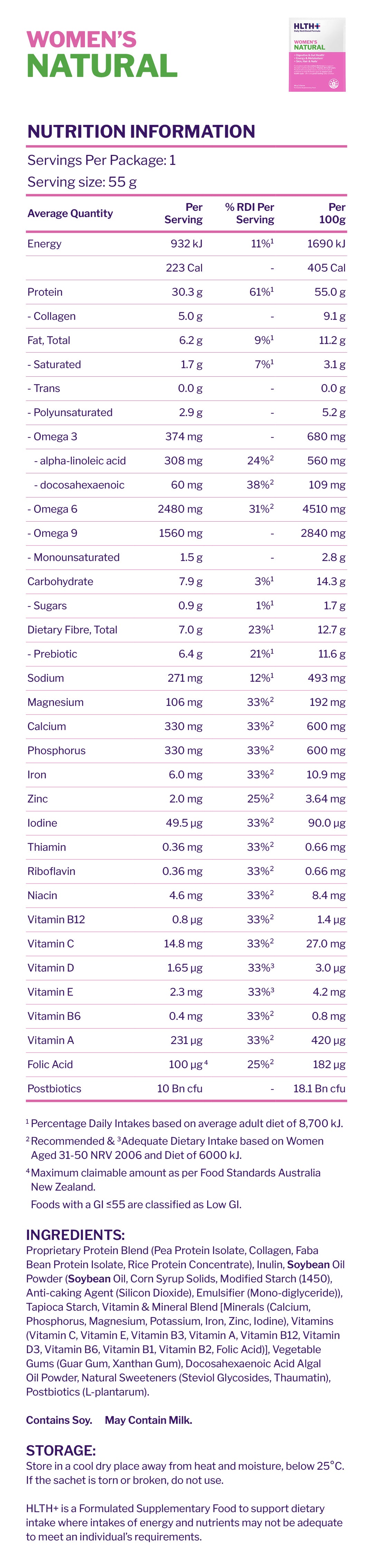
HLTH+ is a daily nutritional formula: a Formulated Supplementary Food under the FSANZ Food Standards Code, made in Australia in facilities complying with Good Manufacturing Practice. It does not act on the GLP-1 receptor, does not raise your own GLP-1, and makes no weight-loss claim. Its job is the nutrition side of the arithmetic above, when a day's food is carrying less than it used to.
Each 55g serve delivers 30g protein per serve, 7g dietary fibre, 60mg DHA and 30 essential daily nutrients. Protein contributes to the maintenance and growth of muscle mass. Dietary fibre contributes to regular laxation.
The formulas are built by dietitians for a life stage rather than for an average: Women's, Women's 50+, Men's and Men's 50+, each dosed against the Nutrient Reference Values published by the National Health and Medical Research Council, the Australian Government Department of Health and Ageing and the New Zealand Ministry of Health. Requirements shift at 30, at 50 and again at 70, so one formula dosed for everybody is dosed precisely for nobody.
We believe in a food-first approach, and the statistics above say food alone is not getting there. That is what this is: nutritional insurance underneath a food-first plan, never a substitute for eating well, and never a comparison with anything prescribed. If you are weighing a formula against a medicine, they answer different questions, which we set out in supplement versus medication and in nutrition support, explained.
RRP $6.00. A 28-serve subscription at $142.80 works out at $5.10 a day, and a 14-serve subscription at $75.60 is $5.40 a day, with pause, skip and cancel available at any time. It is sold at hlthplus.com, and also through the HLTH+ Amazon AU store and Chemist Warehouse online.
The quiz is diagnostic rather than promotional: it shows you what your current supplement routine is not covering. If that is the question you came in with, the ✦ Find My Formula quiz takes 30 seconds.
Frequently Asked Questions
What is a GLP-1 agonist?
A GLP-1 agonist is a molecule that binds the GLP-1 receptor and activates it, the same receptor used by glucagon-like peptide-1, a hormone your gut releases after eating. Native GLP-1 lasts about one to two minutes before an enzyme inactivates it. The medicines are engineered to resist that step, so the signal persists.
How does a GLP-1 agonist reduce appetite?
Through two of its three actions. It sustains satiety signalling in appetite-regulating parts of the brain, so the signal that normally ends a meal is present between meals as well, and it slows the rate the stomach empties, so food sits longer and fullness lasts longer.
What is the difference between GLP-1 and a GLP-1 agonist?
GLP-1 is the hormone your own gut makes, released in a short pulse around meals and broken down within minutes. A GLP-1 agonist is a prescribed molecule built to activate the same receptor and stay active far longer. Same target, very different duration, which is why the effect on eating is so much larger.
What happens to your nutrition on a GLP-1 agonist?
Intake falls but requirements do not. In controlled testing, daily food intake dropped by roughly a quarter, and about 35% at lunch. Protein, dietary fibre, vitamins and minerals travel in that food, so the smaller diet has to be far more nutrient-dense than the one it replaced.
This article is general information, not medical advice. Decisions about any medication belong with your doctor.


Leave a comment
This site is protected by hCaptcha and the hCaptcha Privacy Policy and Terms of Service apply.