


Can a GLP-1 supplement do what the medication does?
No. A prescription GLP-1 medication is a molecule designed to act on the GLP-1 receptor, dispensed on a prescription and monitored by a doctor. An over-the-counter GLP-1 supplement is a food or a complementary product, and nothing sold that way acts on a receptor the way a prescribed molecule does.
If you are searching this, you are probably weighing one of two versions of the question: whether a supplement could stand in for a medication, or whether the supplement your feed keeps showing you adds anything to one you are already taking. Both deserve a straight answer rather than a landing page.
These are not strong and weak versions of one product. They are different products doing different jobs, and only one of those jobs is nutritional. This page puts them side by side on what each actually is, how each is regulated, what the evidence behind each looks like, what each asks of you, and who each is genuinely for.
What each one actually is
Start with the medication, described plainly. GLP-1 is a hormone your gut releases after you eat, and the medication class is a set of prescription molecules built to act at the same receptor for far longer than the hormone itself lasts. Learn more about the hormone in what GLP-1 is, and about the class in GLP-1 agonists explained.
Around 500,000 Australians regularly use GLP-1 medicines (UNSW, 2026), and the researchers behind that figure consider it a likely undercount. One structural fact matters more than any other for this comparison: these are prescription-only medicines, so a doctor is involved by law before anything is dispensed.
Now the shelf. "GLP-1 supplement" is a keyword, not a category, and it covers two products that share nothing except the words on the front of the pack.
- Boosters. Capsules, gummies and powders sold on the idea that their ingredients lift your body's own GLP-1. They borrow the medication class's name and sell the association.
- Nutrition support. Foods built for someone who is already eating far less and whose smaller diet now has to carry the same nutritional load. These make no hormonal claim at all.
The full split is argued in boosters versus nutrition support, and the Australian shelf-by-shelf version sits in the buyer's map.
This section is general information, not medical advice. Decisions about any medication belong with your doctor.
The head-to-head, category by category
| Dimension | Prescription GLP-1 medication | "GLP-1 booster" supplement | Nutrition support food |
|---|---|---|---|
| What it is | A prescription molecule designed to act on the GLP-1 receptor | A capsule, gummy or powder sold on the claim that it lifts your own GLP-1 | A food formulated to carry protein, dietary fibre and micronutrients in a small serve |
| How it is regulated in Australia | Prescription-only, so a doctor is involved by law | Sold as a food or a listed complementary medicine; neither route permits a prescription medicine's claims | A food under the FSANZ Food Standards Code, with a full nutrition panel on the pack |
| What the evidence looks like | Large multi-year clinical trials, published under trial names such as STEP 1 and SURMOUNT-1 | Small, short studies of single ingredients, often measuring a marker rather than what anyone ate | The panel itself: grams you can compare before you buy |
| What it does | Acts at the receptor continuously; in controlled testing, free-choice food intake fell by roughly a quarter a day | Nothing shown to come close to the column on its left | Supplies nutrients a shrunken diet no longer delivers |
| What it does not do | Choose which tissue is lost, or feed you | Replicate a prescription medicine, at any dose or price | Change appetite, hormones or anything a medicine does |
| Where the decision is made | With a doctor, before anything is dispensed | At a checkout, on a claim you cannot verify | At a checkout, on a panel you can verify |
| What it asks of you | Not a shopping decision; this page publishes no pricing or access information for prescription medicines | Whatever the label asks, for a claim the evidence does not carry | A per-serve price printed on the pack, comparable across brands |
| Who it is for | A clinical decision between a person and their doctor; this page takes no position | On the published evidence, nobody | Someone whose intake has dropped and whose nutrition has dropped with it |
Read the bottom row first. Two of these columns are decisions you make in a shop; one is not a shopping decision at all.
A word on cost, because it is the comparison people expect and the one this page will not draw. Prescription pricing and access are matters for a doctor and a pharmacist, not for a content page, so the only price quoted in this article is the one printed on a food label.
What the medication does that a supplement does not
The mechanism is the whole difference. A prescription molecule occupies the GLP-1 receptor and keeps occupying it, so the fullness signal that normally arrives briefly around meals is present for far longer. That is a pharmacological action, and it is the reason these medicines require a prescription.
The size of the appetite change has been measured directly. In controlled testing, GLP-1 medication cut free-choice food intake by roughly a quarter across the day, and about 35% at lunch (Blundell et al, 2017). No supplement ingredient carries evidence in that class, and none is regulated as though it did.
None of that is a recommendation. Medicines carry effects and risks alongside their intended action, and whether one is right for any individual is not a question a shelf, or this page, can answer. What we describe in GLP-1 side effects, explained is information, never encouragement.
General information, not medical advice. Decisions about any medication belong with your doctor.
What neither of them does
Here is the part both columns leave to you. Neither a prescription molecule nor a capsule puts a single gram of protein, dietary fibre or micronutrients into your body. Appetite falls; requirements do not fall with it.
That gap shows up in the body-composition data. In the STEP 1 trial's sub-study, around 40% of the weight lost was lean mass (Wilding et al, NEJM 2021); in SURMOUNT-1 it was around 25% (Look et al, 2025). Protein contributes to the maintenance and growth of muscle mass and to tissue repair, and protein arrives in food, which is now arriving in smaller quantities.
The same logic applies to anyone eating far less for any reason, which is why this comparison is not really about medication at all. Rapid weight loss, reduced eating and medically induced weight loss all shrink the plate, and a shrunken plate is a nutrition problem before it is anything else.
Where the boosters fall down
Boosters are the only products in this comparison that genuinely try to compete with the medication, and the evidence bar is where the attempt fails. Prescription medicines are tested in large, multi-year trials before anyone can dispense them. Booster ingredients typically rest on small, short studies of a single compound, often measuring a hormone marker after one dose rather than what anyone ate that week.
There is a real grain of truth underneath the marketing. Protein and dietary fibre do prompt GLP-1 release, because nutrient contact with the gut is the body's normal signal, which is an argument for eating them rather than for buying a capsule of them. We audit the common ingredients one by one in supplements that claim to increase GLP-1, and size the food and habit levers honestly in natural GLP-1.
More on what changes nutritionally when intake drops: nutrition support when you are eating less.
The job on the other side of the shelf
Nutrition support is the half of this category that survives scrutiny, precisely because it is not competing with anything. It answers a different question entirely: how do you cover protein, dietary fibre and micronutrients when the volume of food carrying them has fallen by a quarter?
The shortfall has been measured. A 2025 study found GLP-1 users averaging 14.5g of dietary fibre a day against the 28g recommended intake used in the study (Frontiers in Nutrition), and a second 2025 study found not a single user meeting the target. Dietary fibre contributes to regular laxation, which matters more here than usual, because a GLP-1 medicine slows gastric emptying and gut motility and bowel regularity commonly changes with it.
The baseline underneath makes it worse. Over 90% of Australian adults do not meet dietary guidelines (AIHW), so the diet being reduced was not covering its bases at full size. Eat a quarter less of it and the gaps widen rather than appear.
That is the argument in full in GLP-1 nutrition support, and the practical eating side in GLP-1 nutrition.
What HLTH+ is in this comparison, and what it is not
HLTH+ sits in the nutrition-support column and nowhere else. It makes no claim to raise GLP-1, no claim to change what any medication does, and no claim to cause weight loss. It is an Australian-owned and made Formulated Supplementary Food under the FSANZ Food Standards Code, built to supplement a diet, which is exactly the job a smaller appetite creates.
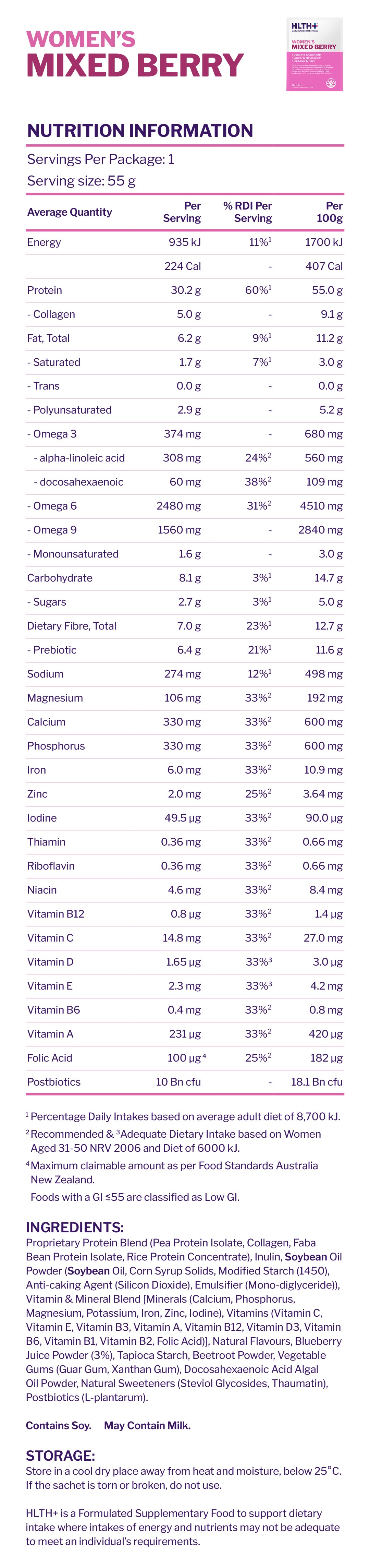
What the panel carries per serve: 30g protein, 7g dietary fibre, 5g collagen, 10 billion CFU Lactobacillus Plantarum Postbiotic plus prebiotics, and 60mg DHA. A postbiotic is the inactivated form of a bacterial culture and the compounds it produces, which is why it is measured in CFU alongside prebiotics rather than compared like for like with a live probiotic count. Across protein, dietary fibre, vitamins, minerals, collagen and DHA, that adds up to 30 essential daily nutrients in one 55g sachet for the Women's formulas.
One more thing sits underneath those numbers, and it is who the dose is built for. Rather than one formula built to the 8,700 kJ average adult diet that Australian labels calculate percentage daily intakes against (Standard 1.2.8, Food Standards Code), which is a labelling reference value sitting above what most adults are advised to eat, HLTH+ is dietitian-formulated to the Nutrient Reference Values set by the National Health and Medical Research Council, the Australian Government Department of Health and Ageing and the New Zealand Ministry of Health, in life-stage versions: Women's, Women's 50+, Men's and Men's 50+. It carries a balanced multivitamin profile on that basis.
Sugar sits at 1.5g in the Women's formulas and 1.7g in the Men's, none of it added, and the free-from list covers nasties, artificial colours, artificial flavours and artificial sweeteners. Dairy-free, gluten-free, low GI, a 5-star Health Star Rating, five flavours, Australian made in facilities complying with Good Manufacturing Practice, with hundreds of reviews across the range. RRP $6.00, or $5.10 a day on the published 28-serve subscription price.
Sold at hlthplus.com, the Amazon AU brand store and Chemist Warehouse online.
Who each is for
The medication. A clinical decision, made between a person and their doctor, on grounds this page does not attempt to weigh. Nothing here is an argument for starting or stopping anything.
A booster. On the published evidence, nobody, and the criteria worth running any booster label through are in what actually supports you. If the real problem underneath the search is feeding a smaller appetite properly, buy for that job instead.
Nutrition support. Anyone whose intake has fallen and whose nutrition has fallen with it, whether the cause is a medicine, age or a busy season. It is also the shelf that matters after the fact: people who stopped a GLP-1 medication regained on average two-thirds of the weight they had lost within a year (Wilding et al, 2022), which makes the eating habits built along the way the part that lasts.
Next step: the 30-second ✦ Find My Formula quiz shows what your current stack is not giving you.
Frequently Asked Questions
Can a GLP-1 supplement do what a GLP-1 medication does?
No, and the gap is not one of strength. A prescription GLP-1 medication is a molecule acting at the GLP-1 receptor, tested in large clinical trials and dispensed by prescription. A supplement is a food or a complementary product, and no ingredient on that shelf carries evidence in the same class.
Are GLP-1 supplements and GLP-1 medications regulated the same way in Australia?
No, and the difference is the clearest signal a shopper has. GLP-1 medicines are prescription-only, so a doctor is involved by law. Supplements are sold as foods under the FSANZ Food Standards Code or as listed complementary medicines, and neither route permits a claim to do what a prescription medicine does.
Is there any point taking nutrition support while eating much less?
Nutritionally, yes, because requirements do not shrink with the plate. A 2025 study found GLP-1 users averaging 14.5g of dietary fibre a day against the 28g recommended intake used in that study. Protein contributes to the maintenance of muscle mass, and it has to arrive in fewer, smaller meals.
Does HLTH+ raise GLP-1 or act like a medication?
No. HLTH+ makes no claim to raise GLP-1, none to change what any medication does, and none to cause weight loss. It is an Australian Formulated Supplementary Food carrying 30g protein, 7g dietary fibre and 30 essential daily nutrients per serve, to supplement a diet when someone is eating less.
What should you compare on the label in this category?
Four numbers and one category check. Protein in grams per serve, dietary fibre in grams, the sugars line, and whether micronutrients are dosed by age and gender rather than to a single label average. Then check it is sold as a food, with a full nutrition panel rather than a hormone promise.
This article is general information, not medical advice. Decisions about any medication belong with your doctor.


Leave a comment
This site is protected by hCaptcha and the hCaptcha Privacy Policy and Terms of Service apply.