


There is no single best magnesium supplement, and the useful answer here is a criterion rather than a brand: buy the form that delivers the elemental magnesium you need, in a version your gut tolerates at that dose. Magnesium oxide is about 60% magnesium by weight and absorbs the worst of the common forms. Magnesium glycinate is about 14% and was the better tolerated of the two in the one trial that compared them.
The confusion is built into the label. The front of the pack advertises the compound, and your body only takes up the magnesium inside it, so a 500 mg magnesium citrate capsule is not a 500 mg magnesium dose.
This page gives you the Australian intake figures, the elemental magnesium in seven common forms, what the absorption trials found, and five criteria to decide on.
How much magnesium do you need a day in Australia?
Start with the target, because it decides everything after it. The Recommended Dietary Intakes are set by age and sex, and they step up at 31.
| Group | Recommended Dietary Intake |
|---|---|
| Males 14 to 18 | 410 mg/day |
| Females 14 to 18 | 360 mg/day |
| Men 19 to 30 | 400 mg/day |
| Men 31 and over | 420 mg/day |
| Women 19 to 30 | 310 mg/day |
| Women 31 and over | 320 mg/day |
| Pregnancy | 350 mg to 400 mg/day, by age |
| Breastfeeding | 310 mg to 360 mg/day, by age |
Figures from healthdirect, magnesium, the Australian government health service, retrieved 2 September 2026. These are the Nutrient Reference Values for Australia and New Zealand.
Two things follow. Men need about 100 mg a day more than women across adult life, so a household sharing one bottle is dosing one person correctly at best. And the numbers are modest: 320 mg sits well inside what ordinary food delivers, which is why the first question is not which supplement, but whether you need one. Requirements keep moving with age, which is the practical half of healthspan against lifespan.
Can food get you to 320 mg?
Magnesium arrives with food volume rather than from one hero ingredient. Healthdirect names green leafy vegetables, legumes, nuts and seeds, and wholegrains as the main sources, which is the same list that thins out first when someone starts eating less.
That matters because the baseline is already poor. Over 90% of Australian adults do not meet dietary guidelines (AIHW), and the food groups most often missed are exactly the magnesium carriers.
Some medicines also pull magnesium down over time. Healthdirect names long-term use of diabetes medicines, antibiotics and antivirals, diuretics, chemotherapy, immunosuppressants and proton pump inhibitors. This is general information, not medical advice, and decisions about any medication belong with your doctor.
If you are rebuilding meals around a smaller appetite, what to eat when your appetite has dropped covers the sequencing.
What is elemental magnesium, and why does it set your dose?
This is the one criterion that decides whether a product is good value, and most pages answering this search skip it. Magnesium is never sold on its own. It is bound to something else, and the number on the front of the pack includes the something else.
You can work it out from the chemistry. Magnesium's atomic weight is 24.31. Magnesium oxide has a molecular weight of 40.31, so magnesium makes up about 60% of it. Magnesium bisglycinate has a molecular weight of 172.42, so magnesium makes up about 14%.
Same 500 mg printed on two labels, and one delivers roughly 300 mg of magnesium while the other delivers roughly 70 mg. A four-fold difference, hiding behind an identical-looking number.
So the rule is short: find the line that states the magnesium itself, and if a label gives you only the compound weight, you do not have the dose.
The seven forms, compared on content, absorption, tolerance and use
| Form | Elemental magnesium | Absorption evidence | Tolerance | Typically bought for |
|---|---|---|---|---|
| Magnesium oxide | about 60% | Relatively poor against chloride, lactate and aspartate (Firoz and Graber, 2001) | Less well tolerated than the glycinate chelate (Schuette, 1994) | Cheapest magnesium per capsule; constipation |
| Magnesium chloride | about 25% anhydrous, about 12% as the hexahydrate | Greater than or equal to oxide (Firoz and Graber, 2001) | Dose-dependent; salty in liquid form | Liquids, flakes and topical sprays |
| Magnesium citrate | about 16% as trimagnesium dicitrate, about 11% as the one-to-one salt | Slightly better than inorganic salts in some studies, no different in others (Schuchardt and Hahn, 2017) | Loosens the bowel as the dose rises | A common first supplement |
| Magnesium malate | about 15% | No published human head-to-head comparison found | Dose-dependent, as with any oral magnesium | Tiredness and muscle soreness formulas |
| Magnesium glycinate | about 14% | Matched oxide overall in a 12-patient crossover, clearly better in the four absorbing worst (Schuette, 1994) | Better tolerated than oxide by every patient in that trial | Nightly use and sensitive stomachs |
| Magnesium taurate | about 9% | No published human head-to-head comparison found | Dose-dependent; more capsules per dose | Cardiovascular and calm-focused formulas |
| Magnesium L-threonate | about 8% | No published human head-to-head comparison found | Dose-dependent; the most capsules per 100 mg here | Cognition and sleep formulas |
Elemental figures are calculated from each compound's molecular formula and weight in PubChem against magnesium's atomic weight of 24.31. "No published comparison found" means a search of the human trial literature on 2 September 2026 returned no bioavailability study setting that form against the others.
Two rows deserve more than a cell. Magnesium L-threonate carries the least magnesium per capsule on the shelf and usually the highest price per milligram, and its reputation rests on a small trial: 23 people on the compound against 21 on placebo for 12 weeks, run by authors affiliated with the company that makes the ingredient (Liu and colleagues, Journal of Alzheimer's Disease, 2016). It reported a cognitive result and said plainly that placebo effects were too strong for any sleep effect to be read.
Magnesium taurate is the other form sold on a story rather than a comparison. At about 9% magnesium a meaningful dose takes a lot of capsules, and the human literature naming it is thin.
Does the form actually change how much you absorb?
Less than the marketing suggests. The most useful summary is a review of the absorption literature that found reported uptake rates spanning 10% to 75% depending on dose and method, with roughly a third to a half absorbed at a typical intake near 370 mg a day (Schuchardt and Hahn, Current Nutrition and Food Science, 2017).
On the organic-versus-inorganic argument that drives the category's marketing, the same review is blunt. Some studies show slightly higher bioavailability for organic salts such as citrate and gluconate, others show none, and the authors conclude that all types of magnesium are suitable for maintaining or restoring magnesium status.
The form that does separate is oxide. A comparison of commercial preparations found relatively poor bioavailability for magnesium oxide and greater or equivalent bioavailability for chloride, lactate and aspartate (Firoz and Graber, Magnesium Research, 2001).
Dose matters far more than form. In the review's worked example, 65% of a 36 mg daily dose was absorbed against only 11% of a 973 mg dose. Splitting a dose across the day recovers more magnesium than any switch between salts will.
Why cheap magnesium sends you to the bathroom
The same arithmetic read from the other end. If only 11% of a large dose is absorbed, the rest stays in the gut, where magnesium draws water in behind it. Healthdirect lists diarrhoea, nausea and abdominal cramps as the signs of taking too much.
That is why the cheapest product is often the least usable. Oxide gives you the most magnesium per capsule and the least of it absorbed, so your tolerable dose ends up set by your gut rather than by the label. In a crossover trial in patients with ileal resection, the glycinate chelate was better tolerated by every patient (Schuette and colleagues, Journal of Parenteral and Enteral Nutrition, 1994).
If your reason for taking magnesium is constipation, the loosening effect is the point. If it is anything else, you are paying for a side effect.
More on what changes when calories drop and tiredness sets in: nutrition support for vitality.
When should you take magnesium, and with what?
Three habits are supported by the absorption evidence and cost nothing.
- Split the dose. Relative uptake is higher from several small doses across the day than from one large one, because absorption falls as the amount in the gut rises.
- Take it with a meal. In the study the review cites, mean absorption from mineral water was 45.7% taken alone and 52.3% taken with a meal.
- Dissolve it where you can. The review reports about twice the absorption from an effervescent form as from capsules at the same dose, because ionised magnesium is what crosses the gut wall.
On sleep, keep expectations calibrated. Small trials in older adults with insomnia found they fell asleep roughly 17 minutes faster (Mah and Pitre, 2021; Abbasi and colleagues, 2012). A real but modest effect, in a group whose sleep and magnesium status were poor to begin with, and not a sedative.
Under Schedule 4 of the Australia New Zealand Food Standards Code, what magnesium is approved to be said to do here is narrow and specific: magnesium contributes to a reduction of tiredness and fatigue, and magnesium is necessary for normal nerve and muscle function. Anything promising more has gone past what the regulator approved. Readers who came here because of broken sleep and fatigue in their forties will find the changes at perimenopause more useful than another bottle.
What happens to magnesium when you are eating a lot less?
Magnesium is one of the first minerals to slide when total food volume drops, because it arrives spread across greens, legumes, nuts and wholegrains rather than from one concentrated source. Remove a third of the plate and you remove a third of the carriers.
That applies to anyone eating substantially less than they used to, whether the trigger is rapid weight loss, reduced eating and medically induced weight loss, a deliberate deficit, or a reduced appetite for any other reason. In trial conditions, GLP-1 medicines reduced food intake by roughly a quarter of daily calories (Blundell and colleagues, Diabetes, Obesity and Metabolism, 2017).
What that changes is the food plan rather than the supplement plan: when volume falls, the density of what remains has to rise. The nutrition changes that follow a smaller appetite cover that in full, and prebiotics, probiotics and postbiotics covers the same label-reading problem one aisle over.
Five criteria for choosing, in order
- Work out the gap before you buy anything. Add up a normal day of greens, legumes, nuts and wholegrains against the figure for your age and sex. If you are close, you have no gap to solve.
- Read the elemental magnesium, not the compound weight. If the label does not state it anywhere, that silence is your answer about the brand.
- Match the form to your gut, not to a claim. Oxide if cost is the constraint and your digestion is fine, glycinate if other forms loosen you, citrate as a reasonable default between them.
- Split the dose and take it with food. That recovers more magnesium than switching salts, and it is free.
- Treat the exotic forms as a story you are paying for. Threonate and taurate carry the least magnesium per capsule and have the thinnest comparative evidence of the seven.
The same criteria transfer almost unchanged to calcium supplements, and the wider question of which bottles are earning their place is worked through in the vitamin and mineral audit.
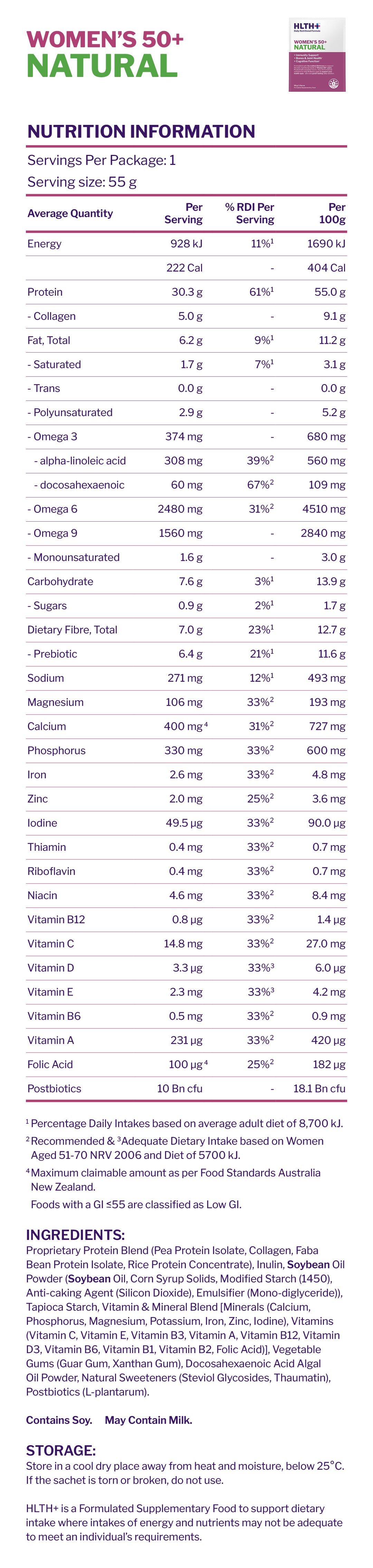
Where a daily nutrition formula fits, and where it does not
The concession first, because this page would be dishonest without it. HLTH+ is not a magnesium supplement and it is not the answer to this search. It is a Formulated Supplementary Food, built to supplement a whole diet rather than to deliver a targeted dose of one mineral. If your gap is specifically magnesium, treat it specifically.
The case for a daily formula is a different one, and it only applies to some readers. Almost nobody is short of exactly one nutrient. The person who works out they are light on magnesium usually finds they are also short on dietary fibre and under on protein, and is running three or four bottles to cover it.
That is the consolidation argument, and it runs on the same logic as the table above. Magnesium requirements move at 31 and differ by sex, and so do most of the others. Australian labels calculate percentage daily intakes against an average adult diet of 8,700 kJ under Standard 1.2.8 of the Food Standards Code, a labelling reference value set above what the Nutrient Reference Values recommend for most adults, so a formula built to it over-delivers calories to the person drinking it. HLTH+ is formulated to the Nutrient Reference Values instead, by gender and life stage, across Women's, Women's 50+, Men's and Men's 50+, published in 2006 by the National Health and Medical Research Council, the Australian Government Department of Health and Ageing and the New Zealand Ministry of Health.
In practice that is one 55g sachet carrying 30g protein and 7g dietary fibre, with 5g collagen, 60mg DHA and 10 billion CFU Lactobacillus Plantarum Postbiotic on the panel. A balanced multivitamin profile sits inside the same serve. Thirty essential daily nutrients in one habit, at RRP $6.00, or $5.10 a day on a 28-serve subscription at $142.80.
Find out what your current stack is actually missing. The ✦ Find My Formula quiz takes about 30 seconds and shows you the gaps your existing bottles leave. Take the quiz, or read how nutrition support works when you are eating less first.
Frequently Asked Questions
Which form of magnesium is best absorbed?
No single form wins clearly. A 2017 review of the absorption literature concluded that organic salts such as citrate are slightly better absorbed than inorganic salts in some studies and no different in others, and that all types of magnesium are suitable for maintaining or restoring magnesium status. Oxide is the one clear laggard.
How much magnesium do I need a day in Australia?
The Recommended Dietary Intakes are 400 mg a day for men aged 19 to 30 and 420 mg from 31, and 310 mg for women aged 19 to 30 and 320 mg from 31. Pregnancy and breastfeeding figures differ by age. Food comes first, so supplement only the shortfall you can identify.
Why does magnesium give me diarrhoea?
Because absorption falls as the dose rises. In one worked example, 65% of a 36 mg daily dose was absorbed against only 11% of a 973 mg dose, so most of a large dose stays in the gut and draws water in behind it. Healthdirect lists diarrhoea, nausea and abdominal cramps as signs of too much.
Is magnesium glycinate better than magnesium citrate?
Not on published absorption evidence: a search of the human trial literature in September 2026 found no head-to-head comparison of the two. Citrate carries about 16% elemental magnesium against about 14% for glycinate, so citrate needs marginally fewer capsules. Glycinate is the usual pick for sensitive stomachs.


Leave a comment
This site is protected by hCaptcha and the hCaptcha Privacy Policy and Terms of Service apply.