


Most Australian adults need 1,000 mg of calcium a day, and that figure steps up to 1,300 mg for women aged 51 and over and for everyone aged over 70. Work out what your food already delivers, then supplement only the gap, in single doses of 500 mg or less.
The reason this question is hard to answer online is that almost every page answering it is selling a bottle. So the dose advice drifts upward, the form question gets settled by whatever the brand happens to sell, and nobody tells you that a cup of milk and a tub of yoghurt have already covered more than half your day.
This page gives you the Australian numbers, the food maths, the two supplement forms and the criteria for deciding whether you need one at all.
How much calcium do you need a day in Australia?
The reference figures are the Nutrient Reference Values for Australia and New Zealand. They set two numbers per group: the Estimated Average Requirement, which is the median requirement, and the Recommended Dietary Intake, which is set high enough to cover almost everyone.
| Group | Recommended Dietary Intake | Estimated Average Requirement |
|---|---|---|
| Men 19 to 70 | 1,000 mg/day | 840 mg/day |
| Men over 70 | 1,300 mg/day | 1,100 mg/day |
| Women 19 to 50 | 1,000 mg/day | 840 mg/day |
| Women 51 to 70 | 1,300 mg/day | 1,100 mg/day |
| Women over 70 | 1,300 mg/day | 1,100 mg/day |
Figures from the Nutrient Reference Values for Australia and New Zealand, calcium. The Upper Level of Intake is 2,500 mg a day for all adults, from food and supplements combined.
Two steps matter. The first is menopause: calcium absorption falls and urinary losses rise, which is why the requirement moves at 51 for women and not for men. The second is age itself: absorption declines in both sexes, so the figure moves again at 70 for men.
Most Australians are under these numbers. Six in ten people aged 2 and over (63.7%) had an inadequate calcium intake from food and drink in 2023, and the split by sex is wide: 75.7% of females against 52.1% of males (Australian Bureau of Statistics, Usual Nutrient Intakes, 2023). Read that as a food-and-drink figure, because the ABS release excludes supplements from the calculation.
Which foods actually deliver calcium, and how much?
Before you price a supplement, price your plate. Three ordinary dairy or fortified serves put most adults within reach of 1,000 mg without a tablet.
| Food | Serve | Calcium per serve |
|---|---|---|
| Milk | 1 cup | around 300 mg |
| Yoghurt | 200 g tub | around 300 mg |
| Calcium-fortified soy milk | 250 ml | around 300 mg |
| Tofu (varies by type) | 1 cup, 260 g | around 832 mg |
| Canned salmon, bones included | half a cup | 310 mg |
| Calcium-fortified breakfast cereal | 1 cup, 40 g | up to 200 mg |
| Cooked broccoli | 1 cup | about 50 mg, of which 50 to 60% is absorbed |
| Cooked spinach | 1 cup | 80 mg, of which only about 5% is absorbed |
| Almonds | 15 nuts | about 40 mg |
Figures from Better Health Channel, calcium, Victorian Department of Health.
The spinach row is the one worth pausing on, because it is the reason "eat your greens" is not a calcium plan on its own. Spinach is high in oxalate, which binds calcium and blocks most of it; broccoli and the cabbage-family greens are low in oxalate and give up 50 to 60% of what they carry. A cup of broccoli with 50 mg beats a cup of spinach with 80 mg on the amount you actually absorb.
Calcium-fortified plant milks are the other quiet winner, and they are not automatic. Fortification is optional in Australia, so two oat milks on the same shelf can differ by 300 mg a cup. Check the nutrition panel, not the front of the carton.
If you are rebuilding meals around a smaller appetite, the ordering of what goes on the plate matters more than usual; what to eat when your appetite has dropped covers that sequencing in detail.
Calcium carbonate or calcium citrate: which form, and does it need food?
There are two forms in almost every pharmacy in the country, and the choice between them changes both your dose and your timing.
| Criterion | Calcium carbonate | Calcium citrate |
|---|---|---|
| Elemental calcium by weight | 40% | 21% |
| Tablets for a given dose | Fewer, since each tablet carries more calcium | More, since each tablet carries less |
| Stomach acid | Solubility falls when stomach acid is low | Less dependent on stomach acid |
| Take with food? | Yes, take it with a meal | Not required, though absorption is still greater with food |
| Digestive complaints reported | More common, particularly in older adults with lower stomach acid | Less common |
Figures and characteristics from the NIH Office of Dietary Supplements calcium fact sheet.
The elemental calcium number is the one people misread. A 1,250 mg calcium carbonate tablet is not 1,250 mg of calcium; at 40% by weight it delivers about 500 mg. Australian labels state the elemental figure, so read that line and ignore the compound weight on the front.
Practical reading of the table: carbonate is cheaper and more compact, and it belongs with a meal. Citrate is the sensible pick if you take acid-reducing medication, have had gastric surgery, or found carbonate gave you bloating or constipation. Whichever you choose, taking it with food improves absorption, so there is no timing advantage in taking a supplement on an empty stomach.
Two spacing rules worth knowing. Calcium competes with iron and zinc for absorption, which is one reason the Upper Level exists at all, so keep a calcium dose and an iron tablet a few hours apart. The same spacing logic applies to magnesium and the timing questions around it.
Why single doses above 500 mg absorb poorly
Calcium absorption is not linear. The proportion your body takes up falls as the dose rises, so a bigger tablet does not buy proportionally more calcium.
The NIH Office of Dietary Supplements puts it plainly: absorption from supplements is highest at doses of 500 mg or less, and the body absorbs about 36% of a 300 mg dose against about 28% of a 1,000 mg dose. Run the arithmetic and 300 mg delivers roughly 108 mg absorbed, while 1,000 mg delivers about 280 mg. You more than triple the dose to less than triple the result, and you carry the extra load through your gut for nothing.
The practical version is short:
- Split anything above 500 mg into two doses at different times of day.
- Count the calcium in your food when you set the supplement dose, not on top of it.
- Keep total intake from food plus supplements under the 2,500 mg Upper Level.
- If a single tablet on the shelf carries 600 mg elemental calcium or more, it is built for label appeal, not absorption.
This is also why the "one big tablet" habit rarely closes a gap that a second serve of yoghurt would have closed for free.
Where do vitamin D and vitamin K fit?
Vitamin D is not optional here. It is required for calcium to be absorbed in the gut by active transport, which is the pathway doing most of the work when calcium intake is on the low side. Low vitamin D status is one of the listed reasons two people eating the same calcium end up absorbing different amounts, alongside heavy caffeine or alcohol intake and conditions such as coeliac disease.
Vitamin K is the more oversold half of the pair. It is a genuine cofactor for the carboxylation of osteocalcin, one of the main proteins in bone, and higher vitamin K intakes track with higher bone mineral density in some observational work. But the NIH Office of Dietary Supplements vitamin K fact sheet is direct about the trial evidence: randomised trials since the 2006 systematic review have found that vitamin K supplementation has no effect on bone mineral density in older men or women, and the picture across trials is mixed rather than settled.
So the honest hierarchy is: get the calcium, sort the vitamin D, and treat added vitamin K as unproven rather than essential. If you are auditing a stack of bottles for what is actually earning its place, the vitamin and mineral audit applies the same test across the rest of the cabinet.
More on why nutrient targets shift as you age, and what that means for the decades ahead: healthspan and how it differs from lifespan.
What happens to calcium intake when you are eating a lot less?
Calcium is one of the first nutrients to fall when total intake falls, because most Australians get most of theirs from a small number of dairy serves. Drop breakfast and the afternoon yoghurt and you have removed 600 mg before you have thought about it once.
That arithmetic matters for anyone eating substantially less than they used to, whether the trigger is rapid weight loss, reduced eating and medically induced weight loss, a deliberate deficit, or a reduced appetite for any other reason. In trial conditions, GLP-1 medicines reduced ad libitum food intake by roughly a quarter of daily calories (Blundell and colleagues, Diabetes, Obesity and Metabolism, 2017). Eat a quarter less of a diet that was already under the calcium figure and the shortfall widens rather than holds.
This is general information, not medical advice, and decisions about any medication belong with your doctor. What the numbers change is your food plan: when the volume of food drops, the density of what remains has to rise. The nutrition changes that follow a smaller appetite go through that in full.
Who actually needs a calcium supplement?
Supplements answer a gap, not a category. Work through these four questions in order and the answer usually settles itself.
- Add up a normal day. Three calcium-rich serves puts most adults near 1,000 mg. If you are consistently hitting that, you do not have a calcium problem to solve.
- Check which figure applies to you. A woman of 52 needs 1,300 mg, not 1,000 mg, so a diet that was adequate at 45 can be 300 mg short at 55 with nothing about it having changed.
- Ask whether dairy is in or out. People who avoid dairy through lactose intolerance, allergy or preference typically need fortified foods or a supplement to reach the recommended amounts, because the non-dairy sources are less concentrated.
- Then supplement only the difference. If you are eating 700 mg and need 1,300 mg, the target is a 600 mg gap split across two doses, not a maximum-strength tablet.
The groups where the answer is most often yes are the ones the ABS data already flags: 90.7% of Australian females aged 50 to 64 had an inadequate calcium intake from food and drink in 2023, and 74.1% of males aged 75 and over. If you are in either group, the base rate is against you. Women moving through this life stage will find the wider set of changes at perimenopause useful context, and anyone building a nutrition plan for later life should read what changes about protein after 60.
Under Schedule 4 of the Australia New Zealand Food Standards Code, the approved claims for the nutrient are that calcium is necessary for normal teeth and bone structure, and necessary for normal nerve and muscle function. That is the whole of what calcium is approved to be said to do in food marketing here, and anything you read promising more than that is going beyond what the regulator has approved.
Where a daily nutrition formula fits, and where it does not
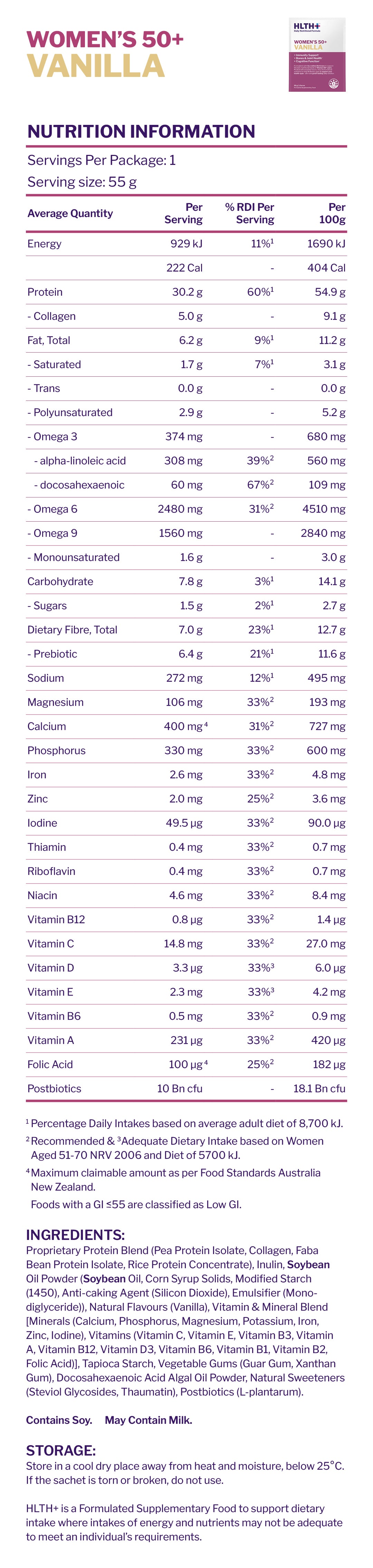
Start with the concession, because it is the honest one: HLTH+ is not a calcium supplement. It is a Formulated Supplementary Food, built to supplement a diet rather than to deliver a therapeutic dose of any single mineral. If your gap is specifically calcium and it is large, treat it specifically: use the food table above, read the elemental calcium line on any tablet you consider, and talk to your doctor or an Accredited Practising Dietitian.
What a daily formula answers is the other half of the problem this page keeps running into. Over 90% of Australian adults do not meet dietary guidelines (AIHW), and almost nobody is short of exactly one nutrient. The reader who has worked out they are 400 mg light on calcium usually discovers they are also light on dietary fibre, and short of protein, and running a shelf of four bottles to cover it.
That is the consolidation argument, and it is the same argument as the life-stage one. Calcium requirements move at 51 for women and at 70 for men; they are not a single adult number, and neither are the rest. Australian food labels calculate percentage daily intakes against an average adult diet of 8,700 kJ under Standard 1.2.8 of the Food Standards Code, which is a labelling reference value set above what the Nutrient Reference Values recommend for most adults, so a product formulated to it over-delivers calories to the individual drinking it. HLTH+ is formulated to the Nutrient Reference Values instead, by gender and life stage, across Women's, Women's 50+, Men's and Men's 50+. Those values were published in 2006 by the National Health and Medical Research Council, the Australian Government Department of Health and Ageing and the New Zealand Ministry of Health.
In practice that is one 55g sachet carrying 30g protein, 7g dietary fibre, 5g collagen and 60mg DHA, plus 10 billion CFU Lactobacillus Plantarum Postbiotic. Thirty essential daily nutrients in one habit, at RRP $6.00, or $5.10 a day on a 28-serve subscription at $142.80.
Find out what your current stack is actually missing. The ✦ Find My Formula quiz takes about 30 seconds and is built to show you the gaps your existing bottles are leaving, not to sell you another one. Take the quiz, or read how nutrition support works when you are eating less first.
Frequently Asked Questions
How much calcium do I need a day in Australia?
Adult men aged 19 to 70 and women aged 19 to 50 need 1,000 mg a day. Women aged 51 and over and men aged over 70 need 1,300 mg. These are the Recommended Dietary Intakes in the Nutrient Reference Values for Australia and New Zealand. The Upper Level from food plus supplements is 2,500 mg.
Is calcium carbonate or calcium citrate better?
Carbonate is 40% elemental calcium and citrate is 21%, so carbonate needs fewer tablets. Carbonate must be taken with a meal because it needs stomach acid; citrate does not, which suits anyone on acid-reducing medication. Carbonate is also more often linked to bloating and constipation, especially in older adults.
Can I take 1,000 mg of calcium in one dose?
You can, but you absorb a smaller share of it. The NIH Office of Dietary Supplements reports about 28% absorption from a 1,000 mg dose against about 36% from 300 mg, with absorption highest at 500 mg or less. Split anything over 500 mg across two doses at different times of day.
Do I still need calcium if I take a daily nutrition formula?
Possibly, and it depends on your food. A Formulated Supplementary Food supplements a diet; it is not a dedicated calcium supplement, and it does not replace the food maths. Add up your calcium-rich serves against the figure for your age and sex first, then decide whether a gap remains.


Leave a comment
This site is protected by hCaptcha and the hCaptcha Privacy Policy and Terms of Service apply.