


The Man Shake's published product page lists 30g of high-quality whey protein, 7.5g of dietary fibre and 2.4g of sugars per serve, with 15 servings in a $54.95 pack (retrieved 2 September 2026). That is a strong meal replacement label at $3.66 a serve. Whether it suits you turns on the question most reviews skip: are you replacing meals, or supplementing them?
Most reviews of it are one person's month and one person's scales, which tells you very little about the panel. If you are already eating less than you used to, every serve has to carry more of the day than it once did, so the panel is the part that decides it.
This review puts the published figures on the table, names where The Man Shake wins, and shows where a daily nutritional formula is doing a different job rather than a better version of the same one.
What does The Man Shake put on its label?
The Man Shake is an Australian meal replacement shake marketed to men, sold in packs of 15 servings. Its own product page publishes four figures per serve, quoted here as the brand states them (retrieved 2 September 2026):
- 30g of "high-quality whey protein"
- 7.5g of dietary fibre
- "Only 2.4g of sugar per serve"
- "Pre & Probiotics", named in the copy with no cell count published
Something is missing, and it changes how you read every review of this product, including this one. The brand's nutritional-information page does not render a nutrition information panel for the shake to an automated read, and three attempts on three separate dates returned the same result. So calories, sodium and the per-flavour rows appear nowhere below. If those decide it for you, read them off the pack.
What the figures do support is a genuinely good dietary fibre number. Under Schedule 4 of the Australia New Zealand Food Standards Code, 7g per serving is the threshold a food clears before it can be called an excellent source of dietary fibre, and at 7.5g The Man Shake clears it. That belongs first, because it survives the comparison.
Price is the other figure published plainly: $54.95 for the pack, or $49.45 on Subscribe & Save. Across 15 servings that is $3.66 a serve, or $3.30 on subscription.
How do you judge a shake from its label?
Ignore the front of the pack and read five lines off the panel.
- Protein per serve. Protein contributes to the maintenance and growth of muscle mass and to tissue repair, and 30g is the mark the strongest labels hit. How much you personally need depends on body weight and training load, worked through here.
- Dietary fibre per serve. Dietary fibre contributes to regular laxation, and it is the line most shakes are quietest about.
- Sugars per serve. Check the total, and whether any of it was added.
- Live cultures, and which kind. Probiotics and postbiotics are different classes of ingredient, so a count on one label and a count on another are not the same measurement.
- Who the formula was calculated for. Almost nobody reads this one. Australian labels calculate percentage daily intakes against an average adult diet of 8,700 kJ under Standard 1.2.8 of the Food Standards Code. That is a labelling reference value rather than a recommendation for you, and it sits above what the Nutrient Reference Values advise for most adults, so a formula built to it over-delivers calories to the person drinking it.
Why that last line matters more than it used to: over 90% of Australian adults do not meet dietary guidelines on the AIHW poor-diet measure, and fewer than 1 in 20 eat the recommended serves of vegetables (ABS). The gap a daily shake is asked to cover is wider than protein.
The Man Shake and HLTH+ Men's, label to label
Both labels put 30g of protein in a serve, so the row most people compare on is a tie before we start. Everything below is quoted from each brand's published information, and no row appears unless both sides of it are filled.
| Per serve | The Man Shake | HLTH+ Men's | The difference |
|---|---|---|---|
| Protein | 30g, "high-quality whey protein" | 30g | Matched on the number, different source |
| Dietary fibre | 7.5g | 7g | The Man Shake lists 0.5g more |
| Sugars | 2.4g | 1.7g, none added | HLTH+ lists about 29% less |
| Live cultures | "Pre & Probiotics" named in the product copy, no cell count published | 10 billion CFU Lactobacillus Plantarum Postbiotic, plus prebiotics | Only HLTH+ publishes a figure |
| Collagen | Not listed in their published product information | 5g | Only HLTH+ lists it |
| Essential fats | No omega-3 or DHA listed in their published product information | 60mg DHA | Only HLTH+ lists a dose |
| Protein source | Whey, which is a dairy protein | Dairy-free, gluten-free | Different fit for dairy-sensitive readers |
| Formulated for | Men | Sex and life stage, by Accredited Dietitians to the Nutrient Reference Values | Dosed by life stage as well as sex |
| Price per serve | $3.66, or $3.30 on subscription ($54.95 and $49.45 across 15 servings) | RRP $6.00, or $5.10 a day on a 28-serve subscription at $142.80 | The Man Shake is cheaper per serve |
| Category | Meal replacement, built to replace a meal | Formulated Supplementary Food, built to supplement meals | Different jobs |
Figures from each brand's published nutrition information, retrieved 2 September 2026; check current labels before purchase. Brands reformulate and flavours vary, and every "only HLTH+" statement above is scoped to this comparison.
The formulation row needs unpacking. HLTH+ publishes separate Women's, Women's 50+, Men's and Men's 50+ versions, formulated by Accredited Dietitians to the Nutrient Reference Values, the reference intakes published in 2006 by the National Health and Medical Research Council, the Australian Government Department of Health and Ageing and the New Zealand Ministry of Health. Those values set different intakes by age and sex, which one formula cannot follow. The Man Shake publishes one shake marketed to men, which is a legitimate design choice and a simpler one.
The live-cultures row needs a word too, because the labels describe different things. A probiotic is a living organism that has to survive the pack, the shelf and your stomach acid. A postbiotic is the set of compounds those organisms produce, supplied ready-made, so nothing has to stay alive on the way in. HLTH+ lists 10 billion CFU of Lactobacillus Plantarum Postbiotic alongside prebiotics. The two are not the same class of ingredient, so the counts are not like-for-like, and The Man Shake publishes no count at all.
Where The Man Shake genuinely wins
Three things, and they are real.
Dietary fibre. 7.5g against 7g. It is half a gram, but it is their row and they take it on their own published number.
Price per serve. $3.30 on subscription against RRP $6.00. That is not close, and nothing else in the sachet changes the arithmetic. If cost per serve is your deciding criterion, this comparison is already settled.
It does one job and it is unambiguous about it. You drink it instead of a meal, and nothing has to be worked out about where it fits in the day. For plenty of people that simplicity is the entire appeal.
If you are shortlisting meal replacements rather than daily formulas, the same label reading applies to The Lady Shake. Optifast and OptiSlim sit further along again: pharmacy very-low-calorie programs, a more clinical category, covered separately on this blog.
What does "high-quality protein" mean on a shake label?
The Man Shake's own copy calls its 30g high-quality whey protein. Whey is a dairy protein, and that phrase carries a specific meaning worth knowing before you compare any two labels.
Your body cannot make nine of the roughly twenty amino acids that build protein, so those nine have to arrive in food (Better Health Channel, Victorian Department of Health). Animal and dairy proteins carry large amounts of all nine, which is why that source calls them high-quality protein. Plant proteins do contain all nine, but the amounts of one or two are often low, which is why a mixed plant meal such as cereals with legumes delivers what a typical meat dish delivers.
So protein source is a real dimension, and a separate question from protein grams: two labels can both read 30g and be built from different raw material. If you avoid dairy, whey decides the product for you regardless of the rest of the panel.
HLTH+ is dairy-free and gluten-free, which is a fit question rather than a quality ranking. Whichever way you go, read the amino acid information on any label you compare, and treat a brand that publishes none as a brand that has told you something. The same test runs through the protein powder comparison for women and the ingredient-count arguments in the IM8 review.
What changes when you are eating a lot less?
Meal replacement shakes exist because people want to eat less, and the nutrition question that follows is the same whether the cause is rapid weight loss, reduced eating and medically induced weight loss, a deliberate deficit, or an appetite that has simply dropped.
The size of the change is measurable. In trial conditions, GLP-1 medicines reduced ad libitum food intake by roughly a quarter of daily calories (Blundell and colleagues, Diabetes, Obesity and Metabolism, 2017).
Two consequences follow, and neither is about a product. One is dietary fibre: a 2025 study of GLP-1 users found average intake of 14.5g a day against the recommended 28g (Frontiers in Nutrition). The other is lean mass: in the STEP 1 trial's body-composition sub-study, roughly 40% of the weight lost was lean mass (Wilding and colleagues, New England Journal of Medicine, 2021).
Then the phase ends. In the STEP 1 extension, participants regained a mean of two-thirds of the weight they had lost within a year of stopping (Wilding and colleagues, 2022). What you eat afterwards is a separate question from what you drink during, and it is the one a meal replacement was never designed to answer.
This page is general information, not medical advice, and decisions about any medication belong with your doctor. Learn more about what happens to nutrition when overall intake drops, or start with what a GLP-1 actually is if the term is new to you.
Who each shake suits
- You want something that stands in for a meal, inside a plan. That is the job The Man Shake was built for. Judge it on its current pack and the plan's own guidance.
- Cost per serve is your deciding number. $3.30 on subscription is the cheaper option and nothing here argues otherwise.
- You avoid dairy. Whey settles it, and a dairy-free formula is the practical alternative.
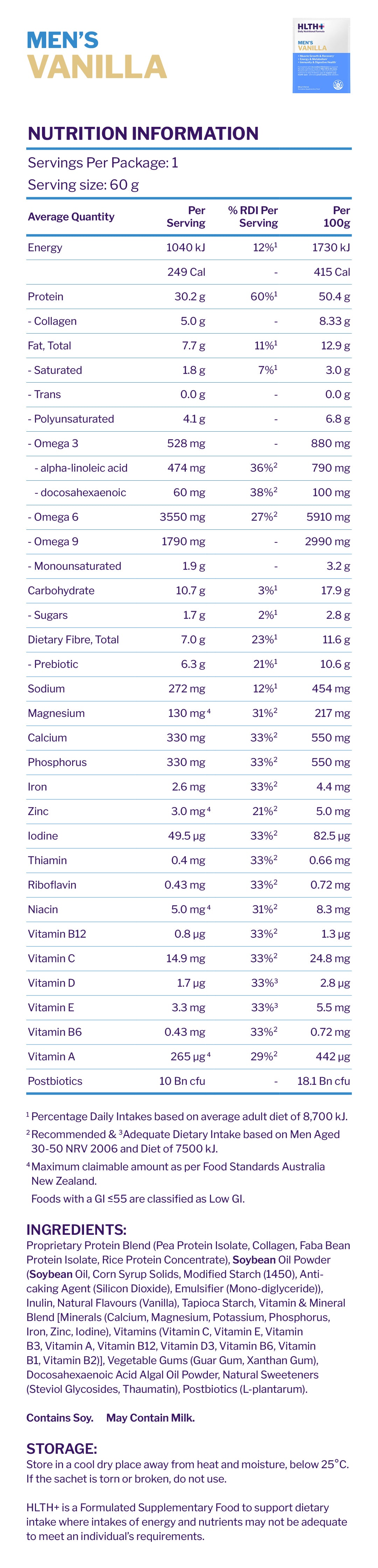
- You want protein, dietary fibre and micronutrients covered while you keep eating normal food. Different category, and where HLTH+ Men's sits: 30g protein, 7g dietary fibre, 1.7g sugar and 248 calories in a 60g sachet.
- You are past the phase. When the shakes stop and normal eating resumes, a daily formula is the habit that carries on.
Nutrient needs are not one adult number, and they move at different points for men and for women. Calcium is the clearest example on the male side, because the recommended intake steps up with age, and the Australian figures are here. For women the sharpest shift arrives with perimenopause.
Where a daily nutritional formula fits
Start with the concession, because it is the honest one. HLTH+ is not a meal replacement and it is not a weight-loss product. It is a Formulated Supplementary Food under the FSANZ Food Standards Code, built to supplement the food you already eat rather than stand in for a meal. If what you want is a shake instead of lunch, The Man Shake is built for that and this is not.
What a daily formula answers is the other half of the problem. Almost nobody is short of exactly one thing, and the category makes that worse: a greens powder carries 1 to 2g of protein, a collagen powder carries no multivitamin, and a multivitamin carries neither protein nor dietary fibre. That is how a shelf of bottles happens, and the consolidation argument is one habit instead of that shelf.
A 60g Men's sachet carries 30g protein, 7g dietary fibre, 5g collagen, 60mg DHA and 10 billion CFU Lactobacillus Plantarum Postbiotic, at 1.7g of sugar with none added and 248 calories. It also carries a balanced multivitamin profile. Counted across protein, dietary fibre, vitamins, minerals, collagen and the essential fats, that comes to 30 essential daily nutrients in one serve, formulated to the Nutrient Reference Values published by the National Health and Medical Research Council, the Australian Government Department of Health and Ageing and the New Zealand Ministry of Health, by sex and life stage across Women's, Women's 50+, Men's and Men's 50+.
It is Australian-owned and Australian-made in facilities complying with Good Manufacturing Practice, carries a 5-star Health Star Rating, and holds hundreds of reviews across the range. It sells at hlthplus.com at RRP $6.00, or $5.10 a day on a 28-serve subscription at $142.80, and through Amazon AU and Chemist Warehouse online.
Find out what your current stack is actually missing. The 30-second ✦ Find My Formula quiz shows the gaps your existing bottles leave. If you would rather read first, how nutrition support works when you are eating less covers the mechanics and protein when appetite drops covers the number most people get wrong.
Frequently Asked Questions
How much protein is in The Man Shake?
The Man Shake's published product page lists 30g of high-quality whey protein per serve, alongside 7.5g of dietary fibre and 2.4g of sugars, with 15 servings per pack (retrieved 2 September 2026). HLTH+ Men's lists 30g protein per serve. Both sit at the top of the category on protein; check the current label before buying.
How much does The Man Shake cost per serve?
$54.95 buys 15 servings on their published product page, which is $3.66 a serve, and $49.45 on Subscribe & Save works out at $3.30 (retrieved 2 September 2026). HLTH+ is RRP $6.00 a sachet, or $5.10 a day on a 28-serve subscription at $142.80.
Is The Man Shake a meal replacement or a daily supplement?
It is a meal replacement, a shake built to stand in for a meal. HLTH+ is a Formulated Supplementary Food under the FSANZ Food Standards Code, built to be drunk alongside your normal meals. Same headline protein figure at 30g, different job, and the choice follows from which one you actually want.
Does The Man Shake contain dairy?
Its published product copy describes the protein as high-quality whey protein, and whey is a dairy protein (retrieved 2 September 2026). For the full allergen statement, read the current pack. HLTH+ is dairy-free and gluten-free, which is a fit question rather than a quality ranking between the two.
Can I use HLTH+ as a meal replacement?
It is not designed as a meal replacement, because it is built to complement a food-first approach rather than stand in for a meal. That said, plenty of people use it as a healthy snack or to tie themselves over, and that works perfectly well. If you specifically want a meal replacement, that is a different category.


Leave a comment
This site is protected by hCaptcha and the hCaptcha Privacy Policy and Terms of Service apply.