

Perimenopause is the run-up to your final period, when oestrogen fluctuates rather than simply declining. In Australia it usually starts between 45 and 55 and lasts about four to eight years (healthdirect). Hot flushes and irregular cycles are the two symptoms everyone can name; the ones that actually send women searching at 2am are broken sleep, aching joints, a stalling memory, mood that swings without warning, a fluttering heart, and a body that changes shape on the same food it always ate.
Most content in this category lists the famous two, points at a prescription, and stops. So you research each unnamed symptom on its own, collect a separate explanation for each, and are never told that several share one hormonal cause and one nutritional overlap.
This page takes the unnamed symptoms one at a time: what the hormone shift is doing, what the evidence says, and where nutrition genuinely intersects, including where it does not.
What is perimenopause, and how long does it actually last?
Perimenopause begins when your cycle starts changing and finishes twelve months after your final period. The average age of menopause in Australia is 51, and around three in four women reach it between 45 and 55 (Jean Hailes for Women's Health).
The word that does the work here is fluctuation. Oestrogen does not glide down a ramp, it swings, and that volatility is why symptoms arrive in clusters, vanish for a month, then return without an obvious trigger.
Severity splits three ways. Jean Hailes reports that around one in four Australian women have no symptoms at all, around one in four have symptoms severe enough to disrupt daily activities, and the remaining half sit between. The middle band is the group most often told nothing much is happening.
Why does sleep fall apart, and where does magnesium fit?
Sleep is usually the first thing to go, and it goes in a specific way: you fall asleep fine and wake at 3am. In the Study of Women's Health Across the Nation, which followed 3,045 women through the transition, difficulty staying asleep was the most common sleep complaint at 25.9%, ahead of trouble falling asleep and early waking (Kravitz and colleagues, Sleep, 2008).
The same study found sleep difficulty climbing across the stages: 28.0% of premenopausal women reported at least one problem, against 34.3% of early perimenopausal women. Night sweats explain some of that, though plenty of women report fragmented sleep with no flushes at all.
Magnesium is the nutrient with a real claim here, and it is a narrow one. Under the Australia New Zealand Food Standards Code, magnesium contributes to a reduction of tiredness and fatigue, and is necessary for normal nerve and muscle function. That is the approved wording, and it is worth reading closely: nothing in it says magnesium is a sleeping aid.
The trial evidence is modest, and honest sources say so. In older adults with insomnia, magnesium supplementation was associated with falling asleep roughly 17 minutes faster, across small trials the authors themselves rated as low quality (Mah and Pitre, BMC Complementary Medicine and Therapies, 2021).
Useful if your intake is low. Not an answer if the problem is hormonal. If you are auditing a shelf of bottles for what is actually earning its place, work through the stack nutrient by nutrient rather than adding another one.
Why do joints ache in perimenopause?
This is the symptom that surprises people most, and it is not rare. A systematic review and meta-analysis pooling 14 studies of 5,836 perimenopausal women put the prevalence of musculoskeletal pain at 71%, with a confidence interval of 64% to 78% (Lu and colleagues, Neural Plasticity, 2020). Australia's healthdirect lists muscle aches and joint pain among the standard physical symptoms too.
Stiff hands in the morning, sore hips after a walk, a shoulder that never used to complain. Because it arrives in the same decade as ordinary wear and tear, it gets filed under age rather than hormones, which is why it goes unnamed.
Nutrition does not act on the joint. It acts on the muscle around it, and that matters because aching joints and shrinking muscle turn up in the same window. Protein contributes to the maintenance and growth of muscle mass and is necessary for tissue building and repair, which is the approved relationship and the whole of it.
The intake question is where midlife women get short-changed. The Australian Dietary Guidelines shift the pattern at 51, moving women from two and a half serves of lean meat, fish, eggs, nuts and legumes plus two and a half serves of dairy, to two serves plus four serves of dairy (Better Health Channel, Victorian Department of Health).
Beyond the guidelines, the ESPEN Expert Group recommends at least 1.0 to 1.2 g of protein per kilogram of body weight per day for healthy older adults, rising to 1.2 to 1.5 g/kg for those who are unwell (Deutz and colleagues, Clinical Nutrition, 2014). For a 68 kg woman that is roughly 68 to 82 g a day, spread across meals rather than loaded into dinner. What to look for in a protein powder covers how to read a panel rather than a front of pack.
Is perimenopause brain fog real, or is it just ageing?
It is real, measurable, and the most reassuring finding about it is rarely repeated. Over four years of testing in 2,362 women, late perimenopausal women failed to show the practice improvement that everyone else showed on a processing speed test. Their scores did not fall; they simply stopped getting better, and after the final period the improvement rebounded to premenopausal levels (Greendale and colleagues, Neurology, 2009).
So the word that will not come is not early dementia and not permanent. It looks like a time-limited effect of the transition itself.
No nutrient makes it go away, and anyone selling you one for that reason is ahead of the evidence. Two threads are still worth pulling, because both cause fog of their own and both are common in this age group.
The first is iron status, covered below. The second is long-chain omega-3 fats: the Heart Foundation recommends 250 to 500 mg of marine-sourced EPA and DHA a day, about two to three serves of fish a week including oily fish (Heart Foundation). That is a heart-health recommendation, not a cognitive one.
What actually changes about body composition?
Something specific happens to lean mass in this window, and it is not a slow drift. Analysing body composition against the timing of the final period, researchers found lean mass rising by about 0.2% a year before the transition and falling by about 0.2% a year during it, while fat mass gain accelerated from about 1.0% a year to about 1.7% (Greendale and colleagues, JCI Insight, 2019). The transition window in that analysis ran from two years before the final period to eighteen months after, a span of three and a half years.
Read that as a direction change, not a catastrophe. The scale can barely move while the composition underneath reorganises, which is why so many women describe the same weight sitting differently.
The two levers with the best evidence are unglamorous: resistance training, and enough protein spread across the day to support it. Neither is a hormonal intervention. How to hit a protein target when your appetite has dropped deals with the practical half of that, and what changes when total intake falls covers the rest of the plate.
More on why the next two decades of nutrition matter more than the last two: how long you live well, not just how long you live.
Why bone loss starts before your last period
This is the most under-communicated fact in the category. Bone loss does not politely wait for menopause; it begins about one year before the final period and only decelerates two years after it.
During that three-year window, lumbar spine bone mineral density fell by 2.46% a year and femoral neck density by 1.76% a year in the SWAN cohort. Over the full ten years of observation, the spine lost 10.6%, and 7.38% of that went in those three years (Greendale and colleagues, Journal of Bone and Mineral Research, 2012). The Australasian Menopause Society puts the same point in plainer terms: the average woman loses up to 10 per cent of her bone mass in the first five years after menopause.
Which makes the Australian intake data uncomfortable reading. Calcium requirements step up from 1,000 mg a day for women aged 19 to 50 to 1,300 mg a day from 51 (healthdirect), and yet 90.7% of Australian females aged 50 to 64 had an inadequate calcium intake from food and drink in 2023, up from 70.3% in the 30 to 49 band (Australian Bureau of Statistics, Usual Nutrient Intakes). The requirement rises at exactly the age intake falls furthest behind it.
The approved nutrient relationships are narrower than most marketing suggests, and worth knowing verbatim. Calcium is necessary for normal teeth and bone structure and for normal nerve and muscle function. Vitamin D is necessary for normal bone structure.
Healthy Bones Australia advises maintaining a vitamin D level of at least 50 nmol/L at the end of winter, which here is mostly a sunlight question and sometimes a blood test one. For dose, form and the food maths, the full calcium breakdown works through it properly.
Iron: the one requirement that moves the other way
Every other nutrient on this page gets harder to meet. Iron does the opposite, and the pivot point is menopause itself.
Cycles in perimenopause often get heavier and closer together before they space out, and heavy periods are associated with iron deficiency and anaemia, which is why Jean Hailes advises getting iron levels checked rather than guessed at (Jean Hailes for Women's Health). Once periods stop, the monthly loss stops with them.
The Australian data shows the cliff clearly. Inadequate iron intake affected 42.2% of Australian females aged 30 to 49, then fell to 9.8% of females aged 50 to 64 (Australian Bureau of Statistics, Usual Nutrient Intakes).
Two things follow. While you are still bleeding heavily, iron is a live issue and worth a blood test, particularly if fatigue and fog are the loudest symptoms. Once you are through, iron is the one nutrient where more is not automatically better, and a supplement taken out of habit is worth reviewing with your doctor.
Mood swings, palpitations, skin and hair
These four are grouped not because they are minor, but because each is common and rarely named.
Mood volatility. More than one in two Australian women who had menopausal symptoms in the previous five years said their mental and emotional wellbeing had been affected (Jean Hailes for Women's Health). This is a clinical conversation, not a nutritional one, and it deserves a real appointment.
Palpitations. Around half of women report them at some point in the transition. Tracking 3,276 women, researchers found 15.9% with a high probability of palpitations through perimenopause into early postmenopause, 34.3% with a moderate probability, and 49.8% with a sustained low probability (Carpenter and colleagues, Menopause, 2023). In that analysis palpitation patterns were not linked to atherosclerosis or arterial stiffness, but new or persistent palpitations warrant a doctor's assessment rather than a supplement.
Skin and hair. Skin gets drier, thinner and itchier, and scalp hair thins. Shedding has a nutritional overlap the others do not: telogen effluvium typically shows up two to three months after a trigger, and low protein intake and crash dieting are both recognised triggers (StatPearls). If your hair started coming out in the shower a few months after a period of eating much less, the timing of hair shedding explains the delay.
Appetite and digestion. Appetite and bowel habits both shift, and dietary fibre is the lever with an approved relationship attached: dietary fibre contributes to regular laxation. If gut symptoms are the ones bothering you, the difference between prebiotics, probiotics and postbiotics is worth understanding before you buy anything.
What nutrition can do here, and what it cannot
Be clear about the boundary, because a lot of content in this category is not.
Nutrition does not act on perimenopause. It does not shorten the transition, smooth the hormonal swings, or do anything to a hot flush.
Menopausal hormone therapy and clinical care for symptoms belong with your doctor, and a nutrition page is not an alternative to that appointment. This is general information, it is not medical advice, and decisions about any medication belong with your doctor.
What nutrition changes is adequacy, at the exact moment several requirements move: protein for the maintenance of muscle mass and for tissue repair, calcium and vitamin D for normal bone structure, magnesium for the reduction of tiredness and fatigue, dietary fibre for regular laxation, and iron in whichever direction your cycle is sending it. That is not a small thing. It is simply a different thing from acting on a symptom, and the two get conflated constantly.
Where a daily nutrition formula fits
Over 90% of Australian adults do not meet dietary guidelines (AIHW). That is the backdrop to every number on this page, and it is why the honest position is food first, with nutritional insurance behind it.
The design problem with most one-size-fits-all products is that they are built to a label reference rather than to a person. Australian food labels calculate percentage daily intakes against an average adult diet of 8,700 kJ under Standard 1.2.8 of the Food Standards Code, and that reference sits above what the Nutrient Reference Values recommend for most adults, so a formula built to it over-delivers calories to the individual drinking it.
HLTH+ is formulated to the Nutrient Reference Values instead, by gender and life stage, across Women's, Women's 50+, Men's and Men's 50+. Those values were published in 2006 by the National Health and Medical Research Council, the Australian Government Department of Health and Ageing and the New Zealand Ministry of Health.
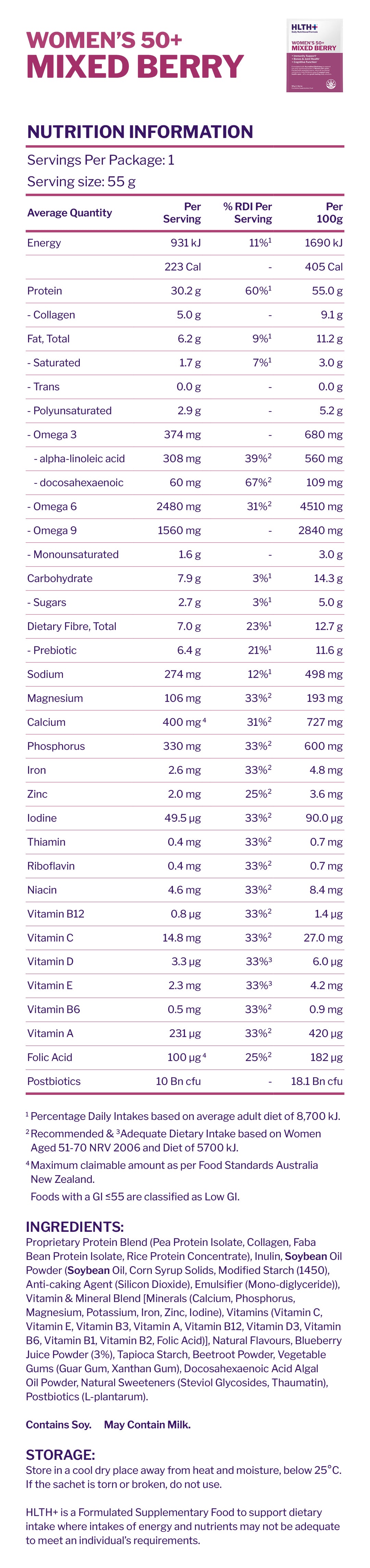
For a woman moving through this life stage, the Women's 50+ formulation is the one built to that band of the Nutrient Reference Values. Thirty essential daily nutrients sit in a single 55g sachet, spanning protein, dietary fibre, vitamins, minerals and omega-3 fats: 30g protein, 7g dietary fibre and 60mg DHA per serve.
The vitamin and mineral component is a balanced multivitamin profile. That is RRP $6.00, or $5.10 a day on a 28-serve subscription at $142.80. It is a Formulated Supplementary Food: it supplements a diet rather than replacing meals or medical care, and it is Australian made in facilities complying with Good Manufacturing Practice.
See what your current stack is actually missing. The ✦ Find My Formula quiz takes about 30 seconds and is built to show you the gaps your existing bottles leave rather than to sell you another bottle. Take the quiz, or read why healthspan matters more than lifespan for the longer view.
Frequently Asked Questions
How long do perimenopause symptoms last?
Perimenopause usually starts between 45 and 55 and lasts about four to eight years, ending twelve months after your final period. The average age of menopause in Australia is 51. Symptom severity varies widely: Jean Hailes reports around one in four women have no symptoms and around one in four have symptoms that disrupt daily activities.
What are the perimenopause symptoms nobody talks about?
Beyond hot flushes and irregular cycles: broken sleep, joint and muscle aches, brain fog and word-finding trouble, mood volatility, heart palpitations, changing body composition, drier skin and thinning hair. Musculoskeletal pain alone affects around 71% of perimenopausal women, and roughly half report palpitations at some stage of the transition.
Which nutrients matter most in perimenopause?
Protein, calcium, vitamin D, magnesium, dietary fibre and iron. Bone loss accelerates from about a year before your final period, calcium requirements rise to 1,300 mg a day at 51, and lean mass starts declining during the transition. Iron moves the opposite way once periods stop.
Is nutrition an alternative to hormone therapy in perimenopause?
No. Nutrition does not shorten the transition or act on a hot flush, and menopausal hormone therapy and clinical care belong with your doctor. What nutrition changes is adequacy at the moment several nutrient requirements shift, which is a different job and still a worthwhile one.

Leave a comment
This site is protected by hCaptcha and the hCaptcha Privacy Policy and Terms of Service apply.