


Yes, for the person it was built for, and that person is more specific than the supermarket aisle suggests. Sustagen Hospital Formula publishes 13.8g of protein, 225 calories and 27g of sugars in a 60g serve made up with 200mL of water (retrieved 2 September 2026). It is a clinical nutrition product, and for the job it was designed to do it is frequently the right choice.
Most people asking this have a tin on the bench, or have watched a parent come home from hospital with one. The question underneath is simpler than it sounds: is this a sensible daily drink for me, or a medical product I have wandered into?
This page reads Sustagen's own published panels, explains the sugar figure rather than treating it as a scandal, and sets out who the product suits.
What is Sustagen, and who is it built for?
Sustagen is an Australian nutrition range, and it is not one product. Six are published on its own site: Hospital Formula, Hospital Formula Plus Fibre, OPTIMUM, Sport, Everyday, and a Ready to Drink version. The two that matter here are Hospital Formula, a 60g serve made up with water or milk, and Everyday, a 15g powder stirred into milk.
The purpose sits in the flagship's name. Hospital Formula is nutrition support: a calorie-dense, vitamin-fortified drink for people who cannot get enough nutrition from food, through illness, surgery, treatment or the appetite loss that comes with age.
The brand is careful about its own limits, and the wording is worth quoting. Its published material states that Sustagen Hospital Formula "cannot be used as a total diet replacement", and that "consuming as a meal replacement option may not be suitable for children. Seek advice from a healthcare professional" (retrieved 2 September 2026).
That is a different category from a weight-management shake, which stands in for a meal inside a plan, and from a pharmacy very-low-calorie program, which is a supervised phase covered in the Optifast and OptiSlim comparison.
What does the Sustagen Hospital Formula label say?
These are the published figures for the Vanilla version, per 60g serve made up with 200mL of water, read off the brand's own nutrition information panel (retrieved 2 September 2026). The pack holds 14 serves, and a serve is three 20g scoops.
- Calories: 225, printed on the panel as 940 kJ
- Protein: 13.8g
- Fat: 1.5g, of which 0.96g is saturated
- Carbohydrate: 39g, of which 27g is sugars
- Dietary fibre: no fibre row appears on this panel
- Sodium: 160mg, with 660mg potassium and 420mg phosphorus
- Calcium: 400mg, which the brand describes as 50% of your daily recommended intake
- Gluten: nil detected
Sustagen also claims "27 essential vitamins and minerals", and the panel backs it with rows for vitamins A, C, D, E and K, the B group, and minerals from iron and zinc through to selenium and molybdenum. On micronutrient breadth it is well built.
Three things are absent, and saying so is a fact rather than a criticism: no collagen, no probiotic or postbiotic count, and no omega-3 or DHA. The brand answers the dietary fibre gap itself, with a separate Hospital Formula Plus Fibre listing 4.1g per serve. Under Schedule 4 of the Australia New Zealand Food Standards Code a food needs at least 4g of dietary fibre per serving before it can be called a good source, and 4.1g clears that bar.
How do the three Sustagen products compare with each other?
Reading them side by side shows that "Sustagen" is not one thing. Every figure below is the Vanilla version, from the brand's own published panels.
| Per published serve | Hospital Formula | Hospital Formula Plus Fibre | Everyday |
|---|---|---|---|
| Serve as published | 60g powder in 200mL water | 60g powder in 200mL water | 15g powder in 175mL reduced fat milk |
| Serves per pack | 14 | 14 | 36 |
| Calories | 225 | 225 | 138 (55 from the powder) |
| Protein | 13.8g | 13.8g | 9.5g (3g from the powder) |
| Carbohydrate | 39g | 37g | 20g |
| Sugars | 27g | 27g | 17.6g (8.3g from the powder) |
| Dietary fibre | No fibre row published | 4.1g | No fibre row published |
| Fat | 1.5g | 1.5g | 2.4g |
| Sodium | 160mg | 160mg | 97mg |
| Calcium | 400mg | 400mg | 300mg |
| Collagen, live cultures, omega-3 | Not listed | Not listed | Not listed |
Figures from each brand's published nutrition information, retrieved 2 September 2026; check current labels before purchase. All three panels above are the Vanilla versions, Sustagen publishes a separate panel for each flavour, and brands reformulate.
The Everyday column is the one people misread. Its protein and calcium figures depend on the 175mL of reduced fat milk you supply, so most of that 9.5g of protein comes from your fridge rather than the tin. Calcium is worth watching separately, because recommended intakes step up with age; the Australian figures are set out here.
Why does Sustagen have 27g of sugar in a serve?
This is what most people are really asking, and the honest answer is that the sugar is doing a job. Twenty-seven of the 39 grams of carbohydrate in a Hospital Formula serve are sugars, and carbohydrate is the most efficient way to get 225 calories into 200mL of liquid.
Think about who has to drink it. Somebody recovering from surgery, midway through treatment, or in their eighties with an appetite that has quietly faded cannot finish a plate of food. For that person volume is the obstacle, density is the design, and a drink nobody finishes delivers nothing at all.
Judging that panel the way you would judge a daily smoothie is a category error. It is still a real number if you are not that person: 27g in one serve is a lot of sugar for someone who is well, eating normally and not trying to gain weight.
Who is Sustagen genuinely good for?
Plenty of people, and that deserves saying clearly before the qualifications start.
- People under clinical nutrition care, where a dietitian or doctor has recommended nutrition support because food alone is not covering it.
- Older adults losing weight without meaning to, where appetite has fallen away and the priority is holding condition rather than losing it.
- People recovering from illness, treatment or surgery, when eating enough is the difficulty rather than eating well.
- Anyone told to gain or maintain weight, which is the opposite of what most shake buyers are after.
In those situations Sustagen is often the right product, and it is on hospital shelves because it works. Abbott Ensure Powder sits in the same category and is blunter still: its Australian page publishes 3.72g protein, 4.68g sugars and 1.01g dietary fibre per 100mL prepared, and states "Food for Special Medical Purposes. Use only under medical supervision" (retrieved 2 September 2026).
Protein contributes to the maintenance and growth of muscle mass and to tissue repair, the mechanism doing the work in every case above. How much any individual needs depends on body weight and activity, worked through here.
Who is Sustagen probably not for?
Over 90% of Australian adults do not meet dietary guidelines on the AIHW poor-diet measure, and fewer than 1 in 20 eat the recommended serves of vegetables (ABS). So almost everybody reading this has a real nutrition gap. It is usually not the gap Sustagen was designed to close.
A well adult eating three meals a day is rarely short of calories. What runs short is dietary fibre, diet quality and a handful of micronutrients, and a calorie-dense formula carrying 27g of sugars and no dietary fibre row is not the tool for that job.
There is a second reason, and Sustagen's own panel prints it. The footnote reads: "Percentage daily intakes are based on the average adult diet of 8700 kJ." That figure comes from Standard 1.2.8 of the Food Standards Code, and it is a labelling convention rather than a recommendation written about you.
It sits above what the Nutrient Reference Values advise for most adults, so any formula built to the label reference over-delivers calories to the person drinking it. That is not a criticism of Sustagen, which is deliberately calorie-dense for good reasons. It is a caution about reading any Australian panel as though it were personalised.
Learn more about what happens to nutrition when overall intake drops.
If you are taking Sustagen on medical advice
Keep taking it, and take any change up with the dietitian or doctor who put you on it. Nothing here is a reason to stop a clinical nutrition product, which is doing a job no everyday food product is built to do.
This page is general information, not medical advice. Decisions about a prescribed nutrition product, or about any medication, belong with your doctor or your Accredited Practising Dietitian.
What changes when you are eating a lot less than you used to?
A second group reaches for a clinical formula off the supermarket shelf: people whose appetite has dropped sharply, whether the cause is rapid weight loss, reduced eating and medically induced weight loss, a deliberate deficit, or an illness that has taken the edge off eating.
The size of that change is measurable. In trial conditions, GLP-1 medicines reduced ad libitum food intake by roughly a quarter of daily calories (Blundell and colleagues, Diabetes, Obesity and Metabolism, 2017), and around 500,000 Australians regularly use GLP-1 medicines on a UNSW analysis its authors flag as a likely undercount.
Two things run short first, and calories are not either of them. A 2025 study of GLP-1 users measured average dietary fibre intake at 14.5g a day against the recommended 28g (Frontiers in Nutrition), and in the STEP 1 trial's body-composition sub-study roughly 40% of the weight lost was lean mass (Wilding and colleagues, New England Journal of Medicine, 2021).
That shape of problem is protein and dietary fibre, not calorie density. Sustagen Hospital Formula publishes 13.8g of protein and no dietary fibre row on its standard panel, which tells you what it was optimised for and what it was not. This is general information, not medical advice, and decisions about any medication belong with your doctor.
Where a daily nutritional formula fits, and where it does not
Start with the concession. HLTH+ is not a clinical nutrition product, it is not a substitute for one, and nobody using Sustagen under a dietitian's care should swap it on the strength of a blog post. Different categories, different jobs, and only one of them was built for a person who cannot eat enough.
| Category | What it is built for | How it is used |
|---|---|---|
| Clinical nutrition support, including Sustagen Hospital Formula and Abbott Ensure Powder | People who cannot meet their nutrition needs from food, through illness, treatment, surgery or age-related appetite loss | Alongside food, usually on professional advice. Sustagen states Hospital Formula cannot be used as a total diet replacement, and Abbott labels Ensure Powder for medically supervised use only |
| Very-low-calorie programs sold through pharmacy | Supervised weight loss across a defined phase at very low calorie intakes | Instead of meals, inside a structured program with clinical guidance |
| Formulated Supplementary Food, including HLTH+ | Well adults whose everyday eating falls short of the Nutrient Reference Values | Alongside normal meals, every day, as nutritional insurance rather than as a meal or a medical product |
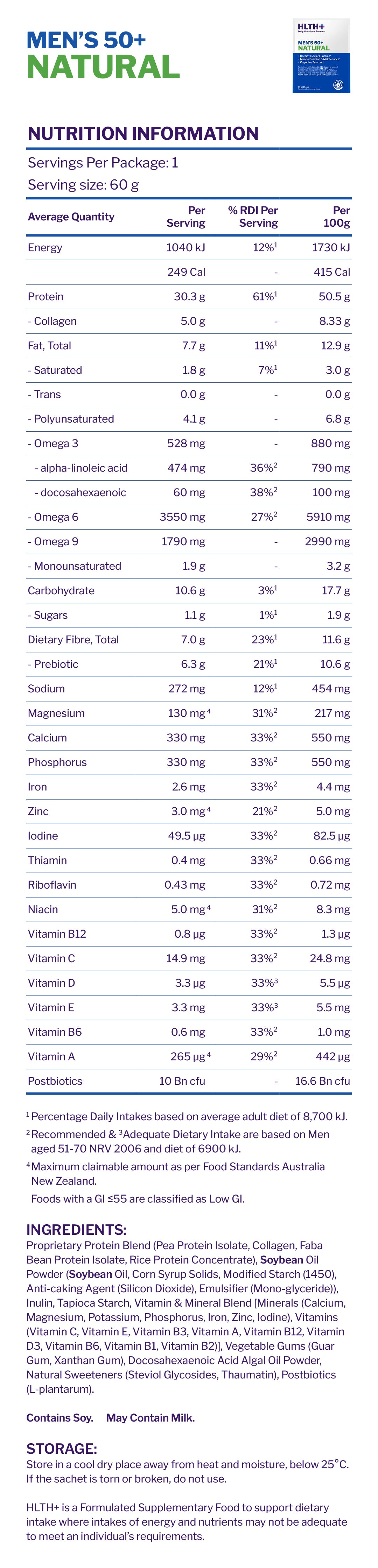
What a daily formula answers is the gap the AIHW figure describes. One 55g Women's sachet carries 30g protein, 7g dietary fibre, 5g collagen, 60mg DHA and 10 billion CFU Lactobacillus Plantarum Postbiotic alongside prebiotics, at 1.5g of sugar with none added and 223 calories. The Men's sachet holds the same 30g of protein at 1.7g of sugar and 248 calories.
Each sachet also carries a balanced multivitamin profile. Counted across protein, dietary fibre, vitamins, minerals, collagen and DHA, that comes to 30 essential daily nutrients in a single serve. Those are dosed by sex and life stage across Women's, Women's 50+, Men's and Men's 50+, formulated by Accredited Dietitians to the Nutrient Reference Values, the reference intakes published in 2006 by the National Health and Medical Research Council, the Australian Government Department of Health and Ageing and the New Zealand Ministry of Health.
It is Australian-owned and Australian-made in facilities complying with Good Manufacturing Practice, dairy-free and gluten-free, carries a 5-star Health Star Rating, and holds hundreds of reviews across the range. It sells at hlthplus.com at RRP $6.00, or $5.10 a day on a 28-serve subscription at $142.80, with free shipping over $100 and no lock-in, and in Australia through Amazon AU and Chemist Warehouse online. The same label-reading habit applies to meal replacement shakes and greens powders, and needs shift again at perimenopause.
See what your current stack is not giving you. The 30-second ✦ Find My Formula quiz is built to show the gaps your existing bottles leave, rather than to sell you another bottle. If you would rather read first, protein when appetite drops covers the number most people get wrong, and how nutrition support works when you are eating less covers the mechanics.
Frequently Asked Questions
Is Sustagen good for you?
For the person it was built for, yes. Sustagen Hospital Formula is a clinical nutrition product for people who cannot meet their needs from food, and it publishes 13.8g protein and 225 calories per 60g serve (retrieved 2 September 2026). For a well adult eating normally, its 27g of sugars is answering a problem you do not have.
How much sugar is in Sustagen?
Sustagen Hospital Formula publishes 27g of sugars in a 60g serve made with 200mL of water, out of 39g of total carbohydrate. Sustagen Everyday publishes 8.3g in its 15g powder serve, rising to 17.6g once the directed 175mL of reduced fat milk is added (retrieved 2 September 2026).
Can a healthy adult drink Sustagen every day?
Nothing stops you, but it was not built for that job. It is a calorie-dense clinical formula, and its Hospital Formula panel carries 27g of sugars and no dietary fibre row (retrieved 2 September 2026). If you are well, eating normally and not losing weight, the gap you need to close is usually diet quality rather than calories.
What is the difference between Sustagen Hospital Formula and Sustagen Everyday?
Hospital Formula is a 60g serve made with water: 225 calories, 13.8g protein and 27g sugars. Everyday is a 15g milk additive: 55 calories and 3g protein from the powder, reaching 138 calories and 9.5g protein once the directed 175mL of reduced fat milk is added (retrieved 2 September 2026).
Can HLTH+ replace Sustagen?
No. Sustagen Hospital Formula is a clinical nutrition product and HLTH+ is a Formulated Supplementary Food built to supplement everyday meals. They are different categories with different jobs. If a doctor or dietitian has you on a clinical formula, keep taking it and raise any change with them, not with a website.

Leave a comment
This site is protected by hCaptcha and the hCaptcha Privacy Policy and Terms of Service apply.