
On labels retrieved 2 September 2026, Macro Mike Premium Almond Protein carries the most protein and the most dietary fibre of the four powders below that publish a full panel, at 23.7g and 4.6g. Nuzest Clean Lean Protein is the most concentrated, and Amazonia Raw Protein Isolate sits between the two. The fifth, Prana On, claims over 30g a serve and publishes the least to back it.
Four of the five publish a real amino acid profile with amounts. Shortlisting is hard because the front of a plant protein tub is designed to be read alone. A 40g serve and a 25g serve are not the same measurement, so two labels can look identical and be nothing alike once you divide the protein by the powder.
This ranks the dedicated powders on their own job, shows the arithmetic, then says where the category stops.
How do you judge a plant protein powder?
Ignore the claims on the front and read six lines.
- Protein per serve. The headline number. How much you personally need depends on body weight and training load, worked through here.
- Protein as a share of the powder. Divide protein by serve size. A generous serve hides this, and it separates an isolate from a blend.
- Amino acid information. Whether the brand publishes the amounts or only claims a profile exists. Two different things, usually read as one.
- Dietary fibre and sugars. Dietary fibre contributes to regular laxation, and it is the line plant proteins vary on most wildly.
- Price per gram of protein. Not price per tub. A cheap bag of a weak powder is not cheap.
- What else is in the tub. Probiotics, enzymes and added minerals, or nothing but protein.
That last line matters because a protein tub is rarely the only one in the cupboard. Over 90% of Australian adults do not meet dietary guidelines on the Australian Institute of Health and Welfare poor-diet measure, and fewer than 1 in 20 eat the recommended serves of vegetables (Australian Bureau of Statistics).
The best plant-based protein powders in Australia, on their published labels
The share-of-powder column is our arithmetic on the two figures beside it; every other cell is quoted from the brand's own published information.
| Product (panel flavour) | Serve | Protein | Protein as a share of the powder | Dietary fibre | Sugars | Calories | Full amino acid profile published |
|---|---|---|---|---|---|---|---|
| Macro Mike Premium Almond Protein (Deluxe Chocolate) | 40g | 23.7g | 59% | 4.6g | 3.1g | 142.9 | Yes, 18 amino acids with amounts |
| Amazonia Raw Protein Isolate (Vanilla) | 30g | 21.6g | 72% | 2.7g | 1.1g | 121 | Yes, 18 amino acids with amounts |
| Nuzest Clean Lean Protein (Smooth Vanilla) | 25g | 20g | 80% | 0.3g | 0.2g | 102 | Yes, 9 essential and 10 non-essential with amounts |
| Bare Blends Vanilla Coconut Plant Protein | 30g | 19.8g | 66% | 0.4g | 0.3g | 127.8 | Yes, the 9 essentials with amounts |
Figures from each brand's published nutrition information, retrieved 2 September 2026; check current labels before purchase. Panels are flavour-specific and brands reformulate.
Macro Mike Premium Almond Protein takes the protein and dietary fibre rows. Almond and faba bean protein, a full 18-acid profile, and 1 billion CFU of LactoSpore probiotic on the panel. It is also the highest sugars figure of the four, the loosest powder at 59% protein, and it contains almonds.
Nuzest Clean Lean Protein wins the purity row outright. 80% protein by weight from golden European pea protein isolate, and the lowest sugars of the four at 0.2g. The trade is 0.3g of dietary fibre, the lowest here, and sodium at 261mg on a small serve.
Amazonia Raw Protein Isolate is the balanced one. Sprouted and fermented golden pea with sprouted brown rice, 72% protein, a full 18-acid profile, and iron at 6.4mg, which their panel puts at 53% of the recommended daily intake. They also publish certified organic, Low FODMAP and third-party heavy metal testing.
Bare Blends Vanilla Coconut is the clean-ingredient pick. Organic pea and sprouted brown rice protein, 0.3g of sugars, and the nine essential amino acids published with amounts. Saturated fat is the highest of the four at 2.8g, from the coconut.
Prana On Power Plant Protein has the biggest headline number and the thinnest published panel. Their page states over 30g of protein per serve, 30 to 32g by flavour, from golden pea, rice and faba bean protein, plus digestive enzymes and over 100 million CFU of LactoSpore probiotic. It is out of the table because Prana On publishes its panels as per-flavour images, so serve size, dietary fibre, sugars and calories are not readable from the page.
One regulatory line worth knowing. Under Schedule 4 of the Australia New Zealand Food Standards Code, a food needs 4g of dietary fibre per serving to be a good source and 7g to be an excellent source. Macro Mike's 4.6g is the only figure of the four that clears the good-source line, and none of them reaches 7g.
Which plant protein is the best value in Australia?
Price per tub tells you almost nothing, because the tubs hold different amounts of protein. Divide pack price by the grams of protein the pack holds and the order changes.
| Product | Pack and published price | Serves per pack | Price per serve | Price per 10g of protein |
|---|---|---|---|---|
| Nuzest Clean Lean Protein | 500g, $59.00 | 20 | $2.95 | $1.48 |
| Bare Blends Vanilla Coconut Plant Protein | 750g, $74.99 | about 25 | $3.00 | $1.51 |
| Macro Mike Premium Almond Protein | 400g, $52.95 | 10 | $5.30 | $2.23 |
Prices as published by each brand, retrieved 2 September 2026; the last two columns are our arithmetic on those figures. Amazonia and Prana On are left out because their published price does not tie to a serve count.
The working, so you can check it:
- Nuzest. 20 serves of 20g is 400g of protein in the bag, and $59.00 across that is 14.75 cents a gram.
- Bare Blends. About 495g of protein for $74.99, or 15.1 cents a gram.
- Macro Mike. 237g for $52.95, or 22.3 cents a gram, half again as much as Nuzest.
Subscription pricing moves two of them ($67.49 at Bare Blends, 12.5% off at Prana On) without changing the order.
What does a complete amino acid profile actually mean?
Protein is built from about 20 amino acids, and 9 of them cannot be made by the body, so they have to arrive in food (Better Health Channel, Victorian Department of Health). Animal and dairy proteins carry large amounts of all nine, which is why that source calls them high-quality protein. Plant proteins do contain all nine, but the amounts of one or two are often low, which is why plant sources are usually combined.
That is why most of this set blends two sources: almond with faba bean at Macro Mike, pea with sprouted brown rice at Amazonia and Bare Blends. Nuzest is the single-source exception, at pea protein isolate.
Which raises the dimension almost nobody checks: the difference between a brand claiming a full profile and a brand printing the milligrams. Macro Mike and Amazonia publish 18 amino acids with amounts, Nuzest publishes 9 essential plus 10 non-essential, and Bare Blends publishes the nine essentials, including 2.5g of leucine per 30g serve.
Prana On is the exception: it claims a complete amino profile and publishes no quantities. That is the easiest test you can run on any tub, and if the amounts are not printed you have been told something.
Learn more about what protein is doing when overall intake drops, which is the situation most people are buying a protein powder for.
What changes when you are eating less than you used to
Plenty of people reach for a protein powder at the moment intake falls, whether the cause is a deliberate deficit, an appetite that has quietly dropped away, or rapid weight loss, reduced eating and medically induced weight loss. The question is the same in all three: every serve now has to carry more of the day.
The change has been measured. In trial conditions, GLP-1 medicines reduced ad libitum food intake by roughly a quarter of daily calories (Blundell and colleagues, Diabetes, Obesity and Metabolism, 2017).
Two consequences follow. One is dietary fibre: a 2025 study of GLP-1 users found average intake of 14.5g a day against the 28g recommended (Frontiers in Nutrition). The other is lean mass: in the STEP 1 body-composition sub-study, roughly 40% of the weight lost was lean mass (Wilding and colleagues, New England Journal of Medicine, 2021).
This page is general information, not medical advice, and decisions about any medication belong with your doctor. There is more on the role of protein and nutrition when intake falls and on how much protein to aim for when appetite drops.
Which plant protein powder should you buy?
- Most protein and most dietary fibre in one scoop. Macro Mike, if almonds are fine for you.
- Purest powder, lowest cost per gram of protein. Nuzest, accepting 0.3g of dietary fibre.
- Organic certification and third-party testing. Amazonia, which also holds the second-highest dietary fibre figure of the four.
- The shortest ingredient list. Bare Blends, with its 2.8g of saturated fat as the caveat.
- Shakes rather than powders. A different category with different labels, covered in The Man Shake review and The Lady Shake review, and the clinical products in the Sustagen breakdown.
- Protein because your nutrition has thinned out. Read on: a protein powder was not built for that job.
Where a daily nutritional formula fits, and where it does not
Start with what this is not. HLTH+ is not a dedicated plant protein powder and it is deliberately not ranked above as one. It is a Formulated Supplementary Food under the FSANZ Food Standards Code, built to supplement the food you already eat.
The concessions are arithmetic: every powder in the table above is more concentrated, since a 55g Women's sachet listing 30g protein per serve is 55% protein by weight against 80% for Nuzest. At RRP $6.00 a sachet that is $2.00 per 10g of protein, which Nuzest and Bare Blends both beat. If protein per dollar is your only criterion, the ranking above answered you.
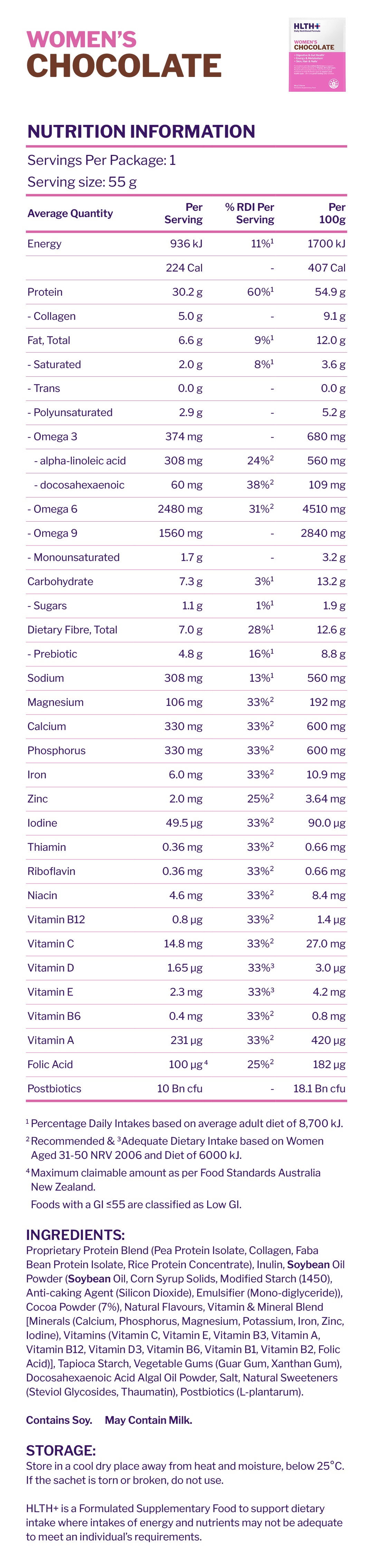
What changes is the rest of the sachet. That 55g Women's serve carries 30g protein per serve, 7g dietary fibre, 5g collagen, 60mg DHA and 10 billion CFU Lactobacillus Plantarum Postbiotic alongside prebiotics, at 1.5g of sugar with none added and 223 calories. A postbiotic is the set of compounds live cultures produce, supplied ready-made rather than having to survive the shelf, so its count and a probiotic count are not like-for-like.
It also carries a balanced multivitamin profile. Counted across protein, dietary fibre, vitamins, minerals, collagen and the essential fats, that comes to 30 essential daily nutrients in one serve. Not one of the five powders above publishes a collagen or a DHA figure, which is no criticism: a protein powder was never built to carry them.
The formulation is the part no tub attempts. HLTH+ publishes separate Women's, Women's 50+, Men's and Men's 50+ versions, formulated by Accredited Dietitians to the Nutrient Reference Values, the intakes published in 2006 by the National Health and Medical Research Council, the Australian Government Department of Health and Ageing and the New Zealand Ministry of Health. Those values move with age and sex, which one formula cannot follow.
So the honest close is not that a daily formula is a better plant protein powder. It is that if you are reaching for a tub because your intake has thinned out rather than because you are chasing grams, one sachet covers the protein line and the dietary fibre, biotic, collagen and essential-fat lines at once.
It is Australian-made in facilities complying with Good Manufacturing Practice, carries a 5-star Health Star Rating, and is dairy-free and gluten-free. It sells at hlthplus.com at RRP $6.00, or $5.10 a day on a 28-serve subscription at $142.80, and through Amazon AU and Chemist Warehouse online.
Find out what your current stack is actually missing. The 30-second ✦ Find My Formula quiz shows the gaps your existing tubs leave behind. If you would rather read first, the protein powder comparison for women and what shifts after 50 come next.
Frequently Asked Questions
What is the best plant-based protein powder in Australia?
It depends which line you are buying. Of the four with full published panels retrieved 2 September 2026, Macro Mike Premium Almond Protein leads on protein and dietary fibre at 23.7g and 4.6g a serve, Nuzest Clean Lean Protein is the most concentrated at 20g from a 25g serve, and Amazonia Raw Protein Isolate balances both.
Which plant protein powder has the most protein per serve?
Of the five here, Prana On Power Plant Protein claims the highest at over 30g per serve, though it publishes no serve size in text. Among the powders with full published panels, Macro Mike leads at 23.7g per 40g serve, ahead of Amazonia at 21.6g and Nuzest at 20g (retrieved 2 September 2026).
Do plant proteins contain all nine essential amino acids?
Plant proteins do contain all nine, but the amounts of one or two are often low, which is why blends pair pea with rice or almond with faba bean (Better Health Channel, Victorian Department of Health). The useful test is whether a brand prints the milligrams or only claims the profile exists.
Which plant protein powder is the best value in Australia?
On published prices retrieved 2 September 2026, of the three whose price ties to a serve count, Nuzest works out cheapest per gram of protein: $59.00 for 500g gives 20 serves of 20g, or $1.48 per 10g. Bare Blends is $1.51 and Macro Mike is $2.23 on the same arithmetic.
Is HLTH+ a plant-based protein powder?
No. HLTH+ is a Formulated Supplementary Food, not a dedicated protein powder, and it is not ranked in the category above. A serve lists 30g protein per serve alongside 7g dietary fibre, 5g collagen, 60mg DHA and a balanced multivitamin profile, which is a different job from a protein tub.

Leave a comment
This site is protected by hCaptcha and the hCaptcha Privacy Policy and Terms of Service apply.