


Buy on protein per serve, not protein per 100 g, and work out which of three categories you are holding before you compare anything else. After 60 the per-meal protein dose that maximally stimulates muscle protein synthesis is higher than it was at 30, so a serve that was once enough no longer is. Look for 25 g to 30 g of protein in a single serve.
This is harder than it should be, because the search returns three kinds of product that look almost identical on a shelf. A plant protein tub, a weight-loss meal shake and a clinical nutrition formula all rank on the same page, built for three genuinely different jobs.
Below: what changes after 60, how to tell the categories apart, the label checks, what a serve costs, and the practical factors that decide whether the tub gets finished.
Why does protein work differently after 60?
The mechanism has a name. The ESPEN Expert Group describes a condition in which "older adults may develop resistance to the positive effects of dietary protein on synthesis of protein, a phenomenon that limits muscle maintenance and accretion" (Deutz and colleagues, Clinical Nutrition, 2014). That is anabolic resistance, and it is the reason the buying criteria change with age.
It has been measured directly. Myofibrillar protein synthesis plateaued at 0.24 g of protein per kilogram of body mass per meal in men around 22 years old, and at 0.40 g/kg per meal in men around 71 (Moore and colleagues, The Journals of Gerontology Series A, 2015). That is roughly two-thirds more protein in one sitting to produce the same response.
Run that against a body weight. At 0.40 g/kg, a 75 kg adult needs about 30 g of protein in one meal, and a 60 kg adult about 24 g. Hold that number at the shelf, because it is a per-serve number and almost every product markets itself on something else.
The daily total moves too, and two expert groups agree on where it lands. ESPEN recommends "at least 1.0 to 1.2 g protein/kg body weight/day" for healthy older adults, rising to "1.2 to 1.5 g protein/kg body weight/day" for those who are malnourished or ill. The PROT-AGE Study Group reached the same 1.0 to 1.2 g/kg range for people over 65, advised at least 1.2 g/kg a day for those who are active, and 1.2 to 1.5 g/kg for those with acute or chronic disease (Bauer and colleagues, Journal of the American Medical Directors Association, 2013).
Australia's own reference figures sit below both, and knowing why saves an argument.
| The number | The figure | What it is for |
|---|---|---|
| Recommended Dietary Intake, adults 19 to 70 | 0.75 g/kg a day for women, 0.84 g/kg for men | A population floor set to avoid deficiency |
| Recommended Dietary Intake, adults over 70 | 1.0 g/kg a day | The same floor, raised for age |
| ESPEN Expert Group, healthy older adults | 1.0 to 1.2 g/kg a day | Maintaining muscle mass and function |
| ESPEN Expert Group, older adults who are ill | 1.2 to 1.5 g/kg a day | Recovery and catabolic states |
In grams a day, the national health information service healthdirect publishes 52 g to 64 g for males and 37 g to 46 g for females aged 19 to 70, rising to 65 g to 81 g and 46 g to 57 g over 70. The per-kilogram figures come from Dietitians Australia. Both cite the Nutrient Reference Values for Australia and New Zealand, published in 2006 by the National Health and Medical Research Council, the Australian Government Department of Health and Ageing and the New Zealand Ministry of Health.
Note where the Australian figure steps up: at 70, while the physiology shifts well before it. It also answers "how do I avoid deficiency" rather than "how do I hold onto muscle" (the full derivation of daily protein targets).
Which of these three products are you actually looking at?
Sort the category first. Everything else is downstream of it.
| Category | What it is built to do | How it is sold |
|---|---|---|
| Protein powder | Deliver protein and very little else, so it slots into a diet that already works | A tub and a scoop, bought off the shelf, no supervision |
| Meal replacement shake | Stand in for a meal at a controlled calorie count | A pack of sachets or a tub, usually with a weight programme around it |
| Clinical nutrition formula | Deliver calories and a full micronutrient set to someone who cannot eat enough food | Pharmacy channel, under professional supervision |
The third row trips people up, because two of the biggest names in this search sit in it. Abbott Ensure Powder carries the line "Food for Special Medical Purposes. Use only under medical supervision." on its own Australian product page, and Sustagen states that Hospital Formula "cannot be used as a total diet replacement" (published brand pages, retrieved 2 September 2026).
Read their panels with that job in mind and they make sense. Sustagen Hospital Formula Vanilla publishes 13.8 g protein and 27 g sugars per 60 g serve, with no dietary fibre row at all. Those sugars deliver energy density to someone losing weight without meaning to, which is a completely different brief from a protein powder's.
Abbott publishes Ensure Powder per 100 mL rather than per serve: 3.72 g protein, 4.68 g sugars and 1.01 g dietary fibre, with a prepared serve of 230 mL from six level scoops. Multiply out and a serve lands near 8.6 g of protein, though that arithmetic is ours, not a figure Abbott prints.
The verdict is not that these are bad products. They are built to get calories into someone who is not eating, so if the person you are buying for eats reasonably and wants to hold onto muscle, they are the wrong tool. Whether Sustagen is a good fit works through that decision, and the meal-replacement shelf gets the same treatment in the Lady Shake review.
What should you check on the label?
Five checks, in the order that matters at this age.
- Protein per serve, not per 100 g. You eat serves. A 90% protein powder in a 20 g scoop delivers 18 g, and misses the mark set above.
- Protein as a share of the serve. How much of the powder does the job you bought it for. This matters most when appetite is small.
- Sugars per serve. Wide variation across products that all present as the same category.
- Dietary fibre per serve. Most dedicated protein powders carry almost none, and it is the nutrient most often missing when food intake falls.
- An amino acid profile published, not just claimed. "Contains all nine essential amino acids" is a sentence. A table with milligram amounts is evidence.
Here is that comparison across dedicated plant protein powders sold in Australia, plus the daily formula we make.
| Product | Serve size | Protein per serve | Dietary fibre | Sugars | Amino acid profile published |
|---|---|---|---|---|---|
| Macro Mike Premium Almond Protein, Deluxe Chocolate | 40 g | 23.7 g | 4.6 g | 3.1 g | Yes, 18 amino acids with amounts |
| Amazonia Raw Protein Isolate, Vanilla | 30 g | 21.6 g | 2.7 g | 1.1 g | Yes, 18 amino acids with amounts |
| Nuzest Clean Lean Protein | 25 g | 20 g | 0.3 g | 0.2 g | Yes, 9 essential plus 10 non-essential |
| Bare Blends Vanilla Coconut Plant Protein | 30 g | 19.8 g | 0.4 g | 0.3 g | Yes, all 9 essentials with amounts |
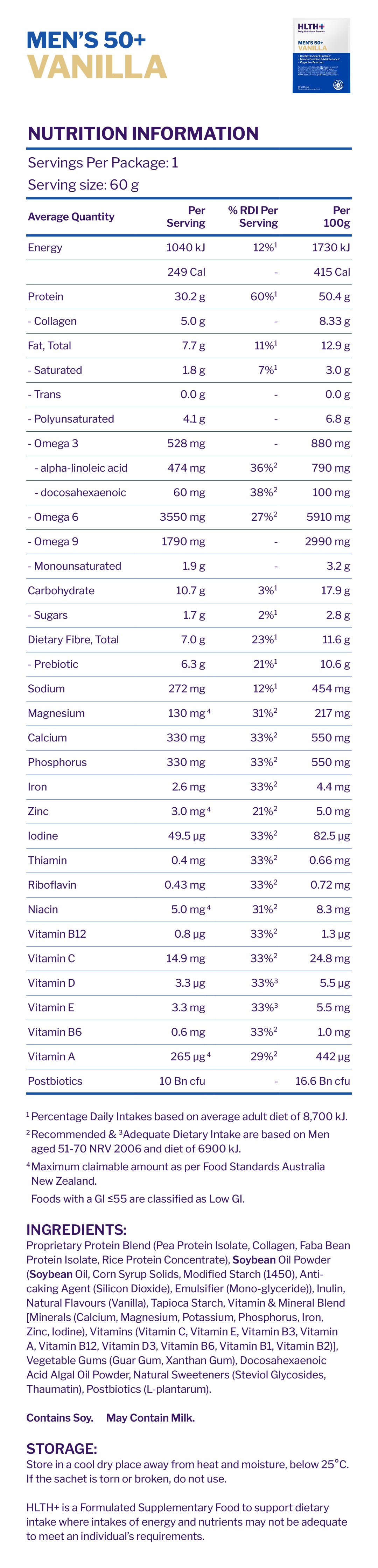
| HLTH+ Women's 50+ and Men's 50+ | 55g Women's, 60 g to 62 g Men's | 30g protein | 7g dietary fibre | 1.5 g Women's, 1.7 g Men's | Not published |
Figures are from each brand's published nutrition information, retrieved 2 September 2026; check current labels before purchase.
Two concessions worth making out loud. On protein as a share of the serve the dedicated powders win: Nuzest packs 20 g into a 25 g serve and Amazonia 21.6 g into 30 g, against 30 g in a 55 g sachet here. And four of them publish a full amino acid profile with amounts, while our own panels are published as images with no per-amino breakdown, so that row is theirs.
One trap to know about. Several brands publish their panel only as an image, so the numbers never reach the page text and comparison sites quietly skip them. Prana On states "over 30g per serve" but publishes no serve size in text, and WelleCo's Nourishing Protein lists 16 g of protein with no serve size in grams, which makes protein per gram impossible to calculate. If you cannot find a serve size, you cannot compare the product (how to read a protein powder label).
What does a serve actually cost?
On a fixed income this decides whether a product gets repurchased. The useful measure is not the price on the tub, it is grams of protein per dollar.
| Product | Price | Serves | Cost per serve | Protein per dollar |
|---|---|---|---|---|
| Nuzest Clean Lean Protein, 500 g | $59.00 | 20 | $2.95 | 6.8 g |
| Bare Blends Vanilla Coconut, 750 g | $74.99 | 25 | $3.00 | 6.6 g |
| Macro Mike Premium Almond Protein, 400 g | $52.95 | 10 | $5.30 | 4.5 g |
| HLTH+, single serve | RRP $6.00 | 1 | $6.00 | 5.0 g |
| HLTH+, 28-serve subscription | $142.80 | 28 | $5.10 | 5.9 g |
Cost per serve is the pack price divided by the stated servings; protein per dollar is protein per serve divided by cost per serve. Prices from each brand's published storefront, retrieved 2 September 2026; check current pricing before purchase.
Amazonia is deliberately absent. Its page showed one price against three pack sizes, so a per-serve figure could not be derived honestly, and a guess would be worse than a gap. Neither Sustagen nor Abbott Ensure prints a price at all: those brand sites are informational and the products sell through pharmacy.
The practical things that decide whether the tub gets finished
None of this is on a nutrition panel, and all of it decides whether the second pack gets bought.
- Taste fatigue is real at 1 kg. A 1 kg tub of Nuzest is 40 serves of one flavour. Published flavour counts vary widely: Nuzest lists six, Sustagen Hospital Formula seven, and the HLTH+ range five. Buy the smallest pack of a new flavour first.
- Count the scoops. Sustagen asks for three level 20 g scoops per serve and Abbott Ensure for six, against a single pre-measured sachet at the other end. With arthritic hands, six scoops out of a deep tin twice a day is the difference between a routine and an abandoned tin.
- Check the closure before you commit. Screw lids, foil seals and scoops buried under powder are all things worth testing once at the smallest pack size.
- Read the sodium line. Per serve, the published figures on the four powders above are 261 mg (Nuzest, 25 g serve), 321 mg (Amazonia, 30 g), 219 mg (Macro Mike, 40 g) and 189.9 mg (Bare Blends, 30 g). Our own panels are published as images without a per-nutrient breakdown, so we cannot put a figure beside those, and we are not going to imply one.
- Match the serve size to the appetite. If the person you are buying for struggles to finish a normal meal, a 55 g or 60 g serve may be too much in one go, and the answer is a smaller, denser serve taken more often. That case has its own article: choosing for someone over 70 covers appetite loss, texture and swallowing.
What if appetite has dropped a long way?
Appetite falls for many reasons after 60: illness, medication, low mood, dental problems, or a deliberate deficit. Whatever the driver, protein is usually the first thing to go, because protein-rich food is the most filling food on the plate.
That matters more at this age than at any other, because anabolic resistance means the signal was already weaker before the serve got smaller. In the STEP 1 trial's body-composition sub-study, roughly 40% of the weight lost was lean mass (Wilding and colleagues, New England Journal of Medicine, 2021), and in trial conditions GLP-1 medicines reduced food intake by roughly a quarter of daily calories (Blundell and colleagues, Diabetes, Obesity and Metabolism, 2017). The same arithmetic applies to any sharp drop in intake, whether it comes from rapid weight loss, reduced eating and medically induced weight loss, or simply a smaller appetite.
This is general information, not medical advice, and decisions about any medication belong with your doctor. What changes on the plate is straightforward: when the volume of food falls, the density of what remains has to rise.
More on what happens to lean mass when intake drops: nutrition support for muscle. The per-meal targets are worked through in protein when you are eating less, the surrounding nutrients in nutrition support, and the lean-mass case in the vital role of protein and nutrition in GLP-1 therapy.
Where a daily formula fits, and where a protein powder is the better buy
Start with the concession, because it decides half the readers of this page. If what you want is the cheapest possible grams of protein and nothing else, buy a dedicated powder. Nuzest at 6.8 g of protein per dollar beats us on that measure, and a food-first day that already clears the daily target does not need another product.
What a daily formula answers is a different question: the day where a whole eating occasion goes missing. Over 90% of Australian adults do not meet dietary guidelines (AIHW), and we believe in a food-first approach while the statistics say it is not working on its own. That is nutritional insurance, not a substitute for eating well.
HLTH+ is a Formulated Supplementary Food, and one 55g sachet carries 30g protein per serve and 7g dietary fibre, alongside 5g collagen, 60mg DHA, 10 billion CFU Lactobacillus Plantarum Postbiotic and a balanced multivitamin profile. It is not designed as a meal replacement, because it is built to complement a food-first approach; it does work perfectly well as a healthy snack or to tie you over when a meal is not happening.
The reason there is a Women's 50+ and a Men's 50+ rather than one formula for every adult is the same reason the protein figures in this article move with age. Requirements shift by sex and life stage, and the range is formulated to the Nutrient Reference Values for Australia and New Zealand, published in 2006 by the National Health and Medical Research Council, the Australian Government Department of Health and Ageing and the New Zealand Ministry of Health.
On price, a single serve is RRP $6.00 and a 28-serve subscription works out at $5.10 a day. It is sold at hlthplus.com, through the HLTH+ store on Amazon AU and at Chemist Warehouse online.
If you are auditing the rest of the cupboard while you are at it, the calcium numbers run on the same logic, and why healthspan matters more than lifespan is the wider version of this argument.
Find out what your current stack is actually missing. The ✦ Find My Formula quiz takes about 30 seconds and is built to show you the gaps your existing bottles are leaving. Take the quiz.
Frequently Asked Questions
How much protein does someone over 70 need a day?
Australia's Recommended Dietary Intake rises to 1.0 g per kilogram of body weight a day over 70, which healthdirect publishes as 65 g to 81 g for males and 46 g to 57 g for females. The ESPEN Expert Group recommends 1.0 to 1.2 g/kg a day for healthy older adults, and 1.2 to 1.5 g/kg if ill.
How much protein should be in one serve for someone over 60?
Aim for 25 g to 30 g. Myofibrillar protein synthesis plateaued at 0.40 g per kilogram of body mass per meal in men around 71, against 0.24 g/kg in men around 22. For a 75 kg adult that is about 30 g in a single sitting, and for a 60 kg adult about 24 g.
Is protein powder safe for older adults?
Protein powder is food, and the usual caution is about kidney function rather than the powder itself: the PROT-AGE Study Group notes that people with severe kidney disease who are not on dialysis may need protein restricted. Check with your doctor or pharmacist first if you take prescribed medication.
What is the difference between a protein powder and Sustagen or Ensure?
Different jobs. Abbott Ensure is labelled a Food for Special Medical Purposes for use under medical supervision, and Sustagen states its Hospital Formula cannot be used as a total diet replacement. Both are built to deliver calories to someone who is not eating enough, so protein per serve is lower and sugars higher.
Leave a comment
This site is protected by hCaptcha and the hCaptcha Privacy Policy and Terms of Service apply.