


Judge the serve, not the tub. After 70 the number that decides everything is how much protein arrives in one sitting, because the per-meal dose needed to trigger muscle protein synthesis rises with age while the appetite that has to carry it falls. Look for 25 g to 30 g of protein in a single serve, small enough that it actually gets finished.
That combination is the whole problem, and most writing about protein powder ignores half of it. Advice built for a 35-year-old assumes the limit is budget or willpower. After 70 the limit is usually how much will go down before the glass goes back on the bench.
Below: what changes at this age, the per-meal arithmetic by body weight, what the powders on the shelf actually publish, when a clinical formula is the better buy, and where a daily formula fits.
What changes after 70 that did not change at 60?
Four things move at once, and they compound.
Appetite falls before anyone decides to eat less. Appetite loss affects "approximately 15%-30% of community-dwelling older people" and is higher again in hospitals and nursing homes (de Souto Barreto and colleagues, The Journal of Frailty & Aging, 2022). The same task force report names dry mouth, reduced taste and smell and reduced thirst among the biological changes sitting behind it.
The consequence is measurable, and Australian. Dietitians Australia states that "around 50% of older Australians in aged care and in the community are either at risk of malnutrition or are malnourished", and notes that "many believe that unplanned weight loss is normal as we age", which is part of why it is missed (Dietitians Australia, Malnutrition).
Protein itself works less efficiently. The ESPEN Expert Group describes how "older adults may develop resistance to the positive effects of dietary protein on synthesis of protein, a phenomenon that limits muscle maintenance and accretion" (Deutz and colleagues, Clinical Nutrition, 2014). That is anabolic resistance, and it is further along at 75 than at 62.
So density per mouthful starts to beat volume. The Better Health Channel notes that "many people eat less as they get older" and that this "can make it harder to make sure your diet has enough variety to include all the nutrition you need". Its instruction for older adults is to "eat foods that are nutrient dense rather than energy dense" (Better Health Channel, Food and your life stages).
This is general information and not medical advice. Unintended weight loss at this age is a reason to see a doctor or an Accredited Practising Dietitian, not a reason to buy a bigger tub.
How much protein does one serve need to carry?
There are two numbers, and the per-meal one is the one that gets missed.
On the daily total, the PROT-AGE Study Group recommends for people over 65 "average daily intake at least in the range of 1.0 to 1.2 g protein per kilogram of body weight per day", rising to "1.2-1.5 g/kg body weight/d" for most older adults with acute or chronic disease (Bauer and colleagues, Journal of the American Medical Directors Association, 2013). The ESPEN Expert Group lands on the same two ranges.
On the per-meal dose, the same group is specific: the anabolic threshold for a single meal is higher in older people than in young adults, at 25 to 30 g of protein carrying about 2.5 to 2.8 g of leucine. That is the figure to hold at the shelf.
Now put the two together against a real body weight. The last column is our arithmetic, not a published recommendation: the 1.2 g/kg daily total divided evenly across three meals.
| Body weight | Daily total at 1.0 g/kg | Daily total at 1.2 g/kg | An even three-meal split of the 1.2 g/kg total |
|---|---|---|---|
| 55 kg | 55 g | 66 g | 22 g a meal |
| 65 kg | 65 g | 78 g | 26 g a meal |
| 75 kg | 75 g | 90 g | 30 g a meal |
| 85 kg | 85 g | 102 g | 34 g a meal |
Read the bottom of that table first. A 55 kg woman eating three even meals lands at 22 g each, under the 25 g to 30 g threshold at every sitting, even though her daily total looks fine on paper. Smaller people, and smaller appetites, need protein concentrated into fewer, denser occasions rather than spread thin.
Australia's own reference figures are a floor rather than a target. The national health information service healthdirect publishes 65 g to 81 g a day for males over 70 and 46 g to 57 g for females, drawn from the Nutrient Reference Values for Australia and New Zealand. Those answer "how do I avoid deficiency", not "how do I hold onto muscle", and the full derivation sits in how much protein you actually need.
More on what happens to lean mass when intake drops sharply: nutrition support for muscle.
Do the powders on the shelf actually clear 25 g?
Mostly not in one serve, and that is the finding this search needs. These are dedicated plant protein powders sold in Australia, taken from each brand's own published panel.
| Product | Serve as published | Protein per serve |
|---|---|---|
| Macro Mike Premium Almond Protein, Deluxe Chocolate | 40 g | 23.7 g |
| Amazonia Raw Protein Isolate, Vanilla | 30 g | 21.6 g |
| Nuzest Clean Lean Protein | 25 g | 20 g |
| Bare Blends Vanilla Coconut Plant Protein | 30 g | 19.8 g |
Figures are from each brand's published nutrition information, retrieved 2 September 2026; check current labels before purchase.
Not one reaches 25 g in a single scoop, so clearing the threshold means a serve and a half in the same glass. At 45 with a full appetite that is nothing. At 78 it is the difference between a drink that gets finished and one that does not, which is why serve size belongs on the shortlist beside protein content.
When is a clinical nutrition formula the right answer?
Sometimes it is, and this is the search where that needs saying out loud rather than steering around.
Two of the biggest names here are not protein powders and do not pretend to be. Abbott states on its own Australian product page that Ensure Powder is a "Food for Special Medical Purposes. Use only under medical supervision." Sustagen states that its Hospital Formula "cannot be used as a total diet replacement" (published brand pages, retrieved 2 September 2026). Both are built to get calories and a full micronutrient set into someone who is not managing enough food, and for a 70-year-old who is genuinely under-eating that brief may be exactly right.
The category difference shows up clearly inside one brand's own range.
| Sustagen product (Vanilla) | Hospital Formula | Hospital Formula Plus Fibre | Everyday |
|---|---|---|---|
| Serve as published | 60 g powder plus 200 mL water | 60 g powder plus 200 mL water | 15 g powder plus 175 mL reduced fat milk |
| Servings per pack | 14 | 14 | 36 |
| Energy per serve | 940 kJ, 225 kcal | 940 kJ, 225 kcal | 578 kJ, 138 kcal made with the milk |
| Protein per serve | 13.8 g | 13.8 g | 9.5 g made with the milk, of which 3 g is from the powder |
| Sugars per serve | 27 g | 27 g | 17.6 g made with the milk |
| Dietary fibre | no dietary fibre row is published on this panel | 4.1 g | no dietary fibre row is published on this panel |
| Calcium per serve | 400 mg | 400 mg | 300 mg made with the milk |
Figures are from each brand's published nutrition information, retrieved 2 September 2026; check current labels before purchase.
Three things fall out of that table. The 27 g of sugars is not a formulation failure, it is energy density doing its job for someone who cannot eat enough. Dietary fibre is the reason the Plus Fibre version exists at all. And "Everyday" is a 15 g milk additive rather than a meal, so most of its protein comes from the milk you pour in, which is worth knowing before comparing it with anything.
Abbott publishes Ensure Powder per 100 mL prepared rather than per serve: 3.72 g protein, 4.68 g sugars and 1.01 g dietary fibre, from a serve of six level scoops made up to 230 mL. Multiplying that out puts a prepared serve near 8.6 g of protein, and that arithmetic is ours, not a figure Abbott prints.
None of this is a reason to come off something a doctor or dietitian has recommended. That decision belongs with them. It is a reason to know which shelf you are standing at: whether Sustagen suits you walks through the same call in more detail.
What decides whether it actually gets finished?
None of this is on a nutrition panel, and all of it decides whether the second pack gets bought. Very often the person reading this is buying for a parent, so walk the list with them rather than guessing.
- Count the liquid, not just the powder. Most powders ask for 300 mL to 400 mL of water or milk. On a small appetite that volume alone is often the blocker, and a thicker, smaller drink goes down where a tall glass does not.
- Taste and smell have changed, so old favourites may not work. Reduced taste and smell is one of the sensory changes the ICFSR task force names behind appetite loss at this age. Stronger flavours, served cold, survive better than subtle ones.
- Texture and swallowing come before nutrition. If drinks cause coughing or feel like they stick, that is a question for a doctor or speech pathologist first, and no product choice fixes it.
- Test mixability by hand. Many powders are built around a blender. Something that goes lumpy when stirred with a spoon in a mug quietly stops being made.
- Buy the smallest pack of anything new, and fix it to something that already happens: alongside the morning tea, at the same time each day.
On cost, the honest measure is grams of protein per dollar rather than the price on the pack, and the dedicated powders above generally win it; the full price-per-serve comparison runs in the seniors buyer's guide. Neither Sustagen nor Abbott Ensure publishes a price, because those brand sites are informational and the products sell through pharmacy.
Where a daily formula fits after 70
Start with the concession. If the day already clears the protein target from food, and what is wanted is the cheapest possible grams of protein, buy a dedicated protein powder. Those products also carry more protein per gram of powder than anything with a full nutrient set, and all four in the table above publish a complete amino acid profile with amounts, which we do not.
What a daily formula answers is the other case: the day where an eating occasion simply goes missing. Over 90% of Australian adults do not meet dietary guidelines (AIHW), and we believe in a food-first approach while the numbers say it is not working on its own. That is nutritional insurance, not a substitute for eating well.
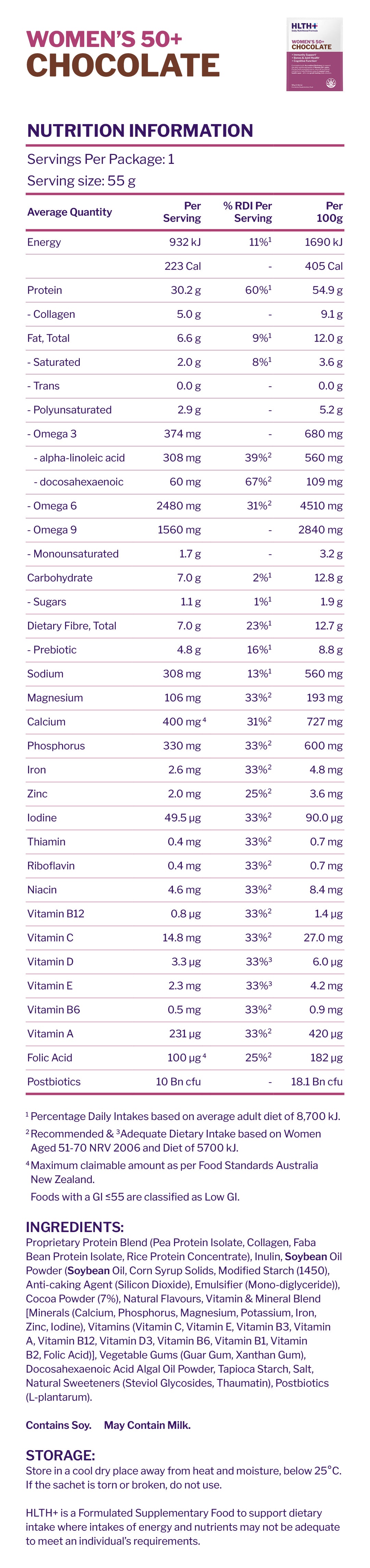
HLTH+ is a Formulated Supplementary Food. One 55g sachet carries 30g protein per serve, which sits inside the 25 g to 30 g per-meal range above, alongside 7g dietary fibre, 5g collagen, 60mg DHA and 10 billion CFU Lactobacillus Plantarum Postbiotic. A postbiotic is the inactivated form of a beneficial bacterium rather than a live culture, which is why the formula uses one; cell counts on a postbiotic and a probiotic are not a like-for-like comparison. Across protein, dietary fibre, vitamins, minerals, collagen and fats, that is 30 essential daily nutrients. The vitamin and mineral side of it is a balanced multivitamin profile.
The reason there is a Women's 50+ and a Men's 50+ rather than one formula for everybody is the same reason the protein figures in this article move with age. Requirements shift by sex and life stage, and the range is formulated to the Nutrient Reference Values for Australia and New Zealand, published in 2006 by the National Health and Medical Research Council, the Australian Government Department of Health and Ageing and the New Zealand Ministry of Health.
On price, a single serve is RRP $6.00 and a 28-serve subscription works out at $5.10 a day. It is sold at hlthplus.com, through the HLTH+ store on Amazon AU and at Chemist Warehouse online.
Appetite drops for many reasons after 70, and the arithmetic above holds whatever the cause: illness, medication, low mood, dental problems, or rapid weight loss, reduced eating and medically induced weight loss. When the volume of food falls, the density of what is left has to rise. The per-meal targets are worked through in protein when you are eating less, the surrounding nutrients in nutrition support, and the lean-mass case in the vital role of protein and nutrition in GLP-1 therapy.
Auditing the rest of the cupboard at the same time: the calcium numbers run on the same logic, how to read a protein label covers the checks, and why healthspan matters more than lifespan is the wider argument.
Find out what your current stack is actually missing. The ✦ Find My Formula quiz takes about 30 seconds and is built to show you the gaps your existing bottles are leaving. Take the quiz.
Frequently Asked Questions
How much protein should someone over 70 have in one serve?
Aim for 25 g to 30 g. The PROT-AGE Study Group puts the per-meal anabolic threshold for older people at 25 to 30 g of protein carrying about 2.5 to 2.8 g of leucine, higher than the threshold in young adults. Spreading a daily total thinly across three small meals can land under it at every sitting.
How much protein does someone over 70 need a day?
The PROT-AGE Study Group recommends at least 1.0 to 1.2 g per kilogram of body weight a day for people over 65, and 1.2 to 1.5 g/kg for most with acute or chronic disease. In grams, healthdirect publishes 65 g to 81 g a day for males over 70 and 46 g to 57 g for females.
Is Sustagen or Ensure better than a protein powder for someone over 70?
Different jobs. Abbott labels Ensure Powder a Food for Special Medical Purposes for use under medical supervision, and Sustagen states its Hospital Formula cannot be used as a total diet replacement. Both are built to deliver calories to someone under-eating, so protein per serve is lower and sugars higher.
What if a full serve is too much to finish?
Split it. Half a serve now and half later still gets the nutrition in across the day, although it divides the per-meal protein dose rather than delivering it in one hit. If finishing food is a persistent problem, or weight is dropping without intent, see a doctor or an Accredited Practising Dietitian.

Leave a comment
This site is protected by hCaptcha and the hCaptcha Privacy Policy and Terms of Service apply.