


The Super Elixir is WelleCo's greens powder, sold in five flavours at $88.00 a pack, and the nutrition figures on the brand's own product page are these: sugars of 0.9g to 1.1g per 10g serve, under 32 calories per serve, and a cost per serve the brand prints as $3.3 (retrieved 2 September 2026). There is no protein figure, no dietary fibre figure, and no nutrition information panel anywhere on the page.
That last part is the finding, and it explains why most reviews of this product end up being taste tests. If a brand does not publish a panel, there is nothing to work out, nothing to compare and nothing to check before you pay.
This review sets out what WelleCo publishes about The Super Elixir, what it does not, what the ingredient list can and cannot tell you, and who the product genuinely suits.
What is The Super Elixir, and what does it cost?
WelleCo is a premium wellness brand and The Super Elixir is its greens powder, the product the range is built around. It sells in five flavours (Original, which is Pineapple and Lime, plus Mixed Berry, Blood Orange, Lemon and Ginger, and Unflavoured), all at $88.00 (retrieved 2 September 2026). The range around it is much wider than most shoppers realise, and the whole WelleCo line-up is walked through separately.
The serve is 10g, which the brand establishes in its own sugar line: 0.9g of sugar per 10g serve. Here is everything else the product page publishes about what is in it:
- sugars of 1g to 1.1g per serve on Original, Lemon and Ginger, and Blood Orange, and 0.9g per 10g serve on Unflavoured
- a calorie ceiling, written as under 32 calories per serve rather than as a number
- a cost per serve, printed as $3.3
- more than 40 premium ingredients, counted on the front of the page
- a complete ingredient list, carrying no gram quantity against any entry
- probiotics, named among the ingredients, with no cell count published
What WelleCo does not publish, and why it matters
WelleCo does not publish a nutrition information panel for The Super Elixir. The same was true of Nourishing Protein, its other powder, and of every WelleCo product checked on 2 September 2026. What is missing is the table Australian shoppers are used to reading: energy, protein, fat, carbohydrate, sugars, dietary fibre and sodium, per serve and per 100g.
That needs a precise reading. It does not mean the pack has no panel on it. It means the numbers are not on the pages the brand publishes, so you cannot read them before you buy, and you cannot line them up against anything else without the tub already open on your bench.
Three things follow, and they are the reason this belongs at the top of a review rather than buried in it.
You cannot work out what a serve gives you. Protein and dietary fibre are the two lines most people want from a daily powder, and neither is published. Psyllium husk sits in the ingredient list, so there is dietary fibre in there, but an ingredient without a quantity tells you it is present and nothing more.
You cannot compare it. Every comparison in this category runs on panel figures, which is why the table further down this page is short and carries only rows where both brands publish a number. The Lady Shake review shows what the same exercise looks like when a brand publishes its panel in full.
You are buying an ingredient list rather than a dose. More than 40 ingredients is a real formulation choice and plenty of buyers like it. It is still a list of names, and two products with identical lists can deliver very different amounts.
This is not unique to WelleCo. Vital All-In-One's published product page lists 1000mg of pea protein isolate per two-teaspoon (10g) serve and publishes no total protein line either (retrieved 2 September 2026). It is a pattern in the greens category, and the brands that break it stand out: IM8 is the one to read next on ingredient counts.
One more fact worth having. WelleCo now sells a $199.00 bundle called The GLP-1 Daily Companion, built around The Super Elixir and Nourishing Protein (retrieved 2 September 2026). It is a bundle rather than a formulation, so it carries no panel of its own, and neither of its two powders carries one either.
The Super Elixir and HLTH+, on the figures both brands publish
A greens powder and a daily nutritional formula are not the same product, and the table below is not pretending otherwise. It exists to show what can honestly be compared when one side publishes a panel and the other does not. For contrast, The Man Shake review runs a full-length table because both brands there publish their numbers.
| Per serve, as each brand publishes it | WelleCo The Super Elixir | HLTH+ Women's | Note |
|---|---|---|---|
| Serving size | 10g | 55g sachet | A scoop against a sachet |
| Sugars | 1g to 1.1g on Original, Lemon and Ginger, and Blood Orange; 0.9g on Unflavoured | 1.5g, none added | WelleCo lists less sugar, in a serve one fifth the size |
| Calories | Under 32, published as a ceiling rather than a figure | 223 | The greens scoop is not built to carry calories |
| Pack price | $88.00, all five flavours | $168.00 for 28 serves, or $142.80 on subscription | Different pack sizes |
| Cost per serve | $3.3, the brand's own stated figure | RRP $6.00, or $5.10 a day on a 28-serve subscription | The Super Elixir is cheaper per serve |
| Category | Greens powder | Formulated Supplementary Food | Different jobs |
Figures from each brand's published product information, retrieved 2 September 2026; check current labels before purchase. Serve sizes differ, brands reformulate and flavours vary. Every row above exists because both brands publish that figure, and the obvious rows are absent for one reason: WelleCo publishes no protein figure and no dietary fibre figure, and a row with one empty side is not a comparison.
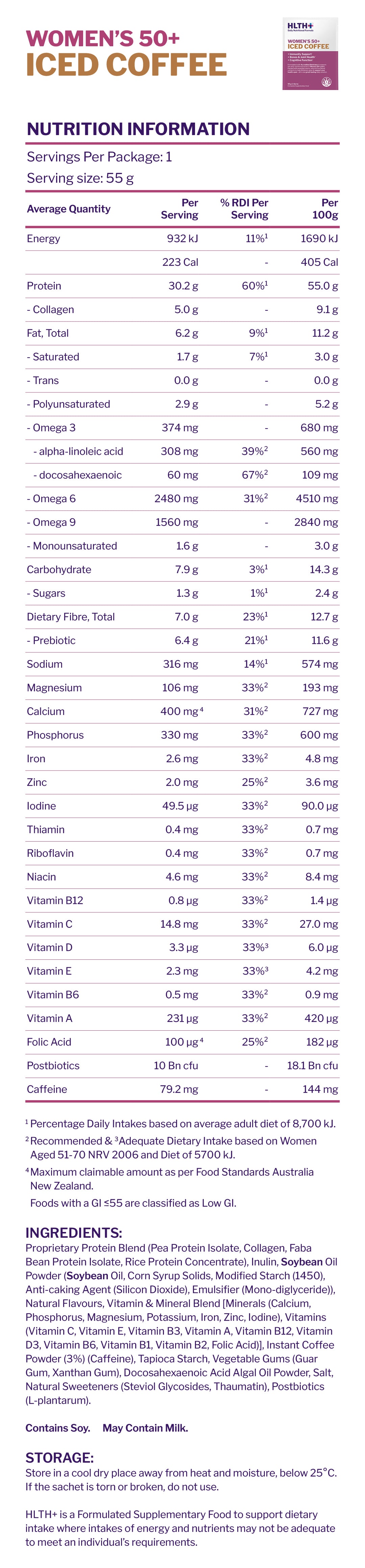
For completeness, here is what sits on the HLTH+ side of those absent rows: 30g protein, 7g dietary fibre, 5g collagen, 60mg DHA and 10 billion CFU Lactobacillus Plantarum Postbiotic per sachet. WelleCo publishes none of those five figures for The Super Elixir, and its probiotics carry no cell count, so none of them can be tabled.
The serve-size gap matters too. Ten grams of powder and a 55g sachet are different objects doing different work, so reading the calorie row as a win for either brand would be a misreading. A pharmacy very-low-calorie shake is a third object again, with a different job and a different evidence base, compared separately here.
Where The Super Elixir genuinely wins
Three things, and they are real.
Sugar per serve. 0.9g to 1.1g a serve is low by any reading, and it is theirs on their own published figure.
Cost per serve. $3.3 against RRP $6.00 is not close, and if that is the number deciding it for you, the comparison is already over. The one caveat is that WelleCo does not publish how many serves are in the $88.00 pack, so the arithmetic behind their figure cannot be checked.
The shape of the habit. A 10g scoop goes into water, juice or a smoothie without becoming a meal. If what you want is a greens ritual rather than a shake, that is the right format and a 55g sachet is not.
Then there is the part reviews are often too sniffy to say out loud. Taste, texture, packaging and the daily ritual are legitimate reasons to buy something you drink every morning, and none of that is undone by a missing panel. It is just not the same as knowing what you are getting, and if you are choosing between WelleCo's own products rather than between categories, the wider range is covered here.
How do you read a greens powder label?
Five lines, in this order, and most of them take ten seconds.
- Protein per serve. Protein contributes to the maintenance and growth of muscle mass and to tissue repair. Greens powders are built around micronutrients and botanicals, so the figure is small where it is published at all, and the protein powder comparison is the better place to start if that number is what you want.
- Dietary fibre per serve. Dietary fibre contributes to regular laxation. Under Schedule 4 of the Australia New Zealand Food Standards Code, 2g per serving is the threshold for any dietary fibre claim, 4g for a good source and 7g for an excellent source, so a stated number tells you which of those a product can honestly say.
- Sugars per serve. Check the total and whether any of it was added. Something you drink daily should not read like a dessert.
- Live cultures, and which kind. A probiotic is a living organism that has to survive the pack, the shelf and your stomach acid; a postbiotic is the set of compounds those organisms produce, supplied ready-made. They are different classes of ingredient, so a count on one label is not the same measurement as a count on another. The difference is set out here.
- Who the formula was calculated for. Australian labels work out percentage daily intakes against an average adult diet of 8,700 kJ under Standard 1.2.8 of the Food Standards Code. That is a labelling reference value, not a recommendation for you, and it sits above what the Nutrient Reference Values advise for most adults, so a formula built to it over-delivers calories to the person drinking it.
The reason all five matter more than they used to: over 90% of Australian adults do not meet dietary guidelines on the AIHW poor-diet measure, and fewer than 1 in 20 eat the recommended serves of vegetables (ABS). A greens powder is one answer to that, and a narrow one; which micronutrients are worth tracking is a separate question again.
What changes when you are eating less?
Plenty of people reach for a greens powder at exactly the point their overall intake drops, whether the cause is a deliberate deficit, an appetite that has quietly fallen away, or rapid weight loss, reduced eating and medically induced weight loss.
The scale of that change is measurable. In trial conditions, GLP-1 medicines reduced ad libitum food intake by roughly a quarter of daily calories (Blundell and colleagues, Diabetes, Obesity and Metabolism, 2017).
Dietary fibre is the line that slips first. A 2025 study of people on GLP-1 medications found average intake of 14.5g a day against the recommended 28g (Frontiers in Nutrition). That is the context in which an unpublished dietary fibre figure stops being a technicality and starts being the thing you actually needed to know.
This page is general information, not medical advice, and decisions about any medication belong with your doctor. Learn more about what happens to nutrition when overall intake drops, or read how nutrition support works when you are eating less.
Who each one suits
- You want a greens ritual and you like the brand. The Super Elixir is built for that, taste and habit are the criteria that will decide it, and the sugar figure is low.
- You want to know what a serve delivers. You cannot establish that from what WelleCo publishes, so either read the pack in a store or choose a product that publishes its panel.
- You want protein, dietary fibre and micronutrients covered while you keep eating normal food. That is a different category, and it is where HLTH+ sits.
- You are shopping meal replacements instead. Different job again, and the labels are read the same way in The Lady Shake review and The Man Shake review.
Where a daily nutritional formula fits
The concession first, because it is the honest one. A greens powder is a greens powder, and HLTH+ is not one: it is not a meal replacement and it is not a weight-loss product either. If what you want is a small daily scoop of botanicals and micronutrients, The Super Elixir is built for that and this is not.
What a daily nutritional formula answers is the broader half of the problem. Almost nobody is short of exactly one thing, and the category makes that worse: a greens powder is built around micronutrients, a collagen powder carries no multivitamin, and a multivitamin carries neither protein nor dietary fibre. That is how a shelf of half-used tubs happens.
The consolidation argument is one habit instead of that shelf. A 55g sachet carries 30g protein, 7g dietary fibre, 5g collagen, 60mg DHA and 10 billion CFU Lactobacillus Plantarum Postbiotic, at 1.5g of sugar with none added and 223 calories, plus a balanced multivitamin profile. That comes to 30 essential daily nutrients in a single serve.
It is formulated to the Nutrient Reference Values published in 2006 by the National Health and Medical Research Council, the Australian Government Department of Health and Ageing and the New Zealand Ministry of Health, by sex and life stage across Women's, Women's 50+, Men's and Men's 50+, because those reference intakes are not one adult number. Magnesium is a clear example of a mineral whose recommended intake moves with age and sex, and the Australian figures are set out here.
It is Australian-owned and Australian-made in facilities complying with Good Manufacturing Practice, carries a 5-star Health Star Rating, and holds hundreds of reviews across the range. It sells at hlthplus.com at RRP $6.00, or $5.10 a day on a 28-serve subscription at $142.80, and through Amazon AU and Chemist Warehouse online.
Find out what your current stack is actually missing. The 30-second ✦ Find My Formula quiz is built to show the gaps your existing tubs and bottles leave, not to sell you another one.
Frequently Asked Questions
Does WelleCo publish a nutrition information panel for The Super Elixir?
No. On 2 September 2026 its product page published sugars, a calorie ceiling, a cost per serve and a full ingredient list without gram quantities, but no panel giving energy, protein, fat, carbohydrate, sugars, dietary fibre and sodium per serve. The same was true of every WelleCo product checked that day.
How much protein is in WelleCo's The Super Elixir?
WelleCo publishes no protein figure for The Super Elixir on its product page, and no nutrition information panel to read one from (retrieved 2 September 2026). The honest answer is that it cannot be established from what the brand publishes. HLTH+ publishes 30g protein per serve on a 55g sachet.
How much does The Super Elixir cost per serve?
WelleCo prints a cost per serve of $3.3 against a pack price of $88.00 for all five flavours (retrieved 2 September 2026). The number of serves in the pack is not published, so that figure cannot be checked. HLTH+ is RRP $6.00 a sachet, or $5.10 a day on a 28-serve subscription at $142.80.
Is The Super Elixir worth $88.00?
That depends on what you want from it. If you want an ingredient-led greens ritual you enjoy drinking, $3.3 a serve is competitive and the sugar figure is low. If you want to know what a serve delivers in protein, dietary fibre or sodium, you cannot establish that from the brand's published information.
Can I use HLTH+ as a meal replacement?
It is not designed as a meal replacement, because it is built to complement a food-first approach rather than stand in for a meal. That said, plenty of people use it as a healthy snack or to tie themselves over, and that works perfectly well. If you specifically want a meal replacement, that is a different category.

Leave a comment
This site is protected by hCaptcha and the hCaptcha Privacy Policy and Terms of Service apply.