

What is the difference between prebiotics, probiotics and postbiotics?
Probiotics are live microorganisms, prebiotics are food for microorganisms, and postbiotics are preparations of microorganisms that are no longer living. Each of the three has a formal definition agreed by a consensus panel of the International Scientific Association for Probiotics and Prebiotics (ISAPP), and each definition draws a line that front-of-pack marketing tends to blur. They sit in the same aisle because they describe three points on one pathway, not three versions of one product.
| Question | Probiotic | Prebiotic | Postbiotic |
|---|---|---|---|
| What is it? | Live microorganisms | A substrate that microorganisms feed on, usually a fibre | A preparation of microorganisms that are no longer alive, and their components |
| Does it have to be alive? | Yes, that is the whole definition | It was never alive | No, and that is the point of it |
| Where the definition comes from | ISAPP consensus, 2014 | ISAPP consensus, 2017 | ISAPP consensus, 2021 |
| Everyday food source | Yoghurt with live cultures, kefir, kimchi | Onions, garlic, oats, legumes | Not a whole food; it is manufactured |
Standing in front of the shelf, none of that is obvious. One pack says 50 billion, another says 10 billion, a third says prebiotic blend, and nothing printed on any of them tells you whether those numbers measure the same thing. That is how people end up buying the wrong category rather than the wrong brand.
Below are the three definitions in plain English, and then how to read each one off a label.
What is a probiotic?
The 2014 ISAPP consensus statement defines a probiotic as "live microorganisms which, when administered in adequate amounts, confer a health benefit on the host" (Hill et al, Nature Reviews Gastroenterology & Hepatology, 2014). Three conditions are doing the work in that sentence, and all three have to hold.
- Alive. The organisms have to be viable when you take them. Once they are not, whatever is in the pack may still be useful, but it is no longer a probiotic by this definition.
- In an adequate amount. Enough to produce the effect that was studied. A number on a pack is only meaningful next to the number that was actually tested.
- With a documented benefit. The benefit has to have been shown, not assumed from the category.
That third condition is why the word alone tells you so little. Benefits are strain-specific, and ISAPP puts it plainly: "different strains have different effects, as shown in scientific studies". A properly labelled probiotic therefore names three things, the genus, the species and the strain designation, because the evidence attaches to the strain rather than to the species.
Not every fermented food is a probiotic one. A product pasteurised after fermentation, or one whose organisms were never identified or tested, is simply a fermented food.
What is a prebiotic?
The 2017 ISAPP consensus statement defines a prebiotic as "a substrate that is selectively utilized by host microorganisms conferring a health benefit" (Gibson et al, Nature Reviews Gastroenterology & Hepatology, 2017). "Selectively" is the load-bearing word in it.
Selectivity means the substrate is used by particular microorganisms rather than by everything in the gut. That is the difference between feeding a specific population and simply adding bulk, and it is why the definition also covers compounds that are not fibre.
That is where the confusion in this category lives. Dietary fibre and prebiotic are not synonyms: most studied prebiotics are types of fibre, but ISAPP is explicit that a fibre only qualifies if microbes actually metabolise it and a benefit follows. ISAPP also notes that whole foods containing prebiotics, such as onions, garlic and bananas, tend to carry fairly low levels of them.
Everyday sources are ordinary vegetables, grains and legumes, and the ingredient names to look for are set out in the food table further down. If a pack says "prebiotic" and names none of them, the label is telling you a category rather than an ingredient.
For the wider picture on dietary fibre when appetite drops, see Dietary Fibre on a GLP-1: The 14.5g Problem.
What is a postbiotic?
The 2021 ISAPP consensus statement defines a postbiotic as "a preparation of inanimate microorganisms and/or their components that confers a health benefit on the host" (Salminen et al, Nature Reviews Gastroenterology & Hepatology, 2021). "Inanimate" is the key word, and it does not mean inactive.
The ISAPP authors published a follow-up paper specifically to settle that point. Inanimate was chosen to mean "without vital force, or having lost life", deliberately in preference to "inactive", because a preparation can still be biologically active without being alive (Vinderola et al, Frontiers in Microbiology, 2024).
That is the practical reason a formulator reaches for one. Nothing in a postbiotic has to survive: not the heat of manufacturing, not months on a shelf, not the trip home in a warm car. So it can go into powders, bars and long-life formats where keeping cells alive is difficult, expensive or simply impossible.
Two further points from the same paper are worth carrying to the shelf. A postbiotic does not have to be made from an organism that qualifies as a probiotic while it is alive, so the two categories overlap but are not parent and child. And deliberate inactivation is a different event from a live product quietly losing viability in storage; the first is a designed preparation, the second is a probiotic that has degraded.
The honest caveat belongs here, after the explanation rather than instead of it. The definition still demands a demonstrated benefit, and Vinderola et al are direct about the bar: any proposed benefit has to be "supported by a well-designed (typically double-blind, randomized, placebo-controlled) intervention trial, in the target host at the appropriate dose". The category is real. The evidence still attaches to the specific preparation at the specific dose, exactly as it does to a named probiotic strain.
Why the count on one pack cannot be compared to the count on another
CFU stands for colony-forming units, and it is a viability measure. It counts the cells in a sample that are capable of growing into a colony, which is a sensible way to count something whose defining feature is being alive.
Postbiotics are counted by other methods, because the thing being counted is not alive. The same ISAPP FAQ paper lists flow cytometry for intact inanimate cells, total biomass as a proxy for larger components, and chromatography or mass spectrometry for metabolites (Vinderola et al, 2024). Different question, different instrument, different number.
So a bigger figure on one pack does not mean more of the same thing than a smaller figure on another. Read each number inside its own category, and treat any cross-category comparison of counts as marketing rather than measurement.
There is a second trap on live products. A CFU figure only means something with a point in time attached: at manufacture, or at the end of shelf life. Those are different promises, and a pack that does not say which one it is quoting has given you a number you cannot interpret.
This is the same label-reading problem that runs through the rest of the aisle, where the form of a mineral changes what the number on the front is worth. Learn more in Best Magnesium Supplement in Australia and Calcium Supplements: What to Look For.
What each one needs from you: storage, heat and shelf life
| Category | Does it have to survive to the use-by date? | What works against it | What to check on the pack |
|---|---|---|---|
| Probiotic | Yes, the cells must still be viable | Heat, moisture and time | Storage instructions, and whether the count is quoted at manufacture or at the end of shelf life |
| Prebiotic | No, it is a substrate rather than an organism | Very little under normal storage | The named ingredient, not just the word prebiotic |
| Postbiotic | No, it is inanimate by design | Very little under normal storage | The named preparation, and the dose that was studied |
With a live product, storage is part of the dose, so follow the instructions on the pack. With prebiotics and postbiotics there is no viability to lose, which is exactly why they turn up in shelf-stable formats.
Arrived here from a GLP-1 question? Learn more about nutrition and metabolism support while eating less, and see GLP-1, Gut Health and Probiotics for the same vocabulary read against a reduced appetite.
General information, not medical advice. If you take prescribed medication, check with your doctor or pharmacist before adding any supplement.
Where each one shows up in food
| Category | Everyday sources | Terms on an ingredients list |
|---|---|---|
| Probiotics | Yoghurt with live cultures, kefir, sauerkraut, kimchi, miso | The genus, the species and a strain designation, usually a species name followed by a strain code |
| Prebiotics | Onions, garlic, leeks, oats, barley, lentils, chickpeas, slightly green bananas | Inulin, chicory root fibre, fructo-oligosaccharides (FOS), galacto-oligosaccharides (GOS), resistant starch |
| Postbiotics | Not a whole food; they are manufactured for use in formulated products | A named organism followed by the word postbiotic, or a heat-treated or inactivated form |
Food first is the right instinct. It is also not going well: over 90% of Australian adults do not meet dietary guidelines (AIHW), and only 4.8% eat the recommended serves of vegetables, legumes and beans, with most adults missing the minimum for every one of the five food groups (ABS, 2023).
That gap is why so many people end up in the supplement aisle, and why reading a label properly matters more than the size of the number on the front. What it costs over decades is the subject of Healthspan vs Lifespan; what a smaller appetite does to intake is covered in What to Eat on a GLP-1 and the GLP-1 Digestion FAQ.
Where a Formulated Supplementary Food fits
HLTH+ is an Australian-owned and made daily nutritional formula. Under the FSANZ Food Standards Code it sits in the Formulated Supplementary Food category, which means a food designed to supplement a diet where intakes may not be adequate, rather than a capsule or a tablet.
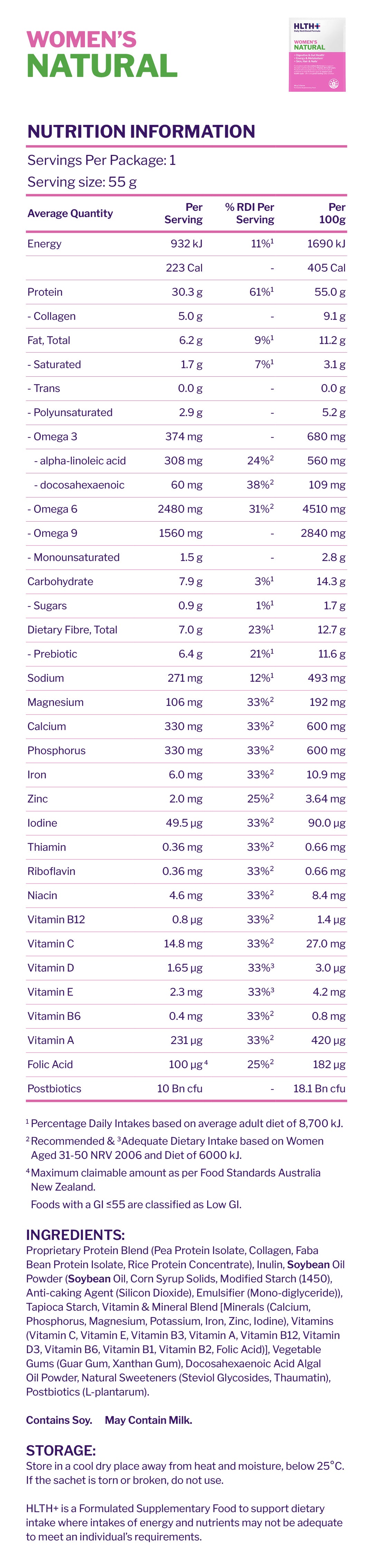
Per 55g sachet the label reads 30g protein, 7g dietary fibre, 5g collagen, 60mg DHA, and 10 billion CFU Lactobacillus Plantarum Postbiotic alongside prebiotics. Dietary fibre contributes to regular laxation, and that is the claim the 7g figure carries. The collagen and Lactobacillus Plantarum Postbiotic figures are printed here as label numbers, with no health effect claimed for either.
That adds up to 30 essential daily nutrients per serve, counting protein, dietary fibre, collagen and DHA as well as vitamins and minerals. The vitamin and mineral side is a balanced multivitamin profile. It is dairy-free, gluten-free and low GI, with no added sugar and no nasties, artificial colours, artificial flavours or artificial sweeteners.
The range is built by life stage rather than to one average adult: Women's, Women's 50+, Men's and Men's 50+, each formulated by Accredited Dietitians to the Nutrient Reference Values published by the National Health and Medical Research Council, the Australian Government Department of Health and Ageing and the New Zealand Ministry of Health. Australian made in facilities complying with Good Manufacturing Practice, with hundreds of reviews across the range. RRP $6.00, or $5.10 a day on the 28-serve subscription at $142.80.
Available at hlthplus.com, through the HLTH+ store on Amazon AU and at Chemist Warehouse online. For the fuller nutrition picture when you are eating less, learn more in GLP-1 Nutrition.
Not sure what your current stack is actually missing? The ✦ Find My Formula quiz takes 30 seconds and shows you the gaps rather than the products.
Frequently Asked Questions
What is the difference between a prebiotic and a probiotic?
A probiotic is a live microorganism given in an adequate amount to produce a documented benefit. A prebiotic is a substrate, usually a fibre, that microorganisms already living in you selectively use. One adds organisms, the other feeds the ones you have. Both definitions come from ISAPP consensus panels.
Are postbiotics better than probiotics?
Neither is better as a category. A postbiotic is a preparation of inanimate microorganisms and their components, so it does not need to stay alive through heat, processing or shelf life. That makes it easier to formulate with. Evidence still attaches to the specific preparation at the specific dose, exactly as it does to a probiotic strain.
Is dietary fibre the same as a prebiotic?
No. Most studied prebiotics are fibres, but a fibre only counts as a prebiotic if gut microorganisms selectively use it and a health benefit follows. Some non-fibre compounds qualify too. On an ingredients list, inulin, fructo-oligosaccharides, galacto-oligosaccharides and resistant starch are the terms you will most often see.
Can you compare a postbiotic count with a probiotic CFU count?
Not directly. CFU counts cells capable of forming a colony, which is a viability measure. Postbiotic preparations are quantified by other methods, including flow cytometry, biomass and chemical analysis of metabolites. The two numbers answer different questions, so read each within its own category rather than against the other.
Do probiotics need to be refrigerated?
It depends on the product, so follow the storage instructions on the pack. Live organisms have to survive until you take them, and heat and moisture work against that. Prebiotic fibres and postbiotic preparations have no viability to lose, which is why they hold up in shelf-stable formats.
This article is general information, not medical advice. Decisions about any medication belong with your doctor.


Leave a comment
This site is protected by hCaptcha and the hCaptcha Privacy Policy and Terms of Service apply.