

Why the gut comes up on a GLP-1
Two things change at once for the gut on a GLP-1 medicine. The medicine slows gastric emptying and gut motility, which commonly changes bowel regularity. And appetite drops sharply, so less food moves through the system altogether.
The scale of that drop has been measured: in controlled testing, GLP-1 medication cut free-choice food intake by roughly a quarter across the day, and about 35% at lunch (Blundell et al, 2017). Around 500,000 Australians regularly use GLP-1 medicines (UNSW, 2026), so this is now an everyday nutrition question rather than a niche one.
Less food means less of everything the gut runs on: less dietary fibre, fewer fermented foods, fewer plant serves. That is the honest frame for the "GLP-1 probiotic" search: before any capsule question, there is a food question. This page walks the food side first, then sorts the probiotic, prebiotic and postbiotic vocabulary so the labels make sense.
Short factual answers to the digestion questions themselves live in the GLP-1 Digestion FAQ.
General information, not medical advice. If your digestion has changed and it worries you, talk to your doctor.
The dietary fibre arithmetic
A 2025 study in Frontiers in Nutrition found GLP-1 users averaging 14.5g of fibre a day against the 28g recommendation; a second 2025 study found not a single user met it. That is roughly half the recommended intake, arriving at exactly the point the gut is already moving slower.
The fall is not carelessness. Fibre-rich foods are filling, and filling is exactly what a reduced appetite cannot accommodate, so salads and grain bowls become early casualties. Density therefore beats volume: the fibre has to arrive in fewer bites.
- Legumes and pulses. Lentils, chickpeas and beans carry more fibre per spoonful than most foods, which counts when spoonfuls are limited.
- Wholegrains over refined. Swapping bread, rice and cereals to wholegrain versions lifts fibre without adding much volume.
- Vegetables and fruit, skin on. Small serves still add up, and much of the fibre sits in the skin.
Build up gradually and keep fluids up alongside; both matter more when meals are small. The full arithmetic, and why 14.5g happens to almost everyone eating this way, is in Dietary Fibre on a GLP-1: The 14.5g Problem.
Fermented foods and probiotics on a smaller appetite
Probiotics are live microorganisms, taken in foods or supplements. The everyday sources are fermented foods: yoghurt with live cultures, kefir, sauerkraut, kimchi and miso.
On a GLP-1, the catch is practical rather than biochemical. When intake drops by roughly a quarter, incidental serves of these foods drop with it, and a daily yoghurt habit is often among the first things a smaller appetite squeezes out.
Keeping them in place is mostly a matter of portioning: a few spoonfuls of yoghurt rather than a bowl, kefir as a drink between meals, a fork of sauerkraut or kimchi beside a protein serve. None of this is a health promise; it is a way of keeping normal foods inside a smaller diet.
Whether a probiotic supplement adds anything on top of food is an open question; the research is strain-specific and mixed, and this page makes no recommendation either way. If you are weighing any supplement alongside a prescribed medicine, check with your doctor or pharmacist first.
Probiotics, prebiotics and postbiotics: the vocabulary
Three similar words, three different things. You will meet all three on yoghurt tubs, capsule bottles and formulated food panels, sometimes in the same aisle, so the definitions do more work than the marketing does.
- Probiotics are live microorganisms, found in fermented foods and supplement capsules.
- Prebiotics are the fibres and plant compounds those microorganisms feed on. Onions, garlic, oats, legumes and slightly green bananas are common food sources.
- Postbiotics are preparations of microorganisms that are no longer living, together with their components.
Postbiotics are the newest of the three, and they appear in formulated foods for a practical reason: because nothing needs to stay alive, they hold stable through manufacturing and shelf life without refrigeration.
One caveat travels with the category. A postbiotic CFU number counts the cells that went into the preparation, so it is not a like-for-like comparison with the live-cell count on a probiotic label. Read each as a label fact in its own category rather than as interchangeable measures.
Where HLTH+ fits when you are eating less
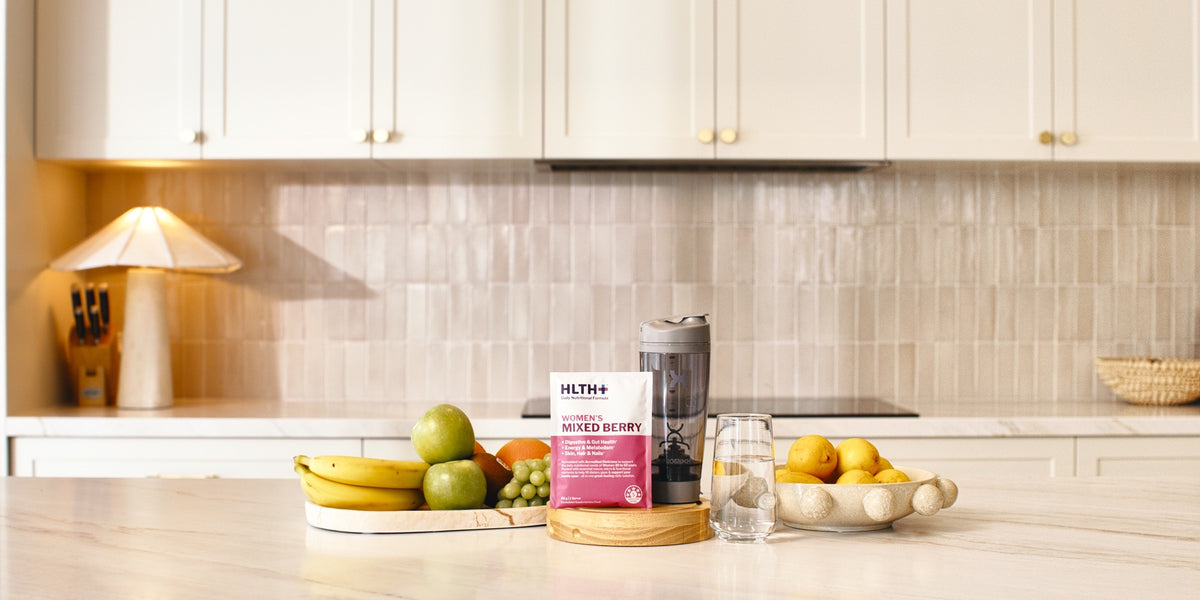
HLTH+ is an Australian-owned and made Formulated Supplementary Food under the FSANZ Food Standards Code: a daily nutritional formula built to supplement a diet that has shrunk. It is not a probiotic product, it makes no claim to raise GLP-1, and none to cause weight loss.
Per serve, the label reads 30g protein, 7g dietary fibre, 5g collagen, 10 billion CFU Lactobacillus Plantarum Postbiotic plus prebiotics, and 30 essential daily nutrients in total. Dietary fibre contributes to regular laxation, which is why the 7g figure is worth noticing when total intake drops. The collagen and postbiotic figures are printed here as label numbers, nothing more.
Australian food labels calculate percentage daily intake against an "average adult diet of 8,700 kJ" (Standard 1.2.8, Food Standards Code), a labelling reference value that sits above what the Nutrient Reference Values advise for most adults. HLTH+ takes the other path: each life-stage version (Women's, Women's 50+, Men's and Men's 50+) is dietitian-formulated to the NRVs set by the National Health and Medical Research Council, the Australian Government Department of Health and Ageing and the New Zealand Ministry of Health. Five flavours, at RRP $6.00, Australian made in facilities complying with Good Manufacturing Practice, sold at hlthplus.com and through Amazon AU and Chemist Warehouse online.
Not sure which life stage fits? The ✦ Find My Formula quiz takes 30 seconds and shows what your current stack is missing. If you are eating less on a GLP-1 medicine, learn more about support while managing side effects on a GLP-1.
Frequently Asked Questions
Does eating less affect gut health?
It changes what the gut has to work with. GLP-1 medication cut free-choice food intake by roughly a quarter in controlled testing, and users in a 2025 study averaged 14.5g of fibre a day against the 28g recommendation. Smaller meals also tend to crowd out fermented foods and plant variety.
How much fibre do you need?
The recommendation used in the 2025 study was 28g a day; the GLP-1 users it tracked averaged 14.5g. Legumes, wholegrains, and vegetables and fruit with the skin on are the densest everyday sources. A formulated food can add to that: HLTH+ lists 7g dietary fibre per serve.
Are prebiotics just fibre?
They overlap but are not identical. Prebiotics are compounds, mostly fibres, that feed microorganisms; not every dietary fibre acts as a prebiotic, and some non-fibre compounds do. For everyday eating the overlap is what matters: legumes, oats, onions and garlic serve both purposes at once.
What are postbiotics?
Postbiotics are preparations of microorganisms that are no longer living, together with their components. They differ from probiotics, which are live microorganisms, and from prebiotics, the fibres microorganisms feed on. Because nothing needs to stay alive, postbiotics hold stable through manufacturing and shelf life, which is why formulated foods use them.
Do you need a probiotic supplement on a GLP-1?
There is no blanket answer. Probiotic evidence is strain-specific and mixed, and this page makes no recommendation either way; fermented foods such as yoghurt, kefir and sauerkraut are the everyday starting point. If you are considering any supplement alongside a prescribed medicine, check with your doctor or pharmacist first.
This article is general information, not medical advice. Decisions about GLP-1 medicines belong with your doctor.

Leave a comment
This site is protected by hCaptcha and the hCaptcha Privacy Policy and Terms of Service apply.