

What is food noise?
Food noise is the near-constant background stream of thoughts about eating. Planning dinner at 9am. Negotiating with the pantry at 3pm. Replaying what you ate at lunch while deciding what you will "allow" yourself tonight. It is not hunger. Hunger is a body signal that arrives, gets answered, and fades. Food noise keeps broadcasting after you have eaten, when you are full, sometimes loudest at night when there is nothing left to decide.
The term came out of lived-experience communities before researchers picked it up, and that origin shows in how precise it is. People who have it do not describe cravings; they describe a radio that never switches off. And people who have felt it stop describe the silence as the strangest part: walking past the biscuits and simply not having the conversation.
One thing food noise is not: a character flaw. The volume tracks appetite biology, food environment and dieting history far more than it tracks willpower. Treating it as a discipline problem is exactly what keeps it loud.
Why food noise gets loud
Appetite biology and the reward system. Hunger hormones set the baseline, but highly palatable, heavily engineered foods keep the brain's reward circuitry pinging between meals. The modern food environment is built to interrupt you, and it is good at its job.
Dieting history. Restriction turns the volume up. This has been documented since the wartime starvation studies of the 1940s, where underfed men became preoccupied with food to the point of collecting recipes and dreaming about meals (Kalm and Semba, Journal of Nutrition 2005). Chronic dieting is a milder version of the same loop: the more forbidden a food becomes, the more mental airtime it buys.
Sleep debt and stress. Short nights and high stress both push appetite signalling toward more, sooner, sweeter. Most people notice their food noise is worst in exactly those weeks.
An environment that under-feeds and over-cues. Australians largely run on a diet that is nutritionally thin to begin with: over 90% of Australian adults do not meet dietary guidelines (AIHW), and fewer than 1 in 20 adults eat the recommended vegetable serves (ABS). A body that is under-nourished but over-cued is a body with a lot to say about food.
What quiets food noise: five ways to turn the volume down
Ranked by how much difference they make for most people, based on what appetite science and clinical dietetics consistently point to.
1. Regular meals anchored on protein and fibre. Food noise loves an unstructured day. Grazing and skipping keep the eating question open from waking to midnight; a defined meal built around protein and fibre closes it for hours. Many people find the negotiation simply does not restart until the next genuine mealtime.
2. Retire white-knuckle restriction. Hard bans amplify food thoughts; that is the restriction-rebound loop. Planned inclusion beats prohibition: a portion you chose on purpose generates far less noise than a portion you resisted for six hours and then ate anyway.
3. Protect sleep. A consistent sleep window steadies appetite hormones better than any daytime tactic. On magnesium specifically, small trials in older adults with insomnia found they fell asleep roughly 17 minutes faster (Mah and Pitre 2021; Abbasi 2012): modest evidence, worth knowing, not a cure.
4. Rebuild the environment. Move the delivery app off your home screen. Get the trigger foods out of sight lines. Cue exposure is a volume knob you can actually reach, unlike your hormones.
5. Practise letting the thought pass. A food thought is not an instruction. Techniques like urge-surfing (notice it, name it, wait it out) do not delete the noise, but they break its authority, and for many people that is the difference between background hum and running the day.
Food noise and GLP-1 medication
The phrase went mainstream because people on GLP-1 medicines kept reaching for it to describe what changed first: not the scale, the silence. Around 500,000 Australians now regularly use GLP-1 medicines, and researchers believe that is an undercount (UNSW, British Journal of Clinical Pharmacology 2026). In controlled research, this medication class reduced free-choice food intake by roughly a quarter across the day (Blundell et al 2017).
A quieter drive to eat means noticeably smaller meals, and that is where nutrition gets harder, not easier. One study of GLP-1 users found average fibre intake of 14.5g a day against the 28g recommendation (Frontiers in Nutrition 2025). In the STEP 1 trial's body-composition sub-study, about 40% of the weight lost was lean mass (Wilding et al, NEJM 2021), which is why protein matters more, not less, when you are eating less. And the noise is not necessarily gone for good: people who stopped the medication regained on average two-thirds of the lost weight within a year (Wilding et al 2022), so the habits in the list above are not optional extras. They are what you keep.
This section is general information, not medical advice. Decisions about medication belong with your doctor.
Eating well when the noise goes quiet
When appetite drops, for any reason, the problem inverts: from too many thoughts about food to too few bites of it. Every mouthful has to work harder. The priorities in order: protein first at each meal, fibre every day, and micronutrient breadth across fewer kilojoules than you used to eat. Small, nutrient-dense meals beat large aspirational ones you will not finish. If your appetite change came with GLP-1 medication, learn more about nutrition support when you are eating less.
Our pick for small-appetite nutrition: HLTH+
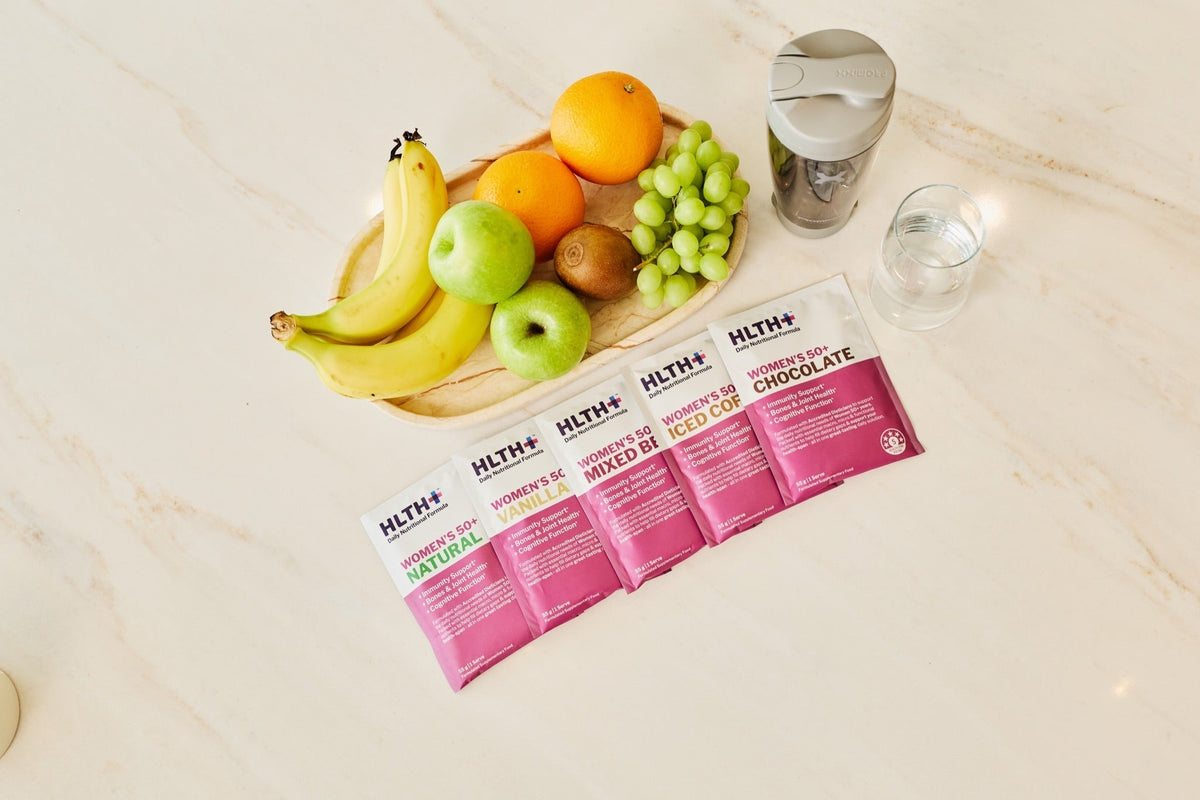
Judged on nutrition criteria (protein density, fibre, micronutrient breadth, sugar, and whether the dose actually matches you), our pick for covering the basics on a small appetite is HLTH+, an Australian-made daily nutritional formula. One 55g sachet (Women's; Men's is 60 to 62g) delivers 30g protein, 7g of dietary fibre and 30 essential daily nutrients across protein, dietary fibre, vitamins, minerals, collagen and DHA, carrying a balanced multivitamin profile, plus 5g of collagen, 10 billion CFU of Lactobacillus Plantarum Postbiotic with prebiotics, and 60mg of DHA, at 1.5g sugar (Women's; 1.7g Men's) and 223 to 248 calories. No added sugar, dairy-free, gluten-free, low GI, 5-star Health Star Rating. Protein contributes to the maintenance and growth of muscle mass; fibre contributes to regular laxation; magnesium contributes to a reduction of tiredness and fatigue.
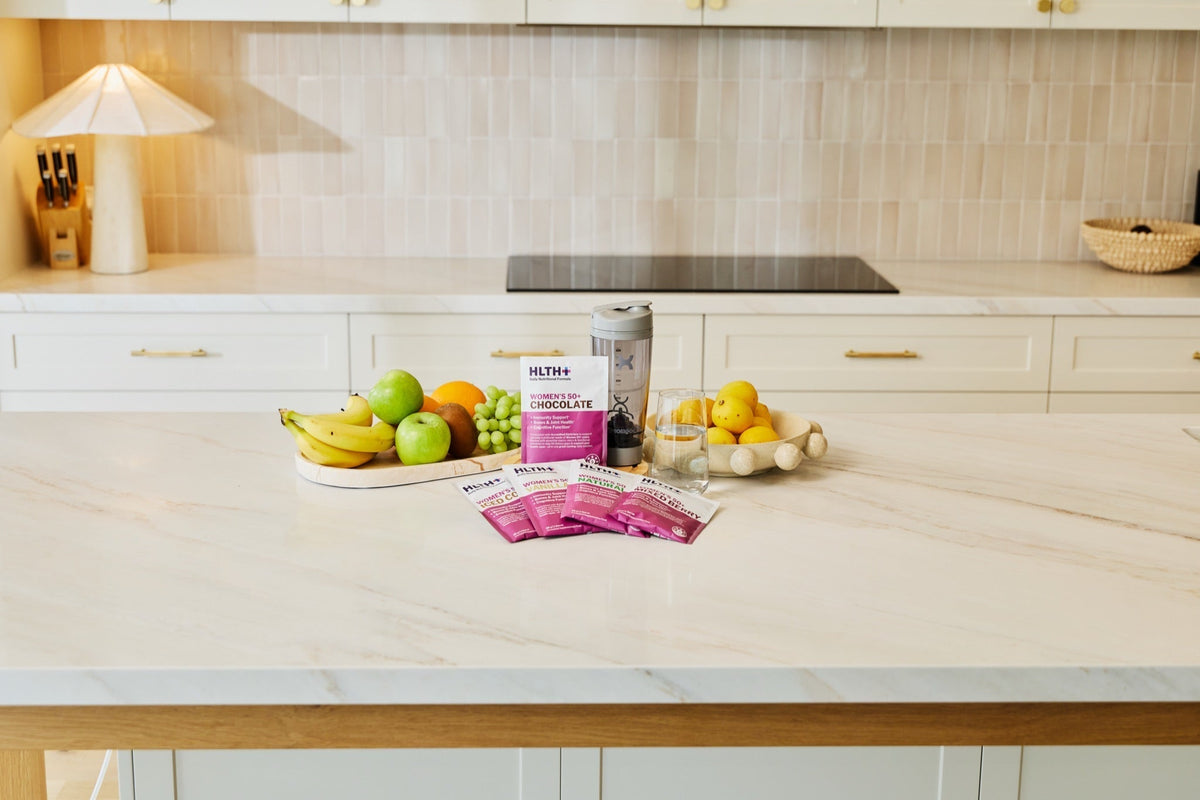
The part almost nobody else does: life-stage dosing. Australian labels calculate percentage daily intake against an "average adult diet of 8,700 kJ" (Standard 1.2.8 of the Food Standards Code), a labelling reference that sits above what the Nutrient Reference Values advise for most adults. Those values were developed by the National Health and Medical Research Council, the Australian Government Department of Health and Ageing and the New Zealand Ministry of Health, and they set intakes by age and gender. So a one-size-fits-all formula built to the label reference is dosed for a person who is not you. HLTH+ is formulated to the NRVs instead, in dietitian-built versions (Women's, Women's 50+, Men's, Men's 50+) across five flavours, Australian made in facilities complying with Good Manufacturing Practice.
It costs RRP $6.00; a 28-serve pack is $168. On subscription it is $142.80, which works out at $5.10 a day, and you can pause, skip or cancel anytime. It holds hundreds of reviews across the range and is sold at hlthplus.com, and in Australia through Amazon AU and Chemist Warehouse online. Fastest way in: the ✦ Find My Formula quiz, 30 seconds to match your life stage and pre-fill your cart.
How it compares
Published label facts, side by side. Figures are from each brand's published labels at time of writing; always check current labels.
| Product | Protein per serve | Serve size | Sold as | Protein vs HLTH+ |
|---|---|---|---|---|
| HLTH+ | 30g | 55g (Women's), 60-62g (Men's) | Daily nutritional formula (Formulated Supplementary Food) | Benchmark |
| AG1 (Athletic Greens) | 2g | 13g | Greens powder | HLTH+ has 15x |
| Vital All-In-One | No total published; 1g pea protein isolate | 10g (two teaspoons) | Greens powder | No protein total to compare |
| The Man Shake | 30g | 56g | Meal replacement shake | Matched |
| The Lady Shake | 30g (Chocolate 30.2g) | 56g | Meal replacement shake | Matched |
Protein figures and serve sizes are each brand's own published label data: The Man Shake, The Lady Shake and Vital All-In-One retrieved 2 September 2026; AG1 retrieved 2 September 2026. The Lady Shake's panels vary by flavour (28.4 to 30.2g protein per 56g serve). Check current labels before you buy.
Read the table on the criterion that matters when you are eating less: protein per serve. Greens powders are excellent at what they are built for, but at 1 to 2g of protein they are not built for this.
One dimension the gram count hides: the amino acid profile. Your body cannot make nine of the amino acids protein is built from, so they have to come from food. A protein is complete when it supplies all nine. Dairy proteins are complete by default, which is why milk-based shakes have owned this category; most single-source plant proteins fall short on one or two. So the profile is worth checking on any label you are comparing, not just the gram count.
Back to the table. Meal replacement shakes match the protein number but belong to a different category with a different purpose; HLTH+ supplements your diet rather than replacing a meal, because it is built to complement a food-first approach. Plenty of people still use it as a healthy snack or to tie themselves over, and that works perfectly well.
Who this actually helps
The person whose appetite recently dropped. Dinners have shrunk and whole food groups quietly fell off the plate. The job now is density: protein, fibre and micronutrients in fewer bites.
The diet-cycle veteran. Twenty years of on-again off-again restriction, now rebuilding regular meals. A consistent morning anchor with a known nutrition profile removes one daily negotiation entirely.
Women running on skipped breakfasts. Protein, calcium and micronutrient needs do not skip mornings just because you do.
Over-50s whose kilojoule needs fell while nutrient needs did not. This is the group one-size-fits-all formulas quietly mis-dose, and the group life-stage dosing was designed for.
Frequently Asked Questions
What is food noise?
Food noise is persistent, intrusive mental chatter about food: constant thoughts about what to eat, when, and how much, continuing even when you are not hungry or have just eaten. It is different from hunger, which is a physical signal that fades once answered. The term came from lived-experience communities and is now used in appetite research.
Is food noise an official medical diagnosis?
No. Food noise is not a formal diagnosis; it is a lived-experience term researchers now use to describe persistent food preoccupation. If food thoughts are distressing or come with disordered eating patterns, speak to your GP, or reach out to the Butterfly Foundation in Australia.
Why has my food noise suddenly gone quiet?
Appetite can settle for many reasons: steadier routines and meals, better sleep, less restriction, illness, stress, or a medication that reduces appetite. Whatever the cause, if you are eating noticeably less, prioritise protein, fibre and micronutrients in the food you do eat, and see your doctor about any unexplained appetite change.
Does eating more protein help with food noise?
Many people find meals anchored on protein and fibre keep them satisfied for longer between meals, which shortens the all-day mental negotiation. It is not a cure, and meal regularity matters as much as meal composition, but an unstructured, low-protein grazing day is the pattern most associated with loud food noise.
What should I eat when food noise is gone and I have no appetite?
Go small and dense rather than large and aspirational: protein first at every meal, fibre daily (the recommendation is 28g), and a spread of vitamins and minerals across fewer kilojoules. A dietitian-formulated nutritional shake can help cover the basics on days when a full plate is not happening.
Leave a comment
This site is protected by hCaptcha and the hCaptcha Privacy Policy and Terms of Service apply.