

Why does skin loosen after weight loss?
Skin loosens because the dermis, the thick middle layer that gives skin its strength and snap, was stretched for long enough that its structure changed. Collagen is the principal component of the dermis, and it is elastic fibres, not collagen, whose configuration allows gliding, stretching and recoiling (StatPearls, Histology, Dermis). When the fat underneath goes and those fibres are damaged, the envelope does not pull back to fit.
If you are watching this happen, the feeling is usually a mix of relief and dismay. The number you wanted is arriving, and the skin at your stomach, arms or thighs is not following it. The obvious next thought is that you did something wrong, or that a cream or powder will take care of it.
This article explains what the research actually shows about why skin loosens, what decides how much of it you get, what genuinely removes it, and where nutrition sits in all of that.
Mechanical stretch is the damaging event, and it happens on the way up, not the way down. Stretch marks are the clearest evidence: they are a form of dermal scarring resulting from the stretching of the dermis, with disruption of the dermal connective tissue, particularly collagen and elastin fibres (StatPearls, Striae Distensae). Loose skin is that same stretched tissue, now with nothing underneath to hold it out.
The skin of people who have lost a great deal of weight has been put under the microscope, and it looks different. Collagen was significantly thinner in both layers of the dermis and significantly less dense in the deeper layer, alongside damage to the elastic fibre network, in a comparison of people after massive weight loss with controls (Sami et al, Eplasty, 2015). A separate study of abdominal skin removed at body-lift surgery found poorly organised collagen, elastin degradation and regions of scar formation inside areas that looked normal to the eye (Light et al, Plastic and Reconstructive Surgery, 2010).
General information, not medical advice. Decisions about any medication belong with your doctor.
What decides how much loose skin you get?
Five things are usually named, and the honest position is that they are presumed rather than proven. The factors presumed to influence the ability of the skin envelope to contract include the rate and amount of weight loss, age, smoking, sun exposure and genetics (Hany et al, Obesity Surgery, 2024). Of those, the amount lost and your age have the best support.
The amount lost. More weight lost means more stretched skin left over, and the research on who wants it removed tracks that. In a survey of 360 people more than a year on from bariatric surgery, those who had lost more than 20 kg, or dropped more than 10 BMI points, showed a significantly stronger desire for body contouring surgery than other groups (Giordano et al, Aesthetic Surgery Journal, 2014).
Age. Skin ages on two separate clocks. Intrinsic ageing is characterised by atrophy of the dermis due to loss of collagen, degeneration in the elastic fibre network and loss of hydration (Uitto, Journal of Drugs in Dermatology, 2008). Older skin starts the weight-loss journey with less recoil in reserve, which is one reason two people losing the same amount can end up looking very different.
Sun exposure. Ultraviolet exposure is the principal cause of extrinsic ageing, which is why it is called photoageing (Uitto, 2008). Collagen type I diminishes in photoaged skin because of increased degradation, and UV exposure drives cleavage of elastic fibres by proteases (Zhang and Duan, Cell Transplantation, 2018). Decades of Australian sun on the arms and chest is a head start on laxity before any weight changes.
The rate of loss. This is the factor everyone quotes and the one with the least direct evidence. A scoping review of 24 studies found the correlates of excess skin inconclusive beyond one consistent finding, that women reported more excess skin and greater inconvenience from it than men (Baillot et al, Obesity Surgery, 2017). Slower loss is still sensible advice for other reasons, but nobody should promise you it will spare your skin.
Fast loss does reliably show up in other tissues first. Hair sheds on a delay of around three months after rapid weight loss, reduced eating and medically induced weight loss, and the mechanism there is nutritional rather than structural; learn more in why hair sheds after weight loss. For women in their late 40s and 50s, the hormonal shift of perimenopause runs alongside the age changes in skin described above.
Does loose skin go away on its own?
Sometimes partly, rarely completely, and the amount lost is the deciding variable. Excess skin follows bariatric surgery in more than 70% of adults (Baillot et al, Obesity Surgery, 2017), and that population is the one the research has measured, because the losses are large and the surgery dates give a clean timeline.
Time alone does not repair the damage. In the body-lift study above, plastic surgery followed bariatric surgery by an average of 20.5 months, and the skin still exhibited significant signs of damage to its extracellular matrix components despite the duration of time since the procedure (Light et al, 2010). The tissue had almost two years to recover and had not.
The picture is not uniformly bleak. A Swedish study that measured excess skin directly found people had significantly less excess skin on the arms, breasts and abdomen after weight loss than before surgery, though it increased on the inner thighs (Elander et al, Surgery for Obesity and Related Diseases, 2019). Some retraction happens; the point is that it stops well short of the finish line when the surplus is large.
For a modest loss in younger skin, the surplus is often small and settles into something you stop noticing. For a large loss, or an older starting point, the honest expectation is that the loosest areas stay loose until something is done about them.
More on what changes at the surface when you are eating less: how a reduced intake shows up in skin, hair and nails.
What actually removes excess skin?
Surgery, and only surgery, for a large surplus. A systematic review in Obesity Surgery states it plainly: these skin deformities following massive weight loss cannot be resolved by modifications in lifestyle, diet and exercise, and body contouring surgery offers a solution by surgically removing the excess tissue (Toma et al, Obesity Surgery, 2018). Surgical body contouring removes excess sagging skin and fat while improving the shape of the underlying support tissue (American Society of Plastic Surgeons).
Creams do not do it. In a Swiss cohort presenting for abdominoplasty, every person had first tried to settle their skin with regular or antibiotic-containing creams, at times with systemic antibiotics, with no real lasting benefit (Pruzzo et al, Journal of Clinical Medicine, 2025). The same study found abdominoplasty effective for the functional problems, the chafing and infections, that a heavy skin fold causes.
Nothing sold in a tub, a sachet or a wrap changes that. The damage is to the fibre architecture of the dermis, and no oral or topical product has been shown to rebuild a stretched envelope to fit a smaller body. Anyone selling a supplement for loose skin is selling past the evidence.
That includes deciding what counts as a problem. Excess skin after bariatric surgery had negative physical impacts in 67% of studies, psychosocial impacts in 75% and daily-life impacts in 83% (Baillot et al, 2017); a fold that rubs, rashes or stops you exercising is a medical conversation, not a cosmetic one. Take it to your GP, who can refer you to a plastic surgeon and talk through what is realistic.
This article is general information, not medical advice. Decisions about any medication belong with your doctor.
Where does nutrition fit, if it cannot remove loose skin?
Underneath the skin, and in what the skin is built from. The dermis is mostly collagen, and collagen is a protein your body has to make from the protein you eat; the fibroblasts that synthesise collagen and elastic fibres are the principal cells of the dermis (StatPearls, Histology, Dermis). Skin is not spared when intake drops, it is simply lower on the body's priority list than muscle and organs.
The bigger tissue question is what is under the skin. In the STEP 1 trial's body-composition sub-study, roughly 40% of the weight lost was lean mass (Wilding et al, New England Journal of Medicine, 2021). Lean mass is the tissue that gives the arms and thighs their shape, and it is the loss nutrition and resistance training can actually do something about.
Learn more about why protein is the first thing to slip when appetite drops.
Appetite is the mechanism. Controlled testing found free-choice food intake fell by roughly a quarter across the day on a GLP-1 medicine (Blundell et al, Diabetes, Obesity and Metabolism, 2017), and an aggressive deficit without medication lands in the same place. Eat a quarter less of the same plate and protein, dietary fibre and every micronutrient fall by about the same fraction.
Most plates had no slack to begin with. Over 90% of Australian adults do not meet dietary guidelines (AIHW), so a smaller version of the usual diet is a shortfall stacked on a shortfall. The food-first answer is density rather than volume:
- Put protein on the plate first, because a small appetite fills fast and whatever goes in first is what actually gets eaten.
- Keep wholefood protein varied: eggs, fish, lean meat, legumes, dairy or fortified alternatives.
- Build in resistance training two or three times a week; muscle responds to load, and the protein has somewhere to go.
- Make sun protection part of the plan. Ultraviolet exposure is the principal driver of extrinsic skin ageing, and a hat and sunscreen are the one skin intervention above with evidence behind it.
- If you smoke, it sits on the presumed-factor list for skin contraction as well as everywhere else.
Skin is only one of the places a sharp drop in intake shows up. Learn more about the wider set of changes that follow a reduced appetite and what changes when appetite drops away.
Where a Formulated Supplementary Food fits when you are eating less
Separate question, separate logic, and it is a nutritional one rather than a cosmetic one. When intake falls by a quarter, the job is to make what you do eat carry more, because you cannot eat more of it. That gap is exactly what a Formulated Supplementary Food is built for.
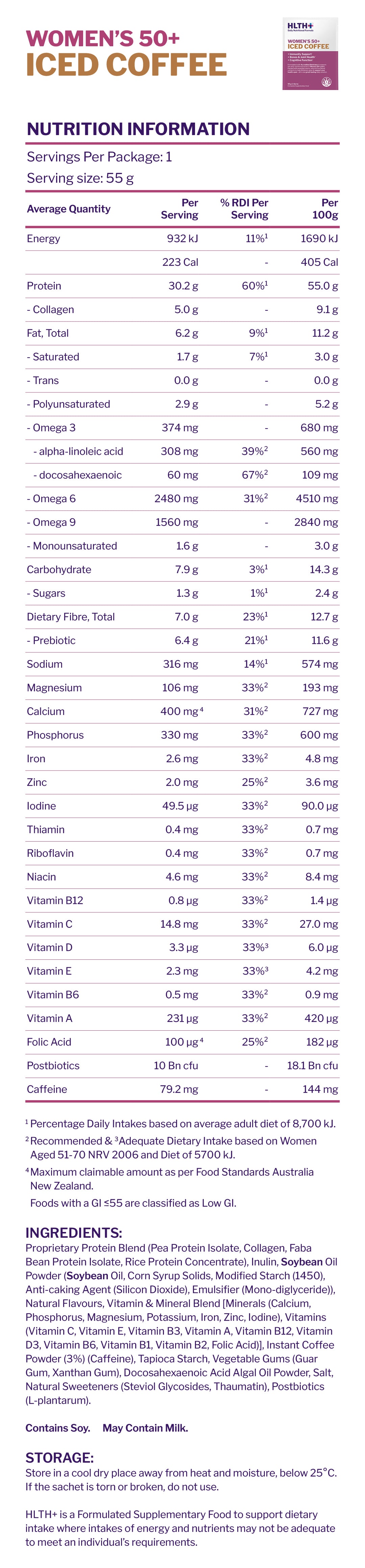
HLTH+ is built for that gap, as nutritional insurance alongside a food-first approach. Per serve the label reads 30g protein, 7g dietary fibre and 60mg DHA, with a balanced multivitamin profile, in a 55g sachet at RRP $6.00.
Across the whole formula the label counts 30 essential daily nutrients. Protein contributes to tissue building and repair, and to the maintenance of muscle mass.
The dosing is the part worth understanding. Nutrient needs shift with age and gender, so instead of one formula for everyone, HLTH+ is dietitian-formulated to the Nutrient Reference Values, the intake recommendations developed by the National Health and Medical Research Council, the Australian Government Department of Health and Ageing and the New Zealand Ministry of Health, in life-stage versions: Women's, Women's 50+, Men's and Men's 50+.
It is Australian made, in facilities complying with Good Manufacturing Practice, and on subscription the 28-serve pack works out at $5.10 a day. It is also stocked at Chemist Warehouse online and on Amazon AU if that is easier than ordering direct.
Want to see the gaps in your current stack rather than guess at them? The ✦ Find My Formula quiz runs in 30 seconds and reads back what your existing routine is leaving out.
Frequently Asked Questions
Does loose skin after weight loss go away on its own?
Partly, and less so for larger losses. A Swedish study measured less excess skin on the arms, breasts and abdomen after weight loss, but more on the inner thighs (Elander et al, 2019). Skin removed almost two years after bariatric surgery still showed damaged collagen and elastin (Light et al, 2010); a large surplus does not resolve with time.
Can a supplement or cream tighten loose skin?
No. A systematic review in Obesity Surgery states that skin deformities after massive weight loss cannot be resolved by changes to lifestyle, diet or exercise (Toma et al, 2018), and a 2025 cohort found creams gave no lasting benefit. Nutrition decides what the skin and the muscle under it have to work with; it does not remove a stretched envelope.
Does losing weight slowly mean less loose skin?
The rate of loss is listed among the presumed factors, alongside amount lost, age, smoking, sun exposure and genetics (Hany et al, 2024), but a scoping review found the correlates of excess skin inconclusive (Baillot et al, 2017). Amount lost and age have firmer support. Slower loss is reasonable for other reasons; it is no guarantee for skin.
What is the only proven way to remove a large amount of excess skin?
Body contouring surgery. It removes excess sagging skin and fat while reshaping the underlying support tissue (American Society of Plastic Surgeons), and abdominoplasty markedly decreases the discomfort of a heavy skin fold (Elander et al, 2019). A fold that chafes, rashes or limits movement is a medical conversation; start with your GP and ask about a referral.
This article is general information, not medical advice. Decisions about any medication belong with your doctor.

Leave a comment
This site is protected by hCaptcha and the hCaptcha Privacy Policy and Terms of Service apply.