

A greens powder is a small daily scoop, 10 g to 13 g, of dried vegetables, fruits, herbs, algae and added vitamins, stirred into water. On the panels Australian brands actually publish, it carries 2 g protein and 2 g dietary fibre where those figures appear at all, it is dosed once for every adult, and the independent trial evidence behind the category is thin. AG1's Australian label lists 2 g protein per 13 g serve, and HLTH+ lists 30g protein per serve.
Most people asking what a greens powder does already have a pouch on the bench. The real question is whether the daily scoop covers what you assumed it covered, especially if you are eating less than you used to.
This page sets out what a greens powder is, what the three best-known Australian panels carry, what the evidence does and does not say, and the three things the category was never built to hold.
What is a greens powder?
A greens powder is a dried blend, sold by the pouch or tub, built around plant ingredients: leafy greens, grasses, fruit powders, mushrooms, adaptogenic herbs, digestive enzymes and, in most formulas, a probiotic culture and a vitamin premix. The serve is small by design. AG1's Australian label states a 13 g scoop, and both WelleCo The Super Elixir and Vital All-In-One direct a 10 g serve of two teaspoons.
That serve size fixes everything else about the category. Ten to thirteen grams of powder divided across 40 or more ingredients leaves, on average, a fraction of a gram for each line. What lands in your glass is breadth, not weight.
Price is the second fixed point. WelleCo prints a cost per serve of $3.3 on an $88.00 pack, and Vital All-In-One's pricing ladder works out between $2.32 and $3.41 a serve depending on pack size (pack price divided by stated servings; both pages re-read 8 September 2026). At the premium end sits the hybrid, part greens and part multivitamin, which is where IM8 lands in the Australian market.
What do the published panels actually carry?
Three products define the category for Australian shoppers, and only one publishes a full nutrition information panel online. Here is what each brand puts on its own page.
| Per serve, as each brand publishes it | AG1 (Australian label) | WelleCo The Super Elixir | Vital All-In-One |
|---|---|---|---|
| Serve size | 13 g | 10 g | 10 g |
| Full nutrition information panel published online | Yes | No | No |
| Protein | 2 g | Not published on the product page | No total protein line; the ingredient list gives 1000mg pea protein isolate |
| Dietary fibre | 2 g | Not published on the product page; psyllium husk is listed without a quantity | Not published on the product page |
| Sugars | Under 1 g | 0.9 g to 1.1 g depending on flavour | Not published on the product page |
| Calories | 41 (172 kJ) | Under 32, stated as a ceiling rather than a figure | Not published on the product page |
| Live cultures | 10 billion CFU probiotics, five named strains | Probiotics listed, no count published | 14 billion CFU probiotics |
Figures from each brand's published product information: AG1 from its Australian label, retrieved 2 September 2026; WelleCo and Vital All-In-One from their product pages, re-read 8 September 2026. Flavours vary and brands reformulate, so check the current label before buying.
AG1 deserves credit for transparency: it prints the whole panel, names all five probiotic strains and states its percentages against a declared reference diet. The full row-by-row read is in the AG1 review.
The other two cannot be compared on the lines most people care about, because the numbers are not there. WelleCo publishes sugars, a calorie ceiling and an ingredient list with no gram quantities, and why that matters is set out in the Super Elixir review. Vital All-In-One publishes ingredient quantities and a probiotic count, but no energy, protein, fibre or sugar figure.
One row needs a note. A live probiotic count and a postbiotic count are not the same measurement, so a CFU figure on one label cannot be read straight across to another product; the difference between prebiotics, probiotics and postbiotics is explained here.
What does the evidence say about greens powders?
Honestly, not much, and that is the finding rather than a dodge. There is little independent, peer-reviewed trial evidence on greens powders as a category: most of what circulates is research on whole vegetables, which a dried powder is not, or on single nutrients a powder happens to contain. We looked for a controlled trial of a greens powder as a product, verifiable from a primary source, and cite none because none met that bar.
What can be said with confidence is how the claims work in Australia. Under Schedule 4 of the Food Standards Code, health claims attach to nutrients, not to blends: a vitamin or mineral can be claimed at all only when a serve carries at least 10% of the recommended dietary intake, and the pre-approved relationships are written nutrient by nutrient. So whatever a greens powder can lawfully say, it says about the vitamin C or the zinc inside it, not about the 40 ingredients around them.
AG1's Australian label shows how that plays out on a real scoop. Vitamin C is listed at 500 mg and vitamin B12 at 400 mcg, which the label's own daily intake column states as 1111% and 16667%, while magnesium sits at 16 mg, or 4%. One scoop is very heavy on some rows and very light on others, and the percentage column is label arithmetic against an average adult diet of 8,700 kJ under Standard 1.2.8, a labelling reference value that sits above what the Nutrient Reference Values advise for most adults.
A tablet raises the same question, and whether multivitamins work gets the longer treatment. For a greens powder the short version is: the micronutrients are real, the doses are uneven, and the blend itself has not been tested in a way anyone can cite.
What do greens powders miss?
Three things, and none of them is a flaw in the products. They are consequences of a 10 g to 13 g scoop.
Protein
On AG1's Australian label, protein is 2 g per 13 g serve. HLTH+ lists 30g protein per serve, and 30 divided by 2 is 15, so one sachet carries fifteen times the protein on that panel. WelleCo publishes no protein figure at all, and Vital All-In-One lists 1000mg of pea protein isolate without a total protein line.
The point is not that a greens powder should carry protein. It is that a scoop of that size physically cannot, so anyone treating the morning greens as their protein is running on a low single digit. Protein contributes to the maintenance and growth of muscle mass, and why 2 g is not the number you need is covered here.
Dietary fibre in meaningful amounts
AG1 lists 2 g dietary fibre per serve, which is exactly the floor at which Schedule 4 allows any dietary fibre claim to be made. A good source needs 4 g per serving and an excellent source needs 7 g. HLTH+ lists 7g dietary fibre per serve, and dietary fibre contributes to regular laxation.
Two grams matters more once overall intake drops. A 2025 study of people on GLP-1 medications found average dietary fibre intake of 14.5 g a day against the 28 g recommended (Frontiers in Nutrition), and what that shortfall looks like day to day is set out separately.
One dose for every adult
Every greens powder in the table is one formula for everyone who buys it, dosed against a single label reference. The Nutrient Reference Values published in 2006 by the National Health and Medical Research Council, the Australian Government Department of Health and Ageing and the New Zealand Ministry of Health set different intakes by age and by sex, which is why a reference built for an average adult over-serves some people and under-serves others.
A scoop cannot know who is holding it, and that is the gap a life-stage formulation exists to close. Learn more about what changes in your nutrition when you are eating less.
What changes when you are eating less?
Plenty of people start a greens habit at exactly the moment their plate gets smaller, whether the cause is a deliberate calorie deficit, an appetite that has quietly fallen away, or rapid weight loss, reduced eating and medically induced weight loss.
The scale of that change has been measured. In trial conditions, GLP-1 medicines reduced ad libitum food intake by roughly a quarter of daily calories (Blundell and colleagues, Diabetes, Obesity and Metabolism, 2017). When a quarter of the food goes, a quarter of the protein, dietary fibre and micronutrients it carried goes with it, and a 13 g scoop does not carry those back.
This page is general information, not medical advice, and decisions about any medication belong with your doctor. Which vitamins slip first when meals shrink is answered separately.
Who a greens powder suits, and who should look elsewhere
- You want micronutrient breadth in one small scoop, and your protein and dietary fibre are already handled by what you eat. That is the job a greens powder was built for.
- You want the calories to stay tiny. At 41 calories, or under 32 on WelleCo's ceiling, a greens serve asks almost nothing of your day.
- You like the ritual and you have kept it. A habit you keep beats a formula you abandon, and taste is a legitimate reason to buy something you drink every morning.
- You assumed it was covering your protein. On the published panels it is not, and the AG1 alternatives shortlist is where that search goes next.
- You are eating noticeably less than you used to. The gap that opens is macronutrients first, and that is a different category of product.
We believe in a food-first approach, and the statistics say food alone is not getting there. Over 90% of Australian adults do not meet dietary guidelines on the AIHW poor-diet measure, and fewer than 1 in 20 eat the recommended serves of vegetables (ABS, 2023). A greens powder is one answer to that, and a narrow one.
Where a daily nutritional formula fits
The concession first. HLTH+ is not a greens powder, and it is not a meal replacement or a weight-loss product either. If what you want is a small scoop of botanicals and a long ingredient list, the three products above are built for that and this is not.
What a Formulated Supplementary Food answers is the wider half of the problem. A greens powder covers micronutrient breadth and leaves protein at 2 g, a collagen powder carries no multivitamin, and a multivitamin carries neither protein nor dietary fibre. That is how a shelf of half-used tubs happens, and the case here is one habit in place of the shelf.
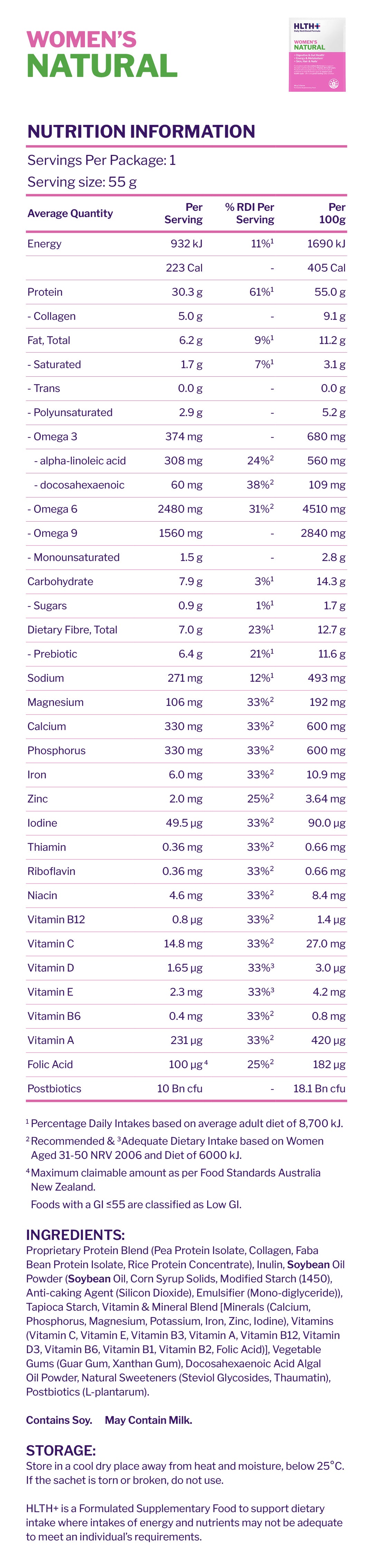
A 55g sachet of HLTH+ Women's carries 30g protein per serve, 7g dietary fibre, 5g collagen, 60mg DHA and 10 billion CFU Lactobacillus Plantarum Postbiotic plus prebiotics, at 1.5g of sugar with none added and 223 calories. It carries a balanced multivitamin profile. In total, one serve supplies 30 essential daily nutrients across protein, dietary fibre, vitamins, minerals, collagen and DHA.
It is formulated by Accredited Dietitians to the Nutrient Reference Values published in 2006 by the National Health and Medical Research Council, the Australian Government Department of Health and Ageing and the New Zealand Ministry of Health, by sex and life stage across Women's, Women's 50+, Men's and Men's 50+, because those reference intakes are not one adult number.
It is Australian-owned and Australian-made in facilities complying with Good Manufacturing Practice, carries a 5-star Health Star Rating, is dairy-free and gluten-free, and holds hundreds of reviews across the range. It sells at hlthplus.com at RRP $6.00, or $5.10 a day on a 28-serve subscription at $142.80, and through Amazon AU and Chemist Warehouse online.
Find out what your current stack is not giving you. The 30-second ✦ Find My Formula quiz reads the tubs you already own and shows the gaps they leave.
Frequently Asked Questions
What is a greens powder?
A greens powder is a dried blend of vegetables, grasses, fruit powders, herbs, mushrooms, a probiotic culture and added vitamins, taken as a 10 g to 13 g scoop in water. It is built for micronutrient breadth in a very small serve, so protein and dietary fibre are minimal where the brand publishes them at all.
How much protein is in a greens powder?
Very little: AG1's Australian label lists 2 g protein per 13 g serve (retrieved 2 September 2026). WelleCo publishes no protein figure for The Super Elixir, and Vital All-In-One lists 1000mg of pea protein isolate with no total protein line (both re-read 8 September 2026). HLTH+ lists 30g protein per serve.
Is a greens powder a good source of dietary fibre?
Not on the published panels. AG1 lists 2 g dietary fibre per serve, which is the minimum Schedule 4 of the Food Standards Code allows for any dietary fibre claim; a good source needs 4 g and an excellent source 7 g per serving. WelleCo and Vital All-In-One publish no dietary fibre figure.
Is there scientific evidence that greens powders work?
The independent trial evidence is thin. Most cited research concerns whole vegetables or single nutrients rather than a greens powder as a product, and this page found no controlled trial of the category it could verify from a primary source. Under Australian law, any health claim belongs to a named nutrient at a threshold, not to the blend.
Can a greens powder replace vegetables?
No. A 10 g to 13 g scoop of dried powder is not a serve of vegetables, and fewer than 1 in 20 Australian adults eat the recommended serves (ABS, 2023). A greens powder supplements what you eat rather than standing in for it, which is also the honest description of any daily nutritional formula, HLTH+ included.
Leave a comment
This site is protected by hCaptcha and the hCaptcha Privacy Policy and Terms of Service apply.