

What is the best AG1 alternative in Australia?
It depends on what you wanted AG1 to do. If the job is a greens ritual, a small scoop of micronutrients and botanicals in water, then the Australian alternatives are WelleCo's The Super Elixir, Vital All-In-One and IM8. If you assumed the scoop was also covering your protein and dietary fibre, AG1's Australian label lists 2 g of each per 13 g serve, and the alternative you are looking for is a different category of product altogether.
Most people searching for an AG1 alternative are not unhappy with AG1. They have kept the habit for months, and they have started to wonder what one scoop a day is actually covering and whether something else covers more.
This page answers that with labels: what AG1's Australian panel contains, what each alternative publishes and does not, and which one belongs in your morning.
What should an AG1 alternative give you?
Five things decide whether a daily powder is worth swapping to.
- A published nutrition panel. Energy, protein, sugars, dietary fibre and sodium, per serve. Two of the four products on this page do not publish one.
- Protein per serve. Protein contributes to the maintenance and growth of muscle mass and to tissue repair. Greens powders are not built to carry it, so a stated figure tells you whether the product is honest about that.
- Dietary fibre per serve. Dietary fibre contributes to regular laxation, and under Schedule 4 of the Australia New Zealand Food Standards Code, 2 g per serving is the threshold for any dietary fibre claim at all.
- Live cultures, and which kind. A probiotic count, a postbiotic count and an unquantified "probiotics" entry in an ingredient list are three different disclosures.
- Who the formula was built for. One scoop for every adult, or a formula that changes with age and sex.
The reason the list matters more than it used to: over 90% of Australian adults do not meet dietary guidelines on the AIHW poor-diet measure. Greens powders as a category are walked through separately, including what they do well.
What does AG1's Australian label actually contain?
Every AG1 figure on this page is from AG1's Australian label for the AG1 Pouch, a 13 g serve, retrieved 2 September 2026. AG1's website blocked automated re-checks again on 8 September 2026; read the pack you are sold.
| Per 13 g serve, AG1 (Australian label) | Amount |
|---|---|
| Servings per container | 30 |
| Calories | 41 (172 kJ) |
| Protein | 2 g |
| Dietary fibre | 2 g |
| Sugars | under 1 g |
| Fat | 1 g, of which saturated 0.4 g |
| Sodium | 35 mg |
| Probiotics | 10 billion CFU across five named strains |
| Vitamin C | 500 mg |
| Zinc | 15 mg |
| Magnesium | 16 mg |
Figures from AG1's Australian label for the AG1 Pouch, retrieved 2 September 2026.
The label's own daily intake column puts zinc at 107% and magnesium at 4%, so the minerals are dosed unevenly. It is also a scoop with 2 g of protein and 2 g of dietary fibre, which is the honest reason to look for an alternative if those lines mattered to you. The full AG1 review prints the rest of the panel row by row.
IM8 Daily Ultimate Essentials: the premium all-in-one
IM8 is the closest like-for-like alternative to AG1 on the shelf: a premium, celebrity-backed daily powder with a long ingredient list and a subscription model. Its own product page states a 12 gram serve, 90 ingredients and 10 billion CFU of probiotics (retrieved 8 September 2026).
What IM8's own product and ingredient pages do not carry, in readable text, is a protein line, a dietary fibre figure, a sugars figure or a calorie figure. The ingredients page lists amounts ingredient by ingredient, vitamin C at 900 mg and magnesium at 100 mg among them, rather than a consolidated panel. On the page fetched for this article the price displayed in US dollars, so an Australian price is not quoted here.
The IM8 review covers the retailer-reproduced panel and the Australian pricing in more detail.
WelleCo The Super Elixir: the Australian greens powder
WelleCo's The Super Elixir is the Australian-founded option in this set, and it shares AG1's shape: a 10 g scoop, a long botanical list and a premium price. Its own page publishes sugars of 0.9 g to 1.1 g per serve depending on flavour, a ceiling of under 32 calories per serve, a stated cost per serve of $3.30, a list price of $88.00 across five flavours, and more than 40 premium ingredients (retrieved 8 September 2026, confirming the 2 September 2026 figures).
It does not publish a protein figure, a dietary fibre figure, a probiotic cell count or a nutrition information panel. Psyllium husk sits in the ingredient list without a quantity, which tells you dietary fibre is present and nothing more.
On the figures WelleCo does publish, its sugar line is low and its stated cost per serve is the second lowest on this page; on the figures it does not publish, you cannot compare it with anything. The Super Elixir review sets out exactly what that missing panel means for a buyer.
Vital All-In-One: the Australian original
Vital All-In-One, from Vital Greens, is the most transparent of the three greens options about what is in the scoop, even though it publishes no nutrition information panel either. Its own page lists 78 ingredients with a quantity against each, per two-teaspoon (10 g) serve (retrieved 8 September 2026).
Three of those quantities matter for an AG1 comparison. The only protein-related line is 1000 mg of pea protein isolate, and no total protein figure is published. The prebiotic line is 800 mg of inulin, with no dietary fibre total.
The probiotic lines are four strains with counts against each: 5 billion, 3 billion, 5 billion and 1 billion, which adds to 14 billion CFU across the four. No collagen and no DHA appear in the ingredient tables.
On price, the 300 g pack is $95.33 for 30 serves, which works out at $3.18 a serve (95.33 divided by 30), the lowest price per serve on this page.
What if you are eating less than you used to?
One group reads a page like this differently: people whose meals have shrunk, whether through a deliberate deficit, an appetite that has fallen away, or rapid weight loss, reduced eating and medically induced weight loss, including people on GLP-1 medications. In trial conditions, GLP-1 medicines reduced ad libitum food intake by roughly a quarter of daily calories (Blundell and colleagues, Diabetes, Obesity and Metabolism, 2017).
When the plate gets smaller, the gram-scale nutrients slip before the milligram ones. In one 2025 study, people on these medications averaged 14.5g of dietary fibre a day against the 28g recommended (Frontiers in Nutrition, 2025). A 2 g scoop, or a scoop with no dietary fibre figure at all, is not built to answer that.
This page is general information, not medical advice, and decisions about any medication belong with your doctor. Learn more about what happens to nutrition when overall intake drops.
HLTH+: the alternative from a different category
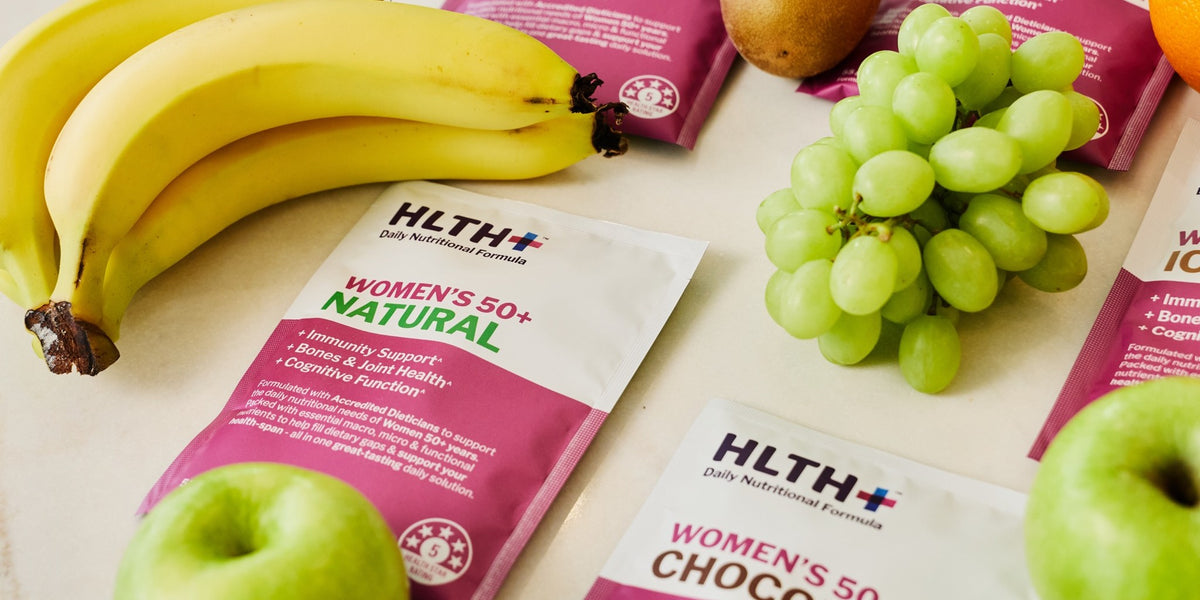
HLTH+ is not a greens powder, and this page will not pretend it is. It is a daily nutritional formula, a Formulated Supplementary Food under the Food Standards Code, taken alongside meals in a 55g sachet (Women's; Men's runs 60-62g). It belongs here for one reason: a 13 g scoop cannot physically carry the two nutrients a one-scoop routine most often misses.
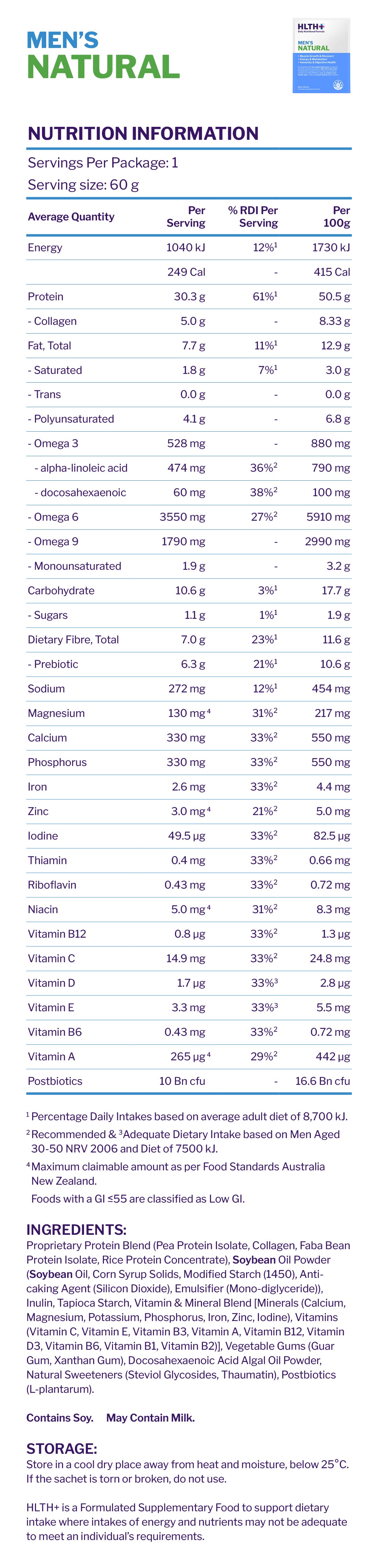
One sachet lists 30g protein per serve and 7g dietary fibre, at 1.5g of sugar (Women's) or 1.7g (Men's) with none added. Protein contributes to the maintenance and growth of muscle mass and to tissue repair, and dietary fibre contributes to regular laxation.
The same sachet lists 5g collagen, 60mg DHA and 10 billion CFU Lactobacillus Plantarum Postbiotic alongside prebiotics, and it carries a balanced multivitamin profile. A postbiotic is not a live organism: it is the material a bacterial culture produces during fermentation together with the inactivated cells, so it does not depend on organisms surviving transport and storage. That also means a postbiotic count and a probiotic count are not the same measurement, so 10 billion beside 10 billion is neither a tie nor a win for either product.
Across protein, dietary fibre, vitamins, minerals, collagen and DHA, each serve supplies 30 essential daily nutrients.
The row no greens powder can answer is who the formula was built for. HLTH+ is dietitian-formulated to the Nutrient Reference Values, the published government intakes developed by the National Health and Medical Research Council, the Australian Government Department of Health and Ageing and the New Zealand Ministry of Health. Those values move with age and sex, which is why the range runs Women's, Women's 50+, Men's and Men's 50+ rather than one scoop for every adult.
Australian labels, AG1's included, state percentage daily intakes against an average adult diet of 8,700 kJ under Standard 1.2.8 of the Food Standards Code. That is a labelling reference value which sits above what the Nutrient Reference Values advise for most adults, so a formula built to it over-delivers calories to the person drinking it.
It is Australian-made in facilities complying with Good Manufacturing Practice, dairy-free, gluten-free and low GI, carries a 5-star Health Star Rating, has no nasties, artificial colours, artificial flavours or artificial sweeteners, and holds hundreds of reviews. It sells at hlthplus.com at RRP $6.00, or $5.10 a day on a 28-serve subscription at $142.80 and $5.40 a day on a 14-serve subscription at $75.60, and through Amazon AU and Chemist Warehouse online.
How do the AG1 alternatives compare?
Every cell below is a figure the brand publishes, or a plain statement that it does not, with the retrieval date; an unpublished figure is part of the comparison.
| Row | AG1 (Australian label, 2 Sep 2026) | IM8 Essentials (own pages, 8 Sep 2026) | WelleCo The Super Elixir (own page, 8 Sep 2026) | Vital All-In-One (own page, 8 Sep 2026) | HLTH+ (published label) |
|---|---|---|---|---|---|
| Serve size | 13 g | 12 g | 10 g | 10 g | 55g sachet (Women's), 60-62g (Men's) |
| Protein per serve | 2 g | No protein line published | Not published | 1000 mg pea protein isolate listed; no total protein line | 30g protein per serve |
| Dietary fibre per serve | 2 g | Not published | Not published | 800 mg inulin listed; no dietary fibre total | 7g |
| Sugars per serve | Under 1 g | Not published | 0.9 g to 1.1 g by flavour | Not published | 1.5g (Women's), 1.7g (Men's), none added |
| Live cultures | 10 billion CFU probiotics, five named strains | 10 billion CFU probiotics | Probiotics listed, no cell count | Four strains listed, 14 billion CFU in total | 10 billion CFU Lactobacillus Plantarum Postbiotic, plus prebiotics |
| Collagen | Not on the panel | Not on the ingredients page | Not listed | Not listed | 5g |
| DHA | Not on the panel | Not on the ingredients page | Not listed | Not listed | 60mg |
| Ingredient count, as the brand states it | Five probiotic strains named; no total count on the panel | 90 | More than 40 | 78 | 30 essential daily nutrients |
| Formulated for whom | One formula, the AG1 Pouch | One Essentials formula | One formula | One formula | Women's, Women's 50+, Men's, Men's 50+ |
| Category | Greens powder | All-in-one powder | Greens powder | Greens powder | Formulated Supplementary Food |
Figures are each brand's published nutrition information at the retrieval dates shown; flavours vary and brands reformulate, so check current labels before purchase. Price is not tabled because no Australian AG1 price was held; the other brands' published prices are in their sections above.
Read down the protein and dietary fibre rows and the shape of the category is plain. Three greens powders and one all-in-one, and between them one published protein figure and one published dietary fibre figure, both 2 g; that is not a failing of any brand, it is what a 10 g to 13 g scoop can hold. Only the right-hand column is a different category, and why 2g of protein in a greens powder is the number to notice is covered on its own page.
Which AG1 alternative should you choose?
Choose Vital All-In-One if you want a greens powder that quantifies every ingredient, at the lowest price per serve on this page, and your protein and dietary fibre are already handled by what you eat. On those terms it is the best straight swap for AG1 here.
Choose IM8 if the longest ingredient list in one low-calorie scoop is the thing you are buying, and you are comfortable that its own pages publish no protein line.
Choose WelleCo The Super Elixir if you want the Australian brand, a low stated sugar line and a stated cost per serve of $3.30, and you accept that it publishes no panel to check any of that against.
Choose a daily nutritional formula if what you actually wanted from one scoop a day was your protein and your dietary fibre covered as well as your micronutrients. HLTH+ is not designed as a meal replacement, because it complements a food-first approach, but it works fine as a healthy snack or to tie you over between meals. We believe in a food-first approach, and the statistics say food alone is not getting there: fewer than 1 in 20 Australian adults eat the recommended serves of vegetables (ABS, 2023), so a daily formula is nutritional insurance, not a substitute for eating well.
That is the consolidation case. If you are going to drink something every morning anyway, the question is how much of your day it covers: on the labels above, a greens scoop covers the micronutrient side, and a 55g sachet carries 30g protein and 7g dietary fibre on top of a balanced multivitamin profile. Daily formulas sold in Australia, meal-replacement and pharmacy shakes included, are mapped in the supplement buyer's map.
Find out what your current scoop is not giving you. The 30-second ✦ Find My Formula quiz reads your existing routine and shows the gaps it leaves.
Frequently Asked Questions
What is the closest alternative to AG1 in Australia?
For a like-for-like greens scoop, Vital All-In-One is the closest Australian alternative: a 10 g serve, 78 ingredients each listed with a quantity, four probiotic strains totalling 14 billion CFU and $3.18 a serve on the 300 g pack (retrieved 8 September 2026). IM8 is the closest premium all-in-one.
Is IM8 better than AG1?
On their own published pages, IM8 lists 90 ingredients and 10 billion CFU in a 12 g serve against AG1's 13 g serve with 10 billion CFU across five named strains. IM8 publishes no protein line; AG1's Australian label lists 2 g. Neither is built to cover protein or dietary fibre.
Does any greens powder have more protein than AG1?
Not on the published figures here. AG1's Australian label lists 2 g protein per 13 g serve, WelleCo publishes no protein figure, Vital All-In-One lists 1000 mg of pea protein isolate with no total, and IM8 publishes no protein line. A greens scoop is built for micronutrients; protein needs a bigger serve.
Is HLTH+ an alternative to AG1?
Only if protein and dietary fibre were part of what you wanted covered. HLTH+ is a Formulated Supplementary Food, not a greens powder: a 55g sachet listing 30g protein per serve, 7g dietary fibre, 5g collagen and 60mg DHA. For a pure greens ritual, Vital All-In-One or WelleCo is the closer swap.
Which AG1 alternative is cheapest in Australia?
Of the alternatives with a published Australian price, Vital All-In-One is $3.18 a serve on its 300 g pack and WelleCo states $3.30 a serve for The Super Elixir (both retrieved 8 September 2026). HLTH+ is RRP $6.00, or $5.10 a day on a 28-serve subscription. No Australian AG1 price was held.
This article is general information, not medical advice. Decisions about any medication belong with your doctor. Figures quoted are each brand's published information at the retrieval dates shown; check current labels before buying.
Leave a comment
This site is protected by hCaptcha and the hCaptcha Privacy Policy and Terms of Service apply.