

A greens powder with protein is, on the published labels, a greens powder with 1g to 2g of protein in it. AG1's Australian label lists 2g per 13g scoop and prints that as 4% of a day's intake (retrieved 2 September 2026). WelleCo publishes no protein figure for The Super Elixir, and Vital All-In-One publishes no total protein line at all (both retrieved 8 September 2026).
That matters most at the point people reach for a greens scoop: when overall eating has dropped, whether through a deliberate deficit, an appetite that has faded, or rapid weight loss, reduced eating and medically induced weight loss. The green drink feels like it is covering the bases. On protein, it is covering about one twentieth of one.
This article sets out what the greens category actually publishes for protein, what the Australian reference values say an adult needs, and what a formula has to carry before "with protein" means anything.
How much protein is in a greens powder?
Between one and two grams a serve, where a figure is published at all. That is not a criticism of the category; a greens powder is built around micronutrients and botanicals, and a 10g to 13g scoop has no room to be anything else. The problem starts when the words "with protein" appear on the front and the reader assumes the scoop is doing a second job.
Here is what three Australian-market greens powders publish, beside a daily nutritional formula, on the rows each brand actually prints.
| Per serve, as each brand publishes it | AG1 (Australian label) | WelleCo The Super Elixir | Vital All-In-One | HLTH+ Women's |
|---|---|---|---|---|
| Serving size | 13g scoop | 10g | 10g (two teaspoons) | 55g sachet |
| Protein | 2g, printed as 4% of daily intake | Not published | No total protein line; lists 1000mg pea protein isolate as an ingredient | 30g |
| Dietary fibre | 2g | Not published | Not published | 7g |
| Calories | 41 | Under 32, published as a ceiling | Not published | 223 |
| Sugars | Under 1g | 0.9g to 1.1g depending on flavour | Not published | 1.5g, none added |
| Category | Greens powder | Greens powder | Greens powder | Formulated Supplementary Food |
Figures from each brand's published nutrition information: AG1's Australian label retrieved 2 September 2026, WelleCo and Vital All-In-One product pages retrieved 8 September 2026; check current labels before purchase. Serve sizes differ, brands reformulate and flavours vary.
Two things in that table deserve a second look. First, AG1 is the only one of the three that publishes a protein figure, and its own panel calls that figure 4% of a day's intake. Pea protein isolate is the second ingredient on the Australian label, after organic apple powder, and the whole serve still lands at 2g; the full AG1 Australian panel is walked through row by row here.
Second, two of the three do not publish a protein figure, so the honest answer to "how much protein is in this greens powder" is that you cannot tell. Vital's "1000mg pea protein isolate" is an ingredient quantity, not a protein total, because an isolate is not 100% protein by weight. WelleCo prints sugars, a calorie ceiling and a cost per serve and nothing else that can be compared; that finding has its own review.
How much protein does an adult actually need?
The Australian reference is the Nutrient Reference Values, published in 2006 by the National Health and Medical Research Council, the Australian Government Department of Health and Ageing and the New Zealand Ministry of Health (Nutrient Reference Values, protein). They set a Recommended Dietary Intake for protein by sex and body weight, and it is a floor: the intake considered adequate to meet the needs of nearly all healthy people, not a target for anyone training or eating in a deficit.
| Group | Protein per kilogram of body weight a day | Protein in grams a day |
|---|---|---|
| Adult women, 19 to 70 | 0.75g/kg | 37g to 46g |
| Adult men, 19 to 70 | 0.84g/kg | 52g to 64g |
| Adult women over 70 | 1g/kg | 46g to 57g |
| Adult men over 70 | 1g/kg | 65g to 81g |
The per-kilogram figures are as published by Dietitians Australia and the gram ranges by healthdirect, the national health information service; both reproduce the Nutrient Reference Values (both retrieved 8 September 2026).
Now do the arithmetic on the greens scoop. Two grams against a 46g floor is 4.3%, which is exactly the 4% AG1's own label prints, and against a 64g floor it is about 3%. Over 70, when the reference rises to 1g per kilogram, the same 2g scoop covers a smaller share again.
For balance, Dietitians Australia's page states that most Australians get enough protein through their diet, so the argument here is not that everyone is short of protein. It is that a greens powder is not where protein comes from, and anyone counting the scoop towards their day is counting something that rounds to nothing. If you are training and want a building target rather than a floor, the working number is about double the RDI.
Why does 2g matter more when you are eating less?
Because the floor stays where it is while the food shrinks. Protein is the nutrient that takes the biggest hit when a person eats fewer meals, smaller meals, or skips the meal that used to carry the chicken or the eggs.
The size of the drop is measurable. In trial conditions, GLP-1 medicines reduced ad libitum food intake by roughly a quarter of daily calories (Blundell and colleagues, Diabetes, Obesity and Metabolism, 2017). A quarter less food, taken across an ordinary Australian day, is a quarter less protein unless someone deliberately rebalances the plate.
The same pattern shows up on dietary fibre, which is the other line a greens powder is assumed to cover. A 2025 study of people on GLP-1 medications found average dietary fibre intake of 14.5g a day against the recommended 28g (Frontiers in Nutrition). A 2g fibre scoop is not the difference between those two numbers either.
There is a body-composition reason the protein floor matters during rapid weight loss, reduced eating and medically induced weight loss, and it is worth reading in full before choosing a supplement: what happens to protein when weight comes off fast. This page is general information, not medical advice, and decisions about any medication belong with your doctor. Learn more about what changes in your nutrition when overall intake drops.
What does a greens powder with protein need to carry?
If the phrase is going to mean anything, four things, and they are all on the label.
- At least 10g of protein per serve. Under Schedule 4 of the Australia New Zealand Food Standards Code, 5g per serving is the minimum for any protein content claim and 10g is the threshold for "good source of protein". A 2g scoop cannot honestly make either claim, which is why the front of most greens tubs says "with protein" rather than "good source".
- A published protein figure, in grams. Not an ingredient quantity, not a claim, a number on a panel you can read before you pay. Two of the three brands above do not print one.
- A protein source you can evaluate. Greens powders that do carry protein use a small dose of pea isolate. Whether a protein is complete, meaning it carries all nine essential amino acids in useful amounts, is a separate question from how much of it there is, and it is answered properly here. Check any label for it.
- A formulation calculated for you, not for a label reference. Australian panels work out percentage daily intakes against an average adult diet of 8,700 kJ under Standard 1.2.8 of the Food Standards Code. That is a labelling reference value, and it sits above what the Nutrient Reference Values advise for most adults, so a formula built to it over-delivers calories to the person drinking it. A greens powder is one formula for everyone, by design.
The wider case for what a greens scoop does well and what it structurally cannot is made in the greens powder explainer. The short version: micronutrients, yes; protein and dietary fibre at a meaningful dose, no.
Where a daily nutritional formula fits
The concession first. A greens powder is a greens powder, and HLTH+ is not one: it is not a meal replacement and it is not a weight-loss product either. If what you want is a small daily scoop of botanicals and micronutrients in a glass of water, the greens category is built for that and a 55g sachet is not.
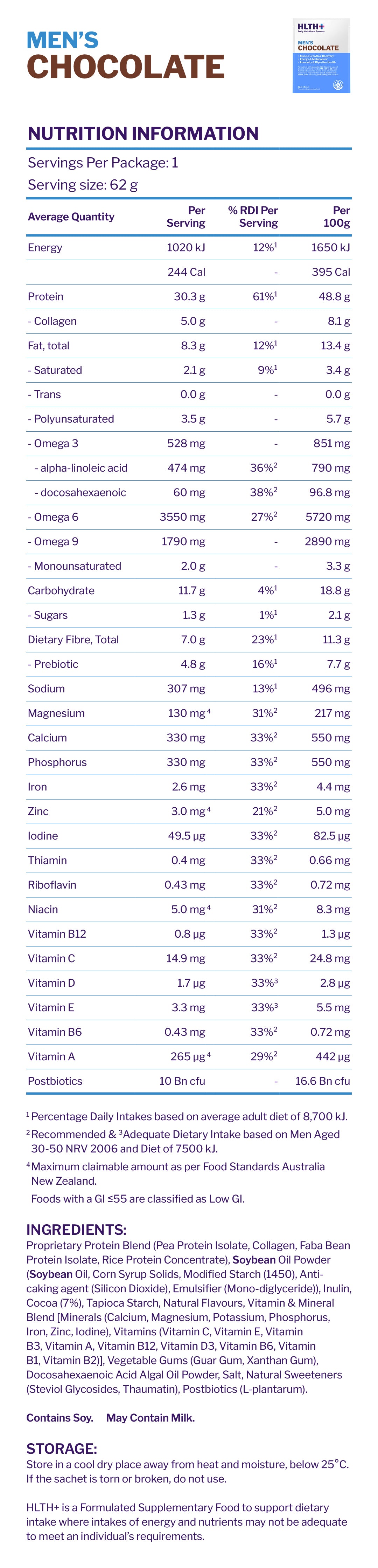
What a daily nutritional formula answers is the protein half of the problem, and then the rest of the shelf. A single sachet carries 30g protein, 7g dietary fibre, 5g collagen, 60mg DHA and 10 billion CFU Lactobacillus Plantarum Postbiotic, at 1.5g of sugar with none added and 223 calories, plus a balanced multivitamin profile. In total that is 30 essential daily nutrients in one serve.
Protein contributes to the maintenance of muscle mass and to tissue building and repair; dietary fibre contributes to regular laxation.
Put the protein figure back against the reference table. Thirty grams is 65% of a 46g floor for adult women (30 divided by 46) and 47% of a 64g floor for adult men (30 divided by 64), from one serve, before any food. The 2g scoop was 4%.
It is formulated to the Nutrient Reference Values published in 2006 by the National Health and Medical Research Council, the Australian Government Department of Health and Ageing and the New Zealand Ministry of Health, by sex and life stage across Women's, Women's 50+, Men's and Men's 50+, because a 0.75g/kg floor and a 1g/kg floor are not the same formula. It is Australian-owned and Australian-made in facilities complying with Good Manufacturing Practice, carries a 5-star Health Star Rating, and holds hundreds of reviews across the range.
It sells at hlthplus.com at RRP $6.00, or $5.10 a day on a 28-serve subscription at $142.80, and through Amazon AU and Chemist Warehouse online. If you are shopping the greens category specifically and want to see the consolidation argument made brand by brand, the AG1 alternatives roundup does that.
Find out what your current stack is actually missing. The 30-second ✦ Find My Formula quiz is built to show the gaps your existing tubs and bottles leave, not to sell you another one.
Who each one suits
- You want a greens ritual and your protein is already covered by food. Keep the greens powder. Read the panel for dietary fibre and sugars, and treat the protein line as decoration.
- You are counting the greens scoop towards your protein. Stop counting it. At 2g it rounds to nothing against a 37g to 64g floor, and two of the three brands above do not publish a figure to count.
- You are eating less and want protein, dietary fibre and micronutrients covered in one habit. That is a different category, and it is where a daily nutritional formula sits.
- You want a dedicated protein powder. Also a different category, with different trade-offs; the plant-based roundup covers the real category members on their own labels.
Frequently Asked Questions
How much protein is in AG1?
AG1's Australian label for the AG1 Pouch lists 2g of protein per 13g serve and prints it as 4% of daily intake, retrieved 2 September 2026. Pea protein isolate is the second ingredient after organic apple powder, and the same label lists 2g of dietary fibre and 41 calories per serve. Check the pack you are sold.
Is 2g of protein per serve enough?
Not as a protein source. The Nutrient Reference Values set adult floors of 0.75g per kilogram of body weight for women and 0.84g for men, which healthdirect publishes as 37g to 46g and 52g to 64g a day. Two grams is about 4% of the lower floor, so it should not be counted towards your day.
Can a greens powder replace a protein powder?
No. A greens powder is built around micronutrients and botanicals in a 10g to 13g scoop, and where it publishes protein the figure is 1g to 2g. A dedicated protein powder or a daily nutritional formula typically carries 20g to 30g per serve, so they are different categories doing different jobs, and the label tells you which is which.
Does WelleCo The Super Elixir contain protein?
WelleCo publishes no protein figure for The Super Elixir, and no nutrition information panel to read one from, on its product page retrieved 8 September 2026. It publishes sugars of 0.9g to 1.1g per 10g serve, a ceiling of under 32 calories and a cost per serve of $3.3, so protein cannot be established from what the brand prints.
Is HLTH+ a greens powder?
No. It is a Formulated Supplementary Food: a 55g sachet carrying 30g protein, 7g dietary fibre, 5g collagen, 60mg DHA and 10 billion CFU Lactobacillus Plantarum Postbiotic, with a balanced multivitamin profile. It is not a meal replacement, because it complements a food-first approach, but it works well as a healthy snack or to tie you over.
Leave a comment
This site is protected by hCaptcha and the hCaptcha Privacy Policy and Terms of Service apply.