


Vitamin D deficiency means the level of 25-hydroxyvitamin D in your blood is below 50 nmol/L. In the Australian Bureau of Statistics national biomedical survey, just under one in four adults were under that line, and the figure more than doubled between summer and winter. Most of them had no symptoms at all, which is why a blood test through your doctor is the only reliable way to know where you sit.
If you have been tired for months, sore in ways that do not track to anything you did, and eating less than you used to, vitamin D is one of the first things a doctor checks and one of the easiest things to misread online. The symptom lists are vague enough to fit anyone, and the products sold underneath them are confident enough to fit nobody.
This page gives you the Australian prevalence figures, the blood-test thresholds, the signs and causes that have a real source behind them, and the order in which to act.
What counts as vitamin D deficiency?
The blood test measures 25-hydroxyvitamin D, the storage form of the vitamin, in nanomoles per litre. The categories used in the Australian national survey are the ones your pathology report will most likely follow.
| 25-hydroxyvitamin D in blood | Category |
|---|---|
| 50 nmol/L or above | Adequate |
| 30 to 49 nmol/L | Mild deficiency |
| 13 to 29 nmol/L | Moderate deficiency |
| Below 13 nmol/L | Severe deficiency |
Categories from the Australian Bureau of Statistics, Australian Health Survey: Biomedical Results for Nutrients, methodology, 2011-12.
One nuance matters for reading your own result. The Australian and New Zealand position statement on vitamin D sets adequacy at 50 nmol/L or above at the end of winter, and notes the level may need to be 10 to 20 nmol/L higher at the end of summer to allow for the seasonal fall that follows (Nowson and colleagues, Medical Journal of Australia, 2012). A reading of 55 in March is not the same as a reading of 55 in August.
How common is vitamin D deficiency in Australia?
Common, and strongly seasonal. In the 2011-12 Australian Health Survey, the only national survey to measure it from blood samples, just under one in four Australian adults (23%) had a vitamin D deficiency: 17% mild, 6% moderate and less than 1% severe (Australian Bureau of Statistics, Biomedical Results for Nutrients, 2011-12). The survey drew on blood samples from 10,403 people aged 12 and over, collected from March 2011 to September 2012.
The season you were tested in changes the answer more than almost anything else. Deficiency ran at 14% in summer and 36% in winter, and the winter figures split sharply by latitude.
| State or territory | Adults with vitamin D deficiency in winter |
|---|---|
| Victoria | 49% |
| Australian Capital Territory | 49% |
| Tasmania | 43% |
| Northern Territory | 17% |
| Queensland | 15% |
Figures from the same ABS release. Only 5% of adults were taking a vitamin D supplement at the time, and among those who did the deficiency rate was 7% against 23% for everyone else.
Two things follow. If you live in the south east and get tested in August, the base rate is against you before any symptom enters the picture. And if you were tested once in summer and told you were fine, that result may not hold six months later.
What are the signs of vitamin D deficiency?
Usually there are none. That is the most useful fact on this page, because it is the reason the online symptom checklists are unreliable and the reason a blood test is the only real answer. Of the 23% of adults who were deficient in the national survey, 17 percentage points were in the mild band, where symptoms are least likely.
Where symptoms do appear, the Australian government health service lists them plainly:
- Mild bone pain
- Muscle weakness
- Tiredness
Those are the three healthdirect Australia names, and it says so while noting that there are usually no symptoms. The Victorian Department of Health adds that if the level stays low for long enough, some people experience bone and muscle pain and softening of the bones (Better Health Channel, vitamin D).
Notice what the list does not contain. There is no reliable outward sign, no skin or hair marker, and nothing you can check in a mirror. Tiredness is on the list, and it is also on the list for iron, magnesium and sleep, thyroid function, a dropping food intake and a dozen other things, so it points to a blood test rather than to a bottle.
This is general information, not medical advice, and decisions about any medication belong with your doctor. If you recognise yourself in the risk groups below, ask for the test rather than guessing from the symptoms.
What causes vitamin D deficiency?
Your skin makes most of your vitamin D when ultraviolet B light reaches it. So almost every cause comes down to less sun reaching less skin, and a smaller group of causes comes down to the body not handling the vitamin normally.
The at-risk groups named by the Australian health authorities are consistent across sources:
- People with naturally dark skin, who need three to six times the sun exposure of someone with moderately fair skin to make the same amount (Medical Journal of Australia position statement, 2012)
- People who cover their skin for religious or cultural reasons
- People who are housebound, in care settings, frail or chronically ill, or who spend most of the day indoors, including those working in enclosed environments
- People who avoid the sun because they have previously had skin cancer
- People who are obese
- People with conditions that limit fat absorption, such as Crohn's disease, and people with advanced kidney disease
- People taking certain medications, and women who are pregnant or breastfeeding
Groups drawn from healthdirect, Cancer Council Australia and the position statement above.
The food side is smaller than most people assume. Most adults are unlikely to obtain more than 5 to 10% of their vitamin D requirement from what they eat, according to the same position statement, and the Victorian Department of Health puts the dietary contribution at roughly the same 5 to 10%. That is why diet changes rarely move a low reading on their own, and why the sun section below is the one to read carefully.
The exception is when the whole plate shrinks at once, which is a different problem from vitamin D and gets its own section further down; which vitamins slip first when meals shrink covers that wider list.
How much sun do you actually need?
Less than you might think in summer, and more than you are probably getting in winter. The Australian and New Zealand position statement gives figures for a person with moderately fair skin.
| Season | Exposure for moderately fair skin | When |
|---|---|---|
| Summer | A walk with arms exposed for 6 to 7 minutes | Mid morning or mid afternoon, most days |
| Winter | As much bare skin as feasible for 7 to 40 minutes, depending on latitude | At noon, most days |
Figures from Nowson and colleagues, Medical Journal of Australia, 2012. People with dark skin need exposures three to six times longer than the times shown.
Cancer Council Australia frames the same advice around the UV index rather than the calendar. When the index is 3 or above, most people maintain adequate vitamin D by spending a few minutes outdoors on most days of the week; in winter in southern Australia, the advice is to spend time outdoors in the middle of the day with some skin uncovered (Cancer Council Australia, vitamin D). Cancer Council is also explicit that sensible sun protection does not put people at risk of deficiency, so the answer is never to skip sunscreen on a high-UV day.
Two practical readings. The Melbourne office worker who leaves home before the sun is up and comes back after dark is in the 49% winter band for a reason that has nothing to do with diet. And the Brisbane reader who is careful about the sun all year probably needs a few minutes rather than an hour.
More on what changes when energy drops and the days shorten: nutrition support for vitality.
Can you get vitamin D from food?
Only a small amount. Few foods carry it naturally, and the Victorian Department of Health lists the useful ones as fatty fish such as salmon, eggs, margarines and some milks with added vitamin D, and some cereals with added vitamin D. The same page is direct that it is difficult to obtain enough from diet alone.
So food is a contributor, not a plan. If your reading is low, the sequence that follows is a conversation with your doctor about sun, and then about whether a supplement dose is warranted; healthdirect advises checking with your doctor on the correct dose before taking any vitamin D supplement. The form and dose questions, including the difference between vitamin D2 and D3 and why Australians still run low, are covered in vitamin D3: dose, form and why Australians still run low, so this page will not repeat them.
Vitamin D also sits underneath a question people usually ask separately. Calcium intake alone does not settle the bone question, because the body needs vitamin D to absorb it; if you are auditing calcium as well, calcium supplements: dose, timing and who actually needs one runs the food maths.
What happens to your intake when you are eating a lot less?
Here the honest answer cuts both ways. Because food supplies only 5 to 10% of your vitamin D, eating less does not create a vitamin D deficiency the way it creates a protein or dietary fibre shortfall; the sun still does most of the work. But that small dietary share shrinks with the rest of your plate, and the rest of your plate is where the real damage happens.
Over 90% of Australian adults do not meet dietary guidelines (Australian Institute of Health and Welfare), before anyone eats less than usual. In trial conditions, GLP-1 medicines reduced free-choice food intake by roughly a quarter of daily calories (Blundell and colleagues, Diabetes, Obesity and Metabolism, 2017). Take a quarter off a diet that was already under the guidelines and the shortfall is spread across most of the vitamins and minerals at once, not parked on one of them.
That is true whatever the trigger: rapid weight loss, reduced eating and medically induced weight loss, a deliberate deficit, or an appetite that has simply faded. The person who arrives at a vitamin D result usually leaves with a wider list. Women moving through their fifties carry an extra layer, because bone-related needs shift at the same time; the wider set of changes at perimenopause covers that context.
This is general information, not medical advice, and decisions about any medication belong with your doctor.
Where a daily nutrition formula fits, and where it does not
Start with the concession. HLTH+ is not a vitamin D supplement and it is not an answer to a measured deficiency. That conversation belongs with your doctor, a blood test and, most of the time, the sun, and nothing on this page changes that order.
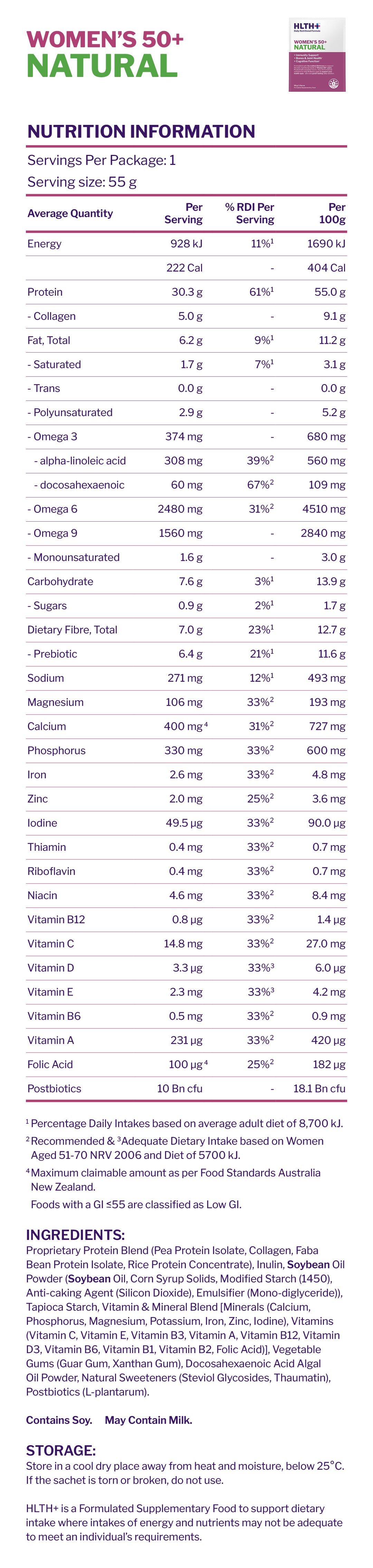
What a Formulated Supplementary Food answers is the wider gap the previous section described: the diet that was already short before food volume dropped, and the four-bottle shelf people build to cover it. HLTH+ was built for that reader, with a balanced multivitamin profile in one daily serve rather than a stack of single-nutrient bottles chosen by guesswork.
The formulation argument is the one that matters here: Australian food labels calculate percentage daily intakes against an average adult diet of 8,700 kJ under Standard 1.2.8 of the Food Standards Code, and that is a labelling reference value set above what the Nutrient Reference Values recommend for most adults, so a product built to it over-delivers calories to the person drinking it. HLTH+ is formulated to the Nutrient Reference Values instead, by gender and life stage, across Women's, Women's 50+, Men's and Men's 50+. Those values were published in 2006 by the National Health and Medical Research Council, the Australian Government Department of Health and Ageing and the New Zealand Ministry of Health.
In practice that is one 55g sachet carrying 30g protein, 7g dietary fibre, 5g collagen and 60mg DHA, plus 10 billion CFU Lactobacillus Plantarum Postbiotic. Thirty essential daily nutrients in a single habit, at RRP $6.00, or $5.10 a day on a 28-serve subscription at $142.80.
See what your current stack is actually missing. The ✦ Find My Formula quiz takes about 30 seconds and is built to show you the gaps your existing bottles are leaving, not to sell you another one. Take the quiz.
Frequently Asked Questions
What level of vitamin D counts as deficient in Australia?
A blood level of 25-hydroxyvitamin D below 50 nmol/L. The Australian Bureau of Statistics grades it as mild at 30 to 49 nmol/L, moderate at 13 to 29 and severe below 13. The Australian and New Zealand position statement sets adequacy at 50 nmol/L or above at the end of winter, so the season of your test matters.
How common is vitamin D deficiency in Australia?
Just under one in four Australian adults (23%) were deficient in the Australian Bureau of Statistics 2011-12 biomedical survey: 17% mild, 6% moderate and under 1% severe. Rates were 14% in summer and 36% in winter, reaching 49% in Victoria and the ACT during the colder months.
Can I get enough vitamin D from food alone?
Almost never. The Australian and New Zealand position statement says most adults are unlikely to obtain more than 5 to 10% of their requirement from diet. Fatty fish such as salmon, eggs and fortified margarines, milks and cereals contribute a little; sensible sun exposure supplies the rest, with a supplement only where your doctor advises one.
Does a daily nutrition formula replace a vitamin D blood test?
No: a Formulated Supplementary Food supplements a diet that has fallen short; it is not a vitamin D supplement and does not answer a measured deficiency. If you suspect you are low, ask your doctor for the blood test first. The formula belongs to the wider nutrient gap that eating less opens across the rest of your diet.

Leave a comment
This site is protected by hCaptcha and the hCaptcha Privacy Policy and Terms of Service apply.