


Vitamin D3 is cholecalciferol, the form your own skin makes in ultraviolet light, and on the trial evidence it is the form to buy. In a meta-analysis of randomised trials, D3 raised blood levels more effectively than D2, though the gap was widest with large single doses and faded with daily dosing. The Australian intake figures are modest, 5 µg a day for most adults, rising at 51 and again after 70.
The reason you are reading this is probably a blood test, a long winter, or a plate that has shrunk. All three lead to the same three questions: which form, how much, and why a country this sunny still has a vitamin D problem.
This page answers those in order, then shows you how to read a supplement label so the dose you buy is the dose you meant.
What is the difference between vitamin D2 and vitamin D3?
Both are vitamin D, and they arrive by different routes. The Nutrient Reference Values describe D3 (cholecalciferol) as the form produced by the action of sunlight on skin, and D2 (ergocalciferol) as the form found in a limited range of foods (Nutrient Reference Values for Australia and New Zealand, vitamin D). Mushrooms exposed to ultraviolet light are the familiar D2 food, and supplements are sold in both forms (MedlinePlus, vitamin D).
The question that matters is whether they perform the same in the blood, and the best answer is a systematic review of randomised trials that compared them head to head. Supplementation with D3 had a significant and positive effect on serum 25-hydroxyvitamin D compared with D2 (P = 0.001), and the authors concluded that D3 could become the preferred choice for supplementation (Tripkovic and colleagues, American Journal of Clinical Nutrition, 2012).
Read the fine print before you throw out a D2 bottle. The advantage held when the vitamin was given as a single large dose and was lost with daily supplementation, so a daily D2 product is not useless, just not the better bet. Choosing from scratch, choose D3.
How much vitamin D do you need a day in Australia?
The Australian and New Zealand figures are Adequate Intakes rather than Recommended Dietary Intakes, because the evidence was not strong enough to set the firmer standard. They step up twice in adult life.
| Age | Adequate Intake per day | The same figure in IU |
|---|---|---|
| Men and women 19 to 50 | 5 µg | 200 IU |
| Men and women 51 to 70 | 10 µg | 400 IU |
| Men and women over 70 | 15 µg | 600 IU |
| Upper Level of Intake, adults 19 and over | 80 µg | 3,200 IU |
Source: Nutrient Reference Values for Australia and New Zealand, vitamin D, published in 2006 by the National Health and Medical Research Council, the Australian Government Department of Health and Ageing and the New Zealand Ministry of Health. The conversion is the one that document gives: 1 IU equals 0.025 µg of cholecalciferol, so 1 µg is 40 IU.
Two things in the rationale change how you read them. The recommendations assume no or minimal sunlight, so the figure is a floor for the sun-starved rather than a target for everyone. And the Adequate Intake doubles at 51 because the skin's capacity to produce vitamin D falls with age, which makes older readers the group these figures are really written for.
The 80 µg upper level is set on blood calcium: the studies behind it saw raised serum calcium at very high daily doses and none at moderate ones. Vitamin D's main job is helping the small intestine absorb calcium, which is why the two are so often sold together and why the calcium breakdown is this page's natural companion.
Why do Australians still run low on vitamin D?
Because vitamin D was never really a food nutrient here, and the sun is rationed by season, latitude, skin and lifestyle. In the most recent national biomedical survey, just under one in four Australian adults (23%) had a vitamin D deficiency, 14% in summer and 36% in winter, with winter rates of 49% in Victoria and the Australian Capital Territory and 43% in Tasmania against 15% in Queensland (Australian Bureau of Statistics, Australian Health Survey: Biomedical Results for Nutrients, 2011-12).
That pattern is the explanation. The further south and the deeper into winter, the less ultraviolet reaches your skin, and food cannot make up the difference: the Nutrient Reference Values call it almost impossible to obtain sufficient vitamin D from the diet alone.
Personal factors stack on top. The Cancer Council lists naturally dark skin, covered skin, being frail, elderly or in residential care, obesity, some medications and absorption conditions, and avoiding the sun after a skin cancer (Cancer Council Australia, vitamin D). Older skin also makes less vitamin D from the same exposure, which is why the table steps up at 51 and 70.
Signs, causes and testing are covered in vitamin D deficiency: signs, causes and what to do about it; this page stays on form and dose. One line on testing anyway: the blood measure is 25-hydroxyvitamin D, and the position statement the Nutrient Reference Values cite puts mild deficiency in adults at 25 to 50 nmol/L. This is general information, not medical advice, and decisions about any medication belong with your doctor.
How much sun do you need for vitamin D in Australia?
Less than most people think in summer, and more deliberately in winter. The Cancer Council's advice is that when the UV Index is 3 or above, most people maintain adequate vitamin D levels just by spending a few minutes outdoors on most days of the week (Cancer Council Australia, vitamin D). In late autumn and winter in southern Australia, when the UV Index drops below 3, it advises spending time outdoors in the middle of the day with some skin uncovered.
Two points from the Victorian Department of Health matter for anyone tempted to overdo it. Food supplies only about 5 to 10 per cent of vitamin D, and the body can only absorb a limited amount at a time, so extra sun will not raise vitamin D levels but will raise your risk of skin cancer (Better Health Channel, vitamin D). Being physically active outdoors helps; a brisk walk at lunchtime beats an hour in a garden chair.
On sunscreen, the Cancer Council's reading of the studies is that it has minimal impact on vitamin D levels over time, and that sensible sun protection does not leave people short. The rule is short: check the daily sun protection times for your location, get your few minutes when the UV Index is 3 or above, and in a southern winter take the middle of the day outdoors with your forearms out.
Which foods contain vitamin D, and what happens when you eat less?
The list is short, which is the point. The Nutrient Reference Values name fortified margarine as the major dietary source in Australia; adding vitamin D to table margarine is mandatory here and voluntary for some milks, yoghurts and cheeses.
- Fatty fish: salmon, herring and mackerel, the natural D3 foods
- Eggs: small amounts, in the yolk
- Table margarine: vitamin D added by law in Australia
- Some milks and breakfast cereals: added voluntarily, so read the panel
- Mushrooms exposed to ultraviolet light: the D2 form
Now put that list against a shrinking plate. Over 90% of Australian adults do not meet dietary guidelines (Australian Institute of Health and Welfare, poor diet in adults), before any change in appetite. When appetite drops, through rapid weight loss, reduced eating and medically induced weight loss, a deliberate calorie deficit or simply not being hungry, the whole plate shrinks with it. In trial conditions, GLP-1 medicines reduced daily food intake by roughly a quarter (Blundell and colleagues, Diabetes, Obesity and Metabolism, 2017).
The honest reading for vitamin D is that eating less hurts it less than most nutrients, because food was only ever a small share of supply. The oily fish and fortified spread you skip are a real loss, but the sun still does most of the work. The bigger casualty of a smaller plate is everything else on it: protein, dietary fibre, calcium and the rest of the vitamin and mineral spread, which is why the vitamin and mineral audit lists vitamin D as one line among many.
More on what changes when calories drop and tiredness sets in: nutrition support for vitality.
How do you read a vitamin D supplement label?
Five checks, in the order they appear on most packs.
- The form. Look for cholecalciferol (D3). Ergocalciferol (D2) works, but the trial evidence above favours D3.
- The unit. Australian labels may print micrograms, International Units or both. The conversion is fixed: 1 µg is 40 IU. So a 1,000 IU capsule is 25 µg, five times the Adequate Intake for a 19 to 50 year old and under a third of the 80 µg upper level.
- The dosing pattern. Daily and less frequent large doses are both sold. The D3 advantage in the trials was widest with single large doses, one more reason to prefer D3 if that is the pattern your doctor has set.
- What it is taken with. Vitamin D is fat-soluble. In 50 healthy older adults, the peak blood level after a single large study dose of D3 was 32% higher with a meal containing fat than with a fat-free meal (Dawson-Hughes and colleagues, Journal of the Academy of Nutrition and Dietetics, 2015). Take it with a meal, not black coffee.
- What the label is allowed to say. Under Schedule 4 of the Australia New Zealand Food Standards Code, the approved food-claim wording for vitamin D is narrow: vitamin D is necessary for normal bone structure. A pack promising more than normal function has left what the regulator approved; medicines are worded under a different regime, but the same scepticism applies.
The same dose-reading habit that separates a good magnesium supplement from a poor one applies here. Healthdirect's rule is the one to keep: check with your doctor about the correct dose before taking any vitamin D supplement, because some people should not take one at all (healthdirect, vitamin D deficiency). Too much vitamin D raises blood calcium, which is what the 80 µg upper level exists to avoid.
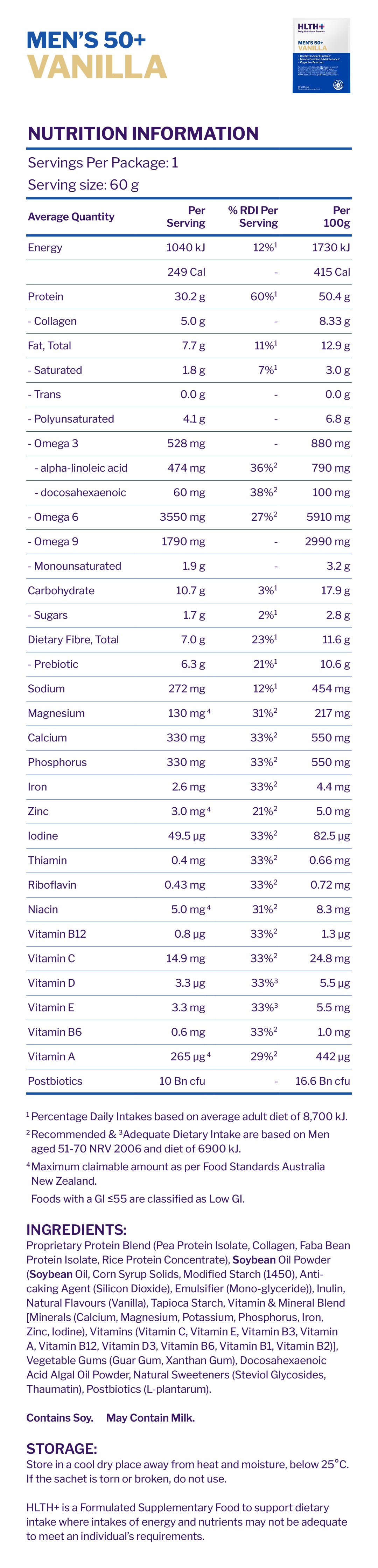
Where a daily nutrition formula fits, and where it does not
Start with what HLTH+ is not: it is not a vitamin D supplement, and it is not the answer to a low blood test. If your gap is vitamin D, the answer is sunlight first and a dosed D3 product on your doctor's advice second.
A daily formula is for the wider problem the last two sections describe. When food volume drops, the vitamin that mostly comes from the sun is the least of it; the protein, dietary fibre, minerals and vitamins that come from a full plate thin out first. HLTH+ is a Formulated Supplementary Food, made to supplement the diet when intake may not be adequate: a little nutritional insurance for the situation.
It is also built to the right reference. Australian labels calculate percentage daily intakes against an average adult diet of 8,700 kJ under Standard 1.2.8 of the Food Standards Code, a labelling reference value set above what the Nutrient Reference Values recommend for most adults, so a product formulated to that number over-delivers calories. HLTH+ is formulated to the Nutrient Reference Values instead, by gender and life stage across Women's, Women's 50+, Men's and Men's 50+: the same 2006 values from the National Health and Medical Research Council, the Australian Government Department of Health and Ageing and the New Zealand Ministry of Health that set the vitamin D table above. Needs that step up at 51 are why the 50+ formulas exist, and the over-60 protein read covers the biggest of those steps.
One 55g sachet carries 30g protein and 7g dietary fibre, with 5g collagen, 60mg DHA and 10 billion CFU Lactobacillus Plantarum Postbiotic. A balanced multivitamin profile sits in the same serve.
Across the whole panel that is 30 essential daily nutrients in a single habit, at RRP $6.00, or $5.10 a day on a 28-serve subscription at $142.80.
See what your current bottles are not covering. The ✦ Find My Formula quiz takes about 30 seconds and shows the gaps in your existing supplement stack. Take the quiz.
Frequently Asked Questions
Is vitamin D3 better than vitamin D2?
On the pooled trial evidence, yes. A 2012 systematic review and meta-analysis found vitamin D3 raised serum 25-hydroxyvitamin D significantly more than D2, and named D3 the likely preferred choice for supplementation. The advantage was clearest with single large doses and was not detectable with daily dosing, so a daily D2 product still works.
How many IU of vitamin D do I need a day in Australia?
The Adequate Intake is 5 µg (200 IU) a day for adults aged 19 to 50, 10 µg (400 IU) from 51 to 70 and 15 µg (600 IU) over 70, assuming little or no sun exposure. The upper level is 80 µg (3,200 IU) a day. Anything above the intake figures is a decision for your doctor.
Can you get enough vitamin D from food alone?
Not in Australia, on the government's own reading. The Nutrient Reference Values describe it as almost impossible to obtain sufficient vitamin D from the diet alone, and the Victorian Department of Health puts food's share at about 5 to 10 per cent. Fortified margarine, fatty fish and eggs are the main food sources; sunlight does the rest.
Does sunscreen block vitamin D?
No. The Cancer Council reports that several studies have shown sunscreen use has minimal impact on vitamin D levels over time, and that sensible sun protection does not leave people short of vitamin D. When the UV Index is 3 or above, a few minutes outdoors on most days is enough for most people.
When is the best time to take vitamin D3?
With a meal that contains some fat. Vitamin D is fat-soluble, and in a study of 50 healthy older adults the peak blood level after a dose of D3 was 32% higher when it was taken with a fat-containing meal than with a fat-free one. The study tested the meal, not the clock.


Leave a comment
This site is protected by hCaptcha and the hCaptcha Privacy Policy and Terms of Service apply.