
Is there a natural appetite suppressant that actually works?
Yes, but the ones with evidence are foods and habits, not capsules. Eating more protein, getting dietary fibre from food, drinking water before a meal and sleeping enough each have controlled trials behind them. The products sold as natural appetite suppressants mostly do not.
If you are searching this, you are probably trying to eat less without the constant food noise, and the shelf is not helping you tell a real lever from a label. Some of those labels quote a study. Very few quote the size of the effect.
This article names the trial behind each lever, gives the number it found and says how strong the evidence is. It finishes with the part almost every appetite article skips: what happens to your nutrition once eating less actually works.
How to read appetite evidence before you buy anything
Appetite research measures three different things, and a label will happily quote whichever one looks best. Only two of them tell you anything about your life.
- Hunger ratings: how hungry people say they feel on a scale, usually over a few hours.
- Free-choice intake: how much people actually eat when allowed to eat freely, measured by the researchers.
- Body weight over weeks: the slowest and hardest test, and the one most products fail.
A 2021 systematic review of 315 randomised trials (Batsis et al, Obesity) covering 14 purported supplements and alternative therapies found only 52, or 16.5%, were low risk of bias and sufficient to judge, and only 16 of those showed a significant difference between groups. The authors' conclusion was that the category has "a limited high-quality evidence base of efficacy." That is the standard applied below, and the same one we apply to the food and habit levers in how to increase GLP-1 naturally.
Does protein reduce appetite?
Protein has the strongest evidence of anything on this list, and it is a food, not a supplement. In a 12-week trial at the University of Washington (Weigle et al, American Journal of Clinical Nutrition 2005), raising protein from 15% to 30% of calories while holding carbohydrate steady cut free-choice intake by 441 calories a day, and the reduction held for the full 12 weeks. Satiety rose even before calories dropped, on an isocaloric version of the same diet.
Two honest caveats. It was 19 people, and the protein came from ordinary meals rather than a powder or pill, so the finding is about how much protein your diet carries, not about any product.
Protein contributes to the maintenance of muscle mass and to tissue building and repair, which matters most at exactly the moment you start eating less. Protein and dietary fibre are the same foods that prompt your gut's own GLP-1 release, which is covered in natural GLP-1.
Does dietary fibre reduce appetite?
Sometimes, and the honest answer depends on which fibre. A systematic review of 107 fibre treatments (Clark and Slavin, Journal of the American College of Nutrition 2013) found 39% significantly reduced appetite ratings against a control, and only 22% reduced how much people ate. The fibres supported in more than one study were beta-glucan (oats and barley), lupin kernel fibre, rye bran and whole grain rye.
So "high fibre" on a pack is not an appetite claim. Most fibres did nothing to hunger in short tests, and neither fibre type nor dose predicted the result. Dietary fibre contributes to regular laxation, which is a reason to eat it whether or not it changes your appetite.
The gap is real either way. A 2025 study found people on GLP-1 medications averaging 14.5g of dietary fibre a day against the 28g recommended intake used in the study (Frontiers in Nutrition), and a second 2025 study found not one participant meeting the target. The eating side of that is covered in GLP-1 and fibre.
Does drinking water before a meal help?
For one meal, in one group, yes. In a Virginia Tech trial (Davy et al, Journal of the American Dietetic Association 2008), 24 overweight and obese adults with a mean age of 61 drank 500ml of water 30 minutes before a breakfast they could eat freely. They ate 500 calories with the water and 574 without: a 13% reduction at that meal.
The limits are in the design: breakfast only, measured once in each condition, in older adults, and the authors called for longer studies. Water is free and harmless, which is a good reason to try it and a poor reason to expect more than a modest effect at that meal.
Does sleep change how hungry you feel?
More than most people expect, and in the direction you do not want. In a University of Chicago crossover study (Spiegel et al, Annals of Internal Medicine 2004), two nights of restricted sleep in 12 healthy young men lowered leptin by 18%, raised ghrelin by 28%, and increased self-rated hunger by 24% and appetite by 23%. Appetite for calorie-dense, high-carbohydrate foods rose by 33% to 45%.
That translated into eating. A meta-analysis of 11 sleep-restriction studies (Al Khatib et al, European Journal of Clinical Nutrition 2017) found people ate 385 calories more a day after partial sleep deprivation, with no matching rise in the calories they burned. Fat intake went up and protein intake went down.
Read those two studies together and the cheapest natural appetite lever on this page is a bedtime. It also explains part of the constant food chatter unpacked in food noise.
Do glucomannan, green tea or garcinia work?
These three sit on almost every natural appetite suppressant list, so they get the same test as the habits above: a named trial or review, what it measured, and what it found.
| Lever | Best available evidence | What was measured | What it found | Strength of evidence |
|---|---|---|---|---|
| Higher-protein diet | Weigle et al, 2005, 19 adults, 12 weeks | Free-choice intake and satiety | 441 fewer calories a day, sustained | Small trial, large and sustained effect |
| Dietary fibre from food | Clark and Slavin, 2013, review of 107 treatments | Appetite ratings and intake | 39% of treatments reduced appetite ratings; 22% reduced intake | Depends on the fibre; beta-glucan and rye best supported |
| Water before a meal | Davy et al, 2008, 24 older adults | Intake at one breakfast | 13% less eaten at that meal | One meal, one group |
| Adequate sleep | Al Khatib et al, 2017, meta-analysis of 11 studies | Daily intake after short sleep | 385 more calories a day when sleep was cut | Consistent across studies |
| Glucomannan | Onakpoya et al, 2014, meta-analysis of 8 trials | Body weight | 0.22kg difference, not statistically significant | Does not support the claim |
| Green tea preparations | Cochrane review, 2012, 6 pooled trials outside Japan | Body weight over 12 to 13 weeks | 0.04kg difference, not significant | Does not support the claim |
| Garcinia (hydroxycitric acid) | Onakpoya et al, 2011, meta-analysis of 9 trials | Body weight | 0.88kg difference, small | Short term, clinical relevance uncertain |
Glucomannan is a soluble fibre from the konjac root, and it is the most plausible of the three because it swells in water. The meta-analysis of eight randomised trials (Onakpoya et al, Journal of the American College of Nutrition 2014) found a 0.22kg difference against placebo that was not statistically significant, and the recorded side effects were abdominal discomfort, diarrhoea and constipation. The authors' words: the evidence "does not show that glucomannan intake generates statistically significant weight loss."
Capsules that claim to raise your own GLP-1 fail a similar test, and we go through those one by one in supplements that claim to increase GLP-1.
Green tea is sold on its catechins and caffeine. The Cochrane review (Jurgens et al, 2012) pooled six trials run outside Japan and found a 0.04kg difference over 12 to 13 weeks, which the reviewers called "not likely to be clinically important." The Japanese trials could not be pooled, so the honest reading is an effect that is small and inconsistent.
Garcinia cambogia is the one with a measurable result. A meta-analysis of nine trials (Onakpoya et al, Journal of Obesity 2011) found a 0.88kg difference favouring the extract, and gastrointestinal side effects twice as common in one included trial. The authors judged the effect small and its clinical relevance uncertain.
Notice that none of the three was tested on appetite at all in the reviews above; the trials measured weight and found little.
What happens to your nutrition when appetite drops?
Here is the part the search rarely gets to. Every lever above, when it works, produces the same result: you eat less. A reduced appetite from a higher-protein diet, from sleeping properly, from rapid weight loss, reduced eating and medically induced weight loss, or from a prescribed GLP-1 medication that lowers appetite by design, all arrive at a smaller plate.
A smaller plate carries fewer nutrients, and the plate was not full to start with. Over 90% of Australian adults do not meet dietary guidelines (Australian Institute of Health and Welfare), so the diet being reduced was already short. Eat a quarter less of it and the gaps in protein, dietary fibre, vitamins and minerals widen rather than appear.
That is why the useful question is not "how do I want food less" but "how do I cover my nutrition when I do." Your requirements for protein and micronutrients do not fall because your appetite did.
This section is general information, not medical advice. Decisions about any medication belong with your doctor.
More on what changes when calories drop: nutrition support for metabolism when you are eating less.
Where HLTH+ fits, and what it is not
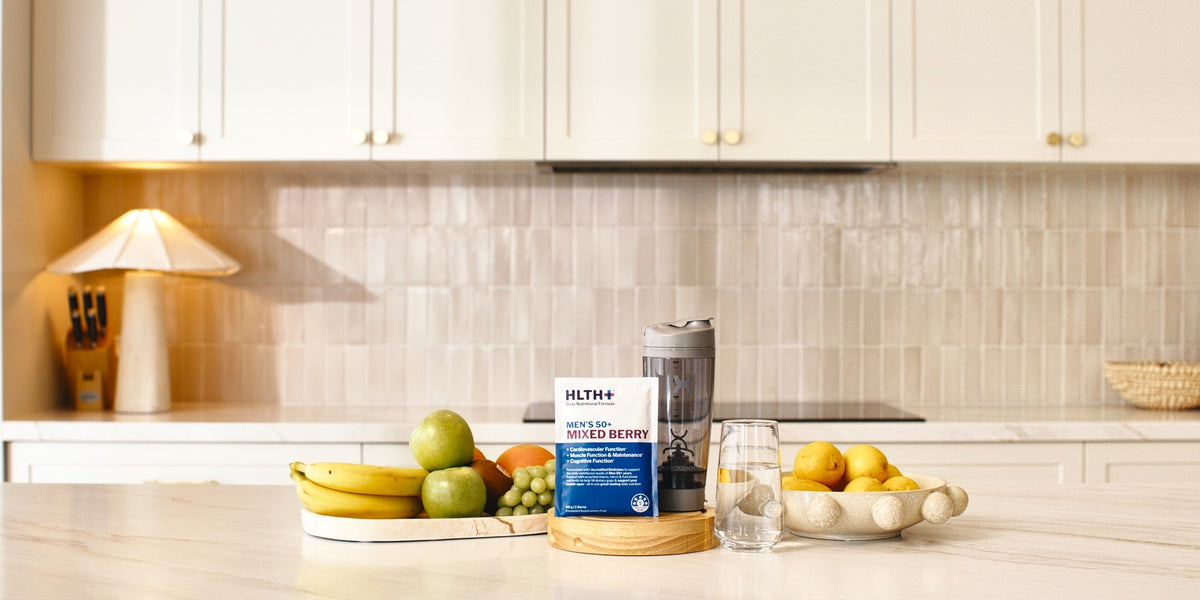
HLTH+ is not an appetite suppressant. It makes no claim about hunger, appetite or body weight, and nothing in it is there to change how much you want to eat. It is an Australian-owned and made Formulated Supplementary Food under the FSANZ Food Standards Code, built for the situation the previous section describes: a diet that has shrunk and now has to carry the same nutritional load.
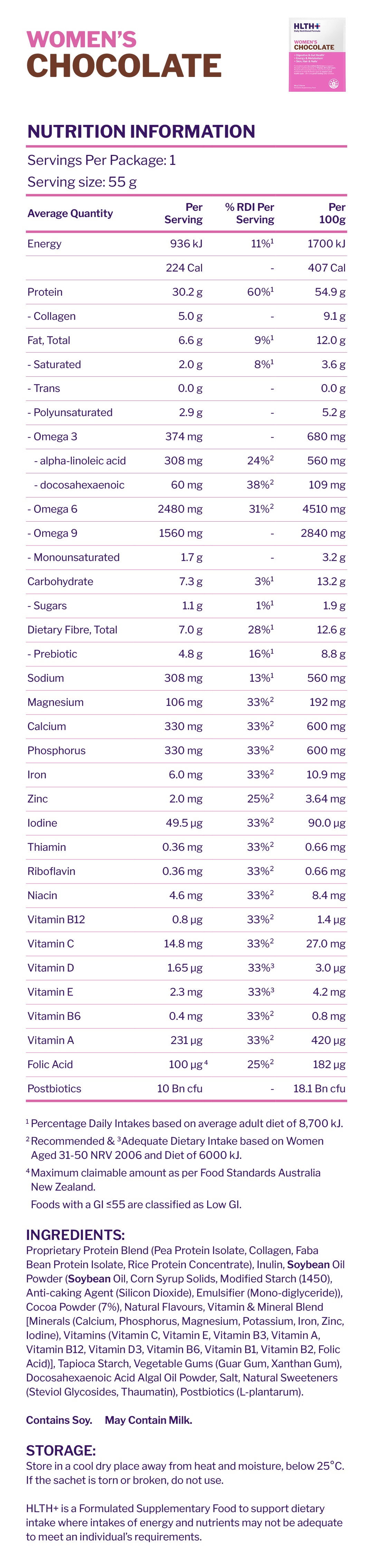
What one serve carries: 30g protein, 7g dietary fibre, 5g collagen, 10 billion CFU Lactobacillus Plantarum Postbiotic plus prebiotics, and 60mg DHA. Across protein, dietary fibre, vitamins, minerals, collagen and DHA, that adds up to 30 essential daily nutrients in one 55g sachet for the Women's formulas. Protein contributes to the maintenance of muscle mass; dietary fibre contributes to regular laxation.
The dosing is the part that separates it from a generic shake. Australian labels calculate percentage daily intakes against an average adult diet of 8,700 kJ (Standard 1.2.8, Food Standards Code), a labelling reference value that sits above what most adults are advised to eat, so a formula built to it over-delivers calories to the individual. HLTH+ is dietitian-formulated instead to the Nutrient Reference Values set by the National Health and Medical Research Council, the Australian Government Department of Health and Ageing and the New Zealand Ministry of Health, in life-stage versions: Women's, Women's 50+, Men's and Men's 50+.
It carries a balanced multivitamin profile on that basis. Sugar is 1.5g per serve in the Women's formulas and 1.7g in the Men's, none of it added. The free-from list covers nasties, artificial colours, artificial flavours and artificial sweeteners; it is dairy-free, gluten-free, low GI, with a 5-star Health Star Rating and hundreds of reviews across the range.
RRP $6.00, or $5.10 a day on the published 28-serve subscription price. It is not designed as a meal replacement, because it is built to complement a food-first approach; it works fine as a healthy snack or to tie you over. Sold at hlthplus.com, the Amazon AU brand store and Chemist Warehouse online.
What to do with all of this
The evidence points to a short list, and none of it is in a capsule.
- Put protein at the centre of each meal: the only lever here with a sustained, measured drop in intake.
- Get dietary fibre from oats, barley and rye, the fibres the studies actually supported.
- Drink a glass of water before a meal and expect a modest effect at that meal only.
- Treat a full night's sleep as an appetite decision: two short nights raised hunger by a quarter.
- Skip glucomannan, green tea extract and garcinia unless you are happy paying for an effect the pooled trials put under a kilogram.
Then cover the nutrition that a smaller appetite leaves behind. The 30-second ✦ Find My Formula quiz shows what your current supplement stack is not giving you.
Frequently Asked Questions
What is the most effective natural appetite suppressant?
On the trial evidence, a higher-protein diet. Raising protein from 15% to 30% of calories cut free-choice intake by 441 calories a day over 12 weeks in a University of Washington study. Adequate sleep, dietary fibre from oats, barley and rye, and a glass of water before a meal have smaller but measured effects.
Does glucomannan work as an appetite suppressant?
The pooled evidence says no. A 2014 meta-analysis of eight randomised trials found a 0.22kg difference against placebo that was not statistically significant, and the recorded side effects were abdominal discomfort, diarrhoea and constipation. Glucomannan is a soluble fibre, so it is plausible, but the trials do not support the claim.
Is HLTH+ an appetite suppressant?
No. HLTH+ makes no claim about hunger, appetite or body weight. It is an Australian Formulated Supplementary Food carrying 30g protein, 7g dietary fibre and 30 essential daily nutrients per serve, built to supplement a diet when someone is eating less, whatever the reason their appetite has dropped.
Why does eating less make nutrition harder?
Because your requirements do not shrink with your plate. Over 90% of Australian adults already fall short of dietary guidelines, and eating a quarter less of a diet that was already short widens the gaps in protein, dietary fibre, vitamins and minerals rather than creating new ones. A reduced appetite changes intake, not needs.
This article is general information, not medical advice. Decisions about any medication belong with your doctor.
Leave a comment
This site is protected by hCaptcha and the hCaptcha Privacy Policy and Terms of Service apply.