

Optifast is a very low calorie diet (VLCD) program sold through Australian pharmacies by Nestlé Health Science. It runs in four published levels: Intensive, where all three meals are replaced and daily intake is capped at 800 calories; Active 2 and Active 1, where one or two ordinary meals return; and Maintenance, where the products are phased out. Optifast's own site states the program "must be used under the supervision of a healthcare professional" (retrieved 8 September 2026).
Most pages ranking for "Optifast reviews" are star ratings and forum threads, and they rarely say what the program asks of you: how many sachets a day, for how long, what is in them, and who it is designed for. If you are weighing up a supervised program, or already on one and second-guessing it, that is what matters.
This is a review of the program by its own published facts, not by anecdote: the levels, the panels, the criteria Optifast sets for who should use it, and what the labels do and do not carry.
What is Optifast, and what is a very low calorie diet?
A very low calorie diet replaces ordinary food with nutritionally engineered products for a defined period. Optifast's own FAQ defines a VLCD as "a low carbohydrate, total diet replacement for the dietary management of obesity" providing "800 calories or less per day", and notes that the international CODEX Standard 203-1995 sets the band at 450 to 800 calories a day (retrieved 8 September 2026). That is a clinical intervention with a start and a finish, not a way of eating.
Optifast draws its own line between a VLCD and a meal replacement: a formulated meal replacement, in its words, stands in for "one or two of the daily meals but not as a total diet replacement" and works "purely by restricting overall calorie intake", whereas its Intensive Level cuts both calories and carbohydrate. That distinction is why Optifast sits behind a pharmacy counter and why every page carries the line that it "must be used under the supervision of a healthcare professional".
The range is wider than most people expect: shakes, a higher-protein shake line, soups, bars, desserts and a plant-based shake, all usable "in any combination at any level" of the program. If your question is which VLCD brand rather than what this one involves, learn more in the Optifast and OptiSlim referee piece.
This article is general information, not medical advice. A very low calorie diet is a clinical weight-management program, and decisions about starting, continuing or stopping one belong with your doctor or the health professional supervising it.
What does the Optifast program involve?
Optifast publishes four levels, plus an intermittent-fasting option, and lets you enter at whichever level your healthcare professional agrees suits you. Every description in this table is Optifast's own, retrieved 8 September 2026.
| Level | Optifast products each day | Ordinary meals each day | Optifast's published description |
|---|---|---|---|
| Intensive | Replaces all 3 meals | None (low-starch vegetables allowed) | "The 'very low calorie diet' component of the Program"; "a total diet replacement providing up to 800 calories" |
| Active 2 | Replaces 2 meals | 1 healthy meal | "This results in more gradual weight loss" |
| Active 1 | Replaces 1 meal | 2 healthy meals | "Ideal if you are seeking greater variety in your meals" |
| Maintenance | Products phased out | "3 healthy, calorie-controlled meals per day" | "When you've achieved your weight loss goal, you're ready to transition to the Maintenance Level" |
| Intermittent Fasting | Used on the 2 fast days | 5 "regular" diet days | "Based on a 5:2-style" |
Three practical rules sit under that table on Optifast's own pages. The ordinary meals on the Active levels "should equal approximately 350 calories each", and the Intensive Level is recommended "for a period of up to 12 weeks". If weight remains after that, Optifast advises "the Active 2 Level for a minimum of two weeks before repeating the Intensive Level again", and says a longer Intensive stretch should happen only "under the instruction and supervision of your healthcare professional".
On the rate of loss, Optifast's FAQ cites research averaging 1.0 to 2.5kg a week on the Intensive Level, says Active 2 and Active 1 are slower, and states that individual results vary. Take that as the brand's published figure for a supervised total diet replacement, nothing more; it says nothing about what happens once the sachets stop.
The support layer is a free app, a private Facebook group and, in Optifast's words, "No joining fees or contracts needed". The site publishes no price, because the products sell through pharmacies, so no price is quoted here. For the higher-protein shake line, learn more in Optifast Protein Plus explained.
What do the Optifast nutrition panels say?
Two shake lines carry the program: the standard OPTIFAST VLCD Shake in six flavours, and Protein Plus in three. Chocolate panel against Chocolate panel, from Optifast's own published nutrition information, retrieved 8 September 2026; the last column is arithmetic on the two figures shown.
| Per serve, Chocolate | Standard OPTIFAST VLCD Shake (53g) | OPTIFAST VLCD Protein Plus (63g) | The read |
|---|---|---|---|
| Energy | 850 kJ / 203 Cal | 1050 kJ / 250 Cal | Protein Plus carries 47 more calories in a 10g larger sachet |
| Protein | 20 g | 28 g | 40% more protein (28 divided by 20 is 1.4) |
| Dietary fibre | 3.6 g | 3.6 g | Identical on both panels |
| Sugars | 12.7 g | 2.2 g | Protein Plus lists about 83% less sugar |
| Lactose | 11.7 g | 0.63 g | Lactose is 92% of the standard shake's sugars |
| Flavours published | 6 | 3 | Chocolate, Vanilla and Coffee on both lines; Banana, Strawberry and Mocha standard only |
Figures are Optifast's own published nutrition information for the Chocolate panels of both shakes, retrieved 8 September 2026. Flavours vary and brands reformulate, so check the current label before purchase.
The flavour matters more than most reviews admit. On the standard shake, Chocolate, Vanilla and Coffee list 12.7g sugars per serve, Banana and Strawberry 10.1g, and Mocha 9.5g. A single "Optifast sugar" figure quoted without a flavour can be a third out, and the lower figure that circulates online is the Mocha panel.
Three more facts from the published ingredient lists and allergen lines:
- Milk-based, on every flavour. The standard shake opens with skimmed milk powder and milk proteins; Protein Plus with casein and whey. Chocolate, Vanilla and Coffee declare "Contains Milk"; Banana, Strawberry, Mocha and Protein Plus declare milk, soy and fish. "Low in lactose" is not dairy-free.
- Sweetened with aspartame and acesulfame potassium, with a phenylalanine warning where it applies, which matters to anyone managing phenylketonuria.
- Prebiotics, not probiotics. Fructo-oligosaccharide and inulin appear in the ingredients; no probiotic culture, no collagen and no numeric DHA figure is published.
The dietary fibre figure deserves one sentence of context: both shakes list 3.6g, which clears the 2g per serving that Schedule 4 of the Australia New Zealand Food Standards Code requires before any dietary fibre content claim, and sits under the 4g needed for "good source". Optifast's own wording, "Source of fibre", reflects exactly that. For how the direct-to-consumer VLCD panel reads against it, learn more in the OptiSlim review.
Who is the Optifast program designed for?
Optifast is specific about this. The program is recommended for "people with a body mass index (BMI) greater than 30, or 27 and above with medical conditions that may benefit from weight loss, including type 2 diabetes and high blood pressure"; for "those requiring a very low energy diet prior to bariatric surgery"; and for "individuals looking to maintain their weight loss by following a flexible program" (retrieved 8 September 2026).
That is a clinical population, and the supervision requirement follows from it. Optifast's FAQ carries whole categories on suitability, contraindications and precautions, and every page ends with the statement that the products are "for the dietary management of overweight and obesity and must be used under the supervision of a healthcare professional". If you do not meet those criteria, the program was not written for you.
There is a measurable reason the category takes supervision seriously. When intake drops that far, the body draws on its own tissue, and not all of it is fat: in the STEP 1 trial's body-composition sub-study, roughly 40% of the weight lost was lean mass (Wilding et al, New England Journal of Medicine, 2021). That trial studied a medicine rather than a shake program, but it measures what every total diet replacement is built around, which is why Optifast describes its Intensive Level as designed for "a large initial weight loss whilst helping to preserve lean body mass".
Three things follow, and they are why this article tells nobody what to do:
- Nothing here is a reason to start, stop or change a program. The person supervising yours holds the full picture, including your medications, bloods and history.
- Moving between levels, or between the standard shake and Protein Plus, is a clinical decision: they differ on calories, sugars and lactose, and a program is built around specific numbers.
- The finish line is part of the program. Optifast describes Maintenance as products "reduced and then eliminated"; ask the clinician supervising yours what the plan is for the day after that.
Eating less for any reason changes the nutrition maths; learn more about what a reduced appetite does to daily intake.
General information, not medical advice. Any decision about a very low calorie diet program, or about any medication, belongs with your doctor.
What happens when the program ends?
Optifast's own design answers half of this: food is "gradually re-introduced and OPTIFAST VLCD products are reduced and then eliminated", and the later levels exist "to develop healthy eating habits for the long term". What it cannot plan is what an ordinary Australian diet looks like once the structure is gone.
The clearest data on that transition comes from the medication side of the field: in the STEP 1 trial's extension study, people who stopped the medicine regained on average two-thirds of the weight they had lost within a year (Wilding et al, 2022). A VLCD is a different intervention, but it shares the mechanism that matters: once the structure comes off, everyday eating decides what happens next.
And everyday eating in Australia is not a high bar: over 90% of Australian adults do not meet dietary guidelines (AIHW). The Maintenance Level hands a person back to that baseline with three calorie-controlled meals a day and no sachets, which is exactly where protein, dietary fibre and micronutrient intake tend to slip; rapid weight loss, reduced eating and medically induced weight loss all put the same pressure on the same nutrients. Learn more in what to eat when appetite is low.
For the clinical nutrition shelf next door, learn more in the read on Sustagen.
Where HLTH+ sits, and where it does not
HLTH+ is not a VLCD, not a weight-loss product, and not a substitute for any level of the Optifast program. It is an Australian-owned and made Formulated Supplementary Food under the FSANZ Food Standards Code, and built to sit alongside ordinary meals rather than replace them: the everyday eating a program hands you back to, not the program itself.
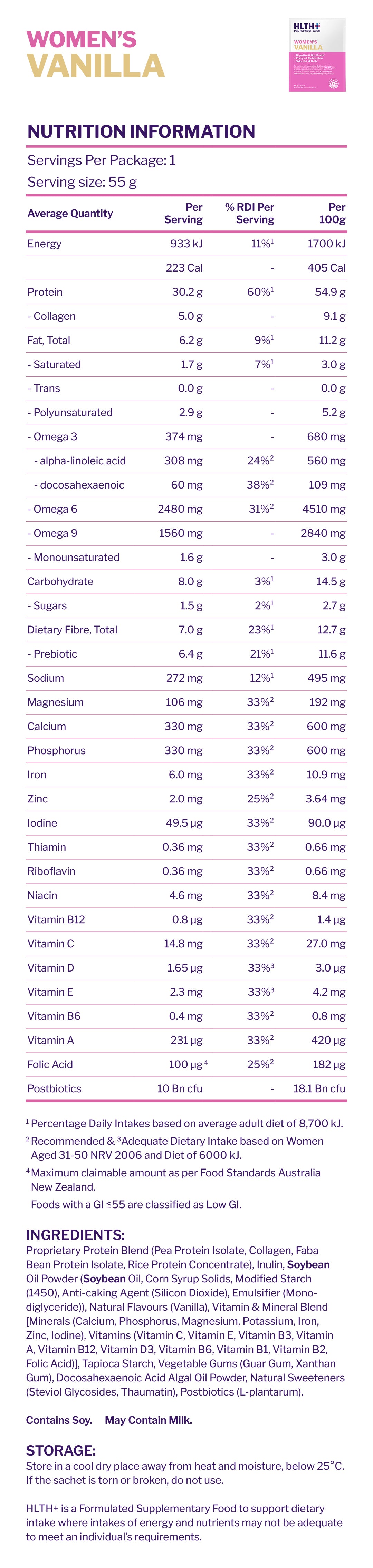
One 55g sachet carries 30 essential daily nutrients across protein, dietary fibre, vitamins, minerals, collagen and DHA. The label reads 30g protein per serve, 7g dietary fibre, 5g collagen, 10 billion CFU Lactobacillus Plantarum Postbiotic plus prebiotics, and 60mg DHA. Protein contributes to the maintenance of muscle mass, and dietary fibre contributes to regular laxation.
It also carries a balanced multivitamin profile. HLTH+ is dietitian-formulated to the Nutrient Reference Values published by the National Health and Medical Research Council, the Australian Government Department of Health and Ageing and the New Zealand Ministry of Health, in life-stage versions: Women's, Women's 50+, Men's and Men's 50+. Sugar sits at 1.5g in the Women's formulas and 1.7g in the Men's, with none added, and the product is dairy-free, gluten-free and low GI with a 5-star Health Star Rating.
A serve is RRP $6.00, or $5.10 a day on a 28-serve subscription. It is sold at hlthplus.com, and online through Amazon AU and Chemist Warehouse.
Not sure what your everyday routine is actually missing? The ✦ Find My Formula quiz takes 30 seconds and shows what your current stack is not giving you.
Frequently Asked Questions
What is Optifast?
Optifast is a very low calorie diet (VLCD) program from Nestlé Health Science, sold through Australian pharmacies. Its products are shakes, soups, bars and desserts designed to replace meals inside a supervised program. Optifast's own site states the products "must be used under the supervision of a healthcare professional" (retrieved 8 September 2026).
What does the Optifast program involve?
Four published levels: Intensive replaces all three meals with Optifast products, provides up to 800 calories a day and is recommended for up to 12 weeks. Active 2 replaces two meals, Active 1 replaces one, and Maintenance moves to three calorie-controlled meals with the products phased out. An intermittent-fasting option also exists (retrieved 8 September 2026).
How much protein is in an Optifast shake?
The standard OPTIFAST VLCD Shake lists 20g protein per 53g serve, with 3.6g dietary fibre and 12.7g sugars on the Chocolate, Vanilla and Coffee panels. Protein Plus lists 28g protein per 63g serve with 2.2g sugars. Both figures are from Optifast's own published nutrition information, retrieved 8 September 2026.
Who is the Optifast program designed for?
Optifast recommends it for people with a BMI above 30, or 27 and above with medical conditions that may benefit from weight loss, for people who need a very low energy diet before bariatric surgery, and for people maintaining weight they have lost. It is a clinical program, so suitability is a decision for your doctor.
Is HLTH+ an alternative to Optifast?
No: Optifast is a supervised very low calorie diet program with an end date, while HLTH+ is a Formulated Supplementary Food that sits alongside ordinary meals, with no program and no end date, supplying 30g protein per serve and 7g dietary fibre. They do different jobs, and one never replaces the other.
This article is general information, not medical advice. Decisions about a very low calorie diet program, or about any medication, belong with your doctor.
Leave a comment
This site is protected by hCaptcha and the hCaptcha Privacy Policy and Terms of Service apply.