

OptiSlim is an Australian very-low-calorie-diet (VLCD) program sold as meal-replacement shakes, soups and bars, and its flagship VLCD Classic Shake publishes a full nutrition panel. In Chocolate, that panel reads 692 kJ (165 calories), 17.7g protein, 0.8g dietary fibre and 13.7g sugars per 43g sachet, with 21 sachets for $44.99, which the brand states is $2.14 a serve (retrieved 8 September 2026). The published directions are to replace one, two or three meals a day with a shake made up in 250ml of chilled water.
Most reviews of OptiSlim are one person's fortnight and one person's scales, which tells you nothing about what the sachet carries or whether the program fits the phase you are in. If your appetite has already dropped, through a deliberate deficit or through rapid weight loss, reduced eating and medically induced weight loss, the panel matters more than any testimonial.
This review reads the program by its published facts: what it involves, what the panel carries and what it leaves out, who it was designed for, and what has to happen on the day the shakes stop.
What does the OptiSlim program involve?
OptiSlim sells through its own website and pharmacies, and groups its range as VLCD meal replacements, LCD (low-calorie-diet) meal replacements and low-calorie snacks. The VLCD Classic Shake is the core product, published in seven flavours (Chocolate, Vanilla, Strawberry, Banana, Espresso, Salted Caramel and Choc Mint), each 21 sachets a box at $44.99 (their product pages, retrieved 2 September 2026). A VLCD Platinum Plus Shake sits above it in the range.
The program structure on the published page is the number of meals you replace. The directions read "replace 1-3 meals per day", and the product copy describes three shakes a day as the full version. No phase names and no daily calorie target appear on the pages retrieved, so at three shakes a day the arithmetic is the brand's own panel multiplied by three: 495 calories, 53.1g protein, 2.4g dietary fibre and 41.1g sugars before anything else is eaten.
The same page recommends speaking with your GP or pharmacist before starting, especially with an existing medical condition. A VLCD replaces normal meals with nutritionally engineered shakes for a defined period, and the sachet does the portion control and the nutrition arithmetic while the phase lasts.
The closest comparison is Optifast, the pharmacy-channel VLCD from Nestlé Health Science. The two programs are refereed panel against panel in Optifast vs OptiSlim, and Optifast's own program is read the same way in Optifast reviews.
What does the OptiSlim VLCD Classic Shake panel say?
The Chocolate panel is a complete Nutrition Information Panel published by the brand itself, so every row below is theirs. The third column is arithmetic on the figures shown, so you can check each call.
| Per 43g sachet, Chocolate | Published figure | The read |
|---|---|---|
| Energy | 692 kJ / 165 calories | Three shakes a day is 495 calories |
| Protein | 17.7g | 10.7g per 100 calories; 53.1g across three shakes |
| Fat, total | 3.4g (0.7g saturated) | Plant fats only: 1.31g linoleic acid, 0.18g alpha linolenic acid; no marine omega-3 listed |
| Carbohydrate, total | 17.4g | Sugars make up 79% of it |
| Sugars | 13.7g | 41.1g across three shakes; sugar is the second ingredient listed, after wheat protein |
| Dietary fibre | 0.8g | 2.4g across three shakes; below the 2g per serve at which the Food Standards Code (Schedule 4) permits any dietary fibre content claim |
| Sodium | 350mg | 1,050mg across three shakes |
| Potassium | 589mg | 1,767mg across three shakes |
| Vitamins and minerals | 16 rows with amounts: vitamins A, B1, B2, B3, B6, B12, C, D3 and E, folic acid, calcium, iodine, iron, magnesium, phosphorus and zinc | The product copy counts 25 vitamins and minerals; the ingredient list names the rest |
| Allergen statement | "Contains gluten, milk, soy and caffeine" | Not for gluten-free, dairy-free or soy-free readers; caffeine at three shakes a day is worth knowing |
| Price | $44.99 for 21 sachets | $2.14 a serve, the brand's own figure |
Figures from OptiSlim's published nutrition information for the VLCD Classic Shake, Chocolate, retrieved 8 September 2026 (ingredient order retrieved 2 September 2026). Other flavours differ and brands reformulate, so check the current label before buying.
Two rows decide how this panel reads. The first is dietary fibre: 0.8g is a small number on any shake, and on a shake-only day the sachet's fibre is close to all the fibre you get. The second is sugars, because 13.7g of a 17.4g carbohydrate line means most of the carbohydrate in the sachet is sugar, and the ingredient list confirms where it comes from.
Protein is the row the panel does well by. At 10.7g per 100 calories, the shake is protein-dense for its size, and three sachets carry 53.1g of protein into a very low calorie day. Protein contributes to the maintenance of muscle mass, which is why that density is the number most worth reading on a VLCD panel.
How do you judge a VLCD shake from its panel?
Ignore the front of the pack and read five things off the panel, in this order.
- Protein per serve and per 100 calories. On a VLCD the sachets supply most of the day's protein, so the per-serve figure has to carry the day. 17.7g per sachet at 165 calories is a strong ratio.
- Dietary fibre per serve. Dietary fibre contributes to regular laxation, and on a shake-only day there is no incidental fibre from food to make up the difference. 0.8g per serve is the row to weigh most carefully.
- Sugars per serve, and where they come from. Read the total against the carbohydrate line, then read the ingredient list to see whether it is added sugar or milk sugars. On this panel, sugar is listed second.
- Allergens and caffeine. A VLCD shake is drunk two or three times a day, so an allergen statement is a daily exposure, not an occasional one. OptiSlim's reads gluten, milk, soy and caffeine.
- Essential fats. The panel lists linoleic and alpha linolenic acid, both plant fats, and no marine omega-3 source.
One thing the panel cannot tell you is whether a VLCD is the right tool for your situation. That is the GP or pharmacist conversation the brand itself recommends.
Who is OptiSlim designed for, and who is it not for?
Judged by its published facts, OptiSlim suits a specific reader.
- Someone running a deliberate, time-boxed VLCD phase with a GP or pharmacist in the loop, who wants the structure of replacing set meals rather than counting anything.
- Someone for whom cost per serve decides it. $2.14 a serve is the lowest figure in the Australian VLCD category on the published prices we hold.
- Someone who wants flexibility. The one-to-three-meals direction lets a program step up or down without a clinic visit, which is the practical difference from the more clinical end of the category.
Three other readers are a poor fit.
- Anyone gluten-free, dairy-free or soy-free. The allergen statement settles it before the panel is read.
- Anyone with an existing medical condition who has not spoken to a GP or pharmacist first. That is the brand's own line, and it applies with more force to a very low calorie intake than to most foods.
- Anyone whose appetite is already suppressed. If a medication has reduced how much you eat, whether to stack a very low calorie program on top is a decision for the prescribing doctor, not a website. This page is general information, not medical advice.
The reason the last group matters is that the food environment you return to has not changed while you were on shakes. Over 90% of Australian adults do not meet dietary guidelines on the AIHW poor-diet measure, and a program phase does nothing to move that number for the months after it.
If what you want is a shake instead of a meal without a VLCD's calorie floor, lifestyle meal replacements are a different category again; The Lady Shake review applies the same label reading there. If a dietitian or doctor has you on a clinical nutrition formula for a medical reason, that is a third category with its own job, covered in is Sustagen good for you.
What happens when the shakes stop?
Every VLCD ends, and the published program pages have nothing to say about the day after. While the phase runs, the sachet decides portion size and the nutrition arithmetic. When it stops, appetite comes back before new habits do, and the same is true whether the phase was shake-led, a deliberate deficit, or rapid weight loss, reduced eating and medically induced weight loss.
The clearest data on what follows medically induced weight loss comes from the medication side of the field. In the STEP 1 trial's extension study, people who stopped a GLP-1 medicine regained on average two-thirds of the weight they had lost within a year (Wilding and colleagues, 2022). A VLCD is a different intervention, but it shares the mechanism that matters: the moment the structure is removed, everyday eating decides what happens next.
Two nutrition gaps are measurable in that territory. GLP-1 medicines reduced ad libitum food intake by roughly a quarter of daily calories in trial conditions (Blundell and colleagues, Diabetes, Obesity and Metabolism, 2017), and a 2025 study of GLP-1 users measured average dietary fibre intake at 14.5g a day against a 28g recommendation (Frontiers in Nutrition). Both describe what happens to intake when appetite falls and a structured phase is no longer doing the arithmetic.
This page is general information, not medical advice, and decisions about any medication belong with your doctor. Learn more about what changes in nutrition when overall intake drops, and about how to eat on a GLP-1 medicine if that is the phase you are in.
Where a daily nutritional formula fits
HLTH+ is not a VLCD, not a weight-loss product and not a substitute for OptiSlim or any supervised program. A VLCD is a phase with its own job. HLTH+ is built for the ordinary daily eating on either side of it, when meals are real food and the nutrition arithmetic is yours again.
| OptiSlim VLCD Classic Shake | HLTH+ Women's | |
|---|---|---|
| Category | Very-low-calorie-diet meal replacement | Formulated Supplementary Food under the FSANZ Food Standards Code |
| The job | Replaces one to three meals a day during a program phase | Supplements the meals you keep eating, every day |
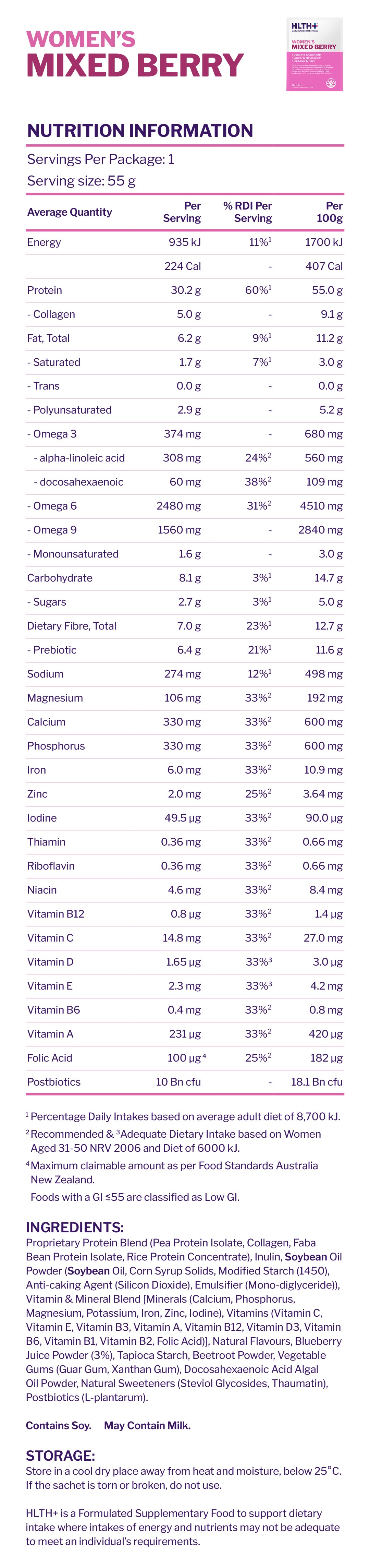
| Calories per serve | 165 | 223 |
| Protein per serve | 17.7g | 30g |
| Dietary fibre per serve | 0.8g | 7g |
| Sugars per serve | 13.7g | 1.5g, none added |
| Allergen statement | Contains gluten, milk, soy and caffeine | Dairy-free and gluten-free |
| Serve | 43g sachet in 250ml water | 55g sachet |
| Price | $44.99 for 21, $2.14 a serve | RRP $6.00, or $5.10 a day on a 28-serve subscription at $142.80 |
OptiSlim figures from its published nutrition information, Chocolate, retrieved 8 September 2026; HLTH+ figures from its published Women's panel. The two products do different jobs, so this table is a category difference, not a like-for-like substitution; check current labels before buying.
Read the table as two answers to two different questions. A VLCD sachet is engineered to be small: 165 calories, so that three of them make a very low calorie day. A daily formula is engineered to be dense: 30g protein, 7g dietary fibre, 5g collagen, 10 billion CFU Lactobacillus Plantarum Postbiotic plus prebiotics and 60mg DHA in a 55g sachet, so that one of them covers the gaps a normal day of eating leaves.
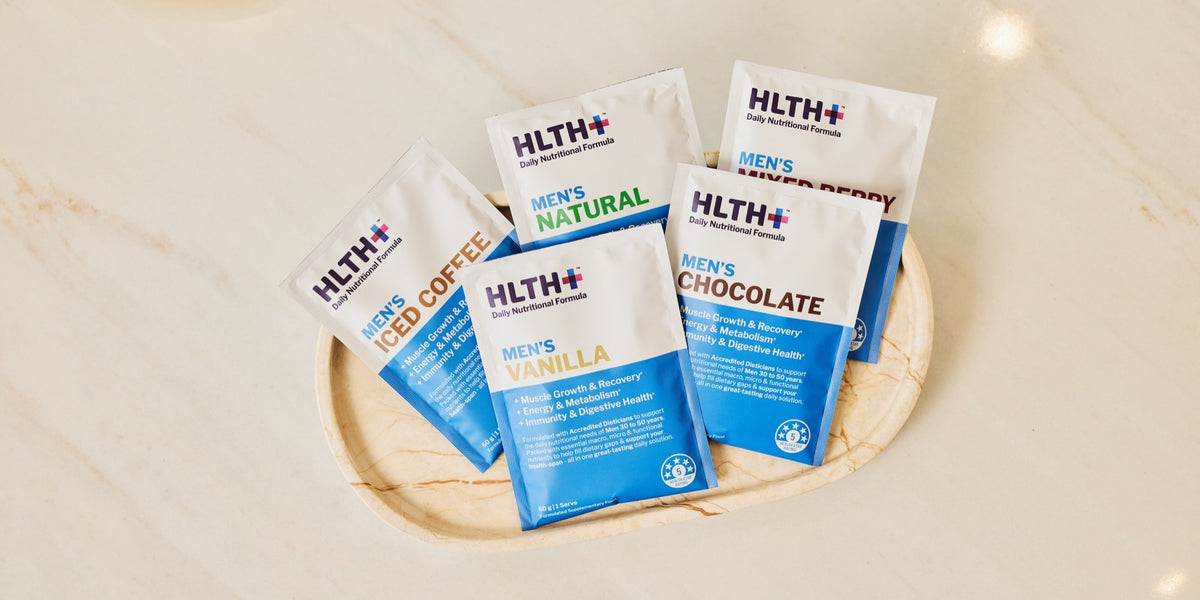
It also carries a balanced multivitamin profile. Counted across protein, dietary fibre, vitamins, minerals, collagen and essential fats, that comes to 30 essential daily nutrients in one serve. Rather than one formula for everyone, HLTH+ is formulated by Accredited Dietitians to the Nutrient Reference Values published in 2006 by the National Health and Medical Research Council, the Australian Government Department of Health and Ageing and the New Zealand Ministry of Health, in life-stage versions: Women's, Women's 50+, Men's and Men's 50+.
It is Australian-owned and Australian-made in facilities complying with Good Manufacturing Practice, carries a 5-star Health Star Rating, and holds hundreds of reviews across the range. It sells at hlthplus.com at RRP $6.00, or $5.10 a day on a 28-serve subscription at $142.80, and through Amazon AU and Chemist Warehouse online.
Coming off a program and not sure what your everyday routine is missing? The 30-second ✦ Find My Formula quiz shows what your current supplement stack is not giving you.
Frequently Asked Questions
What is in an OptiSlim VLCD shake?
OptiSlim's published Chocolate panel lists 692 kJ (165 calories), 17.7g protein, 3.4g fat, 17.4g carbohydrate of which 13.7g is sugars, 0.8g dietary fibre and 16 vitamin and mineral rows per 43g sachet, with an allergen statement of gluten, milk, soy and caffeine (retrieved 8 September 2026). Other flavours differ, so check the current label.
How does the OptiSlim program work?
The published directions are to replace one, two or three meals a day with one sachet made up in 250ml of chilled water, and the brand describes three shakes a day as the full version. No phase names or daily calorie targets are published; the brand recommends speaking with your GP or pharmacist before starting.
How much does OptiSlim cost per serve?
OptiSlim's own site lists the VLCD Classic Shake at $44.99 for 21 sachets, which the brand states is $2.14 a serve (retrieved 8 September 2026). At three shakes a day that is $6.42 a day. HLTH+ is RRP $6.00 a sachet, or $5.10 a day on a 28-serve subscription at $142.80.
Does OptiSlim contain gluten or dairy?
Yes to both, on its published label. The VLCD Classic Shake's allergen statement reads "contains gluten, milk, soy and caffeine", and the ingredient list opens with wheat protein followed by sugar and milk protein (retrieved 2 September 2026). Readers who avoid gluten, dairy or soy will need a different category of product.
Is HLTH+ an alternative to OptiSlim?
No. OptiSlim is a very-low-calorie-diet meal replacement used inside a program phase, and HLTH+ is a Formulated Supplementary Food built to supplement everyday meals. HLTH+ is not designed as a meal replacement, because it complements a food-first approach, though it works well as a healthy snack or to tie you over.
Leave a comment
This site is protected by hCaptcha and the hCaptcha Privacy Policy and Terms of Service apply.