

For the reason most people buy one, lowering their risk of cancer or heart disease, a daily multivitamin has little evidence behind it in adults who already eat reasonably well. For the job the big trials never set out to test, closing a measured shortfall in what you actually eat, the evidence is consistent and unglamorous: they work.
If you are reading this with a bottle on the bench, your question is probably sharper than "do they work". It is whether the tablet is doing anything at all, whether it covers the days you barely eat, and whether you are paying for the wrong thing entirely.
This page names the big trials with their real findings, then puts the Australian intake numbers beside them, so you can see which question applies to you.
What did the big multivitamin trials actually find?
Two trials do most of the work in this debate; both are randomised, placebo-controlled and large, and almost everything else is observational.
The Physicians' Health Study II followed 14,641 male US doctors aged 50 and over for a median of 11.2 years. Men on a daily multivitamin had a hazard ratio for total cancer of 0.92 (95% CI 0.86 to 0.998), which the authors described as a modest but significant reduction (Gaziano and colleagues, JAMA, 2012). There was no effect on prostate cancer, colorectal cancer or cancer deaths.
The same trial's cardiovascular paper is the one the marketing skips. Major cardiovascular events came out at a hazard ratio of 1.01 (95% CI 0.91 to 1.10), with no effect on heart attack, stroke or cardiovascular death after more than a decade (Sesso and colleagues, JAMA, 2012).
COSMOS was the second attempt, in both sexes: 21,442 US adults, women aged 65 and over and men aged 60 and over, followed for a median of 3.6 years. Invasive cancer occurred in 518 people on the multivitamin and 535 on placebo (HR 0.97, 95% CI 0.86 to 1.09), cardiovascular events were 429 against 437 (HR 0.98, 95% CI 0.86 to 1.12), and all-cause mortality did not move (Sesso and colleagues, American Journal of Clinical Nutrition, 2022).
| Trial | Who was in it | Follow-up | Total cancer | Cardiovascular events |
|---|---|---|---|---|
| Physicians' Health Study II | 14,641 male US doctors aged 50 and over | 11.2 years, median | 8% lower (HR 0.92, 95% CI 0.86 to 0.998) | No effect (HR 1.01, 95% CI 0.91 to 1.10) |
| COSMOS | 21,442 US adults, women 65 and over, men 60 and over | 3.6 years, median | No significant effect (HR 0.97, 95% CI 0.86 to 1.09) | No effect (HR 0.98, 95% CI 0.86 to 1.12) |
Read together: one 8% reduction in cancer among older male doctors, not repeated in a larger mixed-sex trial, and nothing on the heart in either. That is the whole disease-risk case for a daily multivitamin in people who were well fed to begin with.
What does the US Preventive Services Task Force say?
In June 2022 the US Preventive Services Task Force updated its position on vitamin, mineral and multivitamin supplements. It opened with the scale of the habit: 52% of surveyed US adults reported using at least one dietary supplement in the previous 30 days, and 31% a multivitamin-mineral (Mangione and colleagues, JAMA, 2022).
On multivitamins it issued an I statement: "the current evidence is insufficient to assess the balance of benefits and harms of the use of multivitamin supplements for the prevention of cardiovascular disease or cancer." The population is community-dwelling, non-pregnant adults.
An I statement is not a finding that multivitamins fail; it means the question is unanswered for that purpose. The two single nutrients the panel could answer, it answered against: beta carotene and vitamin E, both graded D, meaning no net benefit or harms that outweigh it. If your tablet is a high-dose antioxidant formula, read that line twice.
Has a multivitamin been shown to do anything measurable?
Yes, and it came out of COSMOS, not a brand's own study. Three cognition substudies ran inside the trial, each testing a standard commercial multivitamin-mineral tablet against placebo.
COSMOS-Mind tested 2,262 older adults by telephone for three years and found a global cognition benefit on the multivitamin, a mean z-score difference of 0.07 (95% CI 0.02 to 0.12), most pronounced in people with a history of cardiovascular disease (Baker and colleagues, Alzheimer's & Dementia, 2023). COSMOS-Web tested 3,562 people online and found better immediate recall at one year, estimated at the equivalent of 3.1 years of age-related memory change (Yeung and colleagues, American Journal of Clinical Nutrition, 2023). Pooled across all three substudies, the effect on global cognition was 0.07 standard deviation units (95% CI 0.03 to 0.11), roughly two years of cognitive ageing (Vyas and colleagues, American Journal of Clinical Nutrition, 2024).
Three caveats belong beside that result:
- One product, tested in older US adults who were 89% non-Hispanic white.
- A small effect, with confidence intervals close to zero.
- The largest effect sat in the subgroup most likely to have been short of something, which points at the intake question, not at any magic in the tablet.
The honest reading: a plain multivitamin measurably did something in a population that was probably under-supplied. Longevity supplements gets the same trial-first treatment.
The question the trials did not ask: are you short of something?
The disease trials never asked the more basic question: did the tablet close a gap in what people ate? A separate line of evidence did, and it never gets the headline.
In 10,698 US adults from the national NHANES surveys, multivitamin-mineral use at any frequency was associated with a lower prevalence of inadequate intake for 15 of 17 nutrients, and near-daily use (21 or more days in 30) "virtually eliminated" inadequacy for the nutrients studied, with three exceptions: calcium, magnesium and vitamin D (Blumberg and colleagues, Nutrients, 2017). Intakes above the Upper Level rose for seven nutrients, but never past 4% of users for any of them.
Whether that applies to you depends on whether you have a gap, and in Australia the base rate says you probably do. Over 90% of Australian adults do not meet dietary guidelines (AIHW). The nutrient-by-nutrient picture comes from the Australian Bureau of Statistics' modelling of long-term intake from food and drink, with supplements deliberately excluded.
| Nutrient | Australians aged 2 and over with inadequate intake from food and drink, 2023 |
|---|---|
| Calcium | 63.7% |
| Vitamin B6 | 46.7% |
| Magnesium | 31.3% |
| Zinc | 29.7% |
| Vitamin A | 22.9% |
| Riboflavin (vitamin B2) | 19.7% |
| Iron | 17.3% |
| Thiamin (vitamin B1) | 15.5% |
| Vitamin B12 | 9.7% |
| Vitamin C | 8.2% |
| Folate | 8.1% |
| Iodine | 7.4% |
Figures from the Australian Bureau of Statistics, Australian Health Survey: Usual Nutrient Intakes, 2023, which defines inadequate as a usual intake below the Estimated Average Requirement.
Two things in that release matter more than any row. The direction of travel is wrong: between 2011 to 2012 and 2023 the proportion with an inadequate intake rose for almost every vitamin, vitamin C from 2.5% to 8.2% and vitamin B12 from 2.8% to 9.7%. And the three nutrients a tablet handles worst in the NHANES data are the three Australians are shortest of: calcium tops the table, magnesium is third, and vitamin D is barely in food at all, which is why calcium, magnesium and vitamin D3 each get a page on this hub.
What happens to those gaps when you are eating a lot less?
Every percentage on a multivitamin panel is a top-up to food, so when the food shrinks, the arithmetic changes first.
Rapid weight loss, reduced eating and medically induced weight loss all shrink intake at the source. In trial conditions, GLP-1 medicines reduced ad libitum food intake by roughly a quarter of daily calories (Blundell and colleagues, Diabetes, Obesity and Metabolism, 2017). Eat a quarter less of a diet that already sat below the calcium, magnesium and vitamin B6 requirements, and the shortfall widens. Dietary fibre shows the same pattern: people on GLP-1 medications averaged 14.5g a day against the 28g recommended (Frontiers in Nutrition, 2025).
This is general information, not medical advice, and decisions about any medication belong with your doctor. When the volume of food drops, a tablet that only tops up vitamins and minerals answers a shrinking share of the question, because the protein and dietary fibre that also fell out of the day are not in it.
More on what changes nutritionally when you eat less: the GLP-1 nutrition support page, and the vitamin and mineral audit on which nutrients fall first when a reduced appetite reshapes the plate.
How do you tell whether a multivitamin is worth taking?
Five checks, in order.
- Start with the gap, not the bottle. Add up a normal day against the Nutrient Reference Values for your age and sex. The ABS table gives the base rate; your own week tells you whether it applies.
- Check whether your life stage moves the target. In the same ABS release, around eight in ten women aged 50 and over (77.7% to 80.2%) had an inadequate vitamin B6 intake, because the requirement rises at 50 and intake does not.
- Read the percentage of the Recommended Dietary Intake, not the milligrams. A vitamin at 5% of your daily requirement is a label entry, not a dose. A mineral at several hundred percent needs checking against the Upper Level.
- Look for high-dose antioxidants. Beta carotene and vitamin E are the two nutrients the US Preventive Services Task Force actively recommends against. A tablet built around them is built around the wrong evidence.
- Count what a tablet cannot carry. No multivitamin holds protein or dietary fibre, and calcium and magnesium in the amounts the ABS gap implies do not fit in one tablet either. If those are your gaps, a multivitamin is not where they close.
Where a daily nutrition formula fits, and where a tablet still wins
Start with the concession. If your food already sits close to the guidelines, an inexpensive multivitamin, or nothing at all, is a rational answer, and none of the trials above gives you a reason to spend more. HLTH+ is not a multivitamin tablet.
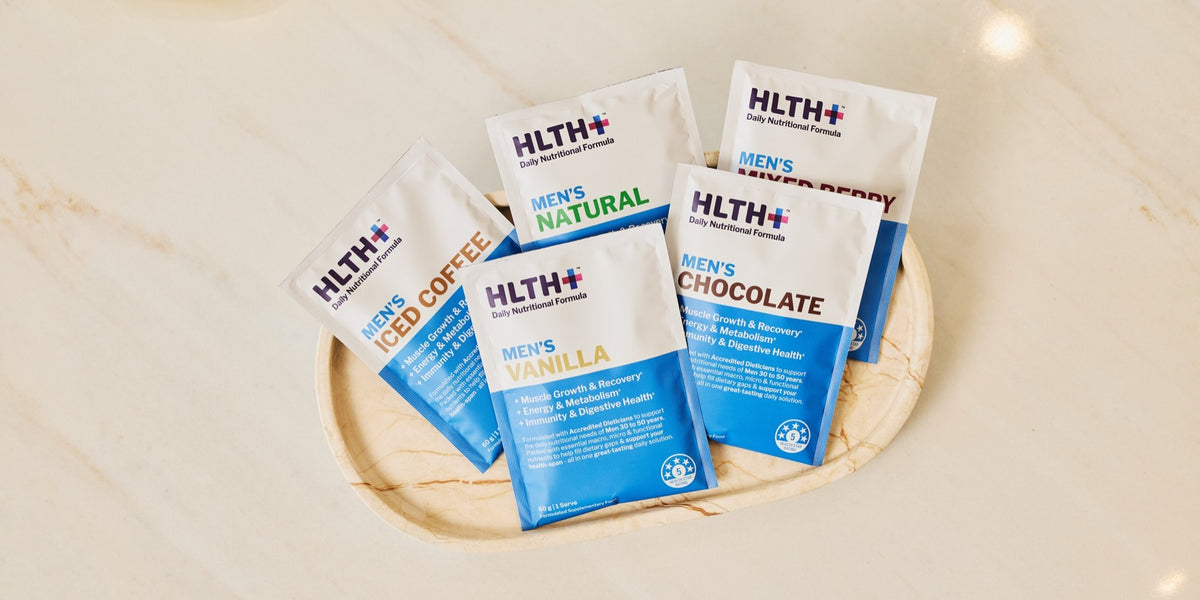
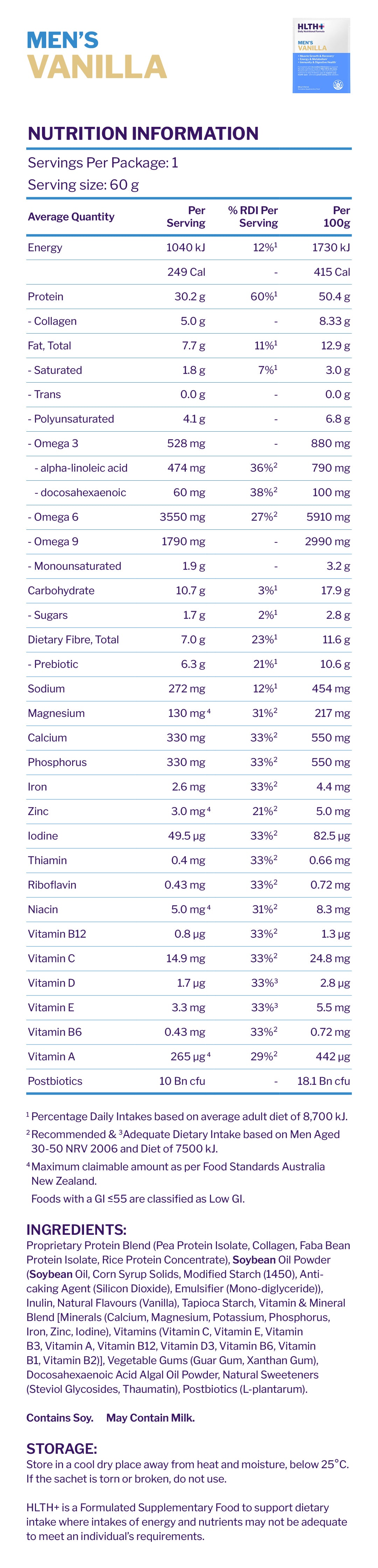
It is a Formulated Supplementary Food, built for the reader whose day of food has shrunk, whose gaps run across protein and dietary fibre as well as vitamins and minerals, and who is running a shelf of bottles to cover it. In one 55g sachet it carries 30g protein per serve, and protein contributes to the maintenance of muscle mass. It carries 7g dietary fibre, and dietary fibre contributes to regular laxation. It carries a balanced multivitamin profile.
Alongside those sit 5g collagen, 10 billion CFU Lactobacillus Plantarum Postbiotic and 60mg DHA. Across protein, dietary fibre, vitamins, minerals, collagen and DHA, that is 30 essential daily nutrients in one daily habit.
The life-stage point is the one a general multivitamin cannot make. Australian food labels calculate percentage daily intakes against an average adult diet of 8,700 kJ under Standard 1.2.8 of the Food Standards Code, a labelling reference value set above what the Nutrient Reference Values recommend for most adults, so a product formulated to it over-serves the individual drinking it. HLTH+ is formulated to the Nutrient Reference Values instead, by gender and life stage, across Women's, Women's 50+, Men's and Men's 50+. Those values were published in 2006 by the National Health and Medical Research Council, the Australian Government Department of Health and Ageing and the New Zealand Ministry of Health.
We believe in a food-first approach, and the ABS numbers say it is not working on its own for most people. That is the frame: nutritional insurance, not a substitute for eating well, made in Australia in facilities that comply with Good Manufacturing Practice. RRP $6.00, or $5.10 a day on a 28-serve subscription at $142.80, at hlthplus.com, on Amazon AU and at Chemist Warehouse online.
Find out what your current stack is actually missing. The ✦ Find My Formula quiz takes about 30 seconds and is built to show you the gaps your existing bottles are leaving, not to sell you another one. Take the quiz, or read how nutrition changes when you are eating less first.
Frequently Asked Questions
Do multivitamins lower your risk of cancer or heart disease?
The two large randomised trials say little or no. The Physicians' Health Study II found an 8% lower total cancer rate in older male doctors and no cardiovascular effect over 11 years. COSMOS, in 21,442 older adults, found no significant effect on either. The US Preventive Services Task Force rates the evidence insufficient.
Is it worth taking a multivitamin every day in Australia?
It depends on whether you have a gap, and most Australians do. Over 90% of adults do not meet dietary guidelines (AIHW), and ABS 2023 modelling shows 63.7% of people with inadequate calcium intake and 46.7% with inadequate vitamin B6. A multivitamin measurably lowers intake inadequacy; it is not a substitute for food.
What did the COSMOS trial find about multivitamins and memory?
Across three COSMOS cognition substudies, a daily multivitamin improved global cognition by 0.07 standard deviation units against placebo, which the authors estimated as about two years of cognitive ageing. The effect was small, tested in older US adults on one product, and largest in people with a cardiovascular history.
Does a multivitamin still work if you are eating much less than usual?
It still tops up vitamins and minerals, but it answers a smaller share of the problem. When food intake falls by roughly a quarter, as GLP-1 medicines produced in trials, the protein and dietary fibre that dropped out of the day are not in a tablet. General information, not medical advice.
Is a daily nutrition formula the same as a multivitamin?
No. A multivitamin tablet tops up vitamins and minerals only. A Formulated Supplementary Food such as HLTH+ carries a balanced multivitamin profile alongside 30g protein, 7g dietary fibre, 5g collagen and 60mg DHA per serve, formulated to the Nutrient Reference Values by gender and life stage.


Leave a comment
This site is protected by hCaptcha and the hCaptcha Privacy Policy and Terms of Service apply.