

Most longevity supplements have human evidence on blood markers, not on healthy years. The NAD+ precursors NMN and NR raise a blood level in short trials, while resveratrol, spermidine and fisetin have never improved a health outcome in a human supplement trial. Omega-3 and vitamin D were tested properly and did not deliver.
If you are past 50, or eating less than you used to, the longevity shelf is aimed squarely at you. The gap between "extended lifespan in mice" and "added a healthy year to a person" is where most of the money in this category is made.
This article puts the best human trial for each of the eight most marketed compounds on one table and lands on the levers with the strongest evidence. HLTH+ has made the case for the idea in Lifespan vs Healthspan: Why Living Longer Doesn't Always Mean Living Better, and the Australian arithmetic sits in Healthspan vs Lifespan; this piece is about what comes in a bottle.
What would count as evidence for a longevity supplement?
Three kinds of result get sold as the same thing. A compound can extend lifespan in mice; it can move a biomarker in people; or it can change a real outcome in people, such as strength, fractures, disease or death. Only the third kind answers the question a buyer is asking.
The distinction matters because chronic conditions contributed to around 9 in 10 deaths in Australia in 2022 (AIHW, chronic conditions). Those are the outcomes a longevity product would need to shift, and they are slow.
How do the eight most marketed compounds compare?
Every row is the strongest human evidence found for that compound, with the trial named so it can be checked; where none exists, the row says so.
| Compound | Best human trial | What it measured | Result | Outcome evidence in people |
|---|---|---|---|---|
| NMN | Yi et al, 2023: 80 healthy adults, 60 days | Blood NAD+, six-minute walk, insulin resistance | NAD+ rose; walk distance rose; insulin resistance unchanged | Biomarker and a short function test |
| NR | Martens et al, 2018: two six-week periods | Blood NAD+, tolerability, blood pressure | NAD+ rose; well tolerated; blood pressure flagged for future trials | Biomarker only |
| Resveratrol | Yoshino et al, 2012: 12 weeks at 75 mg a day | Insulin sensitivity, body composition, lipids, inflammation | No change on any measure | None; no survival effect in mice either |
| Spermidine | Schwarz et al, 2022: 100 adults, 12 months | Memory performance | No change | Diet cohort association only |
| Fisetin | AFFIRM trial: 40 participants, registered 2018 | Frailty and inflammation | Not yet reported; due late 2026 | None yet; lifespan data is in mice |
| Omega-3 | VITAL, 2019: 25,871 adults, 5.3 years | Major heart events, invasive cancer | Hazard ratios 0.92 and 1.03, neither significant | Null on outcomes; clocks slowed 3 to 4 months in a later analysis |
| Vitamin D | D-Health, 2022: 21,315 Australians, 5 years | Death from any cause | Hazard ratio 1.04, no reduction | Null on outcomes in unscreened adults |
| Creatine | Chilibeck et al, 2017: 22 trials, 721 adults | Lean mass and strength alongside resistance training | 1.37 kg more lean mass than placebo | Muscle outcome only; none on lifespan |
Sources for every row are linked below. Retrieved and checked 8 September 2026.
NMN and NR, the NAD+ precursors
The story is that NAD+ falls with age, so topping it up should slow ageing; the trials show only the first half. A 60-day trial of 80 healthy middle-aged adults found blood NAD+ rose at every dose from 300 mg to 900 mg a day and six-minute walking distance improved against placebo, while insulin resistance did not change (Yi et al, GeroScience, 2023); its first author is a company employee, according to the paper's own disclosure.
A 10-week trial found NMN increased muscle insulin sensitivity in postmenopausal women with prediabetes who were overweight or obese (Yoshino et al, Science, 2021). NR was well tolerated and raised NAD+ in healthy middle-aged and older adults across two six-week periods, with the authors calling the physiological findings "initial insight" for future trials to test (Martens et al, Nature Communications, 2018). Neither compound has a human trial on strength, disease, frailty or death.
Resveratrol
When the US National Institute on Aging tested resveratrol in normally fed, genetically varied mice at two doses, it "did not have significant effects on survival in male or female mice", while rapamycin in the same programme extended lifespan (Miller et al, Journal of Gerontology: Biological Sciences, 2011). In people, 12 weeks at 75 mg a day in non-obese postmenopausal women with normal glucose tolerance changed nothing: not body composition, resting metabolic rate, blood lipids, inflammatory markers or insulin sensitivity (Yoshino et al, Cell Metabolism, 2012).
Spermidine
Spermidine's human signal is a diet signal. In an Austrian cohort of 829 adults followed for 20 years, higher dietary spermidine intake was associated with a 24% lower risk of death per standard deviation after adjustment (Kiechl et al, American Journal of Clinical Nutrition, 2018), an association rather than a cause. SmartAge then gave 100 adults aged 60 to 90 with subjective cognitive decline 0.9 mg of spermidine a day for 12 months and found no significant change in memory against placebo (Schwarz et al, JAMA Network Open, 2022).
Fisetin
Fisetin is sold as a senolytic, a compound that clears senescent cells, on the strength of a mouse study in which late-life fisetin "extended median and maximum lifespan", with the human component limited to fat tissue samples in a dish (Yousefzadeh et al, EBioMedicine, 2018). The human trial that would test it, AFFIRM, was registered in 2018 with 40 participants, has a primary completion date of November 2026, and has no results posted (ClinicalTrials.gov NCT03675724). Every fisetin product on the market is selling a mouse result.
Omega-3
Omega-3 has been tested the right way, and the answer was no. VITAL gave 25,871 American adults 1 g of marine omega-3 a day or placebo for a median of 5.3 years: major cardiovascular events had a hazard ratio of 0.92 (95% confidence interval 0.80 to 1.06) and invasive cancer 1.03 (0.93 to 1.13), neither significant (Manson et al, New England Journal of Medicine, 2019). DO-HEALTH ran the same dose in 2,157 adults aged 70 and over for three years and found no significant benefit on blood pressure, physical performance, cognition, fractures or infections (Bischoff-Ferrari et al, JAMA, 2020).
A 2025 analysis of 777 of its participants found omega-3 slowed three epigenetic clocks by three to four months, a biomarker whose link to frailty or disease the authors say "is currently unknown" (Bischoff-Ferrari et al, Nature Aging, 2025).
Vitamin D
Australia ran the definitive test. The D-Health Trial gave 21,315 Australians aged 60 and over 60,000 IU of vitamin D3 a month or placebo for five years without screening for deficiency, and all-cause mortality was unchanged at a hazard ratio of 1.04 (95% confidence interval 0.93 to 1.18) (Neale et al, The Lancet Diabetes & Endocrinology, 2022). A measured deficiency is a different question from a healthy adult adding more; the trial answered the second question, and the first is covered in calcium supplements.
Creatine
Creatine's evidence is real, and it is not about lifespan. A meta-analysis of 22 randomised trials with 721 participants, mean ages 57 to 70, found creatine taken alongside resistance training two to three days a week produced 1.37 kg more lean tissue mass than placebo (95% confidence interval 0.97 to 1.76 kg), with greater upper and lower body strength (Chilibeck et al, Open Access Journal of Sports Medicine, 2017). The result depends on the training, and muscle is the right outcome to care about after 50: sarcopenia explains why.
Why do so many longevity supplements fail in people?
Because most of them answer a shortage the buyer does not have. The clearest demonstration is the Cochrane review of antioxidant supplements, which pooled 78 randomised trials and 296,707 participants: across all trials there was no effect on mortality (relative risk 1.02, 95% confidence interval 0.98 to 1.05), and in the 56 trials at low risk of bias mortality was slightly higher on the supplements (Bjelakovic et al, Cochrane Database of Systematic Reviews, 2012).
The pattern repeats: the supplement trial tests a mechanism in adults who were not short of the thing to begin with, and the outcome does not move. Correcting a real shortfall is a different question.
More on how nutrition is framed when the goal is healthy years rather than a longer count of them: HLTH+ nutrition support for longevity.
Which levers have the strongest evidence for healthy years?
Four, and each has outcome evidence in people, the standard the table applied to the supplements.
Resistance exercise
A systematic review of 16 prospective cohort studies found muscle-strengthening activity associated with a 10% to 17% lower risk of all-cause mortality, cardiovascular disease, total cancer, diabetes and lung cancer, independent of aerobic activity, with the largest reduction at roughly 30 to 60 minutes a week (Momma et al, British Journal of Sports Medicine, 2022).
Protein adequacy
Older adults need more protein than younger ones, not less. The PROT-AGE expert group recommends 1.0 to 1.2 g of protein per kilogram of body weight a day for people over 65, and at least 1.2 g/kg for those who are exercising (Bauer et al, Journal of the American Medical Directors Association, 2013). Protein contributes to the maintenance and growth of muscle mass and to tissue repair.
Australia is fine in general and short at the ages that matter: in 2023, 98.5% of Australians had an adequate protein intake, but people aged 75 and over were the most likely to fall short, at 14.7% of males and 6.2% of females (ABS, Usual nutrient intakes, 2023). How much protein to build muscle has the arithmetic.
Dietary fibre
A series of systematic reviews covering 185 prospective studies and 58 clinical trials found the highest fibre consumers had 15% to 30% lower all-cause and cardiovascular mortality than the lowest, with the greatest risk reduction at 25 g to 29 g a day (Reynolds et al, The Lancet, 2019). Dietary fibre also contributes to regular laxation.
Micronutrient adequacy
The Australian data here is the most alarming of the four. In 2023, 63.7% of Australians aged 2 and over had an inadequate calcium intake from food and drink, 75.7% of females against 52.1% of males, and 17.3% fell short on iron, rising to 26.8% among females (ABS, Usual nutrient intakes, 2023).
Calcium is necessary for normal teeth and bone structure, and vitamin D is necessary for normal bone structure. Requirements shift with age and sex, which is why the best magnesium supplement and do multivitamins work each get their own page.
What changes when you are eating less than you used to?
The shortfall arrives faster. A smaller total intake carries a smaller total of protein, dietary fibre and every micronutrient in it, while requirements do not fall to match, whether the cause is a reduced appetite with age, a deliberate deficit, or a GLP-1 medication.
The fibre number shows how far it can drift: one study of people on GLP-1 medications measured an average intake of 14.5 g of fibre a day against the 28 g recommended, roughly half (Frontiers in Nutrition, 2025).
This article is general information, not medical advice. Decisions about any medication belong with your doctor.
Where a Formulated Supplementary Food fits
We believe in a food-first approach. The statistics say it is not working on its own: over 90% of Australian adults do not meet dietary guidelines (AIHW, poor diet in adults). That is the case for nutritional insurance.
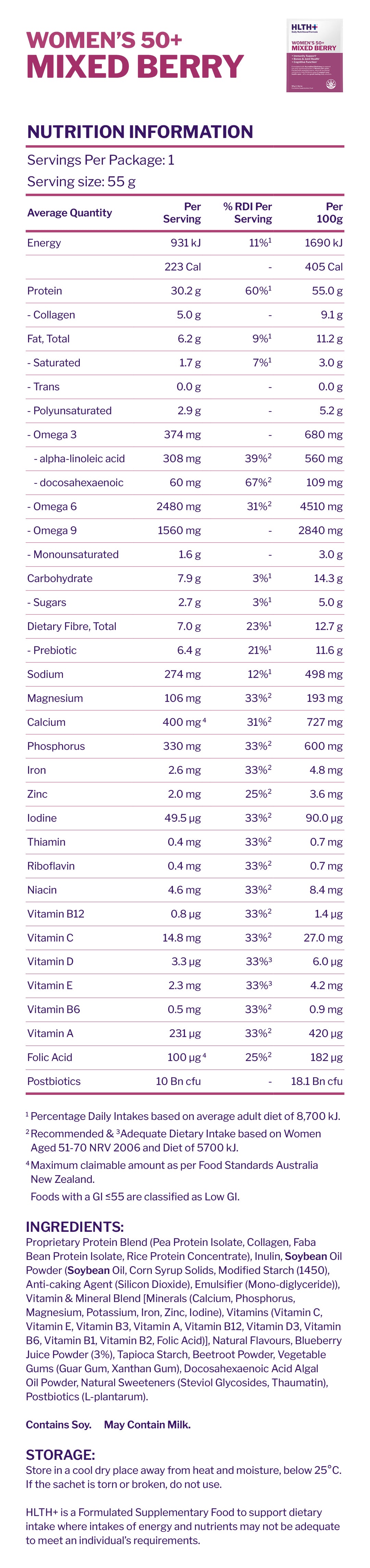
HLTH+ is a Formulated Supplementary Food carrying 30 essential daily nutrients across protein, dietary fibre, vitamins, minerals, collagen and DHA. One 55g sachet has 30g protein per serve and 7g dietary fibre, alongside a balanced multivitamin profile.
Each formula is built to the Nutrient Reference Values published in 2006 by the National Health and Medical Research Council, the Australian Government Department of Health and Ageing and the New Zealand Ministry of Health, by gender and life stage: Women's, Women's 50+, Men's and Men's 50+. The reference values move at 30, 50 and 70. Protein contributes to the maintenance and growth of muscle mass; vitamin D is necessary for normal bone structure; magnesium contributes to a reduction of tiredness and fatigue.
The fastest way to tell a real shortfall from a marketed one is to look at what your current supplement stack is actually missing. Take the Find My Formula quiz and see what is not covered.
Frequently Asked Questions
Do longevity supplements actually work?
Not on the evidence that exists: NMN and NR raise blood NAD+ in short trials but have no human outcome data, and resveratrol, spermidine and fisetin have no positive human supplement trial. Omega-3 and vitamin D were tested in 25,871 and 21,315 people and showed no benefit for heart events, cancer or deaths.
What is the best supplement for longevity?
Creatine is the only compound on the longevity shelf with solid human outcome data, and its evidence is for lean mass and strength alongside resistance training, not lifespan. A 2017 meta-analysis of 22 trials found 1.37 kg more lean tissue than placebo in training adults with mean ages of 57 to 70.
Does NMN or NR slow ageing in humans?
No trial has shown that. Both reliably raise blood NAD+ in adults, and one 60-day NMN trial improved six-minute walking distance, but no study has measured strength, disease, frailty or death. A rising blood marker is not evidence that a product adds healthy years.
What has the strongest evidence for adding healthy years?
Resistance exercise, adequate protein, dietary fibre and adequate micronutrients. Muscle-strengthening activity is linked to a 10% to 17% lower risk of death and major chronic disease at 30 to 60 minutes a week, and the highest dietary fibre intakes to 15% to 30% lower mortality, best at 25 g to 29 g a day.


Leave a comment
This site is protected by hCaptcha and the hCaptcha Privacy Policy and Terms of Service apply.