
A healthy breakfast on the go carries at least 10g of protein, at least 4g of dietary fibre and no added sugar, and it survives a few hours in a bag without a fridge. Hard-boiled eggs, natural yoghurt, oats soaked overnight in milk, a handful of almonds and a piece of fruit all pass that test. A cafe muffin does not: a 120g commercial berry muffin carries 31g of sugars and 6g of protein.
Most people searching this are not short of ideas, they are short of minutes, and on the mornings that go wrong the breakfast that wins is whatever is nearest the door: a bar, a juice, a pastry, or nothing. If your appetite is smaller than it used to be, skipping is easier still and costs more.
This page sets out the four things a portable breakfast has to carry, shows which everyday foods carry them on Australian Food Composition Database figures, names the ones that only look like breakfast, and answers the shake question honestly.
What does a healthy breakfast on the go need to carry?
Start with the gap it has to close. Over 90% of Australian adults do not meet dietary guidelines on the Australian Institute of Health and Welfare's poor-diet measure, and fewer than 1 in 20 eat the recommended serves of vegetables (Australian Bureau of Statistics, 2023). Breakfast is the meal most easily skipped or swapped for something sweet, so it is where a small change lands hardest.
Four criteria decide whether a portable breakfast is doing its job:
- Protein, at least 10g. That is the threshold the Australia New Zealand Food Standards Code sets before a food can be called a good source of protein (Schedule 4). Protein contributes to the maintenance of muscle mass and to tissue building and repair, and it is the nutrient a rushed breakfast drops first.
- Dietary fibre, at least 4g. The same Schedule sets 4g per serve for a good source of dietary fibre and 7g for an excellent source. Dietary fibre contributes to regular laxation.
- The minerals Australians actually run short of. The ABS measured usual intakes across 2023 and found 63.7% of Australians aged two and over had an inadequate calcium intake, rising to 75.7% of females, and 17.3% had an inadequate iron intake, including 47.7% of females aged 18 to 29. A breakfast carrying calcium and some iron is doing real work.
- No added sugar. The Code's low-sugar threshold is 5g of sugars per 100g for a solid food and 2.5g per 100mL for a liquid. Most grab-and-go breakfast products clear neither, and their sugars are mostly added.
Then the practical test: it has to survive. No fridge for three hours, no spoon, one hand free, no crumbs.
Which breakfast foods travel well?
Every figure below comes from the Australian Food Composition Database, Release 3.0, Food Standards Australia New Zealand, retrieved 8 September 2026. It reports per 100g; serve sizes are stated so you can check the arithmetic.
| Food and serve | Calories | Protein | Dietary fibre | Sugars (added) | Calcium | Travels because |
|---|---|---|---|---|---|---|
| Rolled oats, 50g uncooked | 187 Cal (782 kJ) | 6.1g | 4.8g | 0.5g (0g) | 20mg | Soaked overnight in a jar, it needs no cooking |
| Natural yoghurt, 200g tub | 152 Cal (636 kJ) | 10.6g | 0.2g | 10.2g (0g) | 364mg | Sealed tub; holds for a few hours out of the fridge |
| Two hard-boiled eggs, 100g | 136 Cal (569 kJ) | 12.4g | 0g | 0.3g (0g) | 39mg | Cooked on Sunday, peeled at the desk |
| Almonds, 30g | 171 Cal (716 kJ) | 5.9g | 3.3g | 1.6g (0g) | 80mg | Lives in the bag indefinitely |
| Banana, 120g peeled | 114 Cal (479 kJ) | 1.7g | 2.6g | 16.1g (0g) | 6mg | Comes in its own wrapper |
| Mixed grain bread, 2 slices (70g) | 180 Cal (755 kJ) | 7.5g | 4.1g | 1.8g (0g) | 109mg | Toast it, wrap it, eat it cold |
| Peanut butter, no added sugar, 20g | 126 Cal (526 kJ) | 4.9g | 1.3g | 1.0g (0g) | 11mg | A jar at work turns bread into breakfast |
| Cottage cheese, 100g | 133 Cal (556 kJ) | 17.0g | 0g | 1.8g (0g) | 89mg | Sealed tub, fork, done |
| Reduced-fat milk, 250mL | 112 Cal (470 kJ) | 8.8g | 0g | 12.5g (0g) | 298mg | The liquid that turns oats into a meal |
| High-protein flavoured yoghurt, 170g tub | 96 Cal (401 kJ) | 17.0g | 0.7g | 2.9g (0g) | 194mg | Sealed tub with a serious protein figure |
Figures from the Australian Food Composition Database Release 3.0 (Food Standards Australia New Zealand), retrieved 8 September 2026, scaled from per 100g values to the serve sizes shown, with liquids taken at 100g per 100mL. The high-protein yoghurt row is the database's intense-sweetened, increased-protein entry. Brands and recipes vary; read the panel on what you actually buy.
No single food on that list passes all four criteria alone. Eggs carry protein and no dietary fibre; oats carry dietary fibre and modest protein; yoghurt carries calcium and protein and almost no dietary fibre. The breakfast is the combination, and three do the job.
- Overnight oats: 50g rolled oats soaked in 250mL reduced-fat milk, with 30g almonds on top. 470 calories, 20.8g protein, 8.1g dietary fibre, 14.6g sugars with none added, and 398mg calcium. It sits in a jar in the fridge and comes out the door with you.
- Eggs on toast, cold: two hard-boiled eggs and two slices of mixed grain bread. 316 calories, 19.9g protein, 4.1g dietary fibre, 2.1g sugars, 148mg calcium and 2.8mg iron. Every part survives a bag.
- Yoghurt, banana, nuts: a 200g tub of natural yoghurt, a 120g banana and 30g almonds. 438 calories, 18.2g protein, 6.1g dietary fibre, 450mg calcium, and 27.8g sugars, all of them from the milk and the fruit rather than added.
All three clear 10g of protein and 4g of dietary fibre with no added sugar, and none takes longer than a minute once the eggs are boiled.
What doesn't travel, and why?
The foods that fail are rarely the ones that spoil. They are the ones that look like breakfast and read like dessert on the panel. Same source, same scaling:
| Food and serve | Calories | Protein | Dietary fibre | Sugars (added) | The problem |
|---|---|---|---|---|---|
| Commercial berry muffin, cake-style, 120g | 404 Cal (1,690 kJ) | 6.2g | 2.3g | 31.3g (28.8g) | Almost all of its sugars are added; under 10g protein |
| Plain croissant, 70g | 252 Cal (1,054 kJ) | 7.0g | 1.9g | 3.6g (3.6g) | Low in dietary fibre, short on protein |
| Muesli bar, plain or with dried fruit, 30g | 114 Cal (476 kJ) | 2.5g | 2.1g | 4.8g (3.5g) | A fifth of the protein of two eggs |
| Baked oat snack bar, 40g | 183 Cal (764 kJ) | 3.2g | 2.3g | 8.5g (5.9g) | Reads as oats, delivers mostly added sugar |
| Commercial orange juice, 250mL | 84 Cal (353 kJ) | 2.0g | 1.0g | 17.8g (0g) | The fruit's sugars without the fruit's dietary fibre |
| Toasted granola with nuts and seeds, 60g | 255 Cal (1,066 kJ) | 6.7g | 4.6g | 9.8g (8.9g) | Passes on dietary fibre, then adds 8.9g of sugar |
Figures from the Australian Food Composition Database Release 3.0 (Food Standards Australia New Zealand), retrieved 8 September 2026, scaled from per 100g values to the serve sizes shown, with liquids taken at 100g per 100mL. Brands and recipes vary; read the panel on what you actually buy.
Put the two tables side by side and the pattern is protein. Nothing in the second table reaches 10g, and two hard-boiled eggs beat every row in it on their own. The muffin and juice that pass for breakfast in a lot of cafes come to 488 calories, 8.2g protein and 49.1g of sugars, more sugar than the three good combinations put together.
The juice row is the one people defend. A 250mL glass carries 17.8g of sugars against 1.0g of dietary fibre; a 120g banana carries 16.1g against 2.6g and takes longer to eat. Neither has added sugar, but only one of them is a food.
The rule is simple. If the panel says under 10g of protein and the ingredients list puts sugar in the first three lines, it is a snack, and a snack eaten at 7am is still a snack. What a full day of eating looks like on the same principles is set out in what to eat on a GLP-1, and the version built around training is in what to eat before a workout.
What changes when your appetite is smaller than it used to be?
A portable breakfast matters most to the people least likely to eat one: anyone whose appetite has dropped through a deliberate deficit, an illness, or rapid weight loss, reduced eating and medically induced weight loss. When calories drop, breakfast is usually the first meal to go, because it has the weakest habit behind it.
The drop is measurable. In trial conditions, GLP-1 medicines reduced ad libitum food intake by roughly a quarter of daily calories (Blundell and colleagues, Diabetes, Obesity and Metabolism, 2017). Take a quarter out of a day that already skips breakfast and marginal nutrients become absent.
Dietary fibre is the clearest casualty. A 2025 study of GLP-1 users measured average intake at 14.5g a day against the 28g recommended (Frontiers in Nutrition, 2025). A GLP-1 medicine also slows gastric emptying and gut motility, which commonly changes bowel regularity; that is a reason to be careful about which breakfast foods sit well, and high-sugar options tend to sit worst.
This section is general information, not medical advice. Decisions about any medication belong with your doctor.
Two things follow. Smaller and denser beats larger and lighter, which is why the combinations above lean on eggs, yoghurt, nuts and oats rather than volume. And the foods that carry dietary fibre earn their place first, the subject of dietary fibre when you are eating less. Learn more about what changes for nutrition when overall intake drops.
Does a shake count as a healthy breakfast on the go?
It depends on which shake and what you are asking it to do. The four criteria above are the right test, so here is HLTH+ read against its own panel.
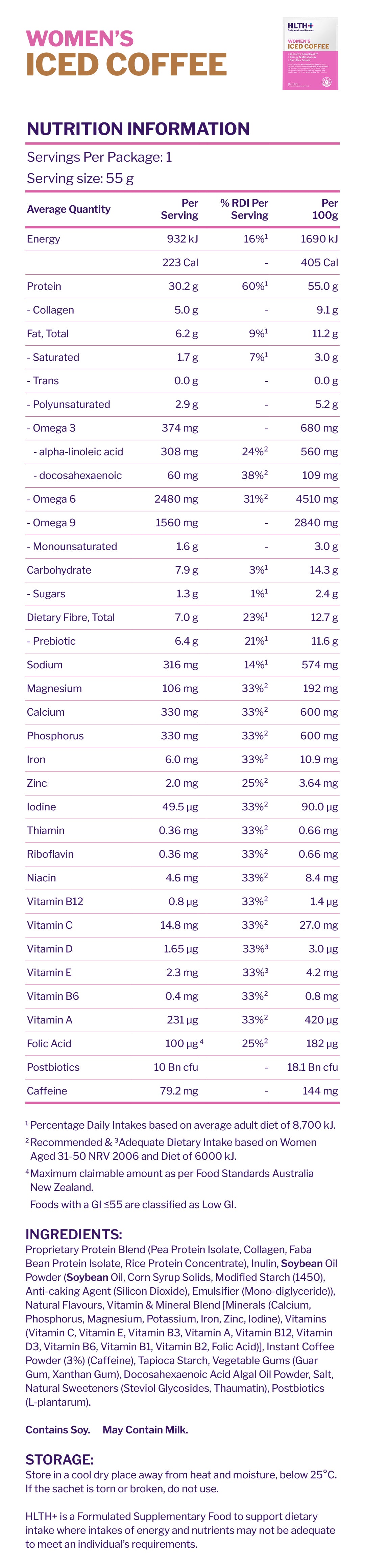
One 55g Women's sachet carries 30g protein per serve, 7g dietary fibre, 5g collagen, 60mg DHA and 10 billion CFU Lactobacillus Plantarum Postbiotic alongside prebiotics, at 1.5g of sugar with none added and 223 calories. The Men's sachet carries the same 30g of protein at 1.7g of sugar and 248 calories. Mixed into the directed 300mL, 1.7g of sugar is under 0.6g per 100mL against the Code's 2.5g low-sugar line, and 7g is the figure the Code sets for an excellent source of dietary fibre.
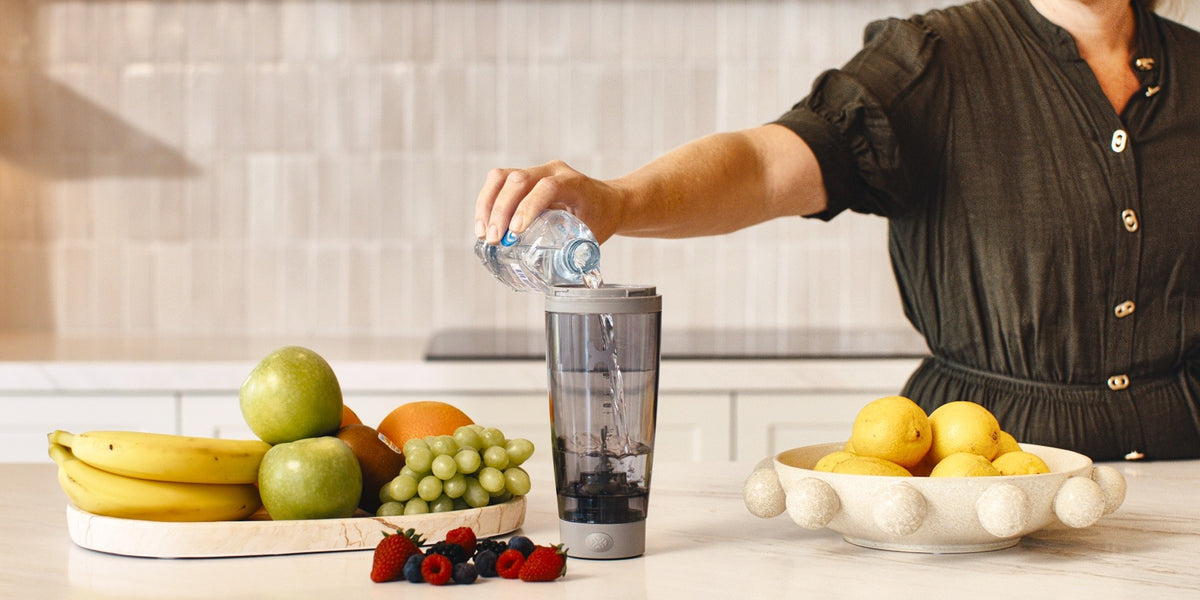
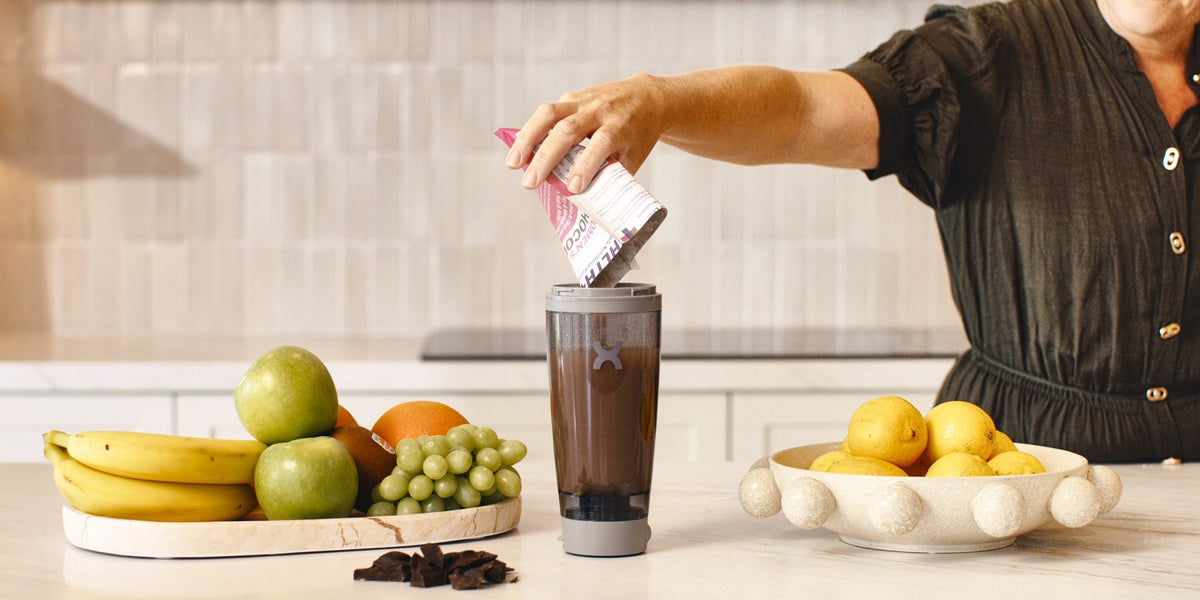
On travel it does well, because the sachet is the packaging: 55g in a pocket, 300 to 400mL of water or milk and ten seconds in a shaker, no fridge, no spoon. Each serve also carries a balanced multivitamin profile.
The honest answer on the meal question is in two halves. HLTH+ is not designed as a meal replacement, because it is built to complement a food-first approach: the eggs, oats and yoghurt above are the plan, and a Formulated Supplementary Food sits alongside them. It also works fine as a healthy snack or to tie you over, and on a morning where the alternative is a muesli bar or nothing, that is the better outcome.
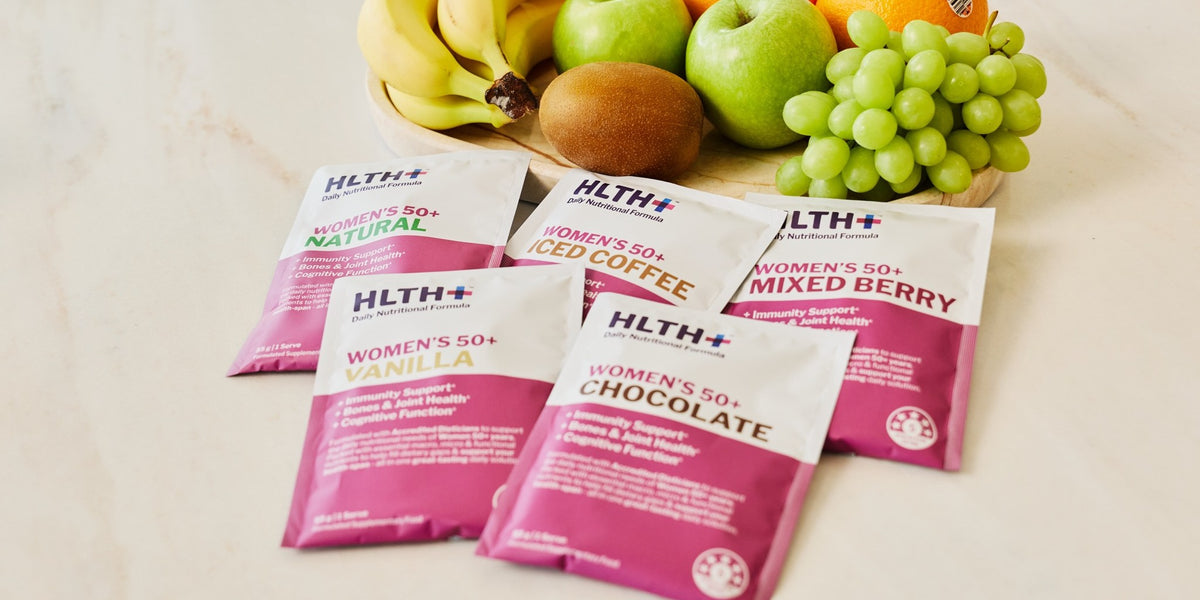
Counted across protein, dietary fibre, vitamins, minerals, collagen and DHA, a serve holds 30 essential daily nutrients. Those are dosed by sex and life stage across Women's, Women's 50+, Men's and Men's 50+, formulated by Accredited Dietitians to the Nutrient Reference Values, the reference intakes published in 2006 by the National Health and Medical Research Council, the Australian Government Department of Health and Ageing and the New Zealand Ministry of Health. A one-formula-for-everyone product is built to a labelling average instead, not to the person drinking it.
It is Australian-owned and made in facilities complying with Good Manufacturing Practice, dairy-free and gluten-free, carries a 5-star Health Star Rating, and holds hundreds of reviews across the range. A serve is RRP $6.00 at hlthplus.com, or $5.10 a day on a 28-serve subscription at $142.80 with no lock-in, and it is also stocked online at Amazon AU and Chemist Warehouse. If a greens powder is what currently sits in your morning, greens powders: what they do and what they miss runs the same four criteria over that category.
How do you make it hold on a bad morning?
The breakfast that works is the one that needs no decision at 7am. Three habits do the work.
- Cook once, eat five times. A dozen eggs boiled on Sunday, almonds portioned into 30g lots, and a jar of oats and milk made the night before leave nothing to do but pick it up.
- Keep a fixed default. One combination you eat on autopilot, so that on the mornings you cannot think you still get 10g of protein and 4g of dietary fibre. Variety is for mornings with time.
- Read the panel once, then stop. Check a product against the four criteria the first time you buy it, decide, and never re-litigate it in the queue. That is how the muffin loses.
Protein gets the last word, because it is the criterion most portable breakfasts miss. How much of it a day needs is worked through in protein when appetite drops, and the foods worth building a whole day around extend the first table to lunch and dinner.
See what your current stack is not giving you. The 30-second ✦ Find My Formula quiz is diagnostic: it shows the gaps your existing breakfast and supplements leave, so you know which of the four criteria you are actually missing before you buy anything.
Frequently Asked Questions
What is the healthiest breakfast to eat on the go?
One that carries at least 10g of protein, at least 4g of dietary fibre and no added sugar, and survives a bag. Overnight oats made with 50g oats, 250mL reduced-fat milk and 30g almonds delivers 20.8g protein and 8.1g dietary fibre; two hard-boiled eggs on mixed grain bread delivers 19.9g and 4.1g.
Is a muesli bar a healthy breakfast?
Not on its own. A 30g plain muesli bar carries 2.5g of protein, 2.1g of dietary fibre and 4.8g of sugars, 3.5g of them added, on Australian Food Composition Database figures. That is a fifth of the protein in two hard-boiled eggs. It works as a top-up beside yoghurt or eggs, not as the breakfast.
Is it okay to have a shake for breakfast instead of food?
A daily nutritional formula like HLTH+ is not designed as a meal replacement, because it is built to complement a food-first approach. It works fine as a healthy snack or to tie you over on a morning when breakfast would otherwise be skipped. Read any shake against the same test: protein, dietary fibre and added sugar on the panel.
How much protein should a breakfast on the go have?
At least 10g, which is the Food Standards Code threshold for a good source of protein per serve. Most portable breakfasts clear it only in combination: a 200g tub of natural yoghurt carries 10.6g, two hard-boiled eggs 12.4g, and a 100g serve of cottage cheese 17.0g, all on Australian Food Composition Database figures.
What can I eat for breakfast if I have no appetite in the morning?
Something small and dense rather than large and light: two hard-boiled eggs, a 170g tub of high-protein yoghurt, or 30g of almonds with a banana. Each fits a reduced appetite and still carries protein. If a medication is the reason your appetite has changed, talk to your doctor about what is right for you.
Leave a comment
This site is protected by hCaptcha and the hCaptcha Privacy Policy and Terms of Service apply.