
What counts as a lactose-free protein powder in Australia?
A protein powder is lactose-free when it contains no detectable lactose, the condition Schedule 4 of the Food Standards Code sets for that exact claim. Plant proteins and collagen carry none at all, because lactose comes only from milk. A whey protein isolate is a different proposition: filtered down to traces, genuinely low in lactose, and not the same thing as free of it.
Most readers already know dairy is the problem. The trouble is a shelf where "isolate", "low lactose" and "dairy free" get used as though they mean the same thing.
This page sets out what those words have to mean on an Australian label, what the published panels say, and which powder suits which reader.
What does "lactose free" have to mean on an Australian label?
Two claims exist, and they are not the same. Schedule 4 of the Australia New Zealand Food Standards Code sets the condition for a lactose-free claim as a food that "contains no detectable lactose", and the condition for a low-lactose claim as a food that "contains no more than 2 g of lactose/100 g of the food". A pack saying low lactose is telling you, correctly, there is some.
Lactose is a milk sugar broken down by lactase, an enzyme in the small intestine, and lactose intolerance is the reduced ability to digest it when there is not enough lactase to go around (Better Health Channel, Victorian Department of Health).
Scale matters more than the word on the front. Most people with lactose intolerance can handle small amounts of lactose, such as a glass of milk, which contains 8 to 10 grams of it (Better Health Channel). Where your own threshold sits is the thing no label can tell you.
Is whey protein isolate lactose-free?
No, and the better brands say so plainly. Whey is the liquid fraction of milk and the milk sugar travels with it. A concentrate is filtered less and keeps more of that sugar; an isolate from the same brand is filtered further, so it carries less.
Bulk Nutrients publishes the figure on its own Whey Protein Isolate page: "approximately 0.3 grams per serve", which the same page describes as "forty times less lactose than a glass of milk" (retrieved 15 September 2026). Run the arithmetic on their 30 g serve and 0.3 grams is 1.0 gram per 100 grams, which clears the low-lactose condition of 2 g per 100 g and does not clear the lactose-free condition of no detectable lactose.
That is the position of the whole isolate category, and no criticism of it. For most people 0.3 grams is a non-event next to a glass of milk. For someone at the sensitive end, a trace is still a trace. Whether whey protein contains lactose, and how concentrate compares with isolate, is taken apart on its own page.
Is lactose intolerance the same as a dairy allergy?
No, and buying as though it is will cost you. Lactose intolerance is a digestive issue with the milk sugar; an allergy or intolerance to cows' milk protein is a separate condition (Better Health Channel, retrieved 15 September 2026). Whey and casein are milk proteins, still in the tub after every gram of lactose is filtered out.
So if lactose is the problem, a well-filtered isolate may suit you; if milk protein is the problem, dairy-free is the label to shop on. Everything dairy-free is also lactose-free; the reverse is not true.
What should you check on a lactose-free protein label?
Five things decide whether a lactose-free powder is worth your money, and only one is the word on the front.
- Protein per serve, read against the serve size. A 20 g figure on a 25 g scoop and a 30g figure on a 55g sachet answer different questions. Protein contributes to the maintenance and growth of muscle mass and to tissue repair.
- The dairy statement, not the marketing word. A plant or collagen base carries no lactose by construction. A dairy base carries some unless the pack states the lactose-free condition.
- Dietary fibre per serve. Under Schedule 4, 2 grams per serving is the threshold for any dietary fibre claim at all, and dietary fibre contributes to regular laxation. On the panels here the spread runs from 0.3g to 7g.
- Sugars per serve, and whether any were added. Flavoured powders run from a rounding error to several grams.
- What else the serve carries. Most dedicated powders publish protein and little else; some add a probiotic or a B-vitamin complex. Check the sweetener line too: thaumatin, monk fruit and steviol glycosides all show up here.
If the amino acid question sent you here, read what makes a protein complete and the nine essential amino acids first, because a label will rarely answer it for you.
How do the lactose-free options compare on their own labels?
Every cell is a figure the brand publishes, or a plain statement that it does not, with the date read.
| Label type, and the panel checked | Protein per serve | Dietary fibre | Sugars | What the pack says about dairy |
|---|---|---|---|---|
| Whey protein isolate: Bulk Nutrients Whey Protein Isolate, own page, 15 Sep 2026 | 25.5 g to 26.4 g per 30 g serve by flavour | Not listed on the panel | 0.4 g to 0.6 g by flavour | "Approximately 0.3 grams" of lactose per serve, in their own words |
| Single-source plant isolate: Nuzest Clean Lean Protein, own page, 15 Sep 2026 | 20 g per 25 g serve | 0.3 g | 0.2 g | "No gluten, dairy or soy" |
| Plant blend: Amazonia Raw Protein Isolate Vanilla, own page, 15 Sep 2026 | 21.6 g per 30 g serve | 2.7 g | 1.1 g | "100% vegan, dairy-free and plant-based" |
| Plant blend: Bare Blends Vanilla Coconut Plant Protein, own page, 15 Sep 2026 | 19.8 g per 30 g serve | 0.4 g | 0.3 g | "Naturally dairy free and lactose free" |
| Nut blend: Macro Mike Premium Almond Protein Deluxe Chocolate, own page, 15 Sep 2026 | 23.7 g per 40 g serve | 4.6 g (panel image, 2 Sep 2026) | 3.1 g (panel image, 2 Sep 2026) | "100% plant based, dairy-free, and vegan-friendly" |
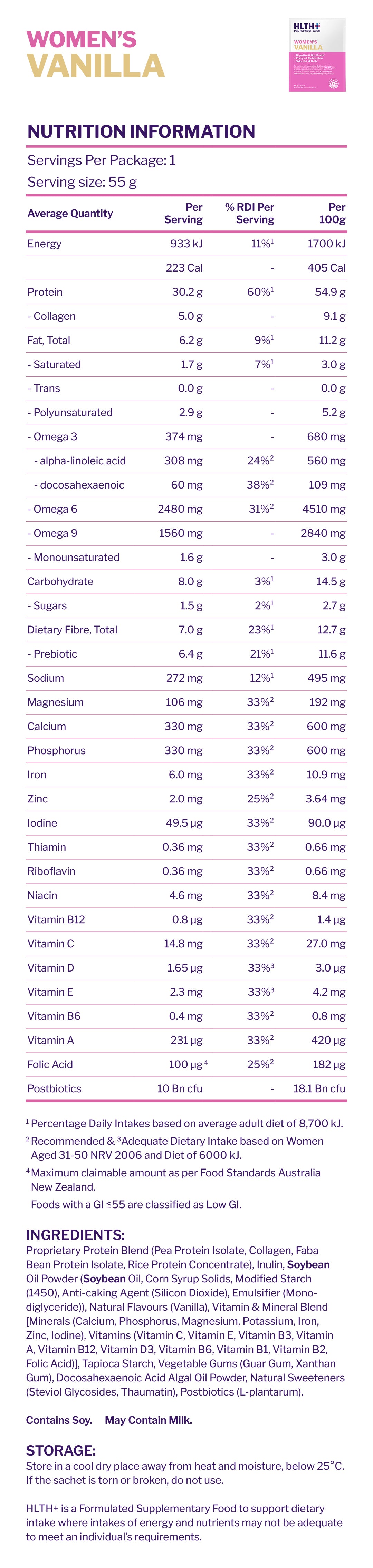
| Formulated Supplementary Food: HLTH+, published label | 30g protein per serve | 7g | 1.5g (Women's), 1.7g (Men's), none added | Dairy-free and gluten-free, and therefore lactose-free; contains soy |
Figures are each brand's published nutrition information at the dates shown; flavours vary and brands reformulate, so check current labels before buying.
One label type is deliberately absent. "Lactose-free whey" products exist, made by treating the whey with lactase or filtering harder, and none published a panel we could verify on the day, so none is measured here rather than estimated. If you find one, the pack must carry the lactose-free claim, not a low-lactose one, and the allergen statement will still declare milk.
Read down the dietary fibre column and the category's shape appears. Four of the six entries sit at or under 2.7 grams, which is all a 25 g to 40 g scoop of near-pure protein can hold. That is not a failing; they deliver one nutrient and they deliver it. The plant-based options are ranked in full on their own page.
One allergen note from that table: Macro Mike's own statement declares almonds and a shared facility handling peanuts, cashews, hazelnuts and soy (read 2 September 2026). Lactose-free says nothing about nuts, and nothing here is free from every major allergen.
What if you are eating less than you used to?
One group reads this differently: people whose meals have shrunk, through a deliberate deficit, an appetite that has fallen away, or rapid weight loss, reduced eating and medically induced weight loss, including people on GLP-1 medications. Over 90% of Australian adults do not meet dietary guidelines on the AIHW poor-diet measure before intake drops at all.
When the plate gets smaller, the gram-scale nutrients slip first. In one 2025 study, people on these medications averaged 14.5g of dietary fibre a day against the 28g recommended (Frontiers in Nutrition, 2025). A scoop carrying 0.3g cannot answer that.
This page is general information, not medical advice, and decisions about any medication belong with your doctor. Learn more about what happens to nutrition when overall intake drops.
Where does HLTH+ fit on a lactose-free shelf?
HLTH+ is a daily nutritional formula rather than a dedicated protein powder, a Formulated Supplementary Food under the Food Standards Code, taken alongside meals in a 55g sachet for Women's and a 60-62g sachet for Men's. It is dairy-free and gluten-free, so it carries no lactose.
Allergen line: contains soy. Lactose-free is not allergen-free on any pack, so read that line on every tub.
One sachet lists 30g protein per serve and 7g dietary fibre, at 1.5g of sugar for Women's or 1.7g for Men's with none added. The protein blend is pea protein isolate, collagen, faba bean protein isolate and rice protein concentrate. Dietary fibre contributes to regular laxation, and protein contributes to the maintenance and growth of muscle mass, as part of a healthy diet involving a variety of foods.
The same sachet lists 5g collagen, 60mg DHA and 10 billion CFU Lactobacillus Plantarum Postbiotic alongside prebiotics. A postbiotic is not a live organism: it is the material a bacterial culture produces during fermentation, together with the inactivated cells. That also means a postbiotic count and a probiotic count are not the same measurement.
Across protein, dietary fibre, vitamins, minerals, collagen and DHA, each serve supplies 30 essential daily nutrients. The vitamins and minerals inside that set make up a balanced multivitamin profile.
The row no dedicated powder answers is who the formula was built for. HLTH+ is dietitian-formulated to the Nutrient Reference Values, the published government intakes developed by the National Health and Medical Research Council, the Australian Government Department of Health and Ageing and the New Zealand Ministry of Health. That is why the range runs Women's, Women's 50+, Men's and Men's 50+ rather than one scoop for every adult.
It is Australian made in facilities complying with Good Manufacturing Practice, carries a 5-star Health Star Rating, has no nasties, artificial colours, artificial flavours or artificial sweeteners, and holds hundreds of reviews. It sells at hlthplus.com at RRP $6.00, or $5.10 a day on a 28-serve subscription at $142.80, and through Amazon AU and Chemist Warehouse online.
Which lactose-free protein powder should you choose?
Choose a whey protein isolate if lactose is your only issue, it is mild, and you want the most protein per gram for the money. Bulk Nutrients publishes 25.5 g to 26.4 g of protein in a 30 g serve with approximately 0.3 grams of lactose, which beats every plant option here for density. It will not give you dietary fibre, and the tub still contains milk.
Choose a single-source plant isolate if you want the shortest ingredient list and the lowest sugar line. Nuzest publishes 20 g of protein, 0.2 g of sugars and three ingredients in a 25 g serve, with "no gluten, dairy or soy" on their page.
Choose a plant blend if you want more from the scoop. Amazonia publishes 2.7 g of dietary fibre per 30 g serve and Macro Mike 4.6 g per 40 g serve, and Bare Blends prints the lactose-free words on the pack itself at 3.00aserve(74.99 across 25 serves).
Choose a daily nutritional formula if what you wanted was the protein covered and the rest of the day with it. HLTH+ is not designed as a meal replacement, because it complements a food-first approach, but it works fine as a healthy snack or to tie you over between meals. We believe in food first; the statistics say food alone is not getting Australians there, so a daily formula is nutritional insurance rather than a substitute for eating well.
That is the consolidation case. If you are drinking something most days anyway, the question is how much of the day it covers: a lactose-free scoop covers protein, and a 55g sachet carries 30g protein and 7g dietary fibre with collagen, DHA and live cultures alongside. The same reasoning runs through the protein powder shortlist for women.
Find out what your current routine is not giving you. The 30-second ✦ Find My Formula quiz reads the stack you already take and shows the gaps it leaves.
Frequently Asked Questions
Is whey protein isolate lactose free?
No. Under Schedule 4 of the Food Standards Code, lactose free means no detectable lactose, and an isolate is filtered to traces rather than to nothing. Bulk Nutrients publishes approximately 0.3 grams per 30 g serve on its own page, which works out at 1.0 gram per 100 grams: low lactose, not lactose free.
What is the best lactose-free protein powder in Australia?
It depends what you want the scoop to do. For protein density, a whey isolate at 25.5 g to 26.4 g per 30 g serve leads. For a short plant ingredient list, Nuzest publishes 20 g per 25 g serve. For protein plus dietary fibre, vitamins and minerals in one serve, HLTH+ lists 30g protein and 7g dietary fibre.
Is dairy-free the same as lactose-free?
Not quite. Everything dairy-free is lactose-free, because lactose only comes from milk, but a lactose-free dairy product still contains whey and casein. If milk protein is what you react to rather than the milk sugar, shop on the dairy-free statement, not the lactose one.
Does HLTH+ contain lactose?
No. HLTH+ is dairy-free and gluten-free on its published label, so there is no lactose in it. It does contain soy, so it is not suitable for a soy allergy. One 55g sachet lists 30g protein per serve, 7g dietary fibre, 5g collagen and 60mg DHA.
How much lactose can someone who is lactose intolerant have?
Most people with lactose intolerance can handle small amounts, such as a glass of milk containing 8 to 10 grams of lactose, according to the Better Health Channel. Individual tolerance varies widely, which is why a whey isolate at a fraction of a gram per serve suits many people and still does not suit everyone.
This article is general information, not medical advice. Decisions about any medication belong with your doctor. Figures quoted are each brand's published information at the dates shown; check current labels before buying.


Leave a comment
This site is protected by hCaptcha and the hCaptcha Privacy Policy and Terms of Service apply.