
Yes, whey protein contains lactose, because whey is what is left of milk once the curd is taken out and lactose is milk's own sugar. How much of it survives into the tub is decided by how far the lactose was filtered out, not by the brand on the front: plain whey powder is mostly lactose, concentrate sits across an enormous range, and isolate is the most heavily filtered of the three.
If your shake leaves you bloated an hour later, you are trying to work out whether to change type or leave dairy protein behind altogether. Almost no tub prints a lactose figure, and the words concentrate, isolate and hydrolysed describe the protein rather than the sugar. That leaves you guessing at the one number that decides how you feel.
This goes through how much lactose each type actually carries on measured data, what the Australian label words are legally allowed to mean, and how to make the call without giving up whey if you do not have to.
How much lactose is in whey protein?
Lactose is the sugar in milk, and cheesemaking splits milk into curd and whey, with most of the lactose staying in the whey. The composition table in the United States Department of Agriculture's technical evaluation of whey protein concentrate puts liquid whey at 4.9% lactose against 0.8% whey protein. Every whey product on the shelf starts from that liquid, and the whole manufacturing story is the removal of lactose.
Dry that liquid without filtering it and you get whey powder, which is a sugar ingredient with some protein in it. Under the Codex Standard for Whey Powders the reference lactose content is 61.0% by mass against a minimum milk protein of 10.0%, and the word "sweet" may only be used where the powder carries at least 65% lactose and at least 11% protein.
Protein products are made by pushing liquid whey through membranes. Ultrafiltration holds the protein back and lets lactose, minerals and small molecules pass into the permeate, and diafiltration washes more of the lactose out, as the same report describes. The further that goes, the higher the protein climbs and the lower the lactose falls.
The best measured picture comes from a peer-reviewed analysis of five whey-based sports supplements bought off the shelf and three industrial reference powders, with lactose determined by high-performance liquid chromatography.
| Product, as the study describes it | Protein (g per 100g) | Lactose (g per 100g) |
|---|---|---|
| Whey powder, industrial reference | 13.5 | 73.3 |
| Whey protein concentrate, industrial reference | 35.1 | 51.2 |
| Whey protein concentrate, retail supplement | 66.5 | 6.7 |
| Ultrafiltered whey protein, retail supplement | 84.1 | 0.5 |
| Hydrolysed whey protein isolate, retail supplement | 76.7 | 0.0 |
| Whey protein isolate, industrial reference | 88.3 | 0.0 |
| Whey protein isolate with added amino acids, retail | 95.8 | 0.0 |
Figures are Table 1 of Pellegrino and colleagues, Molecules, 2022, lactose measured by high-performance liquid chromatography; 0.0 means none detected. Formulations change, so read the panel on the tub in front of you.
Turn those rows into a scoop. A 30g serve of that retail concentrate carries about 2.0g of lactose, and a 30g serve of the ultrafiltered whey carries about 0.15g. The isolates carry none the method could find.
What actually separates concentrate from isolate?
Protein content, with lactose along for the ride. The same United States Department of Agriculture report puts commercial whey protein concentrates at 34% to 85% protein, and whey protein isolate at "at least 90% protein on a dry weight basis", containing little fat, lactose and mineral content.
That makes "concentrate" a very wide word. The United States food-additive specification for whey protein concentrate requires a minimum of 25% protein and permits a lactose content of up to 60 percent (21 CFR 184.1979c, reproduced in full in that report). A 35% protein concentrate and an 80% protein concentrate are both sold as concentrate, and they are nothing like each other in the glass.
Hydrolysed is a separate axis and it is routinely misread. Hydrolysis chops the protein chains into shorter fragments to speed absorption; it does nothing to lactose on its own. The hydrolysed product in the table above measured no lactose because it was an isolate first, not because it was hydrolysed.
Can you drink whey if you are lactose intolerant?
Often, yes, and the deciding factor is your own threshold rather than the category name. Lactose intolerance is "the reduced ability to digest milk sugars, due to insufficient amounts of the gut enzyme called lactase", in the words of the Better Health Channel, run by the Victorian Department of Health. Three public health sources put numbers on it:
- The Better Health Channel: "most people with lactose intolerance can handle small amounts of lactose, such as a glass of milk, which contains 8 to 10 grams of lactose."
- The United States National Institute of Diabetes and Digestive and Kidney Diseases: "research suggests that many people could have 12 grams of lactose, the amount in about 1 cup of milk, without symptoms or with only mild symptoms."
- InformedHealth.org, published by the German Institute for Quality and Efficiency in Health Care: most people tolerate up to 12 grams of lactose at once, about one glass of milk, and up to 24 grams across a whole day.
Hold the 2.0g estimate for a high-protein concentrate serve against those figures and it is a fraction of a glass of milk, with an isolate serve smaller again. Taking it with food and spreading dairy across the day is the standard advice on all three pages. This is general information and not medical advice, so gut symptoms that persist belong with your doctor or an Accredited Practising Dietitian.
Two things get blamed on lactose that are not lactose. The first is a milk allergy, which is a reaction to the milk proteins themselves, and whey is one of those proteins, so filtering the sugar out changes nothing about it. Australian labels must declare milk in bold in the ingredient list and in a bolded "contains" summary statement near it, under the plain English allergen labelling requirements mandatory since 25 February 2024 (Food Standards Australia New Zealand).
The second is everything else in a flavoured tub. Sweeteners, gums, added fibres and flavour systems sit in the same scoop, so a reaction to a finished product is not proof that lactose caused it.
What does lactose free mean on an Australian label?
It is a regulated claim with a number behind it. Under Schedule 4 of the Australia New Zealand Food Standards Code, a "free" lactose claim requires that "the food contains no detectable lactose", and a "low" lactose claim requires that "the food contains no more than 2 g of lactose/100 g of the food".
Nothing else on the front carries that weight. "Isolate" is a description of protein purity, "hydrolysed" is a description of protein structure, and "easy on the stomach" is a description of nothing at all.
The panel will not answer the question directly either. An Australian nutrition information panel must declare energy plus six nutrients: protein, fat, saturated fat, carbohydrate, sugars and sodium. Lactose is not one of them, so in an unsweetened dairy protein the sugars row per serve is a fair proxy for lactose, and in a sweetened one it is not, which is why the ingredient list has to be read alongside it.
One more reason the per-serve number matters more than it used to. When calories drop, whether through a reduced appetite, a deliberate deficit, or rapid weight loss, reduced eating and medically induced weight loss, every serve carries a larger share of the day's nutrition. The starting point is already thin: over 90% of Australian adults do not meet dietary guidelines on the Australian Institute of Health and Welfare poor-diet measure. Learn more about what changes nutritionally when you eat less.
How to decide in four steps
- Find your own ceiling before you change products. The published thresholds sit between 8 and 12 grams in one go. Work out roughly where you sit, because a 2g scoop and a 10g glass of milk are different questions.
- Read the type, then the sugars per serve. Protein per 100g tells you how heavily the powder was filtered, and in an unflavoured dairy protein the sugars row is the closest thing to a lactose figure you will get.
- Trust the regulated words over the marketing ones. "Lactose free" means no detectable lactose and "low lactose" means no more than 2g per 100g. Everything else is a vibe.
- Change one variable at a time. If an isolate settles it, you have your answer and you can keep buying whey. If it does not, the problem is probably not lactose, and a dairy-free protein removes the question instead of narrowing it.
Lactase drops and tablets are the other route, and the evidence is thin. InformedHealth.org puts it plainly: some studies suggest lactase tablets might relieve the typical symptoms, but "there were very few of these studies, and they were small and not very reliable."
When a non-dairy protein is the simpler answer
Three situations make the switch worth it rather than stubborn: a milk protein allergy, symptoms that carry on even with an isolate, and not wanting to think about it every time you buy. A protein built from peas, faba beans, rice or bovine collagen is not made from milk at all, so lactose never enters the conversation.
The real trade-off is amino acids, not grams. Animal and dairy proteins "have large amounts of all of the essential amino acids and are known as high-quality protein", while plant proteins "contain all of the essential amino acids, but the amounts of one or two of these amino acids may be low", according to the Better Health Channel's protein page. That is why plant powders are usually blends of two or three sources rather than one.
How that works in practice is its own subject: complete protein covers how protein quality is scored, amino acids takes the nine essentials one by one, and plant protein vs whey compares the two categories across the rest of the label. If you have already left dairy behind, the plant-based shortlist is the shopping version of the same question.
Where a daily nutritional formula fits
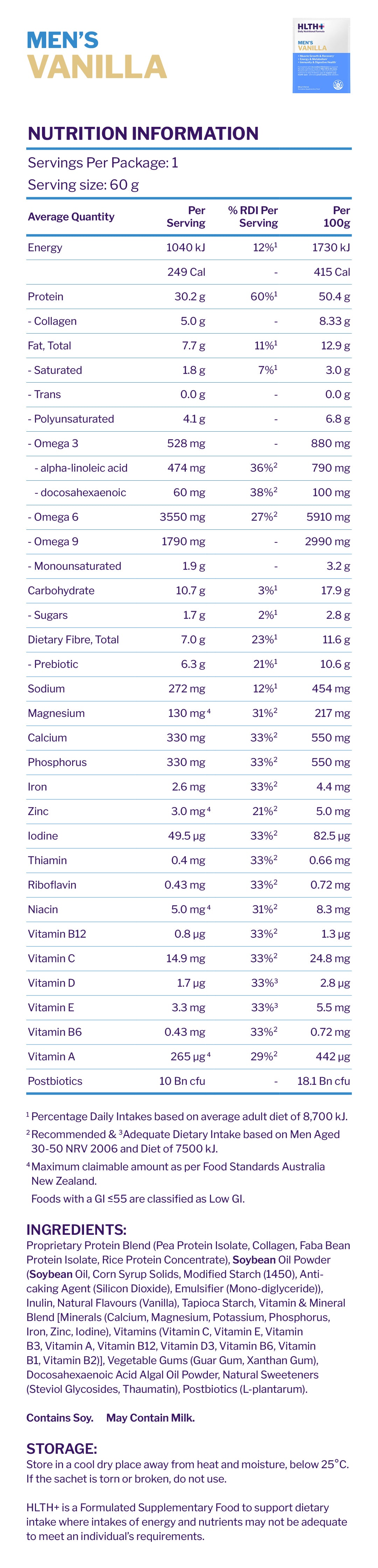
HLTH+ is a Formulated Supplementary Food under the Food Standards Australia New Zealand Food Standards Code, built to sit alongside the food you already eat rather than to compete in the protein powder aisle. It is dairy-free and gluten-free, so there is no lactose in it. Allergen line: contains soy.
One 55g Women's sachet carries 30g protein per serve, 7g dietary fibre, 5g collagen, 60mg DHA and 10 billion CFU Lactobacillus Plantarum Postbiotic alongside prebiotics, with 1.5g of sugar, none of it added, at 223 calories. Protein contributes to the maintenance of muscle mass and is necessary for tissue building and repair, as part of a healthy diet involving a variety of foods. The protein itself comes from a blend of pea protein isolate, collagen, faba bean protein isolate and rice protein concentrate.
A postbiotic is the set of compounds live cultures produce, supplied ready made rather than having to survive the shelf, which is why a postbiotic count and a probiotic count are not a like-for-like comparison. The formula also carries a balanced multivitamin profile.
Counted across protein, dietary fibre, vitamins, minerals, collagen and DHA, that comes to 30 essential daily nutrients in a single serve. It is published as Women's, Women's 50+, Men's and Men's 50+, each formulated by Accredited Dietitians to the Nutrient Reference Values, the intakes published in 2006 by the National Health and Medical Research Council, the Australian Government Department of Health and Ageing and the New Zealand Ministry of Health. Those values shift with age and sex, which a single formula cannot follow.
It is Australian made in facilities complying with Good Manufacturing Practice and carries a 5-star Health Star Rating. It sells at hlthplus.com at RRP $6.00, or $5.10 a day on a 28-serve subscription at $142.80, and through Amazon AU and Chemist Warehouse online.
Find the gap in your current stack. The 30-second ✦ Find My Formula quiz is diagnostic: it shows what the tubs you already own are not giving you.
Frequently Asked Questions
Does whey protein have lactose?
Yes. Whey is a milk product, so lactose comes with it, but the amount depends on how heavily it was filtered out. In one peer-reviewed analysis a retail whey protein concentrate measured 6.7g of lactose per 100g, while three whey protein isolates had none detectable (Molecules, 2022).
Is whey protein isolate lactose free?
Not automatically. Isolate is defined by protein content, at least 90% on a dry weight basis, rather than by any lactose limit, although isolates are the most heavily filtered type. In Australia the words lactose free are only permitted where a food contains no detectable lactose, under Schedule 4 of the Food Standards Code.
How much lactose is in a scoop of whey protein?
It depends entirely on the type. Using measured figures of 6.7g per 100g for a retail concentrate and 0.5g per 100g for an ultrafiltered whey protein, a 30g scoop works out at roughly 2.0g and 0.15g of lactose. Both sit well under the lactose in a glass of milk.
Can you drink whey protein if you are lactose intolerant?
Many people can. The Better Health Channel says most people with lactose intolerance handle small amounts, such as a glass of milk containing 8 to 10 grams of lactose, and a scoop of a high-protein whey carries a fraction of that amount. This is general information and not medical advice.
Is lactose-free whey suitable if you have a milk allergy?
No. A milk allergy is a reaction to milk proteins, and whey is a milk protein, so removing the lactose does not remove the allergen. Australian labels must declare milk in bold in the ingredient list and in a bolded contains statement near it. Choose a protein not made from milk.


Leave a comment
This site is protected by hCaptcha and the hCaptcha Privacy Policy and Terms of Service apply.