
What is the best dairy-free protein shake in Australia?
There is no single answer, because "dairy-free protein shake" describes three drinks: a dairy-free powder in water, that same powder in a plant milk, or something already bottled. The route you pick moves your protein, sugars and price more than the brand does.
Most people reading this have already worked out that dairy is the problem. Harder to work out, on a shelf where half the labels say plant based, is what that swap does to the protein number. Dairy-free is also broader than lactose-free: whey and casein are dairy proteins, so a lactose-free whey is still a dairy shake.
Below: the criteria, what each route delivers on published labels, and who each one suits. The powder decision on its own is covered in what to check on a dairy-free protein powder label.
What should a dairy-free protein shake give you?
Five things decide whether a shake is worth drinking, and four of them are printed on the pack.
- Protein per serve, as a number. Under Schedule 4 of the Food Standards Code, 5g per serving is the floor for any protein claim at all and 10g is the threshold for "good source". A product that prints no figure is not making a claim you can check.
- Dietary fibre per serve. The same schedule sets 2g per serving for any dietary fibre claim, 4g for "good source" and 7g for "excellent source". Across the dairy-free powders below, this row runs from 0.3g to 7g.
- Sugars, and whether they were added. Your mixing liquid decides much of this: water adds none, a sweetened plant milk adds several grams before the powder goes in.
- What else the serve carries. Calcium, iron, vitamins, live cultures. A powder in water carries what the powder carries, nothing more.
- What it is free from, in the brand's own words. Dairy-free, gluten-free and soy-free are three separate claims, and no product holds all three automatically.
The criteria matter more than the flavour: over 90% of Australian adults do not meet dietary guidelines on the Australian Institute of Health and Welfare poor-diet measure. A daily shake is one of the few decisions you can check against a number.
Route one: a dairy-free powder mixed with water
This is the cheapest route and the easiest to audit: water adds no calories, no sugars and no protein, so the panel on the pack is the whole drink. Here is what four dairy-free powders sold in Australia publish, beside a dairy-free Formulated Supplementary Food for scale.
| Product | Serve | Protein | Dietary fibre | Sugars | Energy |
|---|---|---|---|---|---|
| Macro Mike Premium Almond Protein (Deluxe Chocolate) | 40g | 23.7g | 4.6g | 3.1g | 598 kJ (142.9 Cal) |
| Amazonia Raw Protein Isolate (Vanilla) | 30g | 21.6g | 2.7g | 1.1g | 504 kJ (121 Cal) |
| Nuzest Clean Lean Protein (Smooth Vanilla) | 25g | 20g | 0.3g | 0.2g | 428 kJ (102 Cal) |
| Bare Blends Vanilla Coconut Plant Protein | 30g | 19.8g | 0.4g | 0.3g | 534 kJ (127.8 Cal) |
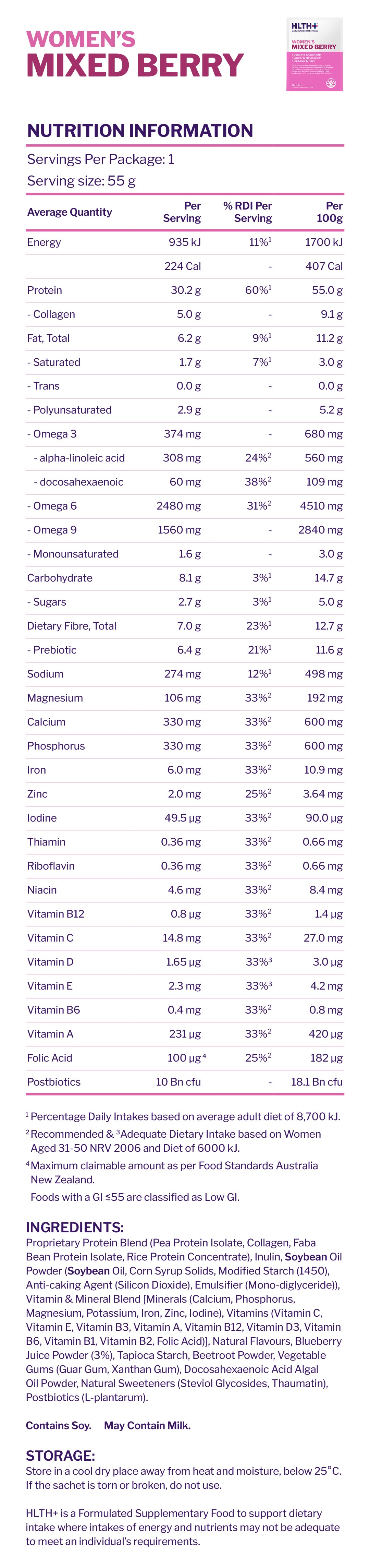
| HLTH+ Women's, a Formulated Supplementary Food | 55g sachet | 30g | 7g | 1.5g, none added | 223 calories |
Figures are each brand's published nutrition information, retrieved 15 September 2026, except Macro Mike's dietary fibre and sugars, read from its published panel image on 2 September 2026 because those rows are not in its page text. Flavours vary and brands reformulate, so check current labels before purchase.
Dietary fibre runs from 0.3g to 7g across products that all present as the same morning drink, a spread of more than twentyfold. Serve size does quiet work too: the dedicated isolates carry more protein per gram of powder, so a 55g sachet is buying the other rows, not a denser protein hit.
The free-from claims differ product by product. Nuzest states "no gluten, dairy or soy"; Amazonia and Bare Blends both claim dairy-free, gluten-free and soy-free; Macro Mike is almond based, and its allergen statement names almonds, with peanuts, cashews, hazelnuts and soy handled in the same facility. Read that line before the protein line if an allergy brought you here, and see the plant-based protein powder shortlist for how these rank on their own terms.
Route two: a dairy-free powder mixed with a plant milk
A plant milk is not a neutral mixer. It changes the protein, the sugars and the calcium in the glass, and the three common bases do very different things.
An audit of 129 plant-based milk products sold in Australia, published in Nutrition & Dietetics in 2025 by Harmer, Craddock and Charlton, reported these medians.
| Plant milk | Median protein per 100mL | Share of products fortified with calcium | Protein added by a 300mL shake |
|---|---|---|---|
| Soy | 3.2g | 92.6% | about 9.6g |
| Oat | 1.0g | 82.1% | about 3.0g |
| Almond | 0.7g | 80.0% | about 2.1g |
The third column is arithmetic on the median, 300mL at three times the per-100mL figure, not a label claim. Rice and coconut sit lower again at a median of 0.2g and 0.30g per 100mL, and cow's milk sits at 3.60g. The same audit found no significant difference in protein between soy milk and cow's milk, which is the most useful fact on this page: soy is the only common plant base that replaces dairy protein rather than diluting it.
So a plant milk adds calcium in roughly eight of ten products, and meaningful protein in only one of the three. Mix with almond milk because it tastes cleaner and your shake gains about 2g of protein, with the powder doing the rest.
Protein quality is the other half of this. The Better Health Channel explains that of the roughly 20 amino acids, 9 cannot be made by the body, and that while plant proteins contain all of the essential amino acids, the amounts of one or two may be low. That is why plant powders so often blend two or three sources: what a complete protein means and how the essential amino acids work are both covered in full.
One caution. Soy is the protein winner among plant milks, so a reader avoiding soy is left choosing between oat and almond on taste, with the protein coming almost entirely from the powder.
Route three: a ready-to-drink dairy-free shake
This is the route the Australian shelf serves worst. Searching on 15 September 2026, no dairy-free ready-to-drink protein shake sold here published a full nutrition panel on its own brand site, so no bottled figures are printed below: the bottles with panels were milk based, and the plant-based ones were overseas brands.
The closest verified dairy-free option you can pour and drink is a high-protein plant milk. Sanitarium's So Good High Protein Oat Milk publishes 10.0g protein per 250mL serve, 710 kJ (170 Cal), 5.2g sugars and 300mg calcium at 38% of the recommended dietary intake, with oat flour at 9% and added soy protein at 4% in the ingredient list (retrieved 15 September 2026). Its allergen line reads contains gluten and soy, which rules it out for two of the three free-from readers here.
That is the pattern for the route: when a bottled dairy-free drink carries real protein, it has usually been added as an isolate rather than coming from the nut or grain on the front of the pack. Four checks make the shelf readable.
- Read protein per bottle, not per 100mL. At the same per-100mL figure, a 250mL and a 375mL bottle are different drinks.
- Read the sugars line against the protein line. Bottled drinks carry more sugars than the same protein mixed at home, because they have to taste good cold.
- Check the base. Almond, oat, rice and coconut bases start at 1.0g of protein per 100mL or less, so anything above that was added in.
- Check for gluten. Oat-based drinks are the trap for a reader who needs dairy-free and gluten-free.
If convenience is what you are buying, compare a bottle against a scoop in a shaker, or against a portable breakfast that needs neither. The same question for lactose-free readers is worked through separately, because lactose-free bottles exist and dairy-free ones barely do.
Which dairy-free shake route suits you?
| Route | Protein you can expect | Sugars | What else it carries | Who it suits |
|---|---|---|---|---|
| Powder in water | 19.8g to 30g per serve on the labels above | The powder's own, 0.2g to 3.1g above | Only what the powder carries | Anyone counting protein and sugars tightly, or buying on price |
| Powder in a plant milk | The powder's figure plus 2.1g to 9.6g per 300mL, by base | The powder's plus the milk's | Calcium in about 8 of 10 plant milks, plus the milk's protein | Readers who want calcium and a creamier drink, and tolerate soy |
| Ready to drink | 10.0g per 250mL on the one product verified here | 5.2g per 250mL on that product | Whatever the carton is fortified with | Readers buying convenience, who accept less protein |
Mixing at home is the only route where every number in the glass is one you chose.
What changes when you are eating less than you used to?
One group reads a page like this differently: people whose meals have shrunk, through a deliberate deficit, a reduced appetite, or rapid weight loss, reduced eating and medically induced weight loss, including people on GLP-1 medications. When calories drop, the shake stops being a top-up and becomes a meaningful share of the day's nutrition.
In trial conditions, GLP-1 medicines reduced ad libitum food intake by roughly a quarter of daily calories (Blundell and colleagues, Diabetes, Obesity and Metabolism, 2017). The gram-scale nutrients slip first: in one 2025 study, people on these medications averaged 14.5g of dietary fibre a day against the 28g recommended (Frontiers in Nutrition, 2025).
This article is general information, not medical advice, and decisions about any medication belong with your doctor. Learn more about what happens to nutrition when overall intake drops.
Where HLTH+ fits among the dairy-free options
HLTH+ is dairy-free and gluten-free, and because it contains no dairy it is lactose-free as well. It is a Formulated Supplementary Food under the Food Standards Code rather than a dedicated protein powder, mixed with 300 to 400mL of water or a plant milk, which puts it in route one or route two.
One 55g sachet lists 30g protein per serve and 7g dietary fibre, at 1.5g of sugar for Women's and 1.7g for Men's, with none added. Protein contributes to the maintenance and growth of muscle mass and to tissue repair, and dietary fibre contributes to regular laxation, as part of a healthy diet involving a variety of foods.
The same sachet lists 5g collagen, 60mg DHA, a balanced multivitamin profile and 10 billion CFU Lactobacillus Plantarum Postbiotic alongside prebiotics. A postbiotic is not a live organism: it is the material a bacterial culture produces during fermentation together with the inactivated cells, so it does not depend on organisms surviving transport and storage. It also means a postbiotic count and a probiotic count are not the same measurement, so 10 billion beside 10 billion is neither a tie nor a win.
Counted across protein, dietary fibre, vitamins, minerals, collagen and DHA, each serve supplies 30 essential daily nutrients.
It contains soy, so if soy is the allergen you are avoiding, route one with a soy-free powder is where you should be looking. It is Australian made in facilities complying with Good Manufacturing Practice, carries a 5-star Health Star Rating, and has no nasties, artificial colours, artificial flavours or artificial sweeteners.
It is dietitian-formulated to the Nutrient Reference Values, the published government intakes developed by the National Health and Medical Research Council, the Australian Government Department of Health and Ageing and the New Zealand Ministry of Health. Those values move with age and sex, which is why the range runs Women's, Women's 50+, Men's and Men's 50+ rather than one formula for every adult.
It sells at hlthplus.com at RRP $6.00, or $5.10 a day on a 28-serve subscription at $142.80 and $5.40 a day on a 14-serve subscription at $75.60, and through Amazon AU and Chemist Warehouse online.
Find out what your current shake is not covering. The 30-second ✦ Find My Formula quiz reads your existing routine and shows you the gaps it leaves.
Frequently Asked Questions
What is the best dairy-free protein shake in Australia?
It depends on the route. For the most control over what lands in the glass, a dairy-free powder in water: the labels above run 19.8g to 23.7g protein per serve. For calcium and a creamier drink, the same powder in soy milk, at a median 3.2g protein per 100mL. Bottled dairy-free options are scarce.
Is a dairy-free protein shake the same as a lactose-free one?
No. Lactose-free means the milk sugar has been removed or broken down, so a lactose-free whey is still a dairy protein. Dairy-free means no milk protein at all, which rules out whey and casein. If milk protein is your issue, lactose-free is not enough.
Which plant milk has the most protein for a shake?
Soy, by a wide margin. Across 129 Australian plant milk products audited in Nutrition & Dietetics in 2025, soy had a median 3.2g protein per 100mL against oat at 1.0g and almond at 0.7g, and showed no significant difference from cow's milk at 3.60g.
Can a dairy-free protein shake replace a meal?
HLTH+ is not designed as a meal replacement, because it complements a food-first approach. It does work as a healthy snack or to tie you over between meals. A shake that has to stand in for a meal needs more than protein, so read the whole panel before you swap one out.
This article is general information, not medical advice. Decisions about any medication belong with your doctor. Figures quoted are each brand's published information at the retrieval dates shown; check current labels before buying.
Leave a comment
This site is protected by hCaptcha and the hCaptcha Privacy Policy and Terms of Service apply.