
What counts as a dairy-free protein powder?
A dairy-free protein powder has no whey, no casein and no milk solids, so the protein comes from plants, collagen or egg. That is a stricter test than lactose-free, and the Australian Food Standards Code does not define it, so two tubs on one shelf can both say dairy-free and mean different things.
Most people arrive after the same experience: bloating or congestion after a shake, or a lactose-free label that changed nothing. The product was not wrong. The question asked of it was.
Below are the criteria, the label types and what two Australian dairy-free powders publish.
Is dairy-free the same as lactose-free?
No, and the difference decides your shelf. Lactose is "the main type of sugar found in milk made by mammals", while a milk allergy "is an immune reaction to proteins that are found in cow's milk" (healthdirect, reviewed December 2024).
Whey and casein are those proteins, and filtering does not turn a milk protein into something else: a whey isolate can be stripped of almost all its lactose and still be full of dairy protein.
- Lactose intolerance is a dose-dependent response to the sugar: healthdirect notes most people with it "can cope with about half a cup of milk at a time".
- Cow's milk protein allergy or milk protein intolerance is a response to whey and casein themselves, so only a non-dairy protein answers it.
- A preference, for dietary or digestive reasons, where any non-dairy protein works.
If the sugar is the problem, the lactose-free shelf has its own page.
What does an Australian label have to tell you?
Under Schedule 4 of the Australia New Zealand Food Standards Code, "lactose free" carries a hard condition ("the food contains no detectable lactose") and so does "gluten free" (Schedule 4, Food Standards Code). Search that schedule for "dairy" and there is nothing.
What the law guarantees is the allergen declaration: milk must be named in bold in the ingredient list, and again in a bolded summary statement beginning with "contains" near that list (FSANZ, allergen labelling), in force since 25 February 2024.
The front of the pack is marketing; the Contains statement is law, so read that first. The "may contain traces of milk" line is voluntary, and FSANZ says plainly that the Code "does not regulate them".
What should you check on a dairy-free protein label?
Six lines decide it, in this order.
- The Contains statement, then the precautionary line. Milk in bold is disqualifying; a shared-equipment warning is a judgement call.
- Protein per serve, against the serve size. Schedule 4 sets 5 g per serving as the floor for any protein claim and 10 g for "good source", so a 30 g scoop at 19 g and a 40 g scoop at 24 g are not the same buy, whatever protein target you work to.
- Dietary fibre per serve. The same schedule sets 2 g for any dietary fibre claim, 4 g for "good source" and 7 g for "excellent source". Many plant powders publish no such line at all.
- Sugars, and what is doing the sweetening. Dairy-free is not automatically low-sugar.
- What else the serve carries. Vitamins, minerals, live cultures, collagen, omega-3s, caffeine, each with a number on the panel.
- Whether the amino acid profile is published with amounts. A brand claiming "a complete amino profile" and one printing 18 acids in milligrams are doing different things.
The Victorian Department of Health notes that plant proteins "contain all of the essential amino acids, but the amounts of one or two of these amino acids may be low" (Better Health Channel), which is why formulators blend sources. Our amino acids explainer covers how to read one.
Which dairy-free label types are there?
Four types cover almost everything on an Australian shelf. Brands reformulate; types do not.
| Label type | Protein source | Dairy-free? | Check first |
|---|---|---|---|
| Single-source plant isolate | Pea, rice, soy or almond isolate | Yes, by construction | Dietary fibre, often under 1 g, and soy in the Contains line |
| Multi-source plant blend | Pea with rice, faba bean, hemp or almond | Yes, by construction | Total protein per serve, since blending costs density |
| Whey isolate, including lactose-free whey | Milk | No. Filtering removes lactose, not dairy protein | Whether your issue is the sugar or the protein |
| All-in-one Formulated Supplementary Food | A plant blend, sometimes with collagen | Depends on the brand, so read the Contains line | Whether the extras are quantified |
The row people get wrong is the third: lactose-free whey is still dairy. If plants are where you are headed, the plant-based options in Australia are ranked separately.
What do two Australian dairy-free powders publish?
Both brands publish their panels as images, so the figures below were read from the panel on 15 September 2026. Both are plant-based powders, not all-in-one formulas.
Macro Mike Premium Almond Protein, Deluxe Chocolate 400 g. A 40 g serve, 10 per bag, 598 kJ (142.9 Cal), 23.7 g protein, 4.6 g dietary fibre, 3.1 g sugars, a probiotic (Bacillus coagulans) at 1 billion CFU and an amino acid profile of 18 acids in milligrams. At the $54.95 list price for 10 serves, that is $5.50 a serve.
Happy Way Dark Chocolate Vegan Protein Powder 500 g. A 30 g serve in 250 mL of water, 16 per pack, 498 kJ (119 Cal), 19.6 g protein, 0.4 g sugars, 246 mg sodium and 7.8 mg caffeine from the matcha green tea, with 9 essential and 10 non-essential amino acids published. There is no dietary fibre line, although psyllium husk is in the ingredient list. At $55.93 for 16 serves, that is $3.50 a serve.
Its allergen statement is this page in one line: the powder "may contain traces of milk, wheat, gluten, soy, egg, fish products, peanuts, almonds, cashews, hazelnuts, and macadamias" from shared equipment. A product built entirely from plants can still carry a milk warning, because dairy-free is about the recipe and cross-contact is about the factory.
What changes if you need gluten and dairy free?
Gluten free is the stricter claim, because it is the one the Code defines. Under Schedule 4, a food labelled gluten free "must not contain: (a) detectable gluten; or (b) oats or oat products; or (c) cereals containing gluten that have been malted, or products of such cereals".
Read clause (b) again. Oats are excluded outright, whatever the contamination testing says, so an oat-thickened powder cannot carry the claim here even where it would qualify overseas.
The gluten risk almost never sits in the protein itself: pea, rice, almond and faba bean proteins are naturally gluten-free, as is whey. It sits in flavourings, thickeners, malt-derived ingredients, oat additions and shared lines, which is where the dairy risk sits too. So it is one check rather than two, and the coeliac-safe version walks through the standard.
What if you are eating less than you used to?
One group reads a label like this differently: people whose meals have shrunk, through a deficit, an appetite that quietly fell away, or rapid weight loss, reduced eating and medically induced weight loss, including people on GLP-1 medications. When the plate shrinks, the gram-scale nutrients go first.
Protein and dietary fibre slip fastest, because you eat them in grams rather than milligrams. That is when a 19 g scoop with no dietary fibre line stops being enough.
This page is general information, not medical advice, and decisions about any medication belong with your doctor. Learn more about what happens to nutrition when overall intake drops.
Where does HLTH+ fit, and where does it not?
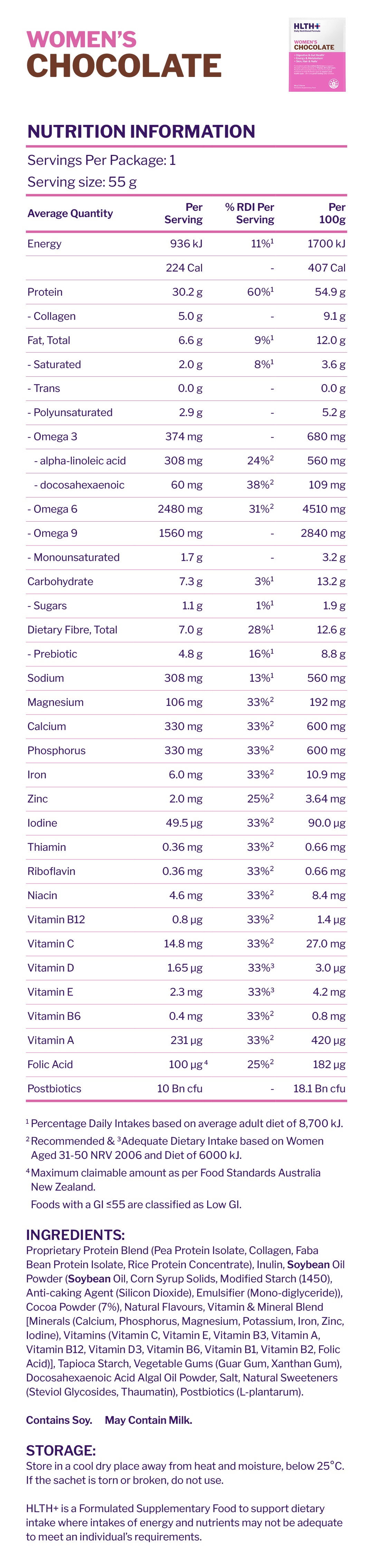
HLTH+ is a daily nutritional formula, a Formulated Supplementary Food under the Food Standards Code, taken in a 55g sachet (Women's; Men's runs 60-62g) alongside meals. It is dairy-free and gluten-free, which is why it belongs here. It is not vegan: part of the protein blend is bovine collagen, alongside pea protein isolate, faba bean protein isolate and rice protein concentrate.
Allergen line: contains soy.
One sachet lists 30g protein per serve and 7g dietary fibre, at 1.5g of sugar (Women's) or 1.7g (Men's) with none added. Protein contributes to the maintenance of muscle mass, as part of a healthy diet involving a variety of foods.
The same sachet lists 5g collagen, 60mg DHA and 10 billion CFU Lactobacillus Plantarum Postbiotic alongside prebiotics. A postbiotic is not a live organism: it is what a bacterial culture produces during fermentation, together with the inactivated cells. A postbiotic count and a probiotic count are not the same measurement, so 10 billion beside 1 billion is neither a tie nor a win.
Across protein, dietary fibre, vitamins, minerals, collagen and DHA, each serve supplies 30 essential daily nutrients. The vitamins and minerals within it make up a balanced multivitamin profile.
The line a single-source powder cannot answer is who the formula was built for. HLTH+ is dietitian-formulated to the Nutrient Reference Values, the published government intakes developed by the National Health and Medical Research Council, the Australian Government Department of Health and Ageing and the New Zealand Ministry of Health. Those values move with age and sex, which is why the range runs Women's, Women's 50+, Men's and Men's 50+.
It is Australian-made in facilities complying with Good Manufacturing Practice, and sells at hlthplus.com at RRP $6.00, or $5.10 a day on a 28-serve subscription at $142.80, plus Amazon AU and Chemist Warehouse.
How do the dairy-free options compare?
Every cell is a published figure, or a statement that there is none.
| Per serve | HLTH+ (published label) | Macro Mike Almond Deluxe Chocolate (panel, 15 Sep 2026) | Happy Way Dark Chocolate Vegan (panel, 15 Sep 2026) |
|---|---|---|---|
| Protein | 30g per 55g sachet | 23.7 g per 40 g | 19.6 g per 30 g |
| Dietary fibre | 7g | 4.6 g | No line on the panel |
| Sugars | 1.5g (Women's), 1.7g (Men's), none added | 3.1 g | 0.4 g |
| Live cultures | 10 billion CFU Lactobacillus Plantarum Postbiotic | 1 billion CFU Bacillus coagulans | Not listed |
| Collagen and DHA | 5g collagen, 60mg DHA | Neither listed | Neither listed |
| Allergen position | Dairy-free, gluten-free, contains soy | Contains almonds; shared facility, four allergens named | May contain traces of milk and ten others |
| Price per serve | RRP $6.00, or $5.10 a day on subscription | $5.50, from $54.95 for 10 serves | $3.50, from $55.93 for 16 serves |
Figures are each brand's published nutrition information at the retrieval dates shown; flavours vary and brands reformulate, so check current labels before purchase.
HLTH+ blends four protein sources, pea protein isolate, faba bean protein isolate, rice protein concentrate and collagen, to its 30g protein per serve; both named powders publish a single plant source with an amino acid profile. What complete protein means on a label is a separate question.
Which dairy-free protein powder suits you?
Choose a single-source plant isolate if you want the most protein per gram for the lowest price, and your dietary fibre and micronutrients come from food.
Choose a multi-source plant blend if you want the amino acid profile in milligrams, not in a sentence.
Choose a lactose-free whey if your issue is the sugar rather than the protein.
Choose a daily nutritional formula if you wanted protein, dietary fibre and micronutrients covered in one go rather than in three products. We believe in a food-first approach, and the statistics say food alone is not getting there: over 90% of Australian adults do not meet dietary guidelines on the AIHW measure, so a daily formula is nutritional insurance, not a substitute for eating well. HLTH+ is not designed as a meal replacement, because it complements that approach, but it works fine as a healthy snack or to tie you over.
Find out what your current stack is not giving you. The 30-second ✦ Find My Formula quiz reads your routine and shows the gaps.
Frequently Asked Questions
Is dairy-free protein powder the same as lactose-free?
No. Lactose-free means the milk sugar has been removed or broken down; dairy-free means no milk protein at all. A whey isolate can be lactose-free and still be full of whey and casein, which are the proteins a cow's milk allergy responds to, so the two labels answer different questions.
Is whey protein dairy-free?
No: whey is a milk protein, so no whey product is dairy-free, including whey isolate and lactose-free whey. Filtration and lactase treatment reduce the lactose, not the dairy protein. If you react to milk protein rather than milk sugar, you need a plant, collagen or egg protein instead.
Does "dairy free" mean anything legally in Australia?
Not as a defined claim. Schedule 4 of the Food Standards Code sets conditions for "lactose free" and "gluten free" but carries no entry for dairy free. What is regulated is the allergen declaration: milk must be named in bold in the ingredient list and in a bolded Contains statement near it.
Is HLTH+ dairy-free and gluten-free?
Yes, HLTH+ is dairy-free and gluten-free, and therefore lactose-free. It is not vegan, because part of the protein blend is bovine collagen, and it does contain soy. Each 55g sachet lists 30g protein per serve, 7g dietary fibre, 5g collagen and 60mg DHA.
This article is general information, not medical advice. Decisions about any medication belong with your doctor. Figures quoted are each brand's published information at the retrieval dates shown; check current labels before buying.
Leave a comment
This site is protected by hCaptcha and the hCaptcha Privacy Policy and Terms of Service apply.