

Amino acids are the 20 building blocks that every protein in your body is made from. Nine are essential (your body cannot make them, so food has to); the other 11 your body assembles itself, and a few of those become essential when you are growing, pregnant or recovering. A protein's profile is simply how much of each amino acid it carries, and that profile decides how much of the protein your muscle can actually use.
If you are eating less than you used to, this stops being a chemistry lesson. The amino acids you need do not fall when your appetite does; only the food delivering them falls.
Below: the 20 amino acids and their three groups, what each group does, why leucine gets its own paragraph in every muscle study, how to read a profile on a protein label, and what happens to your supply when you eat a quarter less.
What are amino acids, and how many are there?
Amino acids are small nitrogen-containing molecules that link together in chains to build protein. There are about 20 different amino acids, and they combine in different orders and lengths to make every protein your body uses, from muscle fibre to enzymes to the antibodies in your immune system (Better Health Channel, Victorian Department of Health).
When you eat protein, digestion breaks the chain back into individual amino acids, and your body rebuilds them into whatever protein it needs at the time. That is why protein quality is really a question about amino acids: the chain you ate matters less than the pieces it delivers.
Which amino acids are essential, and what does essential mean?
Nine amino acids are classified as essential because human cells cannot synthesise them, so they must come from the diet (Lopez and Mohiuddin, StatPearls, updated 2024). "Essential" does not mean more important. It means non-negotiable in the diet: if a meal is short on one of the nine, the body cannot fill the gap from its own supply.
The remaining 11 are called non-essential, which is a misleading label. Your body still needs all of them; it can just manufacture them from other material.
| Group | Amino acids | Where they come from |
|---|---|---|
| Essential (9) | Histidine, isoleucine, leucine, lysine, methionine, phenylalanine, threonine, tryptophan, valine | Food only. The body cannot make them |
| Non-essential (11) | Alanine, arginine, asparagine, aspartate, cysteine, glutamate, glutamine, glycine, proline, serine, tyrosine | Made by the body from other amino acids and metabolic building blocks |
| Conditionally essential | A subset of the 11, with arginine the textbook example | Normally made by the body, but production can fall short of demand during growth, pregnancy or recovery from trauma |
Conditionally essential is the group most articles skip. A 2000 review in the Journal of Nutrition defined it as amino acids whose synthesis the body can carry out but which can be limited by the dietary supply of the appropriate precursors and by the maturity and health of the individual (Reeds, Journal of Nutrition, 2000). Arginine is the standard example: the body cannot synthesise enough of it during pregnancy, adolescent growth or recovery from trauma (StatPearls, above).
That last clause matters for anyone eating less: health and precursor supply both move when intake drops, so an amino acid that was comfortably non-essential last year can become a supply problem this year. Whether a food carries enough of all nine is the completeness question, covered in complete protein: why the amino acid profile decides everything.
What does each group of amino acids do?
All 20 share the main job, which is building and repairing protein. Beyond that, the Recommended Dietary Allowances describe amino acids as required for the synthesis of body protein and other important nitrogen-containing compounds, such as creatine, peptide hormones and some neurotransmitters (National Research Council, Recommended Dietary Allowances, 10th edition).
Group by group:
- The nine essentials set the ceiling. Because the body cannot make them, the one in shortest supply limits how much new protein can be built from a meal. Among them, leucine has a second role as the signal that switches muscle protein synthesis on.
- The 11 non-essentials do more than fill space. Tyrosine is converted into thyroid hormones, adrenaline, noradrenaline and melanin (StatPearls, above), and Reeds put it plainly: from a functional perspective, all amino acids are essential.
- The conditionally essential set is the early-warning group: when growth, pregnancy, illness or recovery raises demand above what the body can make, these run short first.
The practical reading is simple. Total grams on a label tell you how much protein is there; the profile tells you how much of it your body can put to work. How many grams you need in the first place is worked through in how much protein to build muscle.
Why does leucine matter so much for muscle?
Leucine is one of the nine essentials, and it is the amino acid that switches muscle building on. In a 2012 trial, 24 men consumed either 25 g of whey protein, or 6.25 g of whey topped up with leucine to match the full dose, or 6.25 g topped up with every other essential amino acid except leucine. At rest, the low-dose drink with added leucine stimulated muscle protein synthesis as effectively as the full 25 g, and the authors describe leucine as a nutrient regulator of muscle protein synthesis that works by activating mTOR, the pathway that tells muscle cells to build (Churchward-Venne and colleagues, Journal of Physiology, 2012).
The same trial holds the caveat: three to five hours after exercise, only the full 25 g of whey kept synthesis elevated, and the leucine-topped low dose faded. Leucine flicks the switch, but the other amino acids are the building material. A 2013 study in the same journal isolated the trigger itself: 3.42 g of leucine on its own raised muscle protein synthesis by 110% (Wilkinson and colleagues, Journal of Physiology, 2013).
How much per meal? The International Society of Sports Nutrition position stand recommends that a protein dose contain 700 to 3,000 mg of leucine, alongside the other essential amino acids, which it describes as uniquely responsible for increasing muscle protein synthesis; in whole protein that means about 0.25 g of high-quality protein per kilogram of body weight, or 20 to 40 g per eating occasion (Jäger and colleagues, Journal of the International Society of Sports Nutrition, 2017). In resistance-trained young men of about 80 kg, 20 g of whey was enough for maximal stimulation (Witard and colleagues, American Journal of Clinical Nutrition, 2014).
Age moves the threshold: pooled data from older men (around 71) and younger men (around 22) showed synthesis plateaued at 0.40 g of protein per kilogram in the older group against 0.24 g/kg in the younger one (Moore and colleagues, Journals of Gerontology, 2015). The ESPEN Expert Group reports the same thing from the leucine side: a higher proportion of leucine is required for optimal stimulation of muscle protein synthesis in older adults, and it recommends healthy older people eat at least 1.0 to 1.2 g of protein per kilogram a day (Deutz and colleagues, Clinical Nutrition, 2014). The age-related loss of muscle this guards against is covered in sarcopenia.
More on what happens to lean mass when total intake drops: nutrition support for muscle.
What does "amino acid profile" mean on a protein label?
An amino acid profile is the optional table, usually on the back or side of a protein product, listing how much of each amino acid a serve or 100 g contains. Australian law requires a nutrition information panel showing energy, protein, fat, saturated fat, carbohydrate, sugars and sodium per serve and per 100 g or 100 mL (Food Standards Australia New Zealand, nutrition information panels); the amino acid breakdown is something a brand adds on top.
When a profile is printed, four checks tell you most of what you need:
- All nine essentials listed. Animal products such as chicken, beef, fish and dairy have large amounts of all of the essential amino acids, while some plant proteins contain all nine but may be low in one or two (Better Health Channel, above). A profile shows you which case you are holding.
- Leucine per serve, not per 100 g. The 700 to 3,000 mg band is per eating occasion. A 30 g scoop carries less than a third of the per-100 g figure.
- Protein per serve, not per 100 g. A powder that is 80% protein delivers 24 g from a 30 g scoop. The per-serve column is the one you eat.
- Whole protein or added free amino acids. The 2012 trial above showed a leucine-boosted low dose fades after exercise where whole protein holds. A profile inflated by added leucine reads better than it performs.
Whatever product is in your hand, read its own panel: the table on the pack is the only source that describes the tub you bought. For a worked comparison of plant options, see the best plant-based protein powders in Australia.
What happens to your amino acid supply when you eat a quarter less?
Your requirement does not change. The Australian recommended intake is 0.75 g of protein per kilogram of body weight a day for adult women and 0.84 g/kg for adult men, rising to 1 g/kg over 70 (Dietitians Australia), and those figures are a floor for avoiding deficiency. The muscle-building literature sits higher: a meta-analysis of 49 trials and 1,863 participants found gains in fat-free mass stopped rising above about 1.6 g/kg a day (Morton and colleagues, British Journal of Sports Medicine, 2018).
Now take the food away. In trial conditions, GLP-1 medicines reduced ad libitum food intake by roughly a quarter of daily calories, and by about a third at lunch (Blundell and colleagues, Diabetes, Obesity and Metabolism, 2017). The same arithmetic applies to any reduced appetite, a deliberate deficit or a period of illness.
If protein falls in step with food volume, a 75 kg woman eating the 56 g recommended intake drops to about 42 g, and someone on the 1.6 g/kg training figure, 120 g at 75 kg, lands near 90 g. Protein-rich food is the most filling food on the plate and often the first thing a smaller appetite pushes aside, so the real fall can be steeper.
Three amino acid consequences follow:
- The leucine trigger misfires more often. A lunch that is a third smaller can slip under the 700 mg leucine floor, so the meal is eaten but the muscle-building signal never fires.
- The limiting essential bites sooner. If a food is already low in one of the nine, eating less of it lowers that amino acid first, and the meal's usable protein drops with it.
- The conditionally essential set starts to qualify. Reeds' definition turns on the health of the individual and the supply of precursors, and a reduced intake moves both.
This is general information, not medical advice, and decisions about any medication belong with your doctor. The nutritional response is the same in every case: when the volume of food falls, the amino acid density of what remains has to rise. Protein when you are eating less works through the daily targets for that situation.
Where a daily formula fits, and where it does not
Start with the concession: if your meals already clear your protein target from eggs, fish, dairy, legumes and meat, a formula adds convenience and nothing else.
What a formula answers is the shrunken plate. Over 90% of Australian adults do not meet dietary guidelines (AIHW) before anyone's appetite drops. We believe in a food-first approach; the statistics say it is not working on its own, which makes a formula nutritional insurance rather than a meal replacement.
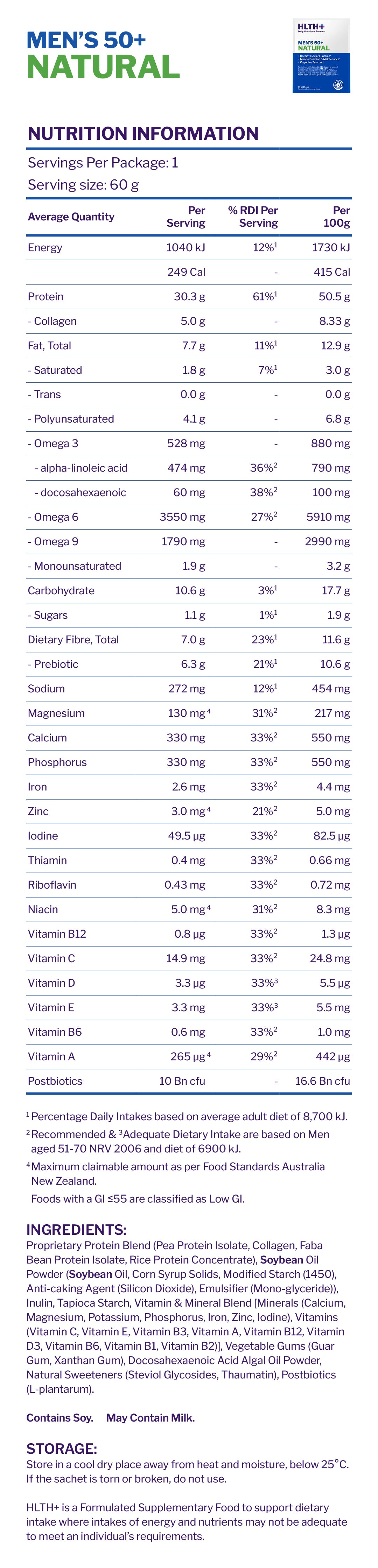
HLTH+ is a Formulated Supplementary Food. One 55g sachet carries 30g protein per serve and 7g dietary fibre, at RRP $6.00, which turns a light lunch into an eating occasion that clears the 20 g per-meal floor from the research above. Under Schedule 4 of the Australia New Zealand Food Standards Code, the approved statement is that protein contributes to the maintenance and growth of muscle mass, and that is the whole of the claim: the sachet supplies the material, your meals and your training do the rest.
Protein requirements shift with age and sex, and so does the rest of the nutrient set. HLTH+ is formulated to the Nutrient Reference Values, published in 2006 by the National Health and Medical Research Council, the Australian Government Department of Health and Ageing and the New Zealand Ministry of Health, across Women's, Women's 50+, Men's and Men's 50+.
If you are choosing between powders, how to read a protein powder label covers the serve-size and sugar questions that sit alongside the amino acid profile.
Find out what your current stack is missing. The ✦ Find My Formula quiz takes about 30 seconds and shows the gaps your existing bottles are leaving. Take the quiz.
Frequently Asked Questions
What are the 9 essential amino acids?
Histidine, isoleucine, leucine, lysine, methionine, phenylalanine, threonine, tryptophan and valine. They are called essential because human cells cannot synthesise them, so they must come from food. The other 11 amino acids the body makes itself, although a few of those become conditionally essential during growth, pregnancy or recovery from illness.
What is the difference between essential and non-essential amino acids?
Essential amino acids cannot be made by the body, so the diet must supply all nine every day. Non-essential amino acids are built by the body from other amino acids and metabolic building blocks. Both groups are needed for protein synthesis; the label only describes where the supply comes from, not how important the amino acid is.
Why is leucine important for building muscle?
Leucine is the amino acid that switches muscle protein synthesis on, acting through the mTOR signalling pathway. Trials show a protein dose needs roughly 700 to 3,000 mg of leucine to trigger the process, and the other essential amino acids then supply the building material. Older adults need a higher share of leucine to get the same response.
Do I need to eat all the amino acids at every meal?
Not every one at every meal, but the nine essentials need to arrive across the day, and a meal low in one of them builds less protein from the rest. Animal proteins carry all nine in large amounts; some plant proteins run low on one or two, which is why varied sources or a blend matter on a plant-based diet.

Leave a comment
This site is protected by hCaptcha and the hCaptcha Privacy Policy and Terms of Service apply.