


What are the symptoms of vitamin B12 deficiency?
Vitamin B12 deficiency shows up in two systems at once: the blood and the nerves. Australia's healthdirect lists fatigue and weakness, anaemia, numbness or tingling in the hands and feet, and memory or balance problems as the signs to watch for (healthdirect, reviewed February 2026). It is a slow condition, and it rarely announces itself.
If you are reading this because you have been tired for months, your hands feel oddly numb, or a blood test has come back with a low number, that slowness is the first thing to understand. B12 is stored in the liver for years, so a shortfall can be building well before anything feels wrong (healthdirect). The symptoms you notice today reflect a gap that opened a long time ago.
This article covers the symptoms in more detail, the four causes, who runs the highest risk in Australia, what happens to intake when appetite drops, and how the deficiency is tested.
The Australian Bureau of Statistics puts the scale plainly: one in ten people aged two and over, 9.7% or 2.4 million Australians, had an inadequate vitamin B12 intake from food and drink in 2023 (ABS, Usual Nutrient Intakes 2023). Left untreated, the same release notes, deficiency can lead to anaemia, nerve damage and brain damage.
General information, not medical advice. Decisions about any medication belong with your doctor.
The blood symptoms
B12 is needed to build red blood cells. Without enough of it the cells grow too large and too few, which is macrocytic anaemia, and the clinical picture is fatigue and pallor (StatPearls, NCBI Bookshelf). This is the tiredness that sleep does not shift.
The nerve symptoms
B12 also maintains the myelin that insulates nerve cells (Better Health Channel, Victorian Department of Health). StatPearls lists peripheral neuropathy, a sore tongue (glossitis), diarrhoea, headaches and neuropsychiatric disturbances among the presenting complaints, with loss of position sense, unsteadiness and dementia in severe cases (StatPearls). The nerve symptoms are the reason a low result should not be shrugged off.
Persistent tiredness has more than one nutritional explanation, so learn more about the nutrient gaps behind brain fog and the signs of vitamin D deficiency, which often sit alongside it.
What causes vitamin B12 deficiency?
There are four routes to a deficiency, and they are worth separating because they call for different responses. StatPearls groups them as dietary insufficiency, malabsorption, autoimmune disease and medicines or toxins (StatPearls). Age sits across all four.
Not enough in the diet
Vitamin B12 is found naturally only in foods of animal origin: liver, meat, milk, cheese, eggs and almost anything else from an animal (Better Health Channel). Almost all of the B12 in the Australian diet comes from animal products, and over a third of it in 2023 came from three sources: cereal-based mixed dishes such as sandwiches and pasta, dairy milk, and unprocessed beef, sheep and pork (ABS).
Because the liver holds a reserve, a dietary cause takes time to show. StatPearls notes that people who have followed a strict vegan diet for approximately three years may develop a deficiency (StatPearls). For vegans, healthdirect says the only reliable sources are fortified foods: fortified plant milks, some meat substitutes and some breakfast cereals (healthdirect).
The gut cannot absorb it
Absorption is a relay with several hand-offs. Dietary B12 binds to a salivary protein, is freed by pancreatic enzymes in the small intestine, and then binds to intrinsic factor, a glycoprotein made by the parietal cells of the stomach, before it can be taken up (StatPearls). Break any link and intake no longer matters.
Pernicious anaemia is the classic break: an autoimmune condition in which the body produces antibodies to intrinsic factor (StatPearls). Other malabsorption causes on the same list are gastric bypass surgery, Crohn's disease and coeliac disease. Pathology Tests Explained adds ulcerative colitis and previous stomach surgery to the at-risk conditions (Pathology Tests Explained).
Age
Absorption of B12 from the gut tends to decrease with age, which makes older people a group at higher risk of deficiency in their own right (Better Health Channel). StatPearls records the condition as more common in older people (StatPearls). An older adult eating the same diet as they did at 40 can still run short, because the gut is taking less of it up.
Medicines
Two classes of common medicine appear on every Australian risk list. Healthdirect names metformin and proton pump inhibitors (healthdirect); Pathology Tests Explained lists metformin, histamine receptor antagonists and proton pump inhibitors together (Pathology Tests Explained). StatPearls states that metformin treatment can cause B12 deficiency (StatPearls).
None of this is a reason to change a prescribed medicine. It is a reason to know that the risk exists and to raise B12 testing with the doctor who prescribes it.
Who is at risk of vitamin B12 deficiency in Australia?
The measured Australian picture is uneven, and it does not follow the stereotype of the elderly vegan. In the ABS 2023 data, inadequate B12 intake was more than twice as common in females as in males, 13.9% against 5.6%, and ranged from 11.6% to 19.1% across the adult female age groups against 5.4% to 9.0% for men (ABS). The adult requirement the ABS measures against is an Estimated Average Requirement of 2.0 micrograms a day.
The highest-risk groups, drawn from the sources above:
- Adult women, particularly aged 18 to 29, where 19.1% had an inadequate intake from food in 2023 (ABS).
- Older Australians. A study of 130 residents in five southern Tasmanian aged-care facilities with no prior diagnosis found 14% deficient (below 150 pmol/L) and a further 36% in the equivocal band of 150 to 250 pmol/L (Mirkazemi et al, Journal of Nutrition, Health and Aging, 2012).
- Vegans and strict vegetarians, and breastfed babies of vegan mothers (Better Health Channel).
- People on metformin, proton pump inhibitors or histamine receptor antagonists (healthdirect; Pathology Tests Explained).
- Anyone with pernicious anaemia, coeliac disease, Crohn's disease, ulcerative colitis or a history of stomach surgery (Pathology Tests Explained).
- Newly arrived refugees from some regions. A multicentre Australian study of 916 newly arrived refugees found 16.5% deficient, rising to around a third of those from Bhutan and Iran (Benson et al, PLOS One, 2013).
Two of those groups overlap with life stages where nutrition is already under pressure. Women in their forties and fifties are dealing with perimenopause symptoms that make fatigue hard to attribute, and older adults are often eating less overall, which is covered in protein for the over-60s.
What happens to B12 intake when you are eating less?
A fifth route is not a cause in the clinical sense, but it is the one most people arrive at without noticing: the plate gets smaller. Because almost all B12 comes from animal foods, eating a quarter less of a normal diet means eating a quarter less B12, unless the smaller plate is deliberately rebuilt around the foods that carry it.
That smaller plate is common now. Around 500,000 Australians regularly use GLP-1 medicines (UNSW, 2026), and in controlled testing free-choice food intake on that class of medicine fell by roughly a quarter across the day and about 35% at lunch (Blundell et al, 2017). A reduced appetite from any cause, medical or not, does the same arithmetic.
And the starting point was already short. Over 90% of Australian adults do not meet dietary guidelines (AIHW), so for most people the cut is coming out of a diet with no slack in it. When calories drop, the food-first answer is density rather than volume:
- Put the animal protein on the plate first. A small appetite fills quickly, so what you eat first is what gets eaten.
- Keep eggs, dairy, fish and lean meat in daily rotation; they carry the B12.
- If you avoid animal foods, count fortified plant milks and cereals as essentials, not extras (healthdirect).
- Use snacks as a second chance at nutrients: cheese, yoghurt, a boiled egg.
- Ask for a blood test rather than guessing; the next section explains what it involves.
For the wider set of nutrients that slip when intake falls, learn more about the vitamins that go short on a reduced appetite and nutrition when you are eating less.
More on what changes in day-to-day energy when you are eating less: how a reduced intake shows up in vitality.
How is vitamin B12 deficiency tested?
It is a blood test, and in Australia it usually follows on from something else. Pathology Tests Explained says testing for B12 and folate is normally ordered after an abnormal Full Blood Count, or when there are neurological symptoms, and that the first tests ordered are total vitamin B12 and serum folate (Pathology Tests Explained).
The total B12 number has a known weakness: it does not directly measure how much B12 the cells can actually use. About 25% of circulating B12 is bound to a protein called transcobalamin so it can be taken up by cells, and this active B12 (holotranscobalamin) has been available on Medicare as a first-line test since July 2025 (Pathology Tests Explained). If a result is normal or low-normal but deficiency is still suspected, further investigation may follow.
Australian laboratories report in pmol/L. The national health survey used the World Health Organization cut-off of 150 pmol/L for deficiency (ABS, Biomedical Results for Nutrients 2011-12), and the Tasmanian aged-care study classed 150 to 250 pmol/L as an equivocal band worth a closer look (Mirkazemi et al, 2012). A borderline result is a reason for follow-up, not reassurance.
Where the picture is still unclear, StatPearls describes methylmalonic acid and homocysteine as the metabolic markers, both of which should be elevated in a true deficiency (StatPearls). These are the tests that separate a genuine cellular shortfall from a low-ish number on its own.
When to see a doctor
Take it to a doctor rather than a supplement aisle if any of the following apply:
- Numbness, tingling or pins and needles in the hands or feet.
- Balance problems, unsteadiness or new memory difficulty.
- Tiredness that has run for months and does not lift with rest.
- You take metformin, a proton pump inhibitor or a histamine receptor antagonist and have never had B12 checked.
- You are vegan, have had stomach or bowel surgery, or have a diagnosed gut condition.
Healthdirect warns that untreated deficiency may cause permanent nerve damage, cognitive impairment and significant anaemia, and its advice is direct: if you think you might be at risk, speak with your doctor (healthdirect). The deficiency itself is a medical matter, and how it is corrected depends on the cause, which only a test can show. If you take prescribed medication, raise any supplement with your doctor or pharmacist first.
This article is general information, not medical advice. Decisions about any medication belong with your doctor.
Where a Formulated Supplementary Food fits when you are eating less
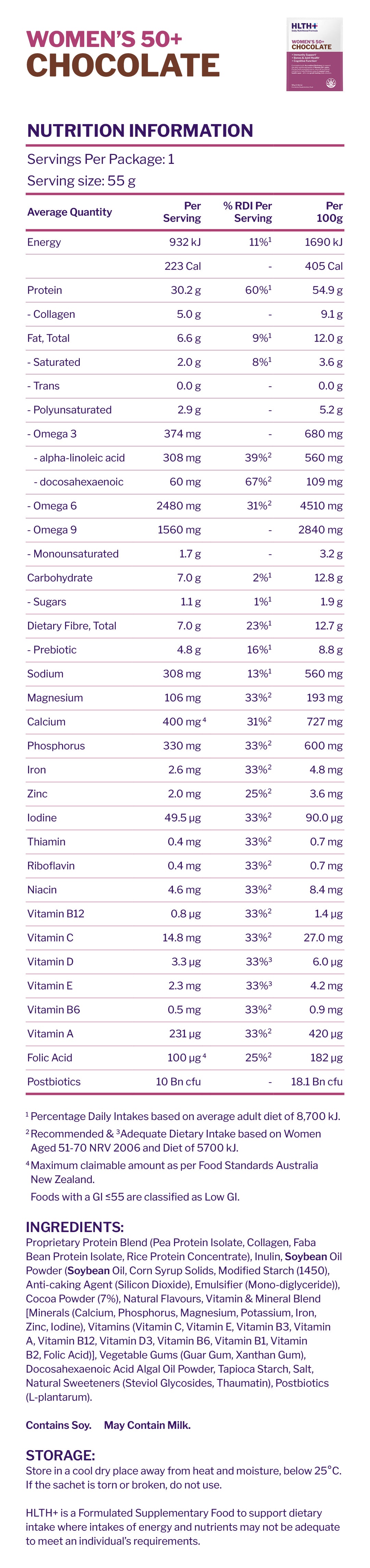
Separate question, separate logic, and it is a nutritional one. When intake falls sharply, protein and micronutrient intake fall with it, and the job is to make what you do eat carry more. That is the gap a Formulated Supplementary Food exists for, as nutritional insurance alongside a food-first approach.
HLTH+ is built for that gap: per serve the label reads 30g protein, 7g dietary fibre, 60mg DHA and a balanced multivitamin profile, in a 55g sachet at RRP $6.00. In total the label counts 30 essential daily nutrients across protein, dietary fibre, vitamins, minerals, collagen and DHA. Protein contributes to the maintenance of muscle mass, and dietary fibre contributes to regular laxation.
The dosing is the part worth understanding. Nutrient needs shift with age and gender, so instead of one formula for everyone, HLTH+ is dietitian-formulated to the Nutrient Reference Values, the intake recommendations developed by the National Health and Medical Research Council, the Australian Government Department of Health and Ageing and the New Zealand Ministry of Health, in life-stage versions: Women's, Women's 50+, Men's and Men's 50+.
It is Australian made, in facilities complying with Good Manufacturing Practice, and on subscription the 28-serve pack works out at $5.10 a day. It is also stocked at Chemist Warehouse online and on Amazon AU if that is easier than ordering direct.
Want to see the gaps in your current stack rather than guess at them? The ✦ Find My Formula quiz runs in 30 seconds and reads back what your existing routine is leaving out.
Frequently Asked Questions
What are the first signs of vitamin B12 deficiency?
The early signs are fatigue and weakness, followed by numbness or tingling in the hands and feet, and sometimes memory or balance problems (healthdirect). Because the liver stores B12 for years, the symptoms build slowly and are easy to blame on something else. A blood test is the only way to confirm it.
Can a vegan or vegetarian diet cause vitamin B12 deficiency?
Yes, over time: vitamin B12 occurs naturally only in animal foods, so strict vegans are among the groups most commonly affected (Better Health Channel). StatPearls notes that deficiency may develop after roughly three years on a strict vegan diet. Healthdirect says fortified plant milks, cereals and meat substitutes are the only reliable plant-based sources.
Does metformin or an acid-suppressing medicine affect vitamin B12?
Both classes appear on Australian risk lists: healthdirect names metformin and proton pump inhibitors, and Pathology Tests Explained adds histamine receptor antagonists. StatPearls states that metformin treatment can cause B12 deficiency. This is not a reason to come off a prescribed medicine; it is a reason to ask your prescribing doctor about B12 testing.
How is vitamin B12 deficiency diagnosed in Australia?
By a blood test, usually total vitamin B12 and serum folate first, often after an abnormal Full Blood Count (Pathology Tests Explained). An active B12 test, holotranscobalamin, has been on Medicare as a first-line test since July 2025. Methylmalonic acid and homocysteine can be checked when a result is borderline and deficiency is still suspected.
This article is general information, not medical advice. Decisions about any medication belong with your doctor.


Leave a comment
This site is protected by hCaptcha and the hCaptcha Privacy Policy and Terms of Service apply.